
The “Silver Tsunami” is upon us. America’s Baby Boomers own nearly 3 million small businesses–employing 32 million workers and generating $6.5 trillion in annual revenue–but most of them are nearing retirement and looking to sell their companies within the next ten years. The fate of these companies is a massive under-the-radar issue that will help shape the American economy for decades to come.
Without intervention, the likely outcomes are dire. Most of these businesses will close, taking valuable jobs and technical know-how with them. Many others will be snapped up by private equity firms, whose typical playbook is to purchase similar companies, consolidate operations, and slash staff before exiting within a few years. Both of these pathways will harm American workers, hollow out America’s industrial capacity, and undermine long-term innovation.
Quick government action can put us on a better path. If we can break down the barriers that deter business owners from selling their companies to their employees, we can use this unique moment to produce the greatest transfer of wealth and ownership to America’s workers in our country’s history. A federal commitment to facilitating employee ownership of these firms will save jobs, build middle-class wealth, and preserve America’s industrial capacity. There is already bipartisan support in Congress and at the state and local level for broader employee ownership. Policymakers should build on that foundation and give both workers and owners better options than they have today.
The Problem: Limited Options for Retiring Owners
Business owners looking to sell are facing a challenging landscape. As a recent McKinsey report put it:
[T]he systems for transferring business ownership in the United States are fragmented and underdeveloped. Today, most exits end in closure rather than transfer, not because the businesses lack value, but because pathways to succession are limited, opaque, or costly. Moreover, starting a business can be more straightforward than acquiring one. The result is a consequential lost opportunity: Firms shut down, jobs disappear, and hard-won mobility gains dissipate through inaction.
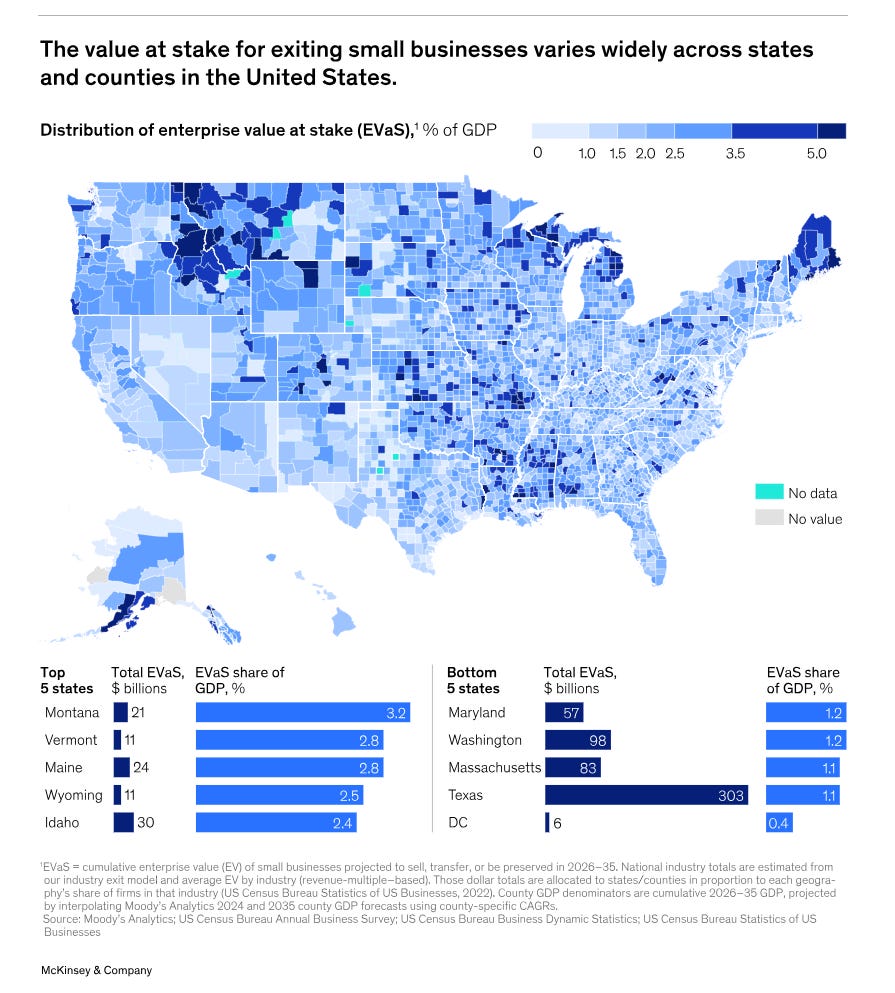
The data is striking. McKinsey estimates that in 2022, roughly 500,000 small businesses exited the market. Only “5 percent were completed as sales, and 3 percent transferred to new owners (often intergenerationally to family members).” The remaining 92 percent closed. The harms of business closure “fall disproportionately on rural areas and owners from historically underrepresented racial and ethnic groups, where access to capital, advisory support, and successor network is often more limited.” Firms “with smaller enterprise value and in labor-intensive sectors (such as construction, food services, and home care and healthcare) are also more at risk.” Without action, a wave of small business closures could accelerate economic decline in rural areas, concentrating even more of the country’s economic activity in urban areas on the coasts:
Meanwhile, private equity firms are poised to snap up many of these companies. While that may be a better outcome than outright closure, the consequences for workers are still often poor. The typical private equity strategy is to buy several similar firms and consolidate operations, often resulting in the closure of locations. Wages for remaining workers typically decrease. And there are negative ripple effects for other workers in the community. For example, an Iowa State University study examining plant closures found that closures that resulted in an average of 418 direct layoffs led to another 100 additional layoffs in the affected community.
There are also negative implications for important supply chains and long-term innovation. Consolidation strategies prioritize cost reduction and margin improvement over investment, and as McKinsey’s analysis notes, consolidation in industries like pharmaceuticals significantly reduced research and development capacity as merged companies pruned their portfolios of development projects. The same logic applies when private equity platforms acquire small manufacturers: the incentive is to standardize, cut overhead, and prepare for exit, not to invest in new process capabilities, apprenticeship programs, or speculative R&D. Each facility closure also removes a node of geographic redundancy, increases lead times for remaining customers, and makes the local industrial network more brittle under stress.
These effects threaten what Harvard Business School’s Gary Pisano and Willy Shih call the “industrial commons.” The industrial commons is the collective R&D know-how, advanced process development, engineering skills, and supply chains that come together in a specific place. When the commons erodes, and when supplier networks and process expertise disappear, a country is less competitive not only in existing industries but in emerging ones as well. As Pisano and Shih argue, when a country loses the ability to make certain products, it loses the ability to innovate in those areas, and eventually loses the capability to manufacture the next generation of products.
The Solution: A New Federal Commitment to Employee Ownership
Instead of standing idly by as these valuable businesses close their doors or get stripped down by private equity firms, the government should seize this moment to make it much easier for business owners to sell their firms to their employees. Facilitating employee ownership would save jobs, build worker wealth, save many rural communities from economic decline, and preserve the industrial commons.
Employee ownership has several benefits. Research finds that employee ownership increases productivity, sales, and employment. During downturns, like the recent COVID-19 economic crisis, employee-owned firms are far more resilient and likely to avoid closure. And their output is high quality. For example, among federal contractors, employee-owned firms achieved ratings of “Excellent” or “Very Good” on quality 79% of the time, compared to 57% for other firms.
This model works at scale. The Mondragon Corporation in Spain’s Basque Country is a federation encompassing over 260 cooperative subsidiaries, employing approximately 75,000 workers and generating roughly $14 billion in revenue. Its operations span advanced sectors such as industrial robotics, machine tools, automotive components, AI, and sustainable energy. During the 2008 financial crisis, when Spanish unemployment exceeded 25%, Mondragon kept Basque unemployment under half the national average. And when its largest cooperative collapsed, the federation deployed inter-cooperation mechanisms to redeploy 1,500 of 1,800 affected workers to other cooperatives through cross-training and capital pooling. This is a fundamentally different endgame than private equity rollups. Rollups are optimized for consolidation and exit. Mondragon instead optimized for long-run industrial continuity, community empowerment, and regional capability.
There is proof of concept in the United States as well. When a Chicago window factory was shut down and slated for liquidation by its corporate owner, the workers faced the loss of their jobs and the relocation of production out of their community. Instead, they organized New Era Windows Cooperative, a worker-owned firm that acquired equipment, restarted production in the city, and kept both industrial capacity and skilled jobs local. Rather than a liquidation sale to distant investors optimized for extracting residual value, the exit channeled ownership and control to the workers, and sustained the business.
But there are several barriers to employee ownership. As McKinsey researchers note, employee ownership models “remain difficult to scale due to limited technical assistance, inconsistent financing structures, and a lack of standardized guidance.”
We propose a three-prong approach to address these barriers at scale. These changes build on existing bipartisan proposals (like the American Ownership and Resilience Act) and related proposals from Democrats (like Senator Bernie Sanders’ Employee Ownership Financing Act) and Republicans (like Senator Bill Cassidy’s Retire Through Ownership Act) that seek to make employee ownership easier.
Create a national conversion finance facility for sales to employees: Employee buyouts often founder today because workers lack capital for a down payment, conventional lenders are unfamiliar with employee stock ownership and cooperative structures, and transaction costs are prohibitively high for employees to shoulder. The federal government should scale loan guarantees to interested groups of workers to $5 billion within the next three years, building on Senator Sanders’ Employee Ownership Financing Act proposal of $500 million. This capital could flow through Small Business Administration-qualified lenders and the Community Development Financial Institution network. The government should also waive the SBA’s personal guarantee requirement for employee ownership conversions and create standardized term sheets that will reduce the technical complexity of these transactions (just as uniform underwriting standards turned home lending from a bespoke negotiation into a repeatable process). And partnering with CDFIs will help drive awareness of new financing options, another critical barrier preventing employee-owned transitions.
Offer significant tax incentives for sales to employees: When comparing a private equity offer against an employee buyout offer, a business owner or their financial advisor will ask: which path is faster, more certain, and yield more money after tax? If private equity wins on all three, the employee ownership option will lose out. Changes to our tax code can help tip the scales in favor of employee ownership. Most significantly, Congress should exempt owner sales to both C-corporation and S-corporation ESOPs from capital gains taxes, or look for similar options that create tax advantages for employee sales.
Expand federal procurement preferences for employee-owned firms: In 2021, Congress authorized a Department of Defense pilot program that allows 100% ESOP-owned defense contractors to receive noncompetitive follow-on contracts if their past performance meets quality standards. Given the superior performance of employee-owned government contractors mentioned above, this pilot should be expanded and made permanent. For current owners who want to see their business thrive after they sell it, this incentive could encourage sales to employee groups.
Employee ownership should be a central part of managing the imminent silver tsunami. Ten thousand baby boomers reach retirement age every day. Rather than seeing the firms they own shutter their doors or get absorbed by private equity, the government should use this opportunity to spark a new era of employee ownership. That would not only protect workers in the short term and help start to close the yawning wealth gap in America, but would also preserve the industrial commons that underpins national security and future competitiveness.
No posts
Comments
Nothing yet. Say the first thing.
Sign in to join the conversation.