
With all the news this week, you might have missed that Senator Bernie Sanders introduced legislation to impose an annual 5% wealth tax on America’s billionaires. According to the Sanders office, the legislation would generate $4.4 trillion in tax revenue over the next ten years, which the bill would dedicate to “social spending programs, including $3,000 cash payments for Americans earning less than $150,000 per year, a $60,000 minimum salary for every public school teacher, and an expansion of Medicare to cover dental, vision and hearing care, among other measures.” The bill won’t go anywhere in the Trump presidency, but it’s a marker in the emerging debate about how to address the revenue needs facing a potential Democratic president in 2029.
Within hours, the Washington Post issued a scathing editorial denouncing the Sanders proposal. My piece today will address the editorial’s various claims, which range from irrelevant to misleading to outright false. A federal wealth tax is an entirely reasonable idea given the obscene levels of wealth concentration in the US and our dire need for more federal revenue after repeated Republican tax cuts for the rich.
Before diving in to the Post’s arguments, I want to explain why we need to consider novel options like a federal wealth tax at all.
The case for a wealth tax
When people ask me why it’s worth considering some form of federal wealth tax, I like to refer to Willie Sutton’s infamous response when asked why he robbed banks: “because that’s where the money is.”
Let me explain.
Repeated GOP tax cuts for the rich have blown a massive hole in our tax code. Here is an overview I wrote a few months ago:
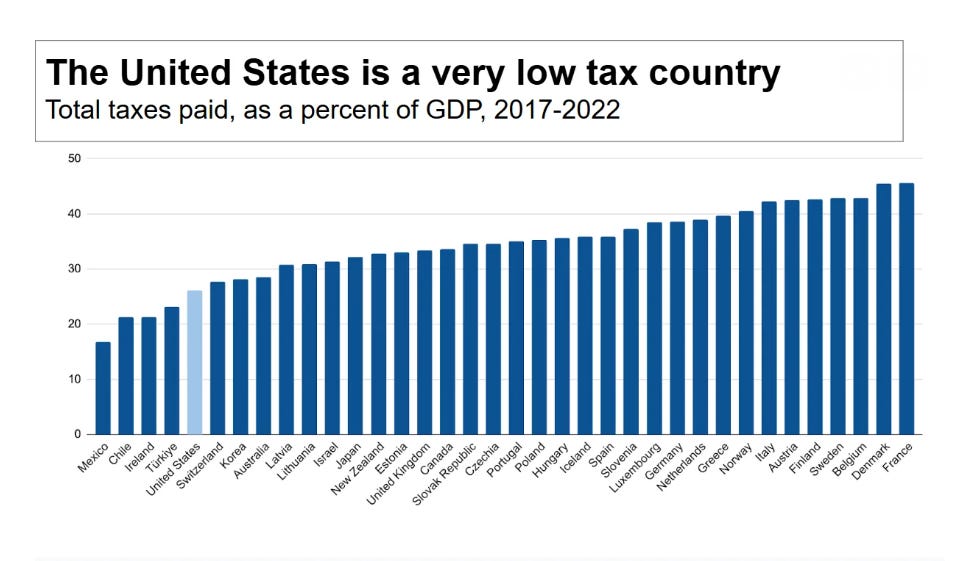
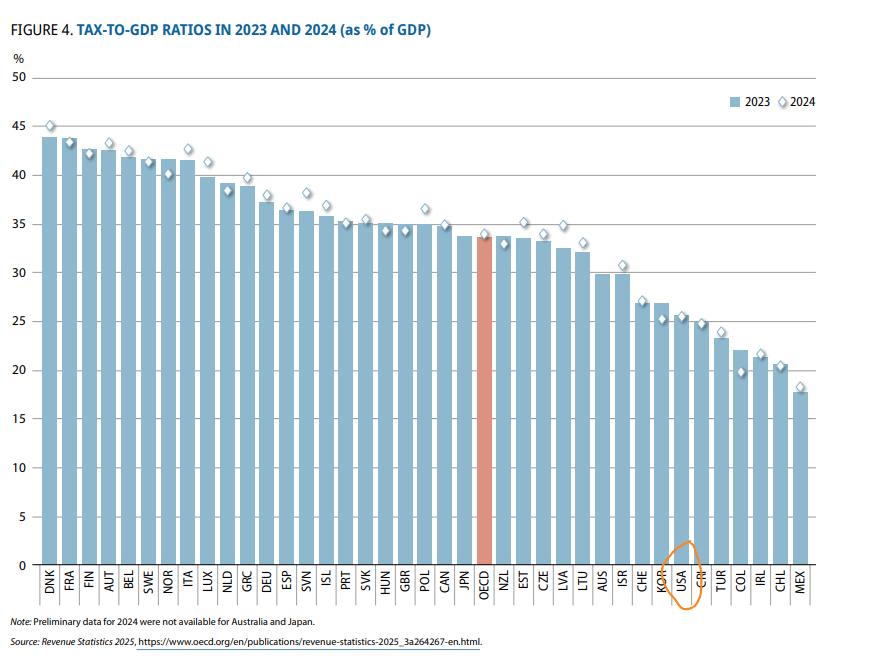
In the early 2000s, the federal government brought in roughly 20% of US GDP in revenue. Thanks to successive tax cuts in the George W. Bush Administration and each of the two Trump terms, it’s now under 17%. Those few percentage points are significant. They represent, in 2025 dollars, almost $1 trillion a year in foregone revenue. The result is that the US is a very low tax country relative to its peers (even before accounting for the multi-trillion dollar tax cut the GOP delivered earlier this year).
Where did that revenue go? Disproportionately to the very wealthy. For most lower- and middle-income people, the main federal tax they pay is the payroll tax, which goes to support Social Security. Those taxes basically have not been changed in the past 25 years. But the Bush and Trump tax cuts have slashed high-end income taxes, the estate tax (which now only applies to estates approaching $30 million), and corporate taxes (which are borne largely by shareholders, who skew wealthy as well). Democrats have passed some new taxes that hit big earners—Obama passed a new investment tax to help fund the Affordable Care Act, Biden passed a new corporate minimum tax and a tax on stock buybacks to help fund the Inflation Reduction Act—but they pale in comparison to the size of the cuts Republicans have delivered.
If you then add in state and local taxes, which tend to be more regressive taxes like sales taxes, the overall result is that the rich are really not paying that much larger of a percentage of their income in taxes than the middle class.
To reinforce that point, here are a couple charts showing how low-tax the US is compared to other leading economies: 1
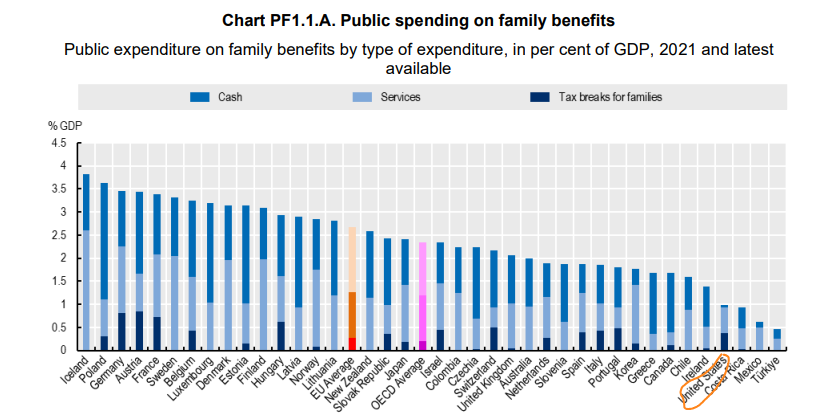
The consequences of our low-tax approach are severe. Our national debt is large and growing. And yet we also vastly under-invest in public benefits, from housing to higher education to nutrition, and more. For example, this OECD chart showing how little support we offer to families with young kids should be a national embarrassment:
In short, America has a glaring problem: a trillion dollar annual revenue hole that Republicans have created largely by enacting repeated tax cuts for the rich, which is blowing out our deficits and making it harder (politically) to offer the levels of support to working-class people that exist in essentially every other major economy in the world.
Simultaneously (and relatedly), America’s top 1% have amassed a a greater percentage of the country’s total wealth than at any time in our recent history:
The top 1% of households owned 31.7% of all U.S. wealth in the third quarter of 2025, the highest share on record since the Federal Reserve began tracking household wealth in 1989. That share has increased even as wealth growth for the rest of the population has stalled or slowed, the data shows.
Collectively, the wealthiest 1% held about $55 trillion in assets in the third quarter of 2025 — roughly equal to the wealth held by the bottom 90% of Americans combined.
Put these facts together and the conclusion is clear: we must generate more tax revenue from the very wealthiest people. But if we’re going to do that, we must focus on taxing their wealth and/or their capital income, not their wage income. While most people make most of their money through wages, the top 1% generate only a quarter of their total income from wages. The rest comes from capital income and other sources. For the ultra-wealthy—the top 0.1% or top 0.01%—that proportion is even more skewed away from labor income.
In his annual budgets, President Biden included a number of changes to capital income taxation. Most notably, he proposed taxing long-term capital gains and qualified dividends at the same rate as wage income for people making over $1 million a year. He also proposed ending “stepped-up basis” for people with estates of more than $5 million. The current stepped-up basis rule inexplicably allows someone to buy an asset, see it accrue in value, and then pass it along to their heir at death without either the original owner or the heir ever paying any taxes on the gain.2
The government undoubtedly should try to generate more revenue from capital income taxation. Even many wealth tax opponents agree with that. But consider the difference in revenue between these proposals and a wealth tax. The Biden Administration projected that the two capital income changes I described above would generate roughly $300 billion in revenue over a ten-year period, which would hardly put a dent in that $1 trillion annual revenue shortfall I mentioned before. The Sanders wealth tax is projected to raise about 15 times more than that, from a much smaller sliver of the population. Even if one takes issue with the wealth tax revenue estimate and cuts it in half (an aggressive discount), the wealth tax would still raise more than seven times as much as the core capital income taxation plans in the Biden budgets.
So why is it worth seriously considering a wealth tax on the very richest households? Because that’s where the money is.
Rebutting the Post’s editorial
That brings me the Post editorial. I will address its key factual claims in turn:
“Even for billionaires, a 5 percent tax on every asset they own would virtually wipe out any gains they make in a normal year.”
This claim is wrong. The source they provide for their claim is an assertion from a post on the social media site X, which does not link to any underlying source. Over the past 30 years, the average annual return from the stock market was 9%. So if your average billionaire was just investing their fortune in boring index funds, their average gains would be comfortably above the annual wealth tax obligation in the Sanders bill. But, of course, billionaires are not like you and me. They have access to certain investment opportunities that tend to offer even higher annual returns than the stock market as a whole. For example, a recent report from the investment bank UBS found that billionaires far outpaced market returns in the last decade:
[B]illionaires grew their wealth by 121% over the decade from 2015 to 2024. Specifically, they grew their assets from $6.3 trillion to $14 trillion.
For context, global equities grew by 73% over that period, as measured by the MSCI ACWI Index. The S&P 500, which has outperformed nearly all other countries’ major stock indexes, grew 77%.
So don’t cry for the billionaires. If history is any guide, their wealth will grow faster than even a 5% annual wealth tax (let alone a 2% annual wealth tax, like Senator Elizabeth Warren originally proposed). The wealth tax will just slow the rate at which their fortunes grow. They won’t be in line at the food bank any time soon.
“In addition to being unconstitutional,3 a federal tax on unrealized gains would force people to sell illiquid assets every year. A lot of AI founders, for example, are billionaires on paper, but their shares are effectively worthless until their businesses deliver on their promises and go public.”
This is a common argument, but it is quite easy to address. First, these are edge cases. Many billionaires are billionaires because they have very large holdings of publicly traded stocks that they can easily sell a small portion of if needed to pay any wealth tax obligation. Second, even the select few “billionaires on paper only” could always choose to borrow against the value of their assets to cover any tax obligation if they truly lacked liquidity. This is a common strategy already because the ultra-rich would often rather borrow against the value of their assets to finance their lifestyle than sell holdings that have the potential to grow in value very quickly. Third, it’s straightforward to design a wealth tax to allow deferral or payment over several years to address cases of genuine “hardship.” Senator Ron Wyden’s Billionaire Minimum Tax—not strictly a wealth tax, but a close variation—has such a provision.
More broadly, it’s funny to see the Post editorial page express such serious concern about taxing the unrealized gains of billionaires when most middle-class families in the United States already pay an effective tax on unrealized gains on what is often their largest single asset: the property tax on their house. When their house goes up in value, they must pay more property taxes even if they don’t sell their home to realize that value. They are just expected to find the liquidity needed to pay it. Is the Post horrified by this concept when it applies to middle-class families? Quite the opposite. Here’s what they had to say about property taxes a few months ago:
The property tax has a lot to recommend it. It’s transparent, hard to cheat, raises stable revenue year-over-year and doesn’t discourage work or investment. It’s better than the income tax on all of those counts.
I guess the Post reserves its concerns for only the truly vulnerable among us (AI founder billionaires).
“The federal government struggles to administer the already complicated tax code; thousands of new bureaucrats would need to be hired to fight with tax lawyers over asset valuations for collections of wines, art, jewelry, and yachts.”
This is my favorite anti-wealth tax argument because it is so silly.
First, the tax is very limited in scope. There are fewer than 1000 American billionaires. And most billionaire wealth is in the form of easily valued publicly traded stock. So the task here is assessing the value of a relatively small portion of wealth among a very small number of people.
Second, the IRS already does complex asset valuations all the time as part of its ongoing enforcement of the federal estate and gift taxes. The agency has many specialists who are experienced in evaluating the current value of shares in privately held companies, not to mention luxury items like fine art.
But third, let’s just assume for the sake of argument that the government would have to hire “thousands of new bureaucrats” to administer a federal wealth tax. For the purpose of this exercise, let’s imagine the IRS needed to hire five new employees per billionaire to work full-time, year-round, to assess the value of their assets (an absurdly high assumption, but bear with me). And let’s assume all these bureaucrats would be paid the top of the salary scale for IRS employees of this kind, which is roughly $200,000 annually. Since there are currently about 1000 billionaires in the US, that works out to 5000 new employees times $200,000 in annual salary, or roughly $1 billion in new annual costs. The Sanders wealth tax is projected to bring in an average of $440 billion in annual revenue, so even under these absurd assumptions, the administrative cost would be about 0.2% of the projected revenue. This is some kind of serious concern?
“Sanders’s revenue estimates were calculated by Emmanuel Saez and Gabriel Zucman from the University of California at Berkeley. They factor in a tax avoidance and evasion rate of just 10 percent, reasoning that people won’t leave the United States. But studies analyzing what other wealth taxes have raised show they raise less than their boosters promise because people shift their behavior. Many billionaires would simply flee or find new ways to shield their holdings. Plenty of European countries already learned this lesson.”
This is the other most common argument against a wealth tax—that it is so onerous that the ultra-rich will figure out ways to avoid paying it (including moving), and it will bring in far less revenue than proponents project.
The editorial is correct that empirical studies of European wealth taxes have shown larger levels of evasion and avoidance than what Saez and Zucman project for the Sanders wealth tax, but those studies are inapt for two key reasons.
First, unlike European countries, the US imposes taxes based on citizenship, not residence. This is a crucial distinction. When France imposed a wealth tax, a rich person in France could shift their residence across the border and avoid the tax entirely. Unsurprisingly, a number of rich French people did that. But the only way for American billionaires to avoid a new wealth tax would be to renounce their citizenship. And the Warren wealth tax proposal in 2019, as well as the new Sanders legislation, both impose a hefty one-time “exit tax” on billionaires seeking to renounce their citizenship. The tax design effectively closes off the avoidance pathway at the heart of the European studies.
Second, unlike the European wealth taxes, the Sanders (and Warren) proposals do not exempt any assets from the wealth calculation. The wealth taxes in Sweden and France, for example, exempted assets in privately held corporations. Other countries exempted farms or residences or pension assets. As you would imagine, rich people in those countries reacted by shifting their assets into those exempted categories, reducing the tax base. Because the leading US wealth tax proposals don’t include exemptions, that potential source of leakage is addressed as well.
“Sanders and Khanna take as a given the capacity of American capitalism to deliver continuing prosperity, no matter how many anchors they weigh it down with. Yet economic history proves that future growth is never guaranteed.”
This vague claim gives me a chance to plug one of my favorite academic papers. It’s fairly technical, but here’s the gist: because a wealth tax applies to overall asset value, it encourages wealthy people to seek out higher returns for their money. In other words, if a billionaire knows they will be facing an annual wealth tax of 5%, they will want to find ways to generate returns above 5%. By contrast, if they are facing only a capital gains tax, some billionaires may be happy to just let their existing investments grow at a lower rate, knowing they will not need to pay any taxes unless they have to sell. As the paper’s title suggests, a wealth tax creates a “use-it-or-lose-it” mentality that can actually help increase productivity in the economy by directing more investment towards higher-return areas. The authors conclude that “wealth taxation has the potential to raise productivity while simultaneously reducing consumption inequality.”
The idea that a wealth tax would crush economic prosperity—especially after accounting for the economic benefits if the tax revenue is directed towards better education and housing and public health for the working class—is standard trickle-down nonsense.
Wealth taxes are very popular. They generate a lot of revenue from the very rich at a time when the federal government desperately needs more revenue from the very rich. They can be designed to address the issues that hampered European wealth taxes. And other attempts to tax the rich will provoke similar backlash but produce far less revenue. I am grateful that Senator Sanders introduced this bill, that Senator Warren popularized the idea during her 2020 campaign, and that Democrats of all kinds seem interested in the concept. Wealth taxes should be part of the option set the next time Democrats have policymaking power in Washington.
The reason these charts show revenue-to-GDP for the US above the 17% I mentioned previously is that they also include state and local taxes.
To make this more concrete, if someone buys $10 million in shares of a company and it grows to $20 million, at which point they sell, they must pay capital gains taxes on the $10 million gain. But if someone buys $10 million in shares of a company and it grows to $20 million, at which point the owner dies and passes the $20 million in shares to their heir, neither the owner nor the heir must pay taxes on that $10 million gain. If the heir later sells the shares (let’s say at $25 million in value), they only pay taxes on the gain above the $20 million basis (hence the name “stepped-up basis”).
The constitutional question is a serious one and I don’t want to brush past it. The basic argument is that Article I of the Constitution requires that “direct taxes” be apportioned among the states according to population, meaning each state must contribute the same share of revenue relative to its population rather than its tax base. A tax on wealth—such as a percentage levy on an individual’s net worth—could be characterized as a “direct tax” because it falls on the ownership of property itself rather than on income generated by that property. In an 1895 Supreme Court case called Pollock v. Farmers’ Loan & Trust Co., the Court held that federal taxes on income from property were direct taxes requiring apportionment, a decision that prompted adoption of the Sixteenth Amendment to allow federal income taxation without apportionment. But the Sixteenth Amendment authorizes taxes on “income,” not on wealth itself. Critics of a federal wealth tax therefore argue that, absent another constitutional amendment, a tax on net worth would be an unapportioned direct tax and thus unconstitutional under Article I.
This is a colorable legal claim, but experts have offered detailed rebuttals explaining: (a) why even a basic wealth tax would be constitutional; and (b) how relatively simple tweaks to the design of a wealth tax could achieve its goals while further strengthening its constitutionality. I won’t get into those arguments in detail here, but if you want to wonk out, these pieces are a good read. In my mind, the economic arguments against a wealth tax are quite poor (as this piece details), but the legal argument—especially given this Supreme Court—will require careful design to address, and there may be other strategies to work around it (like legislating in any wealth tax law that the wealth tax will be replaced with other forms of taxation if the Court strikes it down).
No posts
Comments
Nothing yet. Say the first thing.
Sign in to join the conversation.