
For a decade, the smart money was certain the classroom was dead. Software would eat it, the way it ate retail, taxis and travel.
They were wrong. And the correction has been brutal, and instructive.
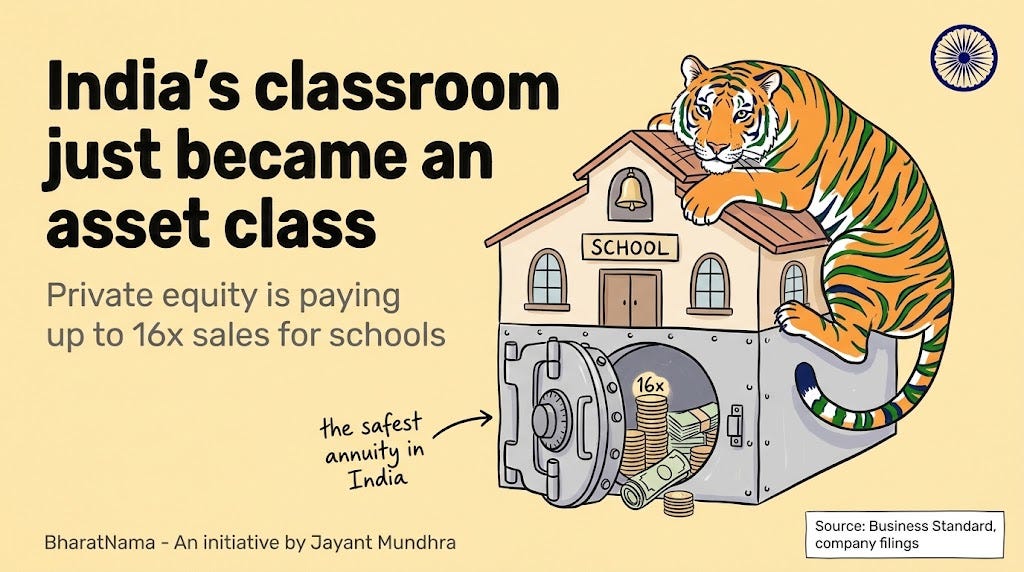
In July 2026, a European buyout firm, Vitruvian Partners, paid ₹1,159 crore for roughly 16% of K12 Techno Services, the company behind the Orchids chain of schools.1 That values a business with ₹523 crore of revenue and a net loss of about ₹25 crore at around ₹7,200 crore.2
Call it 15 to 16 times sales. For a school operator that does not yet turn a profit.2
Now let that sit for a second. The same class of investor that spent 2021 funding apps to make schools obsolete is now paying software-style multiples to own the schools themselves.
This is a rotation, not a one-off. To see why, rewind to the boom that just collapsed.
Indian EdTech raised money at a pace that looked unstoppable:
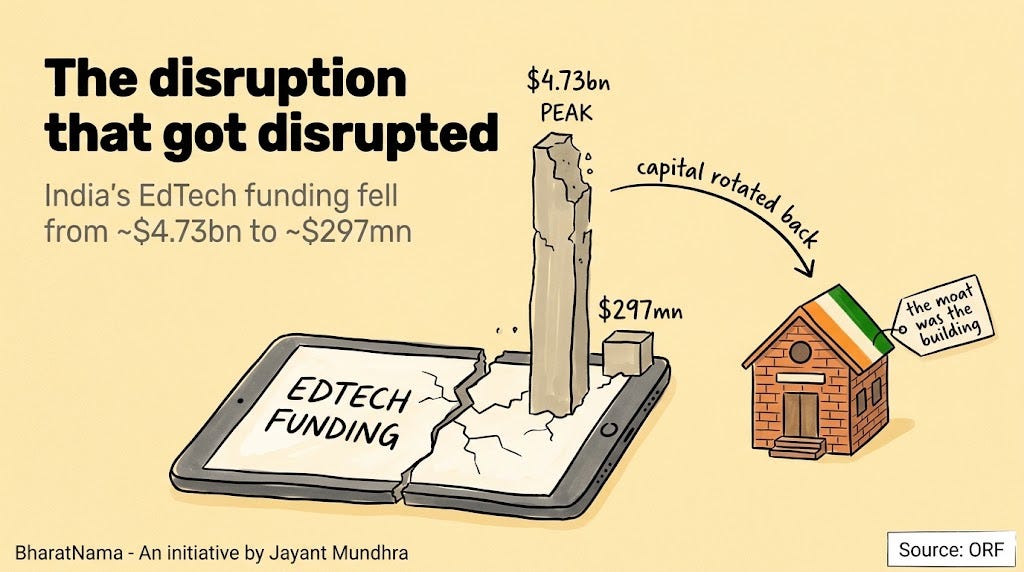
~$1.88bn in 2020, then a peak of ~$4.73bn in 2021.3
Then the fall: ~$2.6bn in 2022, and just ~$297mn in 2023.3
Roughly 4,500 startups were fighting for the same shrinking market, and over 14,000 people were laid off in 2022 alone. Lido and Udayy shut entirely; Byju's, once the poster child, imploded.3
The moment physical schools reopened, the demand for a screen substitute evaporated. Without a building to enforce attendance, without the peer group, without the childcare a school quietly provides, the churn was savage. The survivors, Byju's and PhysicsWallah, ended up spending heavily to buy physical coaching centres.3
Here is the interesting bit. Investors did not conclude that education was a bad business. They concluded the opposite. The physical school was never the weakness in the model. It was the moat.
Apply the two numbers every investor lives by, and you see what they saw.
Customer acquisition cost (CAC): what it costs to win one customer.
Lifetime value (LTV): the total profit that customer throws off before they leave.
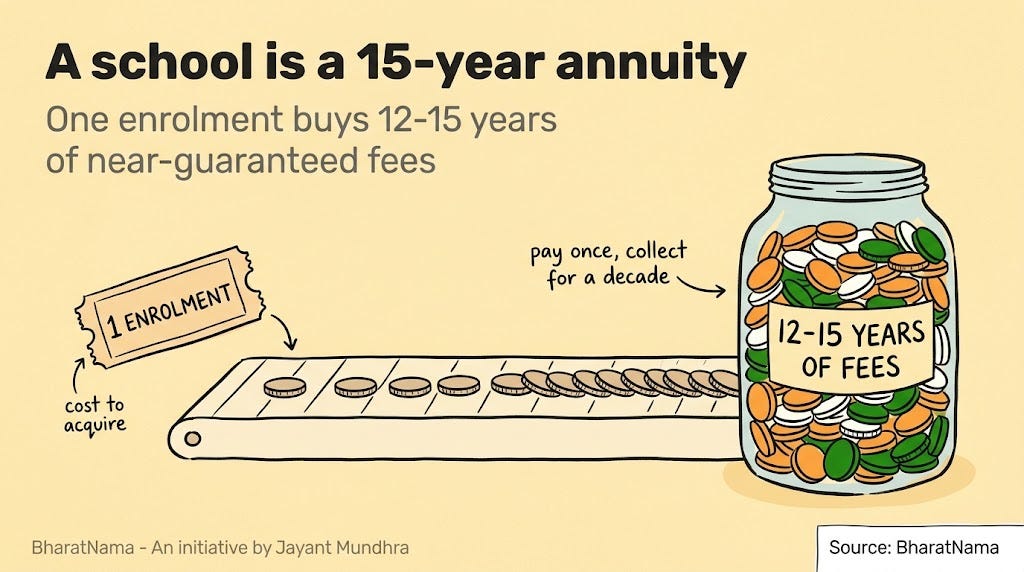
In software, an LTV to CAC ratio of 3 to 1 is considered healthy. A premium school makes that ratio look almost embarrassing, for three reasons.
Near-zero churn. Once a family clears the admissions gauntlet and enrols a child, the odds of that child switching schools before Class 12 are tiny. One acquisition buys 12 to 15 years of recurring fees. A SaaS company would kill for that retention.
Inelastic, K-shaped demand. In a downturn, a family cancels the holiday, delays the car and eats out less, long before it touches the child's school. And the segment PE is chasing, the aspirational top, is the one whose incomes have risen fastest.
Brutal barriers to entry. Prime urban land, a maze of approvals, good teachers and, above all, decades of trust. You cannot spin up a credible school in a funding round. That scarcity is pricing power.
This kind of buried unit economics, the thing that quietly turns a school into a 15-year annuity, is exactly what I keep pulling apart in the BharatNama WhatsApp community, where I share a smaller India deep-dive like this one with thousands of readers every morning (t.ly/h2jq1).
There is one problem. In India, you are not legally allowed to run a school for profit.
For generations, the law has insisted that schooling be charitable. Schools must sit inside not-for-profit trusts or societies. They cannot pay dividends. Any surplus must be ploughed back. To a buyout fund, whose entire job is to return capital, that is uninvestable.
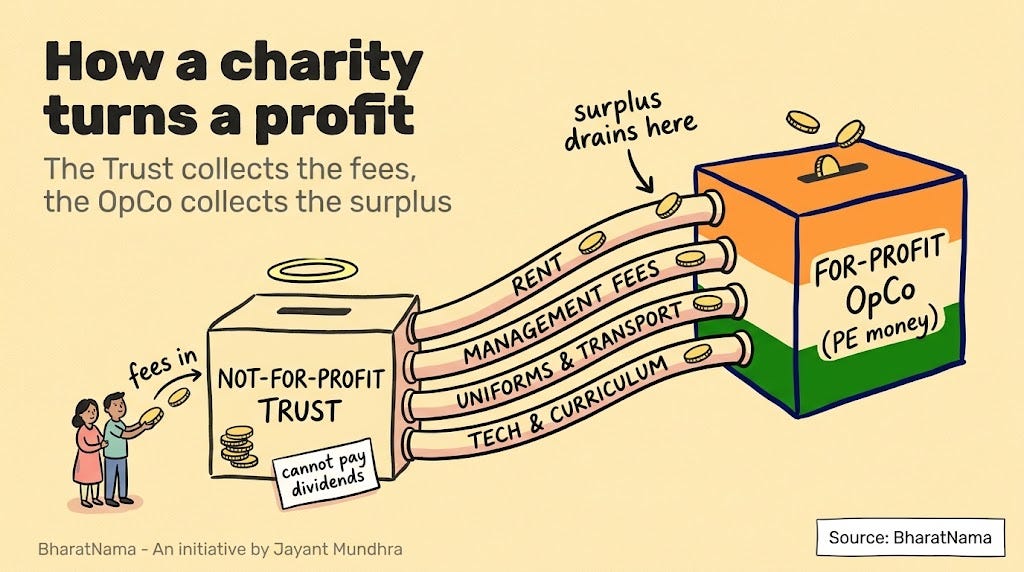
So the industry engineered a workaround, the same one it built for private hospitals. The school is split into two entities:
The not-for-profit Trust. It holds the licence and the board affiliation, employs the teachers, and technically enrols the students. It collects the fees. It cannot distribute profit.
The for-profit Operating Company, or OpCo. This is where the PE money goes. It owns or leases the land, the technology, the brand and the curriculum, and sells all of it back to the Trust through long-term management and service agreements.
The surplus the school generates is then drained out of the charitable Trust and lands on the OpCo's books as revenue, amplified by the high-margin extras: uniforms, transport, digital subscriptions, catering. The distinction between a philanthropic school and a profit machine becomes, in practice, a legal fiction.
K12 Techno is the OpCo done at scale. It does not own the school trusts. It sells them a full stack, curriculum, software, hiring, admin, marketing, across more than 113 institutes in 17 cities.2 That is the business Vitruvian just paid ₹7,200 crore to buy a slice of.1
And the re-rating is the tell. K12 Techno was worth about ₹4,721 crore in its previous round; the July step-up to ₹7,200 crore let an early backer, Peak XV, the old Sequoia India, book close to a 12-fold return on its original bet.2 When an asset class starts minting returns like that, the rest of the capital follows fast.
Zoom out, and India is early to a game the world has already matured into.
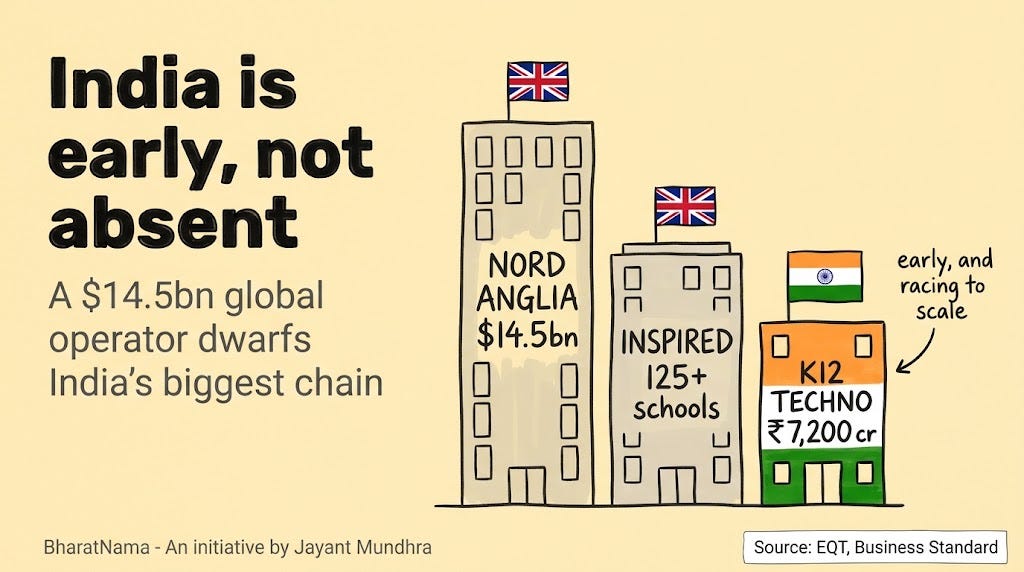
In October 2024, a consortium led by Neuberger Berman with EQT and Canada's CPP Investments agreed to buy Nord Anglia Education for an enterprise value of $14.5bn, one of the largest education deals ever. It closed in March 2025.4 5
Nord Anglia runs 80-plus schools across 33 countries for more than 85,000 students, with tie-ups to MIT, Juilliard and UNICEF. EQT first invested back in 2008 and has compounded the asset ever since, bringing in CPP in 2017.4
Its mirror image, Inspired Education, backed by TA Associates, Warburg Pincus, Stonepeak and Singapore's GIC, now runs more than 125 schools across five continents.6
Against that, India's chains are small. K12 Techno at ₹7,200 crore is roughly $850mn, a fraction of a single Nord Anglia. And that gap is precisely the pitch: the runway is enormous, and the roll-up has barely begun.
Now break the national number open, because this is where the real story sits.
The UDISE+ 2025-26 data, the government's own school census, is stark:
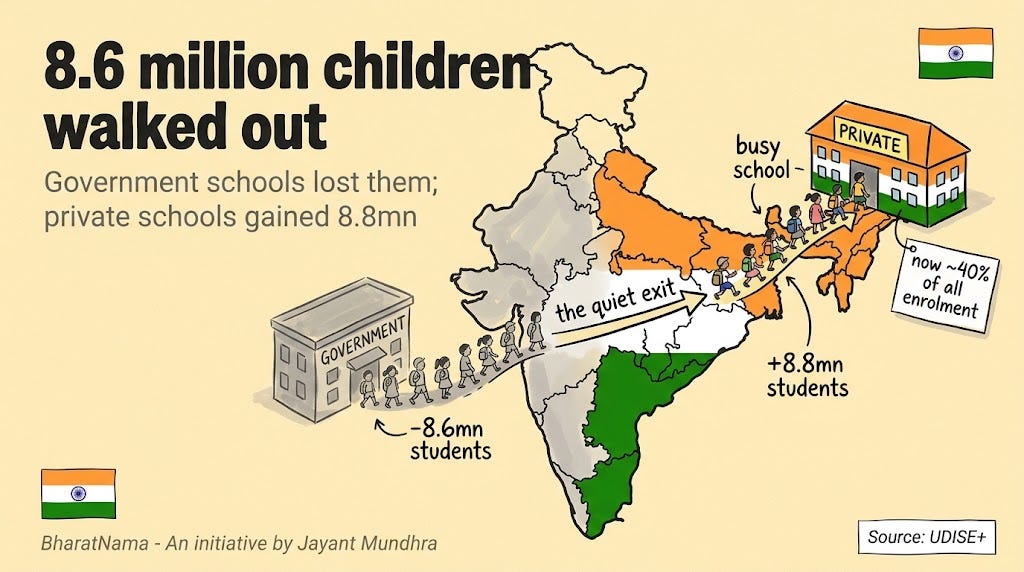
Government schools have shed enrolment from ~128mn to ~119mn, losing roughly 8.6mn students in two years.7
Private unaided schools have gone the other way, from ~90mn to ~99mn, adding roughly 8.8mn students.7
Private unaided schools now hold close to 40% of all enrolment.7
So the migration is real and it is large. But the slice PE actually wants is tiny. Of India's ~248mn school students, only about 7.9mn sit in schools charging ₹1 lakh a year or more, drawn from perhaps 28.2mn households that can afford it.1 That is the sliver the capital is racing for.
This split, 8.6mn children walking out of one system while 8.8mn walk into another, is the sort of India-versus-India thread we chew on daily in the BharatNama WhatsApp group (t.ly/h2jq1), where a version of this deep-dive lands every morning.
The other big consolidator shows how far this goes. KKR-backed Lighthouse Learning, the old EuroKids, now runs 1,850-plus preschools and 60 K-12 schools for more than 190,000 students, under EuroSchool, Kangaroo Kids and Billabong High.8 KKR bought EuroKids in 2019 for about ₹1,400 crore9, brought in Canada's PSP Investments in a fresh round in late 20258, and is now buying the ultra-premium Pathways School in Gurgaon for around ₹1,500 crore.1 A trophy IB asset, at the very top of the market.
Here is the uncomfortable part, and it is why this matters beyond the deal pages.
The rich world has already run this experiment, in higher education, and the results are on record. A landmark study by Eaton, Howell and Yannelis found that when private equity bought colleges, enrolment and profits went up, but educational inputs fell, tuition and student debt rose, graduation rates dropped and graduates earned less.10 The firms were very good at capturing subsidies. They were not good at teaching.
The mechanism to watch is the teacher. Salaries are the biggest cost line in any school, so the incentive is to trim them, raise class sizes and lean on younger staff. But the evidence says that is exactly where the damage lands. Ronfeldt, Loeb and Wyckoff, studying over 600,000 student records in New York, showed that higher teacher turnover measurably lowers achievement in maths and English, and not only by losing good teachers, but by tearing the school's social fabric.11
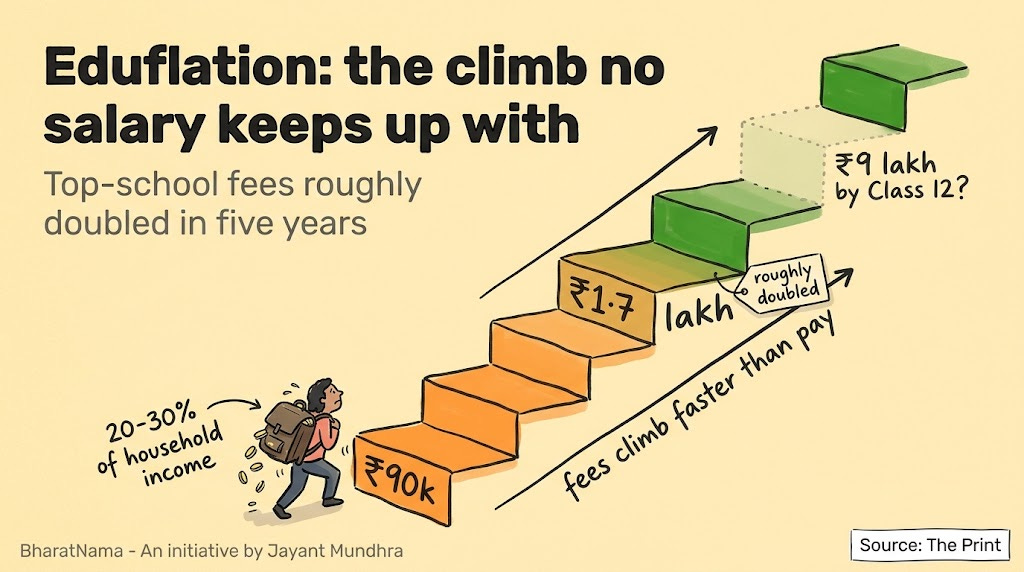
And the consumer squeeze is already visible in India as "eduflation". Fees at a school like Delhi Public School, Vasant Kunj roughly doubled from ₹90,000 in 2019-20 to ₹1.7 lakh by 2024-25, and many urban families now spend 20% to 30% of household income on their child's education.12 When a handful of well-capitalised chains set the regional benchmark, that pricing power only hardens.
And underneath all of it sits a mismatch that no amount of financial engineering resolves. A buyout fund needs its exit in three to seven years; a school's reputation compounds over decades. The pressure to inflate value before the exit window is precisely the pressure that pushes against patient, expensive, unglamorous good teaching. That is the unresolved variable in this entire thesis.
So what is portable, and what is not?
Portable: transparency and fee discipline. India already has the tools, state fee-fixation committees and disclosure laws in Delhi, Rajasthan and Chhattisgarh. The gap is enforcement, not statute.
Not portable: a simple "cap the fees" answer. The Supreme Court, in TMA Pai and PA Inamdar, protected private schools' autonomy while barring profiteering. India has to hold both at once, capital that funds good schools, without letting the classroom become pure extraction.
Whether K12 Techno or Lighthouse files for an IPO. The exit is the whole point of a buyout, and a listing would price the entire sector.
Whether states tighten scrutiny of the Trust-OpCo structure and ancillary charges, or keep looking the other way.
Whether the Pathways deal actually closes at ₹1,500 crore, and what multiple it sets for trophy schools.
The court cases and protests, from the Orchids affiliation row in Bengaluru to the fee-hike agitations in Gurgaon and Delhi, and whether any regulator's order is actually enforced.
Private equity did not disrupt the Indian classroom; it discovered that the classroom was the safest annuity in the country, and quietly bought the annuity.
And well that is it for today's edition. That said, do check out my core WhatsApp community Biz News+ where I share 4-5 deepdives from the world of business, economics & public economics daily: https://t.ly/h2jq1
And if you want to understand where China stands and what it means for India, do check out my companion newsletter, Decoding the Dragon: https://t.ly/t7uhs
And, do check out my work on the following platforms as well: Instagram, LinkedIn and Youtube
Best,
Jayant
Business Standard, "The business of education: Why PE is lining up for India's premium schools", link
SaaSRise deal brief, "Vitruvian Partners acquires 16% stake in K12 Techno Services for ₹1,159 crore", link
Observer Research Foundation, "Edtech in India: Boom, bust, or bubble?", link
CPP Investments / EQT, consortium to acquire Nord Anglia Education, link
Ropes & Gray, "EQT Consortium Completes $14.5 Billion Acquisition of Nord Anglia Education", link
Inspired Education Group, corporate news, link
Free Press Journal, "UDISE+ 2025-26 Report: Government Schools Lose Nearly 86 Lakh Students As Private Schools Gain Over 88 Lakh Enrolments", link
PSP Investments, "KKR Further Invests in Lighthouse Learning to Support Next Phase of Growth", link
Business Standard, "PE firm KKR enters education sector in India, buys 90% stake in EuroKids", link
Eaton, Howell & Yannelis, "When Investor Incentives and Consumer Interests Diverge: Private Equity in Higher Education", NBER Working Paper 24976, link
Ronfeldt, Loeb & Wyckoff, "How Teacher Turnover Harms Student Achievement", American Educational Research Journal, link
The Print, "Indian parents trapped in a spiral of soaring private school costs. Aspiration fuels eduflation", link
Comments
Nothing yet. Say the first thing.
Sign in to join the conversation.