
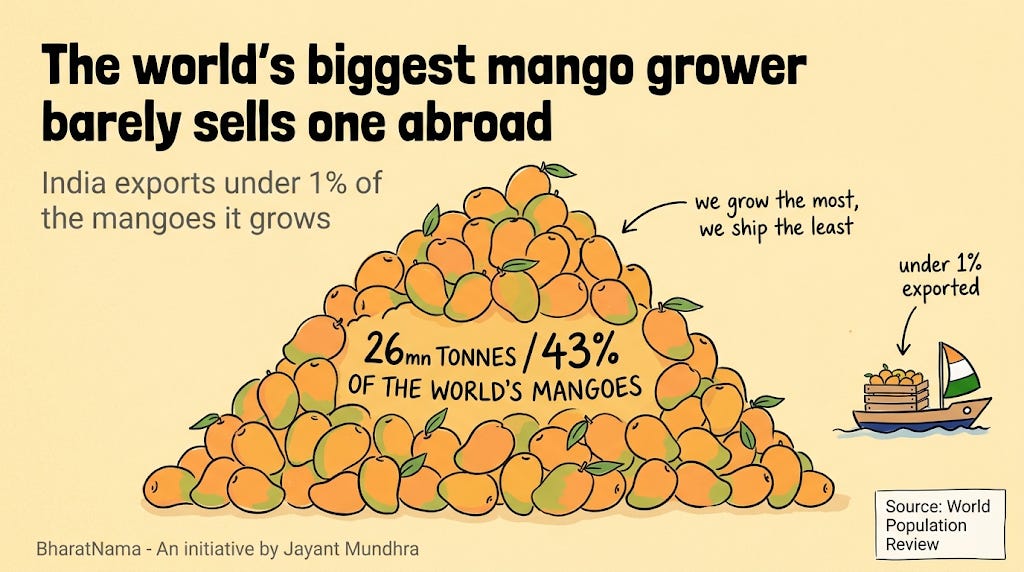
India is the largest mango producer on earth. We grow roughly 26mn tonnes a year, about 43% of the entire global crop.1 And we export less than 1% of it.1
Let that sit for a second. The country that basically defines the fruit sells almost none of it to the world.
That one number tells you most of what you need to know about where Indian agriculture actually stands in 2026. We have never been better at growing food, and we have never negotiated harder to sell it. Farm exports hit $53.1bn in 2025-26, a whisker below the all-time record and up 2.3% in a year when overall merchandise exports barely moved.2
And yet, at inspection counter after inspection counter, our produce keeps getting turned away.
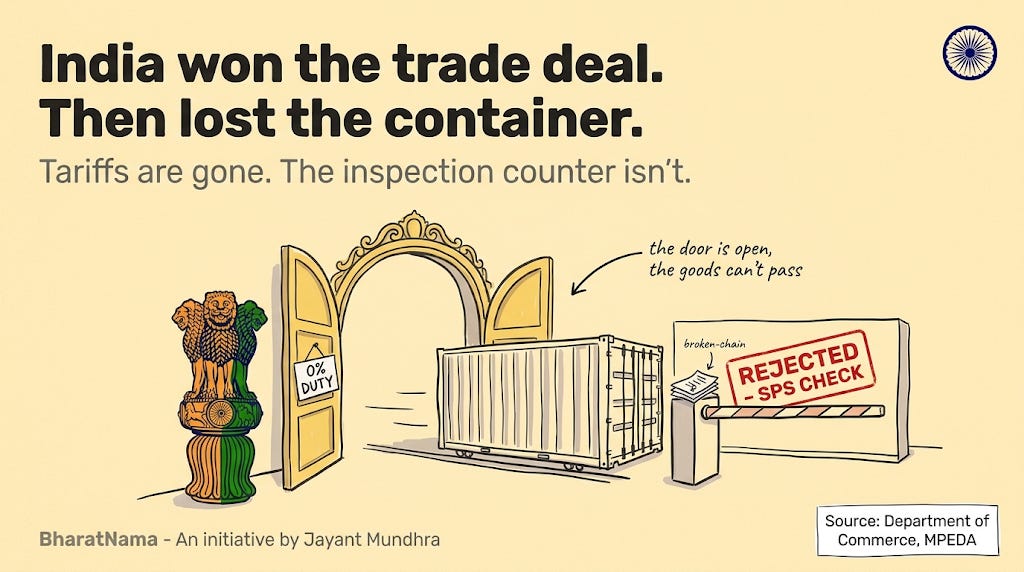
We win the negotiation, then lose the container
Here is the thing. India has quietly become very good at one half of trade, and stayed fragile at the other.
The first half is market access, the diplomacy of tariffs. On that, New Delhi has been on a tear:
New Zealand signed a free trade deal on 27 April 2026 giving India duty-free access across all 8,284 of its tariff lines, plus a $20bn investment pledge over 15 years.3
The India-UK CETA came into force on 15 July 2026, scrapping duties on about 99% of Indian goods and targeting a doubling of two-way trade to $56bn by 2030.4
The second half is compliance: the world of sanitary and phytosanitary rules, or SPS, the residue limits, fumigation certificates and heat-treatment protocols that decide whether a container actually clears the border. On that, we are bleeding shipments every week.
Australia has just suspended 44 Indian fumigation agencies.5
The EU ranked India first in the world for pesticide alerts last year.6
Japan halted our mangoes for the first time in 20 years.7
And banned antibiotics drove 43% of our shrimp rejections.8
This is the compliance paradox. We have optimised the art of the trade deal, and our fragmented supply chain still cannot meet the zero-tolerance rulebooks on the other side. This split, brilliant at the table and shaky at the counter, is exactly the tension I keep pulling apart, and it is the sort of thread we chew on every morning in my BharatNama WhatsApp community, where I share a smaller India deep-dive like this one with thousands of readers (t.ly/h2jq1).
The new trade diplomacy: take a lot, give a little
India's trade posture has flipped. For decades we were the reluctant partner who walked out of RCEP. Now we are signing, and fast.
But read the fine print and one pattern jumps out. We take almost everything, and give back carefully. Call it asymmetric liberalisation.
New Zealand:
Wellington opens 100% of its 8,284 lines to us, immediately.3
India liberalises 70.03% of its lines, and only 30% of those go to zero on day one; the rest phase in over three to ten years.3
Crucially, India walls off 29.97% of its tariff lines completely: dairy, onions, chickpeas, corn, sugar and edible oils.3
UK CETA:
Britain drops duties on about 99% of Indian goods.4
India opens roughly 89.5% of its lines, but only 24.5% of UK exports get duty-free access immediately.4
Scotch whisky, for instance, only falls from 150% to 100% now, reaching 40% after a decade.4
Dairy, cereals, millets, pulses and apples stay excluded.4
The logic is defensible. About 89% of India's agricultural households farm under two hectares.14 You cannot expose that base to New Zealand milk powder or Australian chickpeas overnight.
But here is the quiet cost. By winning duty-free access abroad and shielding the farm gate at home, the government has handed the entire burden of execution to the exporter. Tariffs are gone. Non-tariff barriers are not. And non-tariff barriers are technical, unforgiving, and exactly where India's supply chain breaks.
Look at the UK prize. Britain imports about $37.5bn of agriculture a year and takes just $811mn of it from India, around 2.2%.9 The headroom is enormous. Shrimp, tuna and fishmeal that carried 4.2% to 8.5% UK tariffs are now duty-free.9 Tea, spices and basmati walk in free.9 On paper, a windfall. In practice, only if the container clears inspection.
SPS: the barrier that replaced the tariff
When tariffs fall, the friction does not disappear. It just moves to SPS and to technical barriers to trade, or TBT: the standards, certifications and residue limits a country is allowed to set under WTO rules, as long as they rest on science and are not disguised protectionism.
As tariffs vanished worldwide, SPS notifications surged. They have quietly become the modern weapon of trade friction, and they fall hardest on developing exporters who cannot pivot the moment a rule changes.
India's problem is rarely the intrinsic quality of the food. It is the chain of proof. In global trade the absence of contamination is not enough; you need an unbroken chain of accredited paperwork and residue compliance. When that chain snaps, or when a foreign regulator moves faster than our farms can adapt, the shipment dies. Four live crises show exactly how.
1. Australia: the cost of a broken certificate
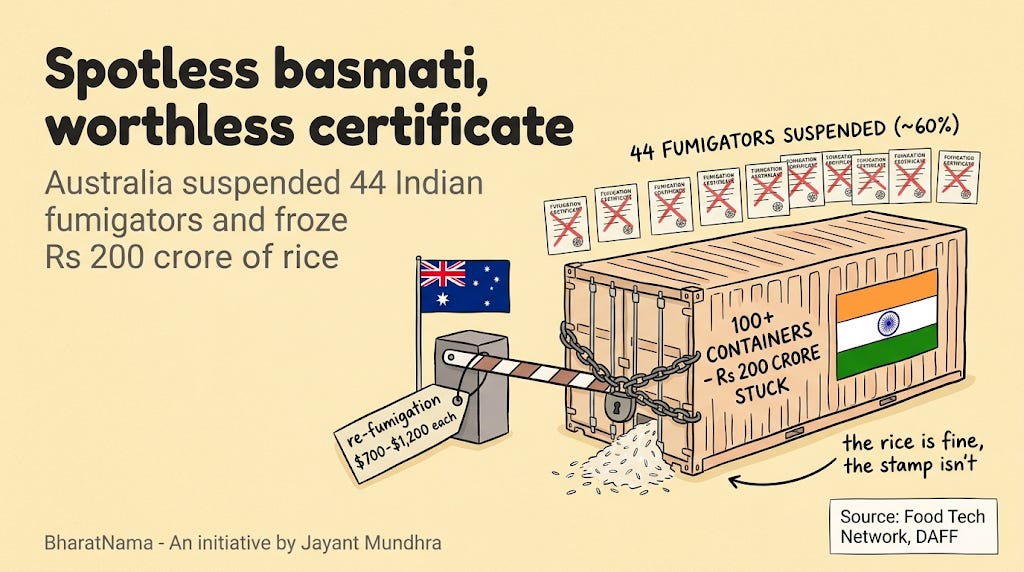
Australia runs one of the strictest biosecurity regimes on earth. It does not test every container; it trusts accredited Indian fumigators to treat rice with methyl bromide or aluminium phosphide before it sails.
On 13 July 2026, its agriculture department suspended 44 Indian fumigation agencies, roughly 60% of the ones it accredits, most clustered in the basmati belts of Haryana and Punjab.5 Audits had found certificates that did not add up, including consignments recorded as packed before they were fumigated.5
The fallout is brutal:
More than 100 containers of basmati, worth about ₹200 crore, are stuck in regulatory limbo.5
Each now faces mandatory re-fumigation on arrival, at $700 to $1,200 a container.5
The rice itself may be spotless. But the paperwork lost its validity, so the shipment became a liability. That is the paradox in a single container.
2. The EU: a chemical chasm
India and the EU farm by different rulebooks. Our food regulator sets residue limits for a hot, humid, pest-heavy country; Brussels pushes maximum residue limits toward near-zero for anything it has banned. Chemicals our farmers lean on are simply illegal in Europe.
The collision shows up in the EU's rapid alert system. In 2025, India ranked first in the world for pesticide alerts, with 124 of them, ahead of Turkey at 105, Egypt at 88, China at 48 and Brazil at 34.6 Being number one in that particular league is not a badge anyone wants.
The repeat offenders are familiar: ethylene oxide, a banned fumigant, turning up in sesame; tricyclazole, a rice-blast fungicide, in basmati; chlorpyrifos in rice. Indian sesame now carries a 20% EU border-check rate for ethylene oxide, and cumin a 30% rate for other residues.10 Every alert triggers destroyed consignments, higher insurance and slower clearance for everyone shipping behind you.
3. Japan and Nepal: blocked by a protocol
For 20 years India shipped premium Alphonso and Kesar mangoes to Japan using vapour heat treatment, a chemical-free process that cooks out fruit-fly larvae. Then, on 29 May 2026, Japan suspended imports carrying certificates issued after 25 March, after inspectors flagged lapses at a treatment facility in Rehmanpur, Uttar Pradesh.7
Japan is tiny for us, about $1.54mn a year, mostly Gujarat's Kesar.7 But it was our first Japanese restriction in two decades, and the reputational hit travels.7
Nepal added to the noise. Reports of a Nepali "ban" flew around, but both governments have since clarified there is no formal ban; Nepal has instead introduced new phytosanitary conditions, including hot water treatment, and India is contesting the measures through the WTO and bilateral channels.11 Notice the pattern across all three: the block is never about the fruit. It is about a protocol.
4. Shrimp: zero tolerance on antibiotics
Our marine sector faces the hardest wall of all. Western regulators permit no trace of antibiotics like chloramphenicol or nitrofurans, because of links to antimicrobial resistance.
Per India's own drug regulator, banned residues drove 43% of shrimp rejections in 2025 across the EU, the US and Japan.8 The US FDA alone logged 93 antibiotic-linked shrimp refusals that year, its sixth-highest count in 24 years.8
Where India stands, against itself
Now BharatNama's favourite question. Where inside India does the problem actually live? Because the national number hides a very lopsided map.
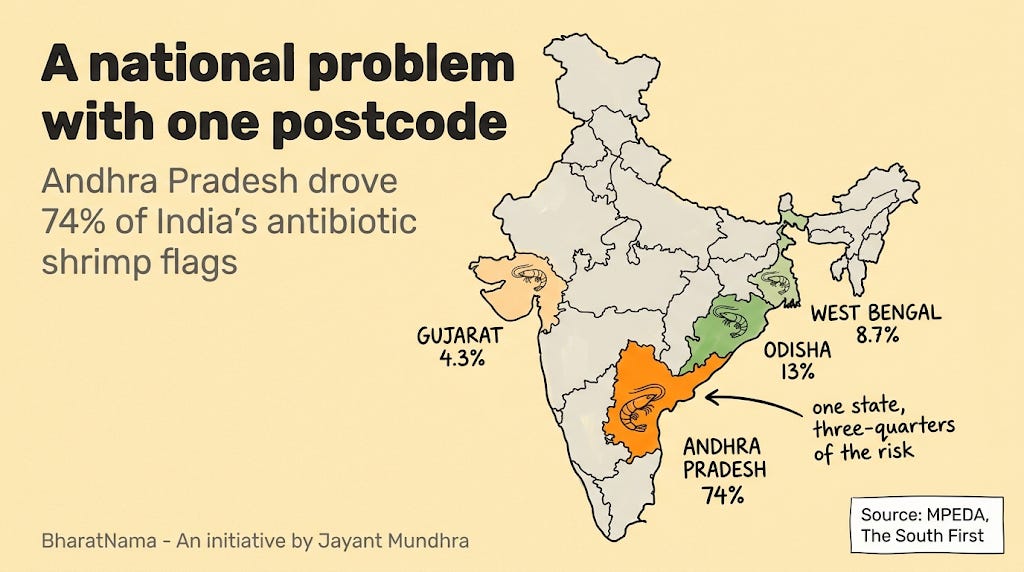
When our marine authority traced the farms behind the 2026 antibiotic detections, the concentration was staggering:
Andhra Pradesh accounted for 74% of the implicated farms.8
Odisha made up 13%, West Bengal 8.7% and Gujarat 4.3%.8
One state drives three-quarters of a national reputational risk. The basmati story is just as concentrated: the suspended fumigators sit overwhelmingly in Haryana and Punjab.5 These are not "India" problems in the abstract. They are problems of a handful of clusters, which is the bad news, concentration of risk, and the good news, because a handful of nodes is exactly what you can fix. This kind of state-versus-state spread is the sort of number I find genuinely fascinating, and if unpacking them is your thing too, come join the daily India deep-dives in the BharatNama WhatsApp group (t.ly/h2jq1).
Where India stands, against the world
Set India beside the countries it actually competes with, on current numbers, and the picture sharpens.
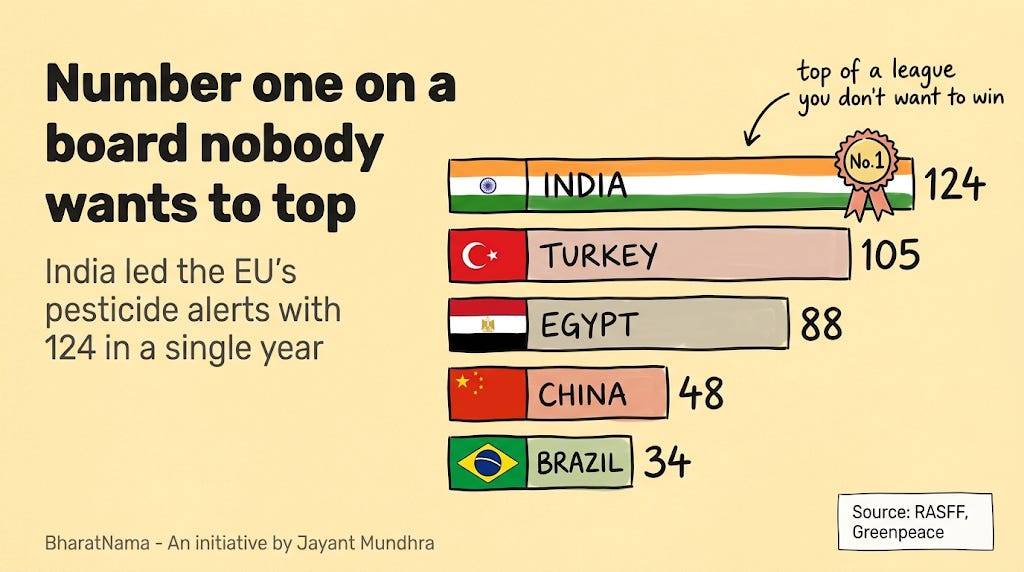
On EU pesticide alerts, India leads the whole table: 124 against China's 48 and Brazil's 34.6 Yes, we ship more, so we trip more, but the gap is not only about volume.
In seafood, Vietnam out-earns us outright. It exported about $11.3bn of seafood in 2025, shrimp alone at roughly $4.65bn, growing 13% in a year.16 India's marine exports were about $7.45bn in 2024-25.17
Vietnam is the tell. It faced the same Western zero-tolerance wall we do. It responded by wiring tighter traceability, cold chains and compliance into the supply chain, and then climbed the value ladder.16 We are the bigger farm; they are the better exporter.
What India can learn
The countries that cracked this all did one thing we have not. They pushed compliance upstream, to the farm, instead of trying to inject it at the port.
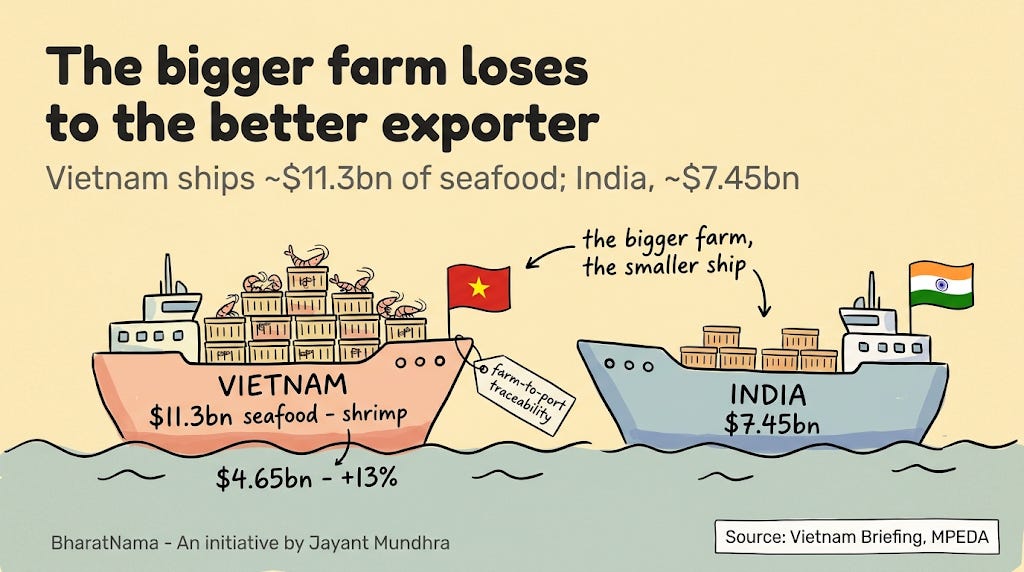
Vietnam built traceability and third-party certification into its seafood chain, and is now an $11.3bn exporter.16
Kenya and Peru turned smallholder horticulture into EU-grade exports by clustering farmers under GlobalGAP certification, so a single verified block, not a lone farmer, carries the audit.18
What actually transfers to India, and what does not, matters here, because I have no time for lazy "India should just copy them" takes.
Portable:
Farm-level traceability, geo-tagged plots, residue testing before harvest, and clustering small farmers into certified blocks. We have started: our marine authority runs pre-harvest ELISA testing across a network of 12 labs and a Shaphari antibiotic-free certification scheme, and APEDA is building farm-to-port traceability for crops.12,13
Not portable wholesale:
We cannot simply adopt EU residue limits. India's roughly 89% smallholder base farms in humid, pest-heavy conditions and depends on affordable agrochemicals to feed 1.4bn people.14 A blanket ban on tricyclazole would help exporters and hurt domestic yields. The realistic path is phased harmonisation inside designated export zones, not a national copy-paste.
Credibility begins at home
There is a home-front dimension foreign regulators watch closely. In July 2026, our food safety authority suspended the licence of Westend Agro Products, maker of the "Organic Shastra" brand, after finding machinery altering batch numbers and expiry dates, and packaging that falsely claimed the goods were "organic".15
When your own regulator keeps uncovering date-tampering and fake-organic claims, foreign border agencies quietly mark up your risk profile. The enhanced checks abroad and the adulteration raids at home are two ends of the same credibility problem.
And underneath it all sits the real question: who actually owns export quality? On paper, everyone. In practice, no one. State governments run primary agriculture, the food authority sets domestic safety, APEDA promotes crop exports, the marine authority governs seafood, Plant Quarantine issues phytosanitary certificates, Customs signs the exit. Every silo does its slice; none owns the outcome. The exporter, aggregating produce from hundreds of untraceable micro-farms, ends up a collector of paperwork rather than an architect of quality. When Brussels tightens a residue limit, the signal has to crawl back through that maze to a village pesticide dealer, and by then the container is already destroyed.
What to watch
Whether India wins a one-time Australian exemption for the ₹200 crore of basmati already in transit, using the consultation framework in the India-Australia trade agreement.5
Whether Japan restores mango access once the Rehmanpur treatment facility is re-audited.7
Whether pre-harvest testing actually pulls Andhra Pradesh's antibiotic rejection share down over the next two shrimp cycles.8,12
Whether APEDA's farm-to-port traceability moves from pilot to scale before UK CETA volumes ramp up.4
India has learned to open the world's doors. It has not yet learned to walk its containers through them.
And well that is it for today's edition. That said, do check out my core WhatsApp community Biz News+ where I share 4-5 deepdives from the world of business, economics & public economics daily: https://t.ly/h2jq1
And if you want to understand where China stands and what it means for India, do check out my companion newsletter, Decoding the Dragon: https://t.ly/t7uhs
And, do check out my work on the following platforms as well: Instagram, LinkedIn and Youtube
Best,
Jayant
Comments
Nothing yet. Say the first thing.
Sign in to join the conversation.