
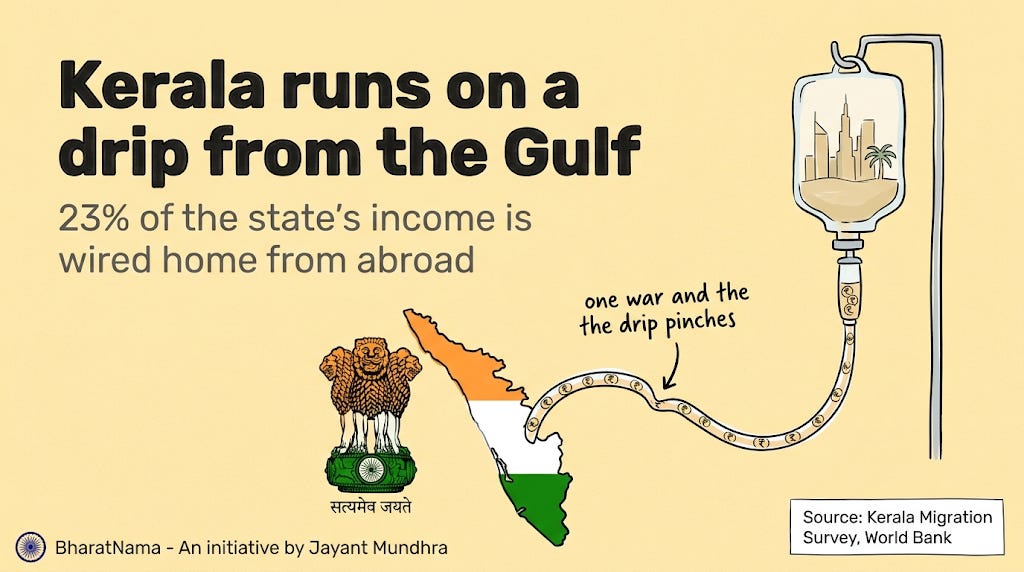
Here is a number that should not really be possible for an Indian state. The money Keralites working abroad sent home in 2023 came to ₹2.17 lakh crore, which is 23.2% of the state's income.1
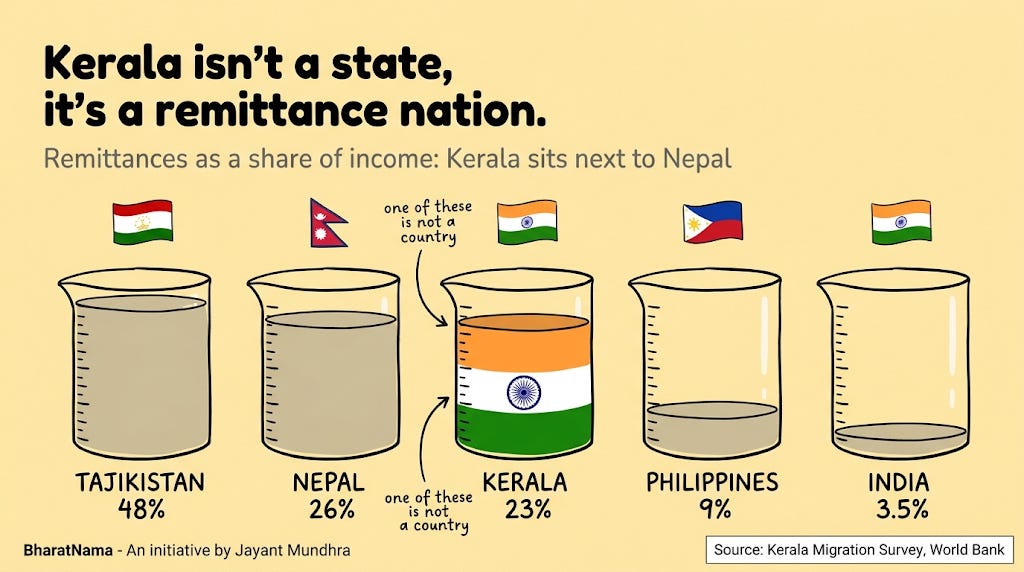
Now put that beside a country instead of a state, and it lands. Nepal, the textbook remittance economy, runs at about 26% of GDP.2 Kerala is sitting right next to it. India as a whole is at just 3.5%.2
So on this one metric Kerala does not really behave like a part of India. It behaves like a small nation that exports its people and lives on what they wire back. That model has worked beautifully for half a century. This year, a war is quietly asking whether it still works.
The mechanics are worth stating plainly, because they are unusual.
Kerala does not earn its keep by making things. It manufactures very little, imports most of what it eats, wears and builds, and pays for those imports with foreign wages. Roughly 2.2mn Keralites work overseas,1 about one in every fifteen people in the state, and their money has quietly underwritten the hospitals, the schools and the property market that the "Kerala model" is celebrated for.
Two features make this fragile.
It is dangerously concentrated. 80.5% of Kerala's emigrants are in the six Gulf states, and 38.6% are in the UAE alone.1 There is almost no geographic hedge.
It is exposed to precisely one thing going wrong: instability in the Gulf.
That is the thing now going wrong. The 2026 war between Israel, the United States and Iran has flared through this year, with a fragile ceasefire that keeps breaking down into fresh strikes across the region.3 For most of India this is an oil-price story. For Kerala it is an income story, and a far more direct one.
The people who track this closely, led by the migration economist S. Irudaya Rajan, expect remittances into Kerala to fall by around a fifth this financial year if the war drags on.4 The state's new Chief Minister has put the same number on record. V.D. Satheesan, who took charge in May 2026 after the Congress-led UDF ended the Left's ten-year run,5 told an interviewer in July that he expects a 20% dip in remittances this year, called them "the backbone of the state economy", and confirmed he has gone to Delhi asking for special assistance to ride it out.6
A 20% fall does not sound apocalyptic until you remember what those remittances actually do.
The instinct is to assume Kerala has been slowly weaning itself off the Gulf. The data says the opposite. The dependence has deepened.
Remittances into Kerala went from ₹85 thousand crore in 2018 to ₹2.17 lakh crore in 2023, a rise of about 155% in five years.1
As a share of the state's income, they climbed from 13.5% to 23.2% over the same period.1
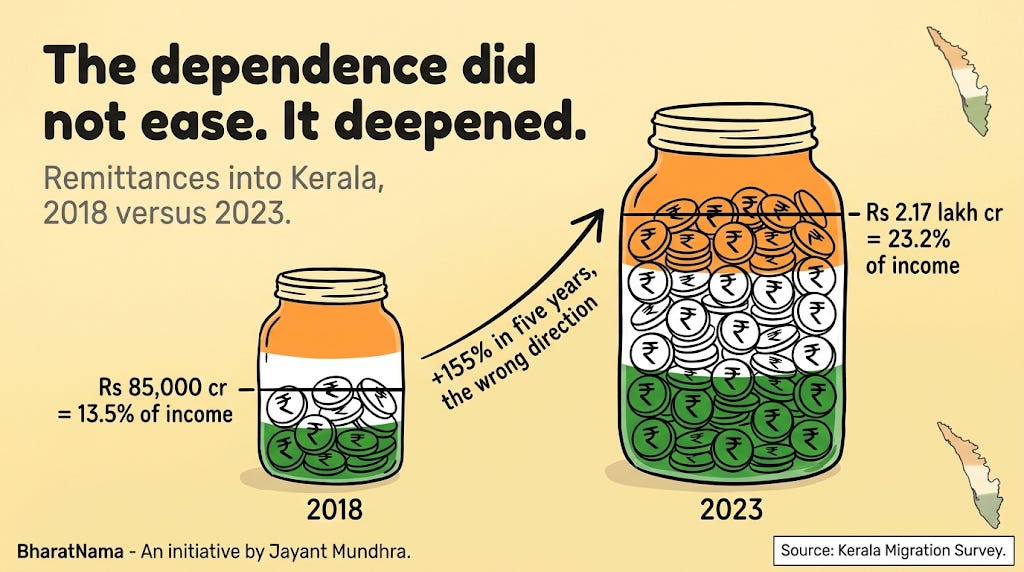
In other words, in the years when everyone assumed Kerala was diversifying, the state actually became more hooked on foreign wages, not less. The Gulf money flowed in, went first into repaying the debt that funded the migration, and then into land, houses and gold, inflating an asset base that has very little to do with what Keralites at home actually earn.
This is exactly the kind of thread I keep pulling at, and it is the sort of thing we go back and forth on in the BharatNama WhatsApp group, where I share a smaller India deep-dive like this most mornings (t.ly/h2jq1).
The composition of who leaves has shifted underneath all this, and that shift is the real story of the next decade.
Student emigration from Kerala doubled, from about 130 thousand in 2018 to 250 thousand in 2023, and students are now 11.3% of all emigrants.1
Among women who leave, 51.6% go as nurses, and 40.5% of them now prefer Europe and the West over the Gulf.1
The young and the highly qualified are increasingly skipping the Gulf entirely for Canada, the UK, Australia and Germany, where there is a path to residency and a life, not just a contract. That is good for those families. It is quietly terrible for the remittance model, because a nurse who settles in Toronto with her family stops wiring the bulk of her salary back to Kochi in a way a construction supervisor in Dubai never did.
Two comparisons make the position clear, and both are built on current, like-for-like data.
India against the world. On remittance dependence, Kerala is an outlier not just within India but globally:
Tajikistan: about 48% of GDP.2
Nepal: about 26%.2
Kerala: 23.2% of state income.1
Philippines: about 9%.2
India as a whole: 3.5%.2
Kerala belongs on the list of economies that survive on their diaspora, sitting beside Nepal, far above the Philippines, while the country it is part of barely registers. That is a genuinely strange place for one of India's richest, most literate states to be.
India against itself. Here is the sharper contrast. India's remittance base has already pivoted away from the Gulf. Kerala has not.
For India as a whole, the United States is now the single largest source of remittances at 27.7%, having overtaken the UAE at 19.2%, according to the RBI's latest survey.7
Advanced economies, the US, UK, Singapore, Canada and Australia together, now send more than half of all money remitted to India, while the Gulf's share has slipped to 38%.7
Kerala, meanwhile, is still 80.5% dependent on those same Gulf states.1
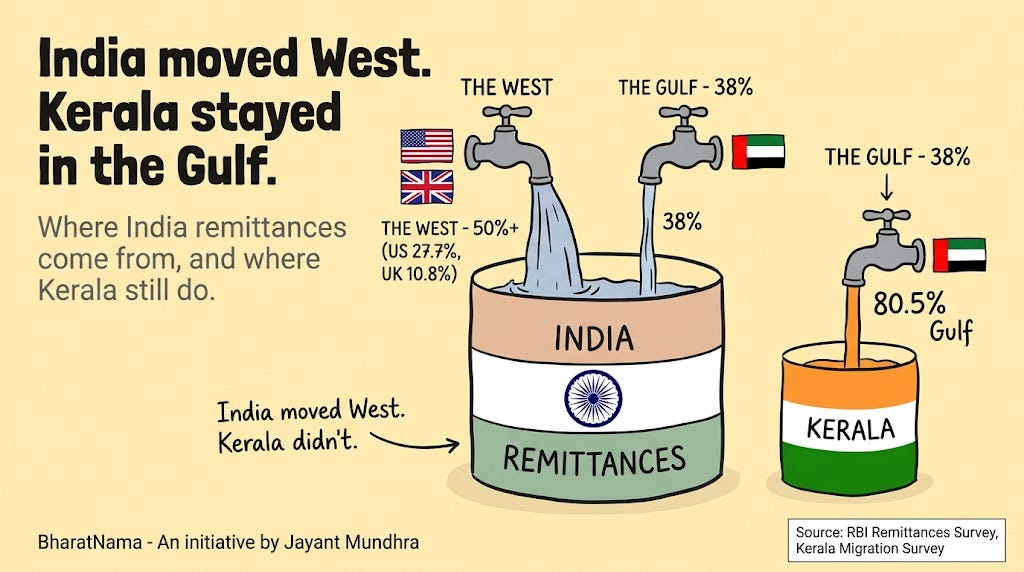
So the rest of India has, almost accidentally, diversified its way to safety through white-collar migration to the West. Kerala is still carrying the blue-collar Gulf model that India as a whole is walking away from. When a war hits the Gulf, the country shrugs and Kerala shakes.
None of this would matter so much if Kerala had room in its budget to absorb a shock. It does not. It is caught in what economists call a scissor effect: revenue is being squeezed from one side while spending obligations are fixed on the other.
Start with the spending blade. Kerala's 2026-27 budget shows a state with almost no financial flexibility left:
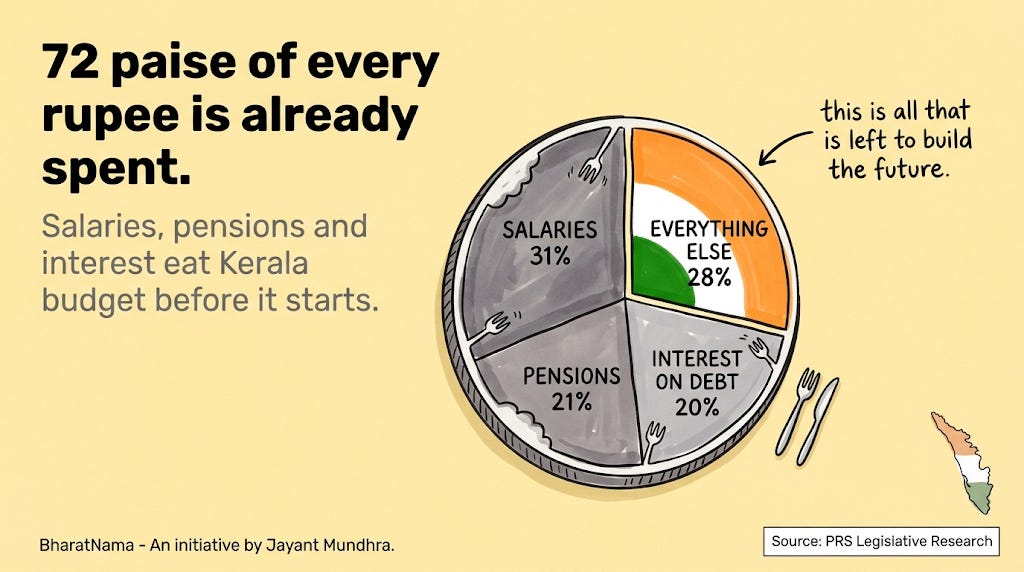
Committed expenditure, the money it has no choice but to spend, is 72% of revenue receipts, split across salaries (31%), pensions (21%) and interest payments (20%).8
Interest alone eats one in every five rupees the state earns.8
Capital spending, the money that actually builds the future, is stuck near 1.2% of GSDP, among the lowest in India.8
The revenue deficit is 2.2% of GSDP and outstanding debt is 34% of GSDP.8
Now the revenue blade, and this is the fresh cut. When a state consumes less, its tax take falls, because Kerala's revenue is overwhelmingly consumption-based (it makes little to tax at the factory gate). A 20% drop in remittances feeds straight through into weaker spending on cars, gold and construction, and therefore into weaker GST. The income that funds the state and the income that gets taxed are the same Gulf income.
That is the trap. The shock that cuts Kerala's revenue is the same shock that would force it to spend more, on returning, jobless migrants who need rehabilitating.
Faced with a revenue hole, any government would normally borrow. Kerala's problem is that it cannot, and the reason has become a landmark constitutional fight.
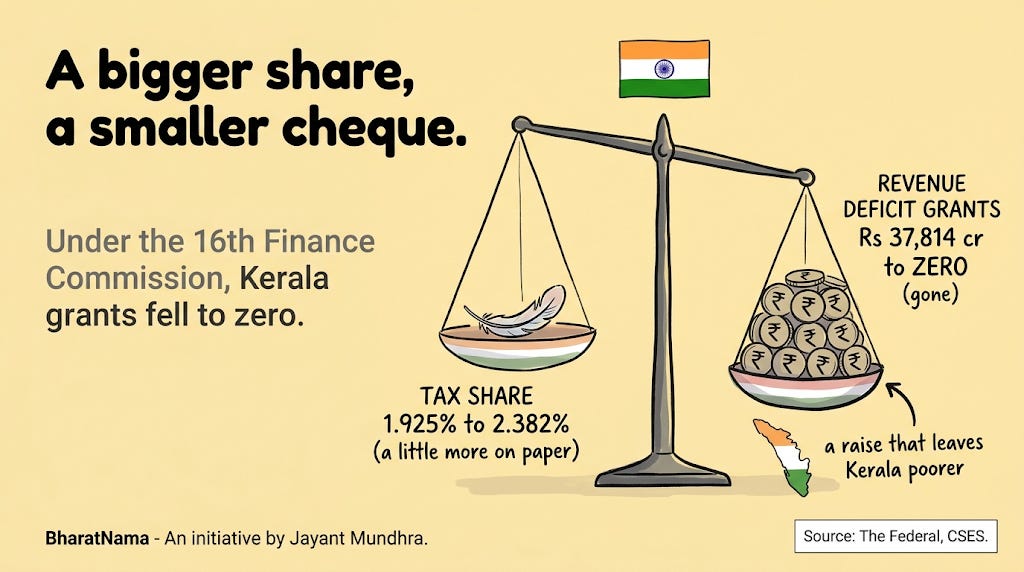
Two things happened at once. First, the Sixteenth Finance Commission, whose award runs from 2026, raised Kerala's share of central taxes slightly, from 1.925% to 2.382%, but scrapped the revenue deficit grants that had cushioned the state.9 Kerala had drawn ₹37,814 crore in such grants over the previous five-year cycle; the new figure is zero.9 The Chief Minister called it "a huge shock to the state exchequer".6 Kerala gains on paper and loses in cash.
Second, the Centre tightened the borrowing rules. States can normally borrow up to 3% of GSDP under the fiscal-responsibility framework. But the Union began counting the off-budget borrowings of state entities, most importantly the Kerala Infrastructure Investment Fund Board (KIIFB), against that same ceiling, shrinking the room Kerala actually has to raise money.
Kerala's response was extraordinary. In December 2023 it sued the Union of India in the Supreme Court, arguing that borrowing is a state subject and that Delhi was strangling its fiscal autonomy. In April 2024 the court refused Kerala interim relief of ₹26,226 crore in borrowing space, but it also referred the deeper questions to a five-judge Constitution Bench, because Article 293, which governs how states borrow, has never been properly interpreted in the country's history.10 That reference is still pending, and whenever it is decided it will settle, for every Indian state, exactly how much fiscal freedom the Constitution actually grants.
This is the part I find genuinely gripping, and it is the kind of structural, second-order story we dig into daily in the BharatNama community rather than just the headline (t.ly/h2jq1).
India does not have to invent an answer here. The Philippines, the other great labour-exporting economy, faced the same dependence decades ago and built its way out of the worst of it.
It diversified geography relentlessly. Filipino workers are spread across more than a hundred countries, so no single war or oil crash can take down the whole flow. Kerala's 80.5% concentration in one region is the opposite of this.
It built institutions around migration, culminating in a full Department of Migrant Workers, with mandatory pre-departure training, contract vetting and reintegration support for returnees.
It kept remittances at a manageable share of GDP, about 9%,2 precisely because the domestic economy, especially business-process outsourcing, grew fast enough to give people an option at home.
The transferable lesson for Kerala and for India is not "copy the Philippines". It is narrower and harder: diversify the destinations, formalise and protect the skilled migration that is already happening (the ILO and Kerala's own NORKA agency began exactly this work on nurses and care workers in 2026), and above all build enough of a domestic economy that a returning migrant has somewhere to land. Kerala has the human capital; what it has never built is the local job.
Whether the 2026 Gulf ceasefire holds, and whether Gulf construction and hiring restart. This is the single biggest swing factor for Kerala's FY27.
Kerala's own remittance and bank-deposit data through the year, to see if the projected 20% fall actually shows up.
Whether the Centre grants Chief Minister Satheesan the special assistance he has asked for, and on what conditions.
Whether the Supreme Court's Constitution Bench finally takes up the Article 293 reference, the outcome of which binds every state.
Kerala spent fifty years proving that you can build a rich, healthy, literate society without building an economy. The bill for that shortcut is now arriving in the same envelope as a war.
And well that is it for today's edition. That said, do check out my core WhatsApp community Biz News+ where I share 4-5 deepdives from the world of business, economics & public economics daily: https://t.ly/h2jq1
And if you want to understand where China stands and what it means for India, do check out my companion newsletter, Decoding the Dragon: https://t.ly/t7uhs
And, do check out my work on the following platforms as well: Instagram, LinkedIn and Youtube
Best,
Jayant
Kerala Migration Survey 2023, International Institute of Migration and Development (IIMAD) / GIFT: iimad.org
Remittances as % of GDP (World Bank data), TheGlobalEconomy: theglobaleconomy.com
2026 Iran war ceasefire and July 2026 escalation, Al Jazeera: aljazeera.com
Kerala likely to see 20% drop in remittances as West Asia war drags on (S. Irudaya Rajan), FLAME University / GIFT: flame.edu.in
Kerala Assembly election results 2026, UDF returns to power, Business Standard: business-standard.com
West Asia war a blow to Kerala's remittance-backed economy: CM Satheesan (interview, July 2026), Business Standard: business-standard.com
Advanced economies overtake Gulf nations in share of remittances to India (RBI 6th Remittances Survey, 2023-24), Business Standard: business-standard.com
Kerala Budget Analysis 2026-27, PRS Legislative Research: prsindia.org
Why Kerala gains on paper but loses fiscally under the 16th Finance Commission, The Federal / CSES: thefederal.com
Extent of state's power to borrow funds from Union (Article 293 case status), Supreme Court Observer: scobserver.in
Comments
Nothing yet. Say the first thing.
Sign in to join the conversation.