
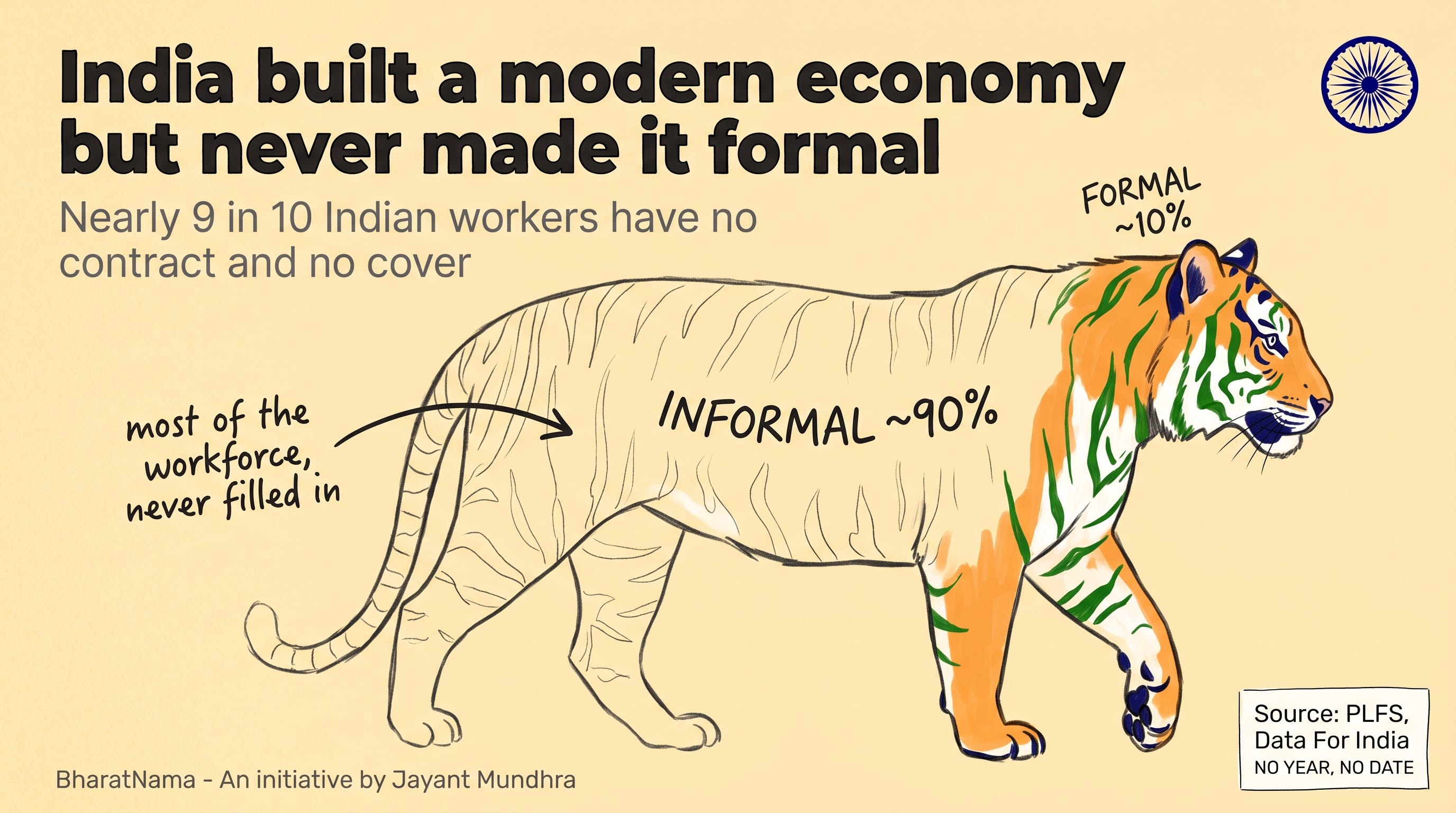
Here is a number that should stop any celebration of India's rise cold. After three decades of world-beating growth, roughly 9 in 10 Indians who work still do so informally.1 No written contract. No paid leave. No provident fund. Nothing between them and a bad month.
I keep coming back to this because it quietly breaks the story we tell ourselves. We have the GDP. We have the unicorns. We have UPI rails clearing more digital payments than any system on earth. And yet the typical Indian worker is about as exposed today as their parent was a generation ago.
The thing is, this is not an accident of bad luck. It is the direct result of the particular road India took to get richer. We grew fast, but we skipped the one phase that usually turns growth into secure work.
First, what "informal" actually means
Two ideas get muddled here, so let me separate them cleanly.
The informal (or unorganised) sector is about the enterprise: tiny, unregistered firms that sit outside the tax, legal, and regulatory net. About 82% of India's workforce sits in it.1
Informal employment is about the worker: no written contract, no social security, no paid leave, whoever the employer is. Nearly 90% of Indians are informally employed.1
That second gap is the important one, because informal employment exists even inside formal, registered companies. The contract cleaner in a gleaming IT park and the delivery rider working for a listed, deep-pocketed platform are both informally employed, working for very formal firms.
And this is not a fringe of the economy. The unorganised sector still produces close to 45% of India's GDP.2 This is the water most Indians swim in, not a puddle at the edge.
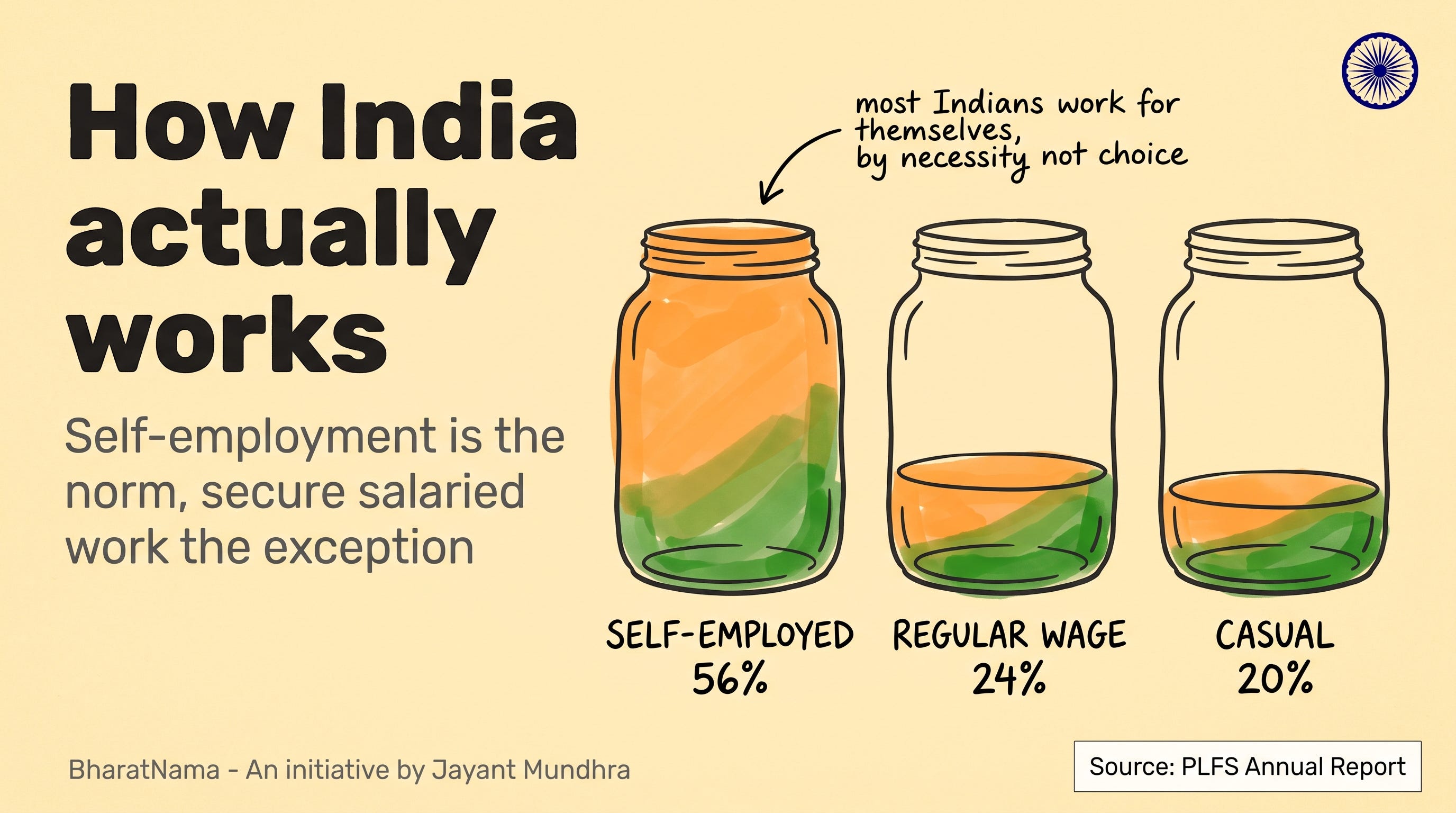
Look at the shape of who works and how, from the latest Periodic Labour Force Survey, the government's official employment survey:
Self-employed: 56.2% of all workers in 2025, the largest slice by far.1
Regular wage or salaried: 23.6%.1
Casual labour: 20.2%.1
Even that "regular" fifth is misleading. Most of them still have no contract and no benefits. Genuine formal, protected jobs are a rounding error, not the norm.
We took the services lift and skipped the factory floor
To see why we are stuck, go back to the baseline. Around 1991, agriculture employed close to 60% of Indians. By 2025 that is down to 43%.1 Vast numbers left the farm. The question is where they went.
The textbook path, the one every East Asian success story followed, runs farm to factory to formal. Surplus farm labour moves into labour-intensive manufacturing, and the factory itself does the formalising: it needs payrolls, contracts, shift rosters, and eventually provident funds and unions.
India did something unusual. It jumped straight from farms to services, largely bypassing the factory phase. Economists call it "premature de-industrialisation", ageing out of manufacturing before ever fully industrialising.
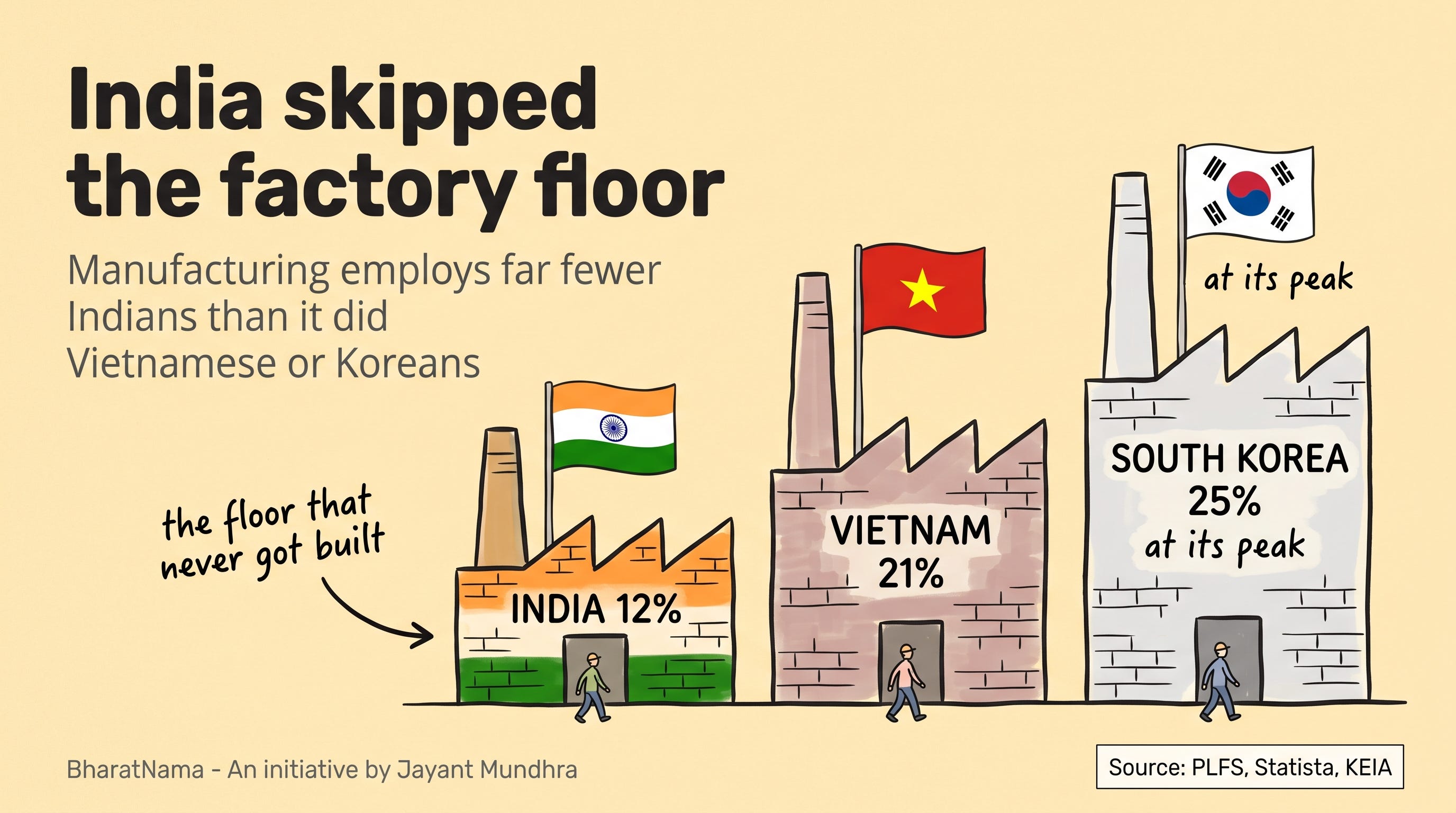
The tell is in one stubborn number. Manufacturing's share of employment has barely moved in a decade, sitting at just 12.1% in 2025.1 It simply never became the sponge that soaked up the people leaving agriculture.
Services grew instead, and grew spectacularly. But modern services, IT, finance, professional work, are capital-heavy and skill-heavy. They cannot absorb the enormous numbers of workers with modest schooling. So the labour leaving farms did not walk into air-conditioned offices. It walked into the low-productivity end of services: petty retail, security, domestic work, construction, and now app-based delivery.
This is the thread I find myself pulling on again and again, and it is exactly the kind of structural puzzle we chew over in the BharatNama WhatsApp community, where I share a smaller India deep-dive like this with thousands of readers every morning (t.ly/h2jq1).
The missing middle, and why firms refuse to grow up
If services could not absorb low-skill labour, why did manufacturing not step up? Because the incentives actively punish scale.
India's factory landscape is barbell-shaped. A vast ocean of tiny firms at one end, a handful of giants at the other, and almost nothing in the middle. Roughly three-quarters of enterprises employ fewer than ten people. These micro-firms run on thin margins and have neither the money nor the reason to put workers on formal payrolls.
Why stay small on purpose? Because growing up is expensive and frightening:
A growing enterprise can face over 1,450 compliance obligations a year, costing around ₹13 lakh annually, with a chunk carrying the risk of jail for procedural slips.3
Formal credit is scarce. Only about 14% of MSMEs can access formal, institutional credit at all.4
The sector's credit gap is roughly ₹25 lakh crore, so the rest borrow from moneylenders at punishing rates or stay stunted.4
Faced with that, thousands of firms make a rational choice: stay below the radar. Stay informal. Which means their workers stay informal too.
When even the formal sector goes informal
Here is where it gets genuinely uncomfortable. Even when the organised sector does grow, it increasingly refuses to create secure jobs. It hires contract workers instead of permanent ones.
The number is striking, and it is current. Contract workers are now 42% of the organised manufacturing workforce, the highest share since 1997-98.5 Go back to 1999-2000 and it was around 20%. It has doubled.5
The usual explanation is that rigid labour laws make it hard to fire permanent staff, so firms hire contract labour to stay flexible. But deeper plant-level work by economists Radhicka Kapoor and P.P. Krishnapriya finds a sharper motive: contract labour is used to dilute the bargaining power of permanent workers and keep overall wages in check.6
Tellingly, contractualisation kept rising even as the wage gap between contract and permanent workers narrowed. If it were only about cheap labour, that should have slowed it. It did not. This is about control, not just cost. The formal sector has learned to reproduce informal conditions inside its own gates.
And you can see the result in pay. The real monthly wage of a regular salaried worker actually fell to about ₹10,925 in 2022, from ₹12,100 in 2012.7 A decade of headline growth, and the typical salaried Indian was earning less in real terms at the end of it.
Where India stands, against the world and against itself
This is the part that matters most to me, because a number for India alone is just a fact. Set beside others, it becomes an insight.
India versus the world, on the metric that drives formalisation, factory jobs:
India: manufacturing employs ~12% of workers.1
Vietnam: closer to a fifth, around 21%, and rising every year.8
South Korea, at its industrial peak, took manufacturing to about 25% of employment while farm work collapsed from 50% to under 20%.9
Same starting point, roughly. Poor, agrarian, labour-rich. Wildly different destinations. Vietnam and Korea pulled their farm workers onto factory floors that formalised them by design. India did not build enough of those floors.
India versus India is just as revealing, and here the disparities and the commonalities both bite:
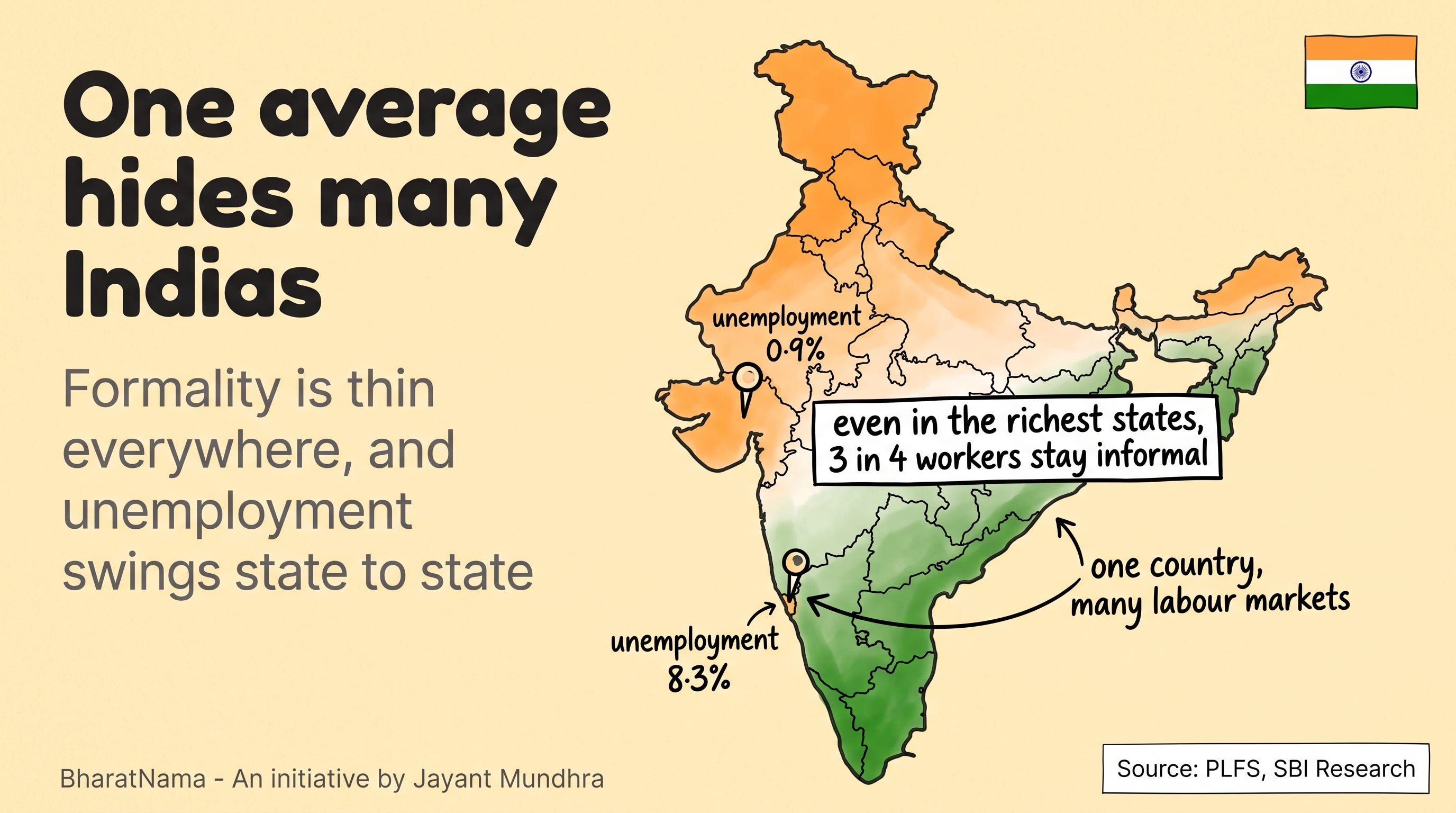
Even in the richest western and southern states, three in four workers still sit outside the formal sector.10 Formality is thin everywhere, not just in poor states.
Unemployment ranges from 0.9% in Gujarat to 8.3% in Goa.1 One national average, many different countries inside it.
Earnings vary most in self-employment across states, far more than in regular salaried work.10 The people with the least protection also face the widest spread in what they take home.
What India can learn from the ones who cracked it
I am wary of lazy "India should just copy X" takes, so let me be specific about what actually transfers and what does not.
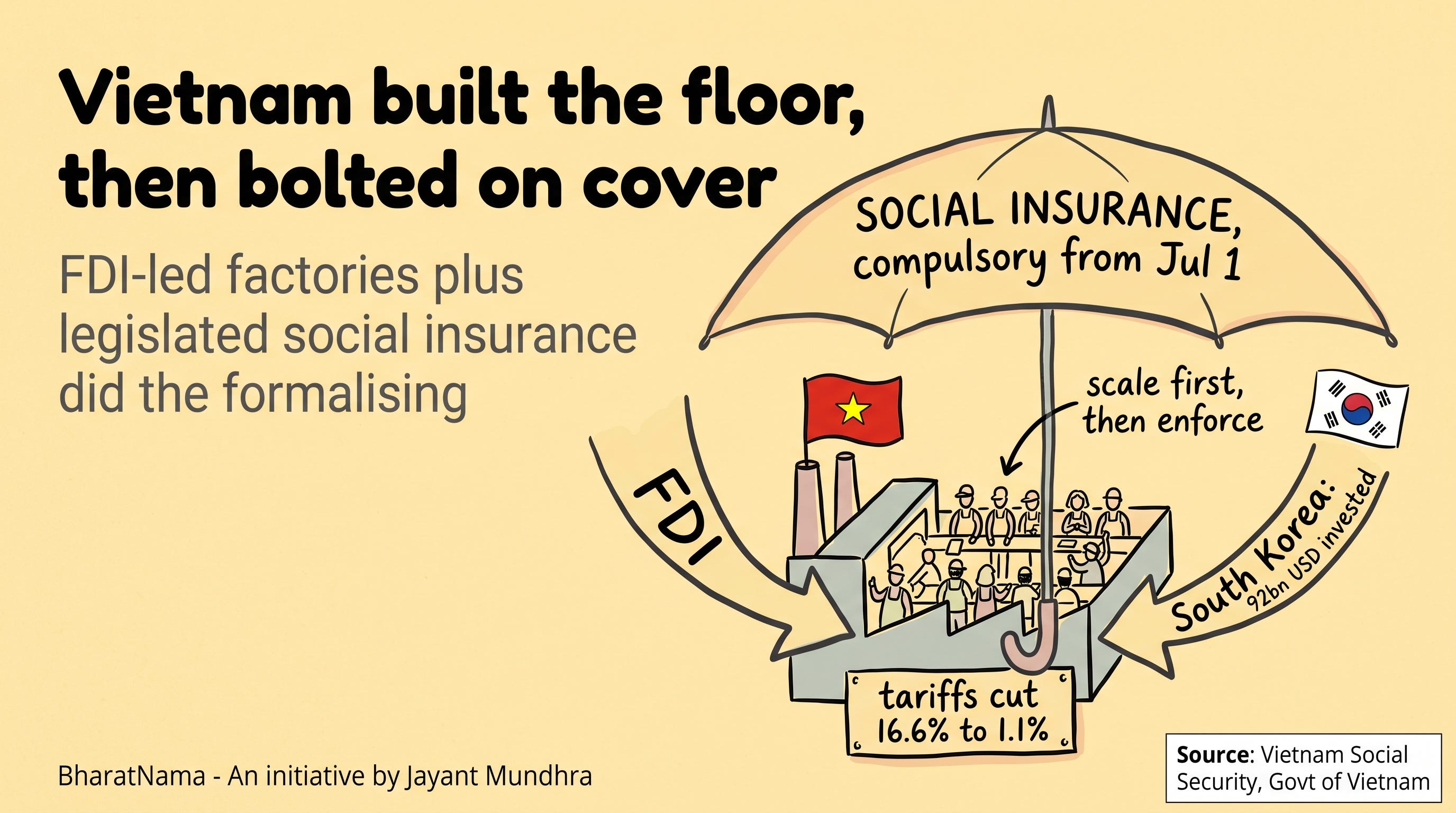
Vietnam is the closest parallel. It was agrarian and poor in the 1980s. Then, from the 1986 Doi Moi reforms, it slashed tariffs on manufactured goods from about 16.6% to 1.1%, threw the doors open to foreign investment, and became a factory to the world. South Korea alone has poured in over $92bn and is now Vietnam's largest foreign investor.8 Those big, compliance-bound multinationals hire on formal contracts by default.
Then Vietnam went further and legislated. Its new Social Insurance Law took effect on 1 July 2025, pulling part-time workers, unsalaried managers, and long-contract foreigners into compulsory social insurance, and reclassifying deliberate non-payment as "evasion" that can trigger criminal proceedings.11
South Korea did it a generation earlier, with the 1973 Heavy and Chemical Industry drive, channelling capital into large industrial groups that scaled fast and formalised as they grew.9
What is portable for India: the sequence of scale first, enforcement second. Build firms big enough to formalise, then legislate to lock it in. India has laid the groundwork with e-Shram, its registry of unorganised workers, now carrying over 30.9 crore registrations, 53.68% of them women.12 Registration is real progress. But a name in a database is not a provident fund. The next step is portable social security that a migrant carries across state lines and between gig apps without losing cover.
What does not transfer neatly: India's federal structure, its tighter fiscal room, and a state that is brilliant at big-bang digital rollouts but patchy at the daily grind of enforcing labour law across a sea of tiny firms. This is exactly the gap between formalising the economy and formalising the worker, and it is the thread I most enjoy arguing out with readers in the BharatNama community every day (t.ly/h2jq1).
What to watch
Whether the four new labour codes are actually implemented, not just notified, and whether they widen social security or simply ease hiring and firing.
Whether e-Shram registrations convert into real, portable benefits, or stay a database.
The manufacturing employment share in the next PLFS. If it does not break clearly above 12%, the structural problem is unchanged.
The contract-labour share in the next Annual Survey of Industries. A move past 42% means the formal sector is informalising further, not less.
The puzzle of India is not that it failed to grow. It is that it grew rich in output while staying poor in the one thing that makes growth felt in a household: a secure job.
And well that is it for today's edition. That said, do check out my core WhatsApp community Biz News+ where I share 4-5 deepdives from the world of business, economics & public economics daily: https://t.ly/h2jq1
And if you want to understand where China stands and what it means for India, do check out my companion newsletter, Decoding the Dragon: https://t.ly/t7uhs
And, do check out my work on the following platforms as well: Instagram, LinkedIn and Youtube
Best,
Jayant
References
Periodic Labour Force Survey (PLFS) Annual Report 2025, PIB / MoSPI: https://www.pib.gov.in/PressReleasePage.aspx?PRID=2246009
Informal sector's share of India's GDP, Data For India: https://www.dataforindia.com/informal-sector-sizing/
MSME compliance burden, TeamLease RegTech 2025: https://www.teamleaseregtech.com/msme-compliance-report/
MSME credit gap and formal credit access, Deloitte via YourStory: https://yourstory.com/2025/05/msme-credit-gap-india-financing-challenges-2025
Contract labour share at 42%, highest since 1997-98 (ASI 2023-24), Business Standard: https://www.business-standard.com/economy/news/on-the-rise-share-of-contract-labour-at-42-highest-in-over-25-years-125090801010_1.html
Explaining the contractualisation of India's workforce, Kapoor & Krishnapriya (ICRIER): https://icrier.org/pdf/Working_Paper_369.pdf
Real wages of salaried workers declined 2012-2022, ILO India Employment Report 2024 via Business Standard: https://www.business-standard.com/economy/news/real-wage-of-salaried-workers-dipped-in-2012-2022-period-ilo-report-124040100999_1.html
Vietnam manufacturing employment and South Korea's $92bn investment: https://en.baochinhphu.vn/south-koreas-investment-in-viet-nam-hits-us92-bln-111250515092839514.htm
South Korea's industrialisation, Korea Economic Institute: https://keia.org/the-peninsula/south-koreas-important-role-in-vietnams-rapid-development/
State-level employment disparities, PLFS 2025 analysis, SBI Research: https://sbi.bank.in/documents/13958/14472/08052026_PLFS_SBI+RESEARCH.pdf
Vietnam's 2024 Social Insurance Law, effective 1 July 2025, Vietnam Social Security: https://vss.gov.vn/
e-Shram registrations over 30.68 crore, 53.68% women, PIB: https://www.pib.gov.in/PressReleasePage.aspx?PRID=2109828
Comments
Nothing yet. Say the first thing.
Sign in to join the conversation.