
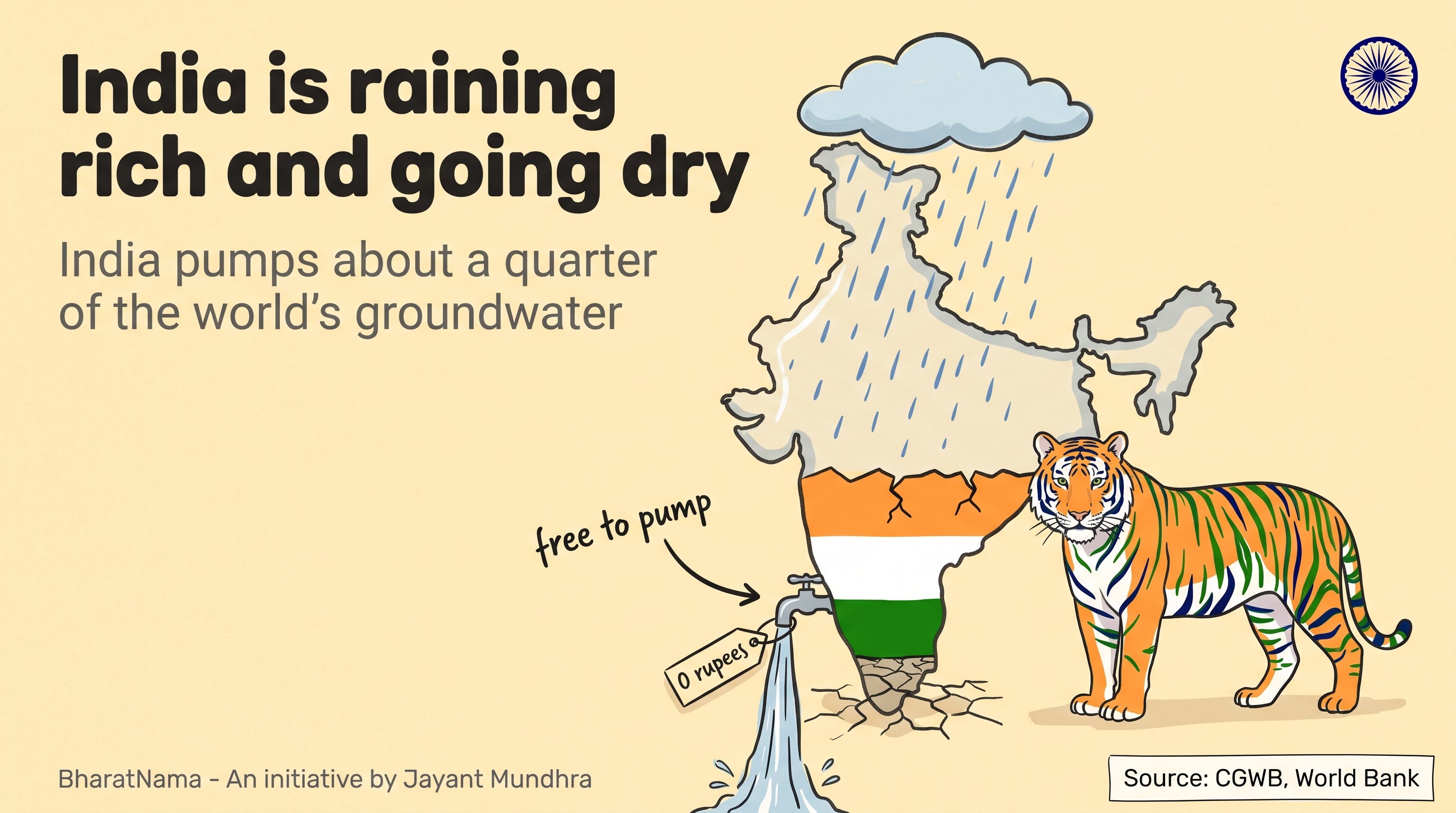
India is the single largest extractor of groundwater on the planet. Not per capita, not adjusted for anything. In absolute terms, India pumps up roughly a quarter of all the groundwater humanity draws in a year, more than the United States and China do combined.1
Now let that sit for a second. A country that receives close to 4,000 billion cubic metres of rainfall a year2, more than enough on paper to water every field and fill every tank, is quietly mining its aquifers dry. The last official Dynamic Ground Water Resource Assessment, released in early 2025, puts annual extraction at ~246bn cubic metres against a recharge of ~447bn.3
The thing is, this is not a story about the monsoon failing us. It is a story about us pricing water at nothing, and then acting surprised when people used it like it was worth nothing.
What the numbers actually say
Start with the metric that matters most: per-capita water availability. It is the standard way the world measures whether a country has enough water to go around, and India's line on that chart only points one way.
1951: ~5,177 cubic metres per person a year. Comfortably water-rich.4
2021: ~1,486 cubic metres. Officially "water-stressed" on the UN scale, which sets the stress line at 1,700.4
2050 (projected by the Jal Shakti Ministry and Central Water Commission): ~1,200 to 1,230 cubic metres, brushing against the 1,000 mark that defines absolute scarcity.5
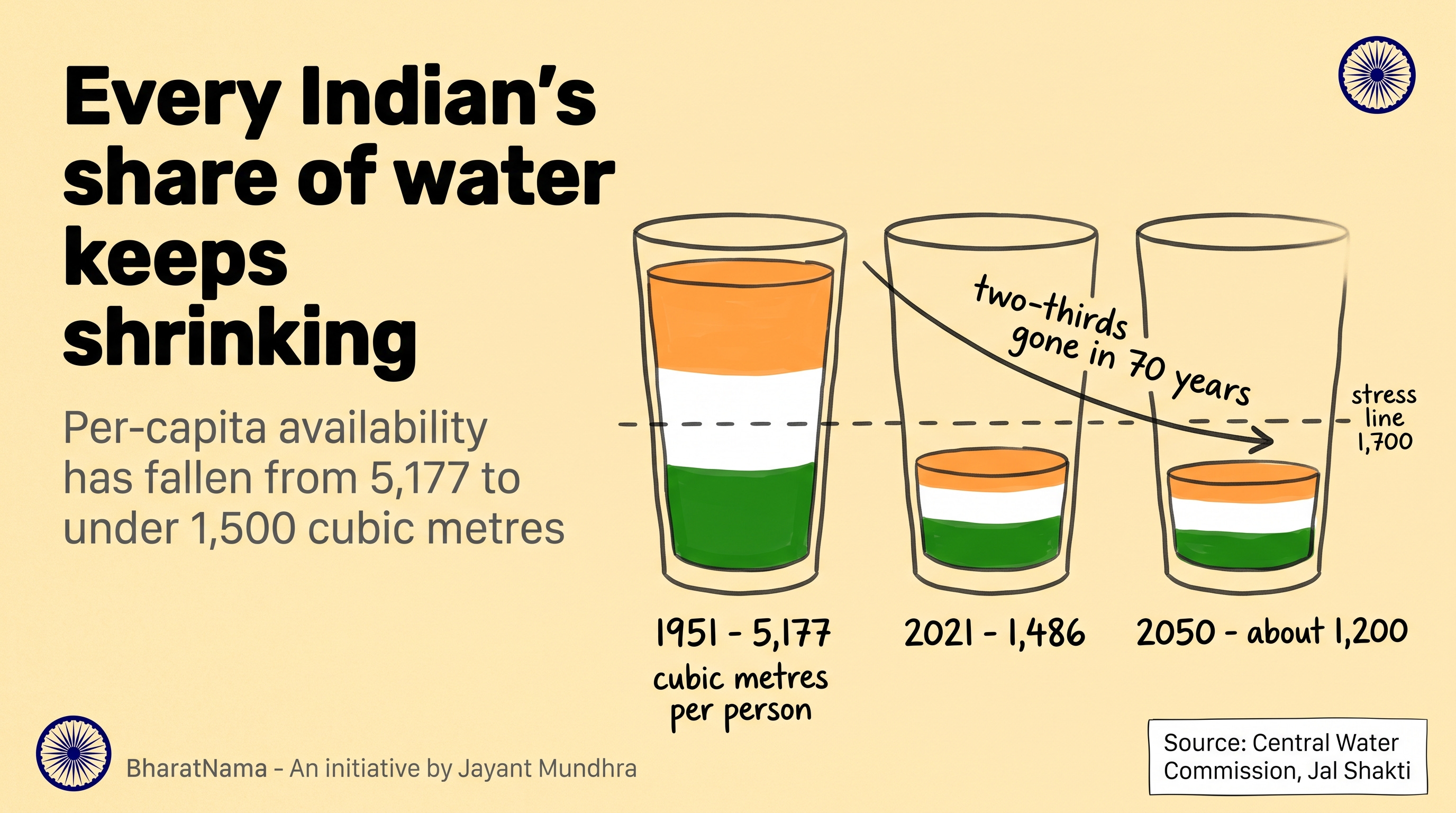
That is a two-thirds collapse in seven decades. Some of it is arithmetic, because the same water is now divided among far more people. But the water we actually consume is being pulled disproportionately from underground, and that is where the real damage hides.
At the national level, India's "stage of extraction" (how much of the replenishable groundwater we draw each year) sits at 60.47%.3 That sounds almost prudent. It is not, because the national average is a lie of composition. Of the 6,746 assessment units the Central Ground Water Board tracks, 751 are already classified "over-exploited", and once you add the critical and semi-critical blocks, more than a quarter of the country is pumping faster than nature refills.3
And these blocks are not random. They cluster exactly where India grows its food: Punjab, Haryana, western Uttar Pradesh, Rajasthan, Gujarat, and pockets of the south.3 Groundwater irrigates around 60% of India's cropped area and supplies about 85% of rural drinking water6, so the aquifer is not a backup. It is the main line.
This is exactly the kind of buried-in-the-average number I keep pulling on, and it is the sort of thread we go back and forth on in the BharatNama WhatsApp group, where I share a smaller India deep-dive like this with thousands of readers every morning (t.ly/h2jq1).
The Green Revolution's hidden invoice
To understand how we got here, follow the incentive, not the rainfall.
Groundwater is invisible. The only real brake on using it is the cost of the energy to lift it. Price that energy at zero, and you have priced the water itself at zero. That is precisely what several states did, and Punjab is the cleanest case study in the country.
In 1997, Punjab moved from metered farm power to free electricity for farmers, first for small holdings, then for everyone, regardless of land size.7
With power free, the marginal cost of one more litre of pumped water fell to nothing. The feedback loop that would normally push a farmer towards drip irrigation or a less thirsty crop simply vanished.
The bill has been staggering. Between January 1997 and March 2024, Punjab spent roughly ₹1.25 lakh crore subsidising farm power.7 For 2024-25 alone, free power to about 14.5 lakh agricultural pumps is budgeted at ~₹10.2k crore, nearly half the state's entire power-subsidy bill.8
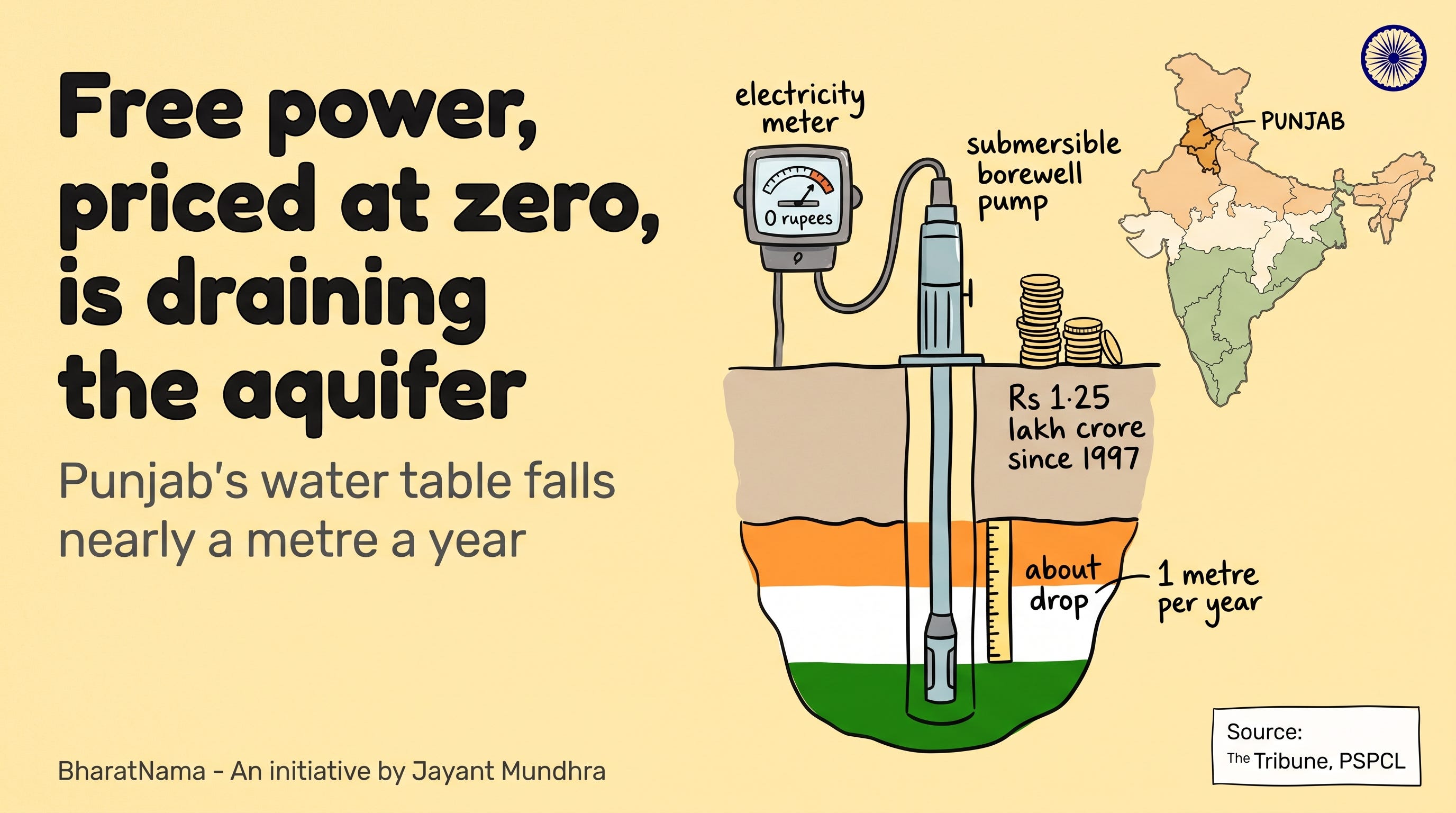
And the water responded exactly as economics predicts. As tables fell, farmers swapped shallow centrifugal pumps for deep submersible ones, chasing the water down. Ludhiana alone now runs more than 1.17 lakh tube wells, and the districts with the most pumps show the steepest table decline.9 In central Punjab, the water table now drops by close to a metre every single year.9 The state extracts far more than it recharges, which means it is no longer using renewable water at all. It is mining fossil water that took centuries to accumulate.
Here is the part that should genuinely unsettle you. Growing one kilogram of Punjab rice takes an estimated 3,500 to 4,000 litres of water.10 India then ships that rice across the country and abroad. In effect, one of the most water-stressed corners of the country is exporting its vanishing groundwater, embedded invisibly in every grain. The farmer is not being reckless. He is behaving perfectly rationally inside a system that pays him to pump.
Where India stands, against the world and against itself
This is where benchmarking makes the picture honest, because a number for India alone tells you nothing about whether it is good or bad.
India against the world, on annual groundwater extraction:
India: ~246bn cubic metres a year, roughly a quarter of the global total.1 3
China: an estimated ~100 to 150bn, and increasingly rationed through central quotas and its South-to-North transfer megaproject.1
United States: over ~100bn, but wrapped in metering, tradable water rights, and state laws like California's groundwater act.1
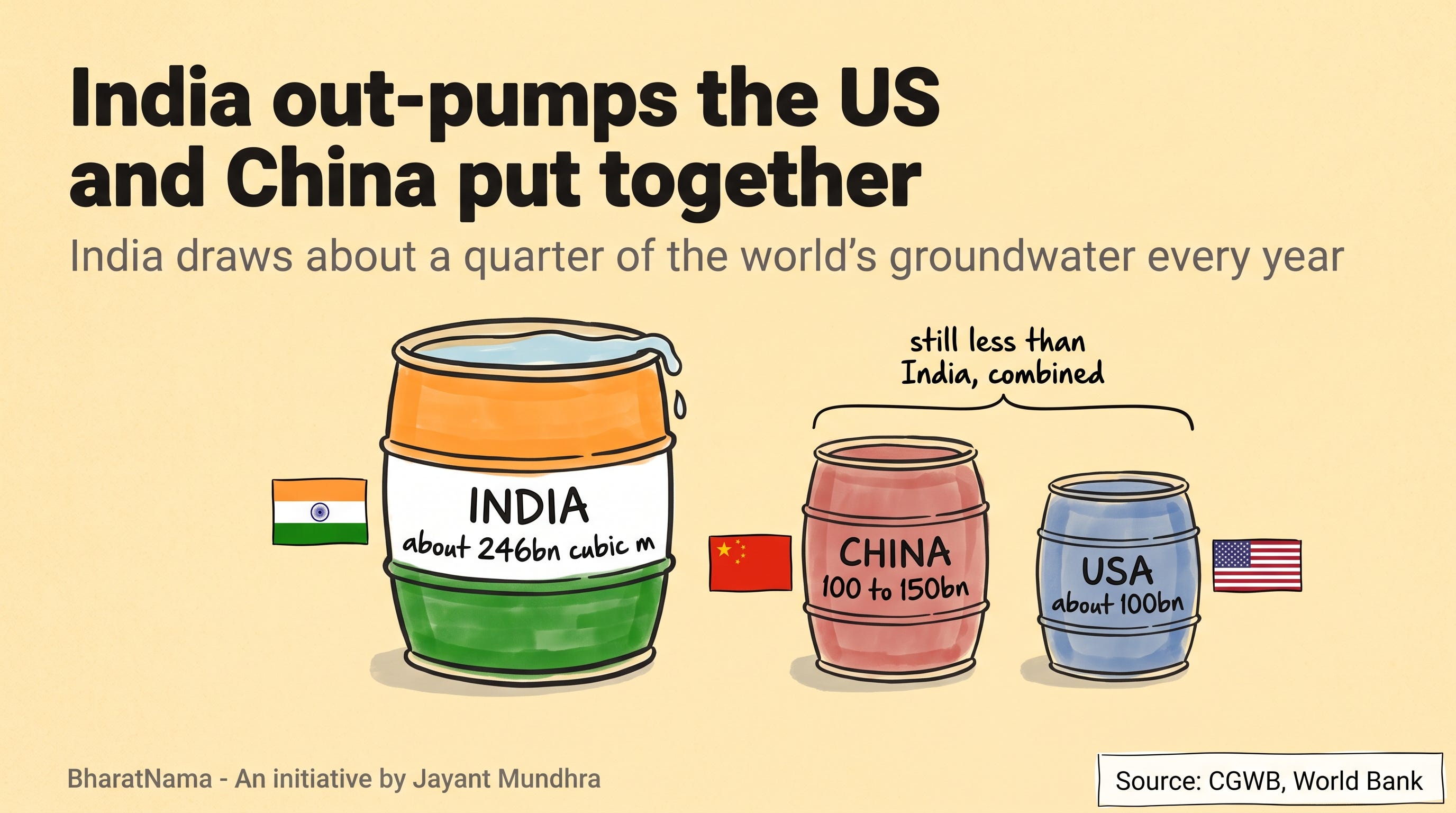
So India out-pumps both giants combined, but with almost none of their regulatory scaffolding. Their extraction is largely industrial-scale and monitored. Ours runs through more than 20 million individual borewells, each one a private straw, almost none of them metered.1
India against itself is where it gets sharper still:
Punjab draws far more groundwater than it recharges, the extreme end of the distribution.9
At the other end, large parts of the east and northeast sit in the "safe" category, some barely tapping their aquifers.3
Nationally, agriculture accounts for 80 to 90% of groundwater use, while industry is still only about 8%, though NITI Aayog expects industrial demand to roughly triple by 2050.6
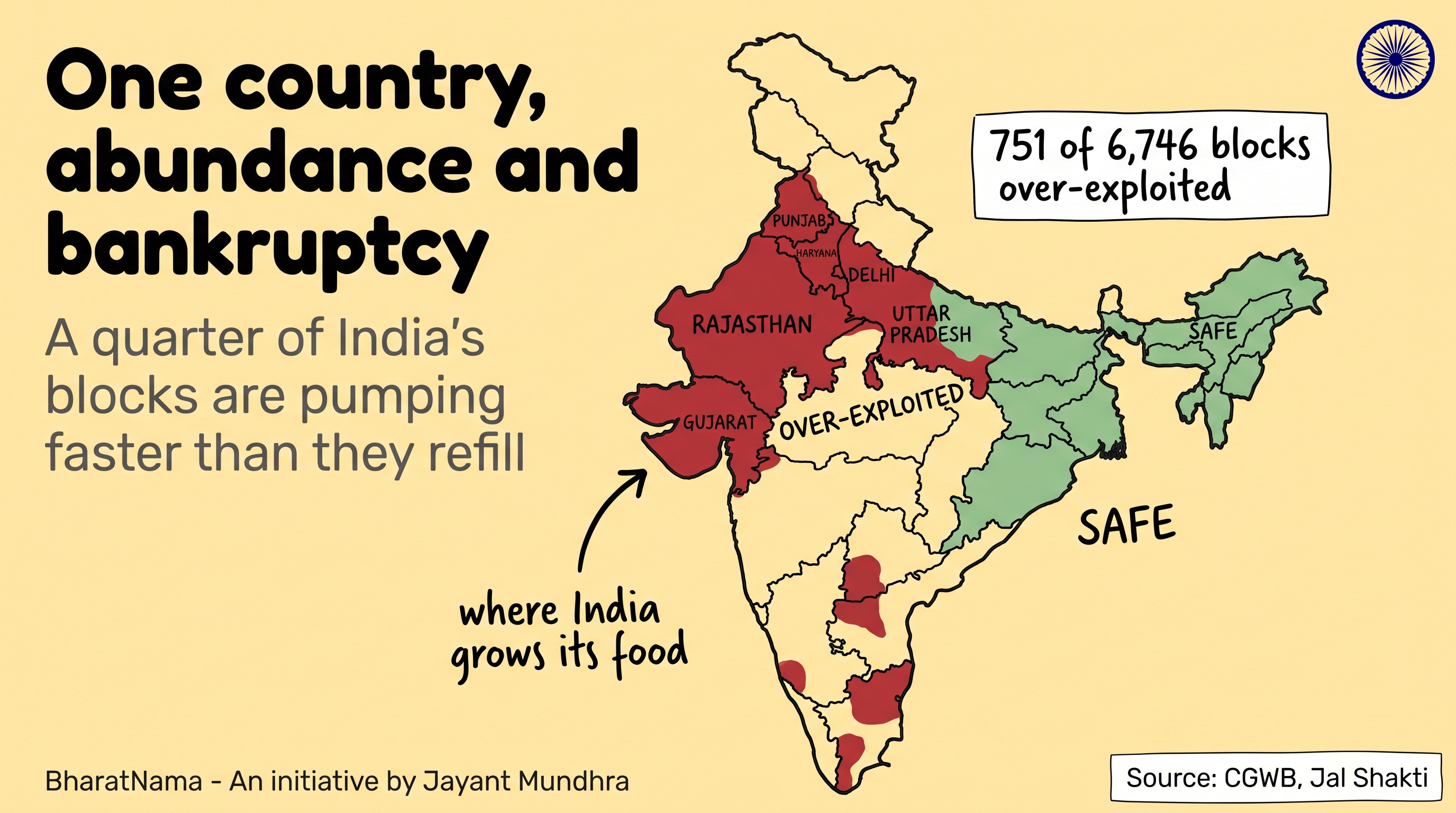
The tragedy is that the same country holds both water abundance and water bankruptcy, often a few hundred kilometres apart, and has almost no mechanism to move water, or water-pricing discipline, from one to the other.
The lesson from a desert that never runs dry
If you want proof that aridity is a choice, not a sentence, look at Israel. It sits in a genuine desert with a fraction of India's rainfall, and yet it runs a water surplus and even exports water. It did not do this with a single clever technology. It did it with governance.
It nationalised water in law. Israel's 1959 Water Law made all water public property. Owning land gives you no automatic right to the water beneath it, so every drop is allocated and metered by the state.
It runs one regulator, not thirty. A single national Water Authority controls abstraction, distribution, agriculture, and sewage together, instead of India's tangle of competing state boards and ministries.
It prices for full cost recovery. Tariffs are set to cover the entire system, including expensive desalination and treatment, with essentially no distorting subsidy, and rise steeply once a household crosses a basic threshold.
It recycles almost everything. Israel reuses close to 90% of its municipal wastewater, around four times more than any other country on earth.11 The Shafdan plant near Tel Aviv alone treats ~97mn gallons a day and pipes the reclaimed water south to irrigate the Negev.12
What actually transfers to India? Not the desalination plants, and not the top-down control, given India's federal structure and scale. But three things absolutely do: metering every pump, charging something above zero for the marginal unit, and building a serious treat-and-reuse economy for urban wastewater, which India today mostly dumps into its rivers.
The honest catch is political. India has tried the gentle version and watched it fail. Punjab's "Pani Bachao Paise Kamao" scheme paid farmers cash for the power they saved if they agreed to a meter, a genuinely clever design, and enrolment stalled at around 6% because farmers feared metering was a trojan horse for ending free power altogether.13 Haryana's crop-diversification scheme saved real water but keeps bumping against the fact that the minimum support price still makes paddy the safe bet.13 Voluntary conservation cannot out-compete a zero-cost entitlement. That is the whole lesson, and it is where the community keeps landing too, because this is ultimately a pricing problem dressed up as an environmental one (t.ly/h2jq1).
The bill nobody has booked yet
The cost of "free" water is not zero. It is deferred, and it is compounding.
Quality collapses as tables fall. As pumping pulls water from deeper, older rock, geogenic toxins come with it. The CGWB's 2024 assessment found nearly a fifth of monitored samples breaching safe limits for contaminants like uranium, arsenic, and fluoride.14
The land itself is sinking. Over-extraction compresses aquifers and causes measurable land subsidence across the Indo-Gangetic plain, damaging buildings and worsening flood risk.
Drinking water is the frontline. The same NITI Aayog work warned that about 40% of Indians could have no access to drinking water by 2030, and that unsafe water already contributes to roughly 200,000 deaths a year.15
The macro number is real. NITI Aayog has warned that unmanaged water stress could shave up to 6% off India's GDP by 2050, with around 600mn Indians already facing high-to-extreme water stress.15
What to watch
Whether any large agricultural state moves from flat-rate free power to metered pumps with a Direct Benefit Transfer, which is the single reform that would restore a price signal without cutting farm incomes.
Whether the Centre expands guaranteed procurement for millets, maize, and pulses in depleted zones, so diversification stops being a financial gamble.
Whether the next Dynamic Groundwater Assessment shows the over-exploited block count rising past 751, or finally plateauing.
Whether any Indian metro commits to Israel-style dual piping and tertiary wastewater reuse at real scale, rather than as a pilot.
India's water crisis is not written in the clouds. It is written in a tariff sheet. We decided to treat a finite, sovereign asset as an infinite, worthless one, and the aquifer is simply sending us the invoice, with interest.
And well that is it for today's edition. That said, do check out my core WhatsApp community Biz News+ where I share 4-5 deepdives from the world of business, economics & public economics daily: https://t.ly/h2jq1
And if you want to understand where China stands and what it means for India, do check out my companion newsletter, Decoding the Dragon: https://t.ly/t7uhs
And, do check out my work on the following platforms as well: Instagram, LinkedIn and Youtube
Best,
Jayant
References
The Week / World Bank IEG, India uses more groundwater than US and China combined: link
PMF IAS, Water Crisis in India (annual precipitation ~4,000 BCM): link
PIB / Ministry of Jal Shakti, Findings of the Dynamic Ground Water Resources Assessment 2024: link
GS Times / CWC, Per capita water availability 1,486 cubic metres by 2021: link
ThePrint, India to be in water stress; per-capita 2050 projection: link
World Bank IEG, Lessons from India, the world's largest user of groundwater: link
The Tribune, Punjab spent ₹1.25 lakh crore on free farm power since rollout: link
The Tribune, Why power subsidy drains groundwater reserves in Punjab: link
Morsel Research, Water Crisis in India: the world's largest groundwater user: link
Drishti IAS, India's Water Scarcity (water footprint of paddy): link
Fluence, Israel leads the world in water recycling (~90% reuse): link
Mekorot, Shafdan Wastewater Treatment Plant: link
Drishti IAS, Addressing India's Water Crisis (PBPK, MPMV schemes): link
Mongabay India, Government report highlights groundwater contamination across India: link
India.com / NITI Aayog, Water management report warns of 6% GDP loss: link
Comments
Nothing yet. Say the first thing.
Sign in to join the conversation.