
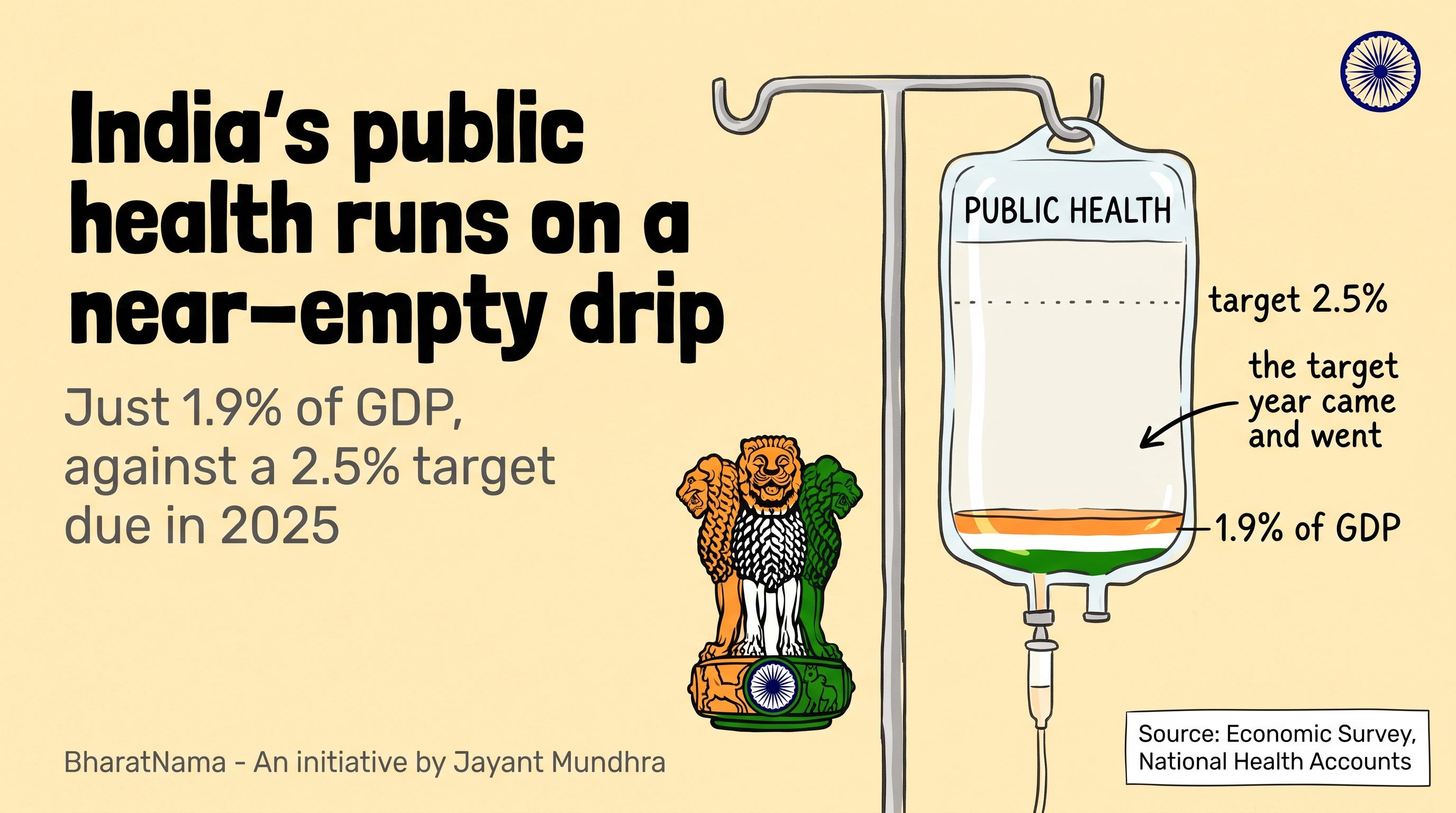
I want to start with a date that quietly passed us by. In 2017, the National Health Policy set India a single, structurally sensible target: raise government health spending to 2.5% of GDP by 2025.1 That year has come and gone. We are now in the second half of 2026, and government health expenditure is still stuck at roughly 1.9% of GDP.2
Here is the thing that unsettles me. We usually read a missed target as a bureaucratic footnote. This one is not a footnote. When a country underfunds public health, the demand for healthcare does not disappear. It just gets pushed onto the household. That 0.6 percentage point of GDP India never spent is not saved money. It is a bill that millions of families pay themselves, often at the worst possible moment of their lives.
The official story is one of progress, and parts of it are genuinely true.
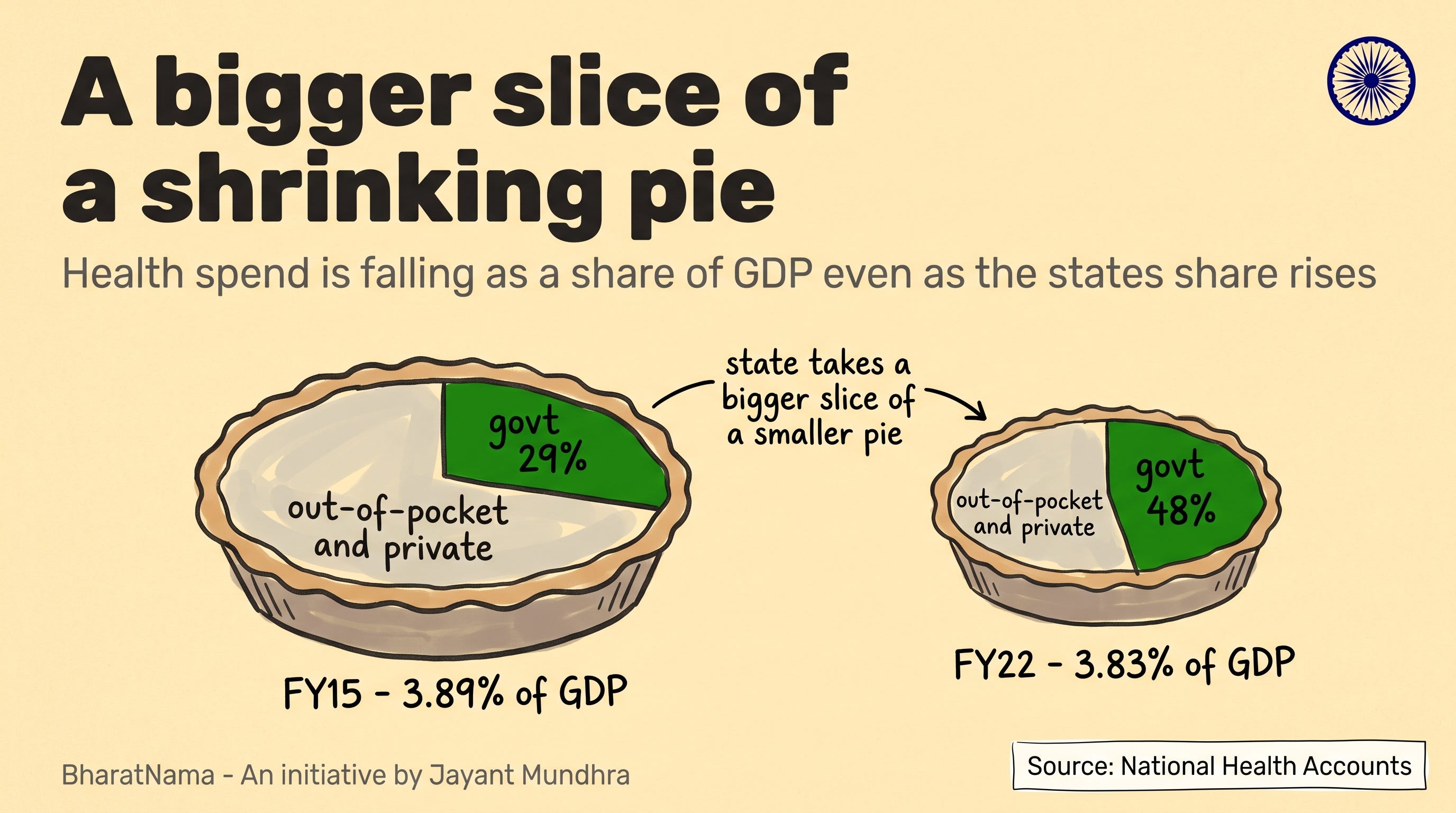
Government's share of total health spending has jumped from 29% in FY15 to 48% in FY22.3
Out-of-pocket expenditure, or OOPE, the money families pay directly from their own pockets, has fallen from 62.6% of total health spending in FY15 to 39.4% in FY22.3
Per capita total health expenditure has risen to about ₹6,600.3
So far, so encouraging. But now look at the same picture from a different angle, and a paradox appears.
Total health expenditure, government plus private, was 3.89% of GDP in FY15. By FY22 it had slipped to 3.83%.3
In other words, the state is taking a bigger slice, but the whole pie is shrinking relative to how fast India's economy is growing.
That is the quiet failure. India's economy expanded at around 6.4% in FY25, right on its decadal trend.4 Health spending has not kept pace with that. We are getting richer faster than we are getting healthier. And 1.9% of GDP is not a rounding error against the global norm; it is roughly a third of what a functioning universal health system tends to cost.
To understand why the number stays stuck, you have to follow the money, and it is a genuinely strange journey.
Under the Constitution, public health sits in Entry 6 of the State List.5 So the states are legally responsible for building and running hospitals and clinics. But the states do not control the big, elastic taxes; the Centre does. You end up with a split brain: the level of government with the constitutional duty to deliver health has the least money, and the level with the money has no direct duty to deliver.
The 15th Finance Commission tried to force the issue. It recommended that every state push health spending to at least 8% of its own budget by 2022, with two-thirds of that going to primary care, and it set aside over ₹1 lakh crore in health grants for 2021-26.6 It was one of the most serious attempts yet to expand the fiscal space for health.
The compliance has been dismal. Barely a handful of states get anywhere near the 8% mark; most, including Rajasthan at around 7.5% and Delhi nearer 6%, still fall short years after the deadline.7 8 This is exactly the kind of state-versus-state spread I keep pulling apart, and it is the sort of thread we chew on every morning in the BharatNama WhatsApp community, where I share a smaller India deep-dive like this one with thousands of readers (t.ly/h2jq1).
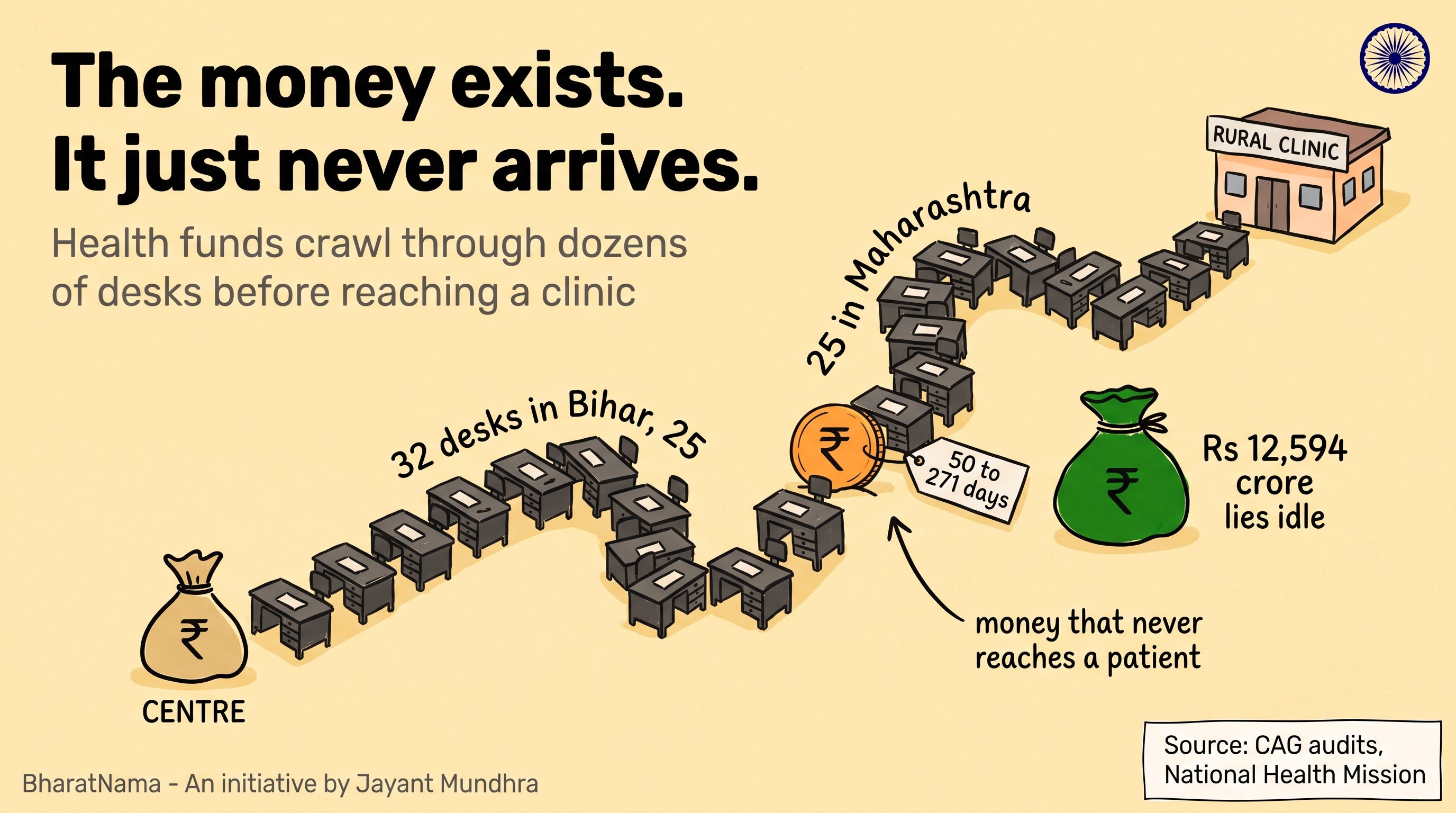
Even when the money is appropriated, it moves like treacle. The National Health Mission, which eats over a third of the health ministry's budget, routes funds from the Centre through state treasuries to state health societies before they reach a rural clinic.9 CAG audits have documented this journey passing through dozens of bureaucratic desks, 32 in Bihar and 25 in Maharashtra, with transfers taking anywhere from 50 to 271 days.9
The result is money that exists on paper but never reaches a patient.
States have routinely spent only 50 to 80% of their NHM allocations.9
In FY19 alone, an estimated ₹12,594 crore lay idle as unspent NHM balances.9
Funds are locked into rigid, disease-specific "flexipools" that state health departments cannot reallocate to their own local realities.9
So even the meagre 1.9% gets diluted by friction long before it becomes a doctor, a diagnostic test, or a strip of tablets.
When the state vacates primary care, the vacuum does not stay empty. Missing doctors, empty medicine shelves, and broken diagnostics push people into the private, fee-for-service market, and the bill lands on the household.
At around 40% of total health spending, India's OOPE is still one of the highest in the world.3 And here is the detail that most people miss: the damage is not driven by dramatic surgeries. It is driven by everyday medicines.
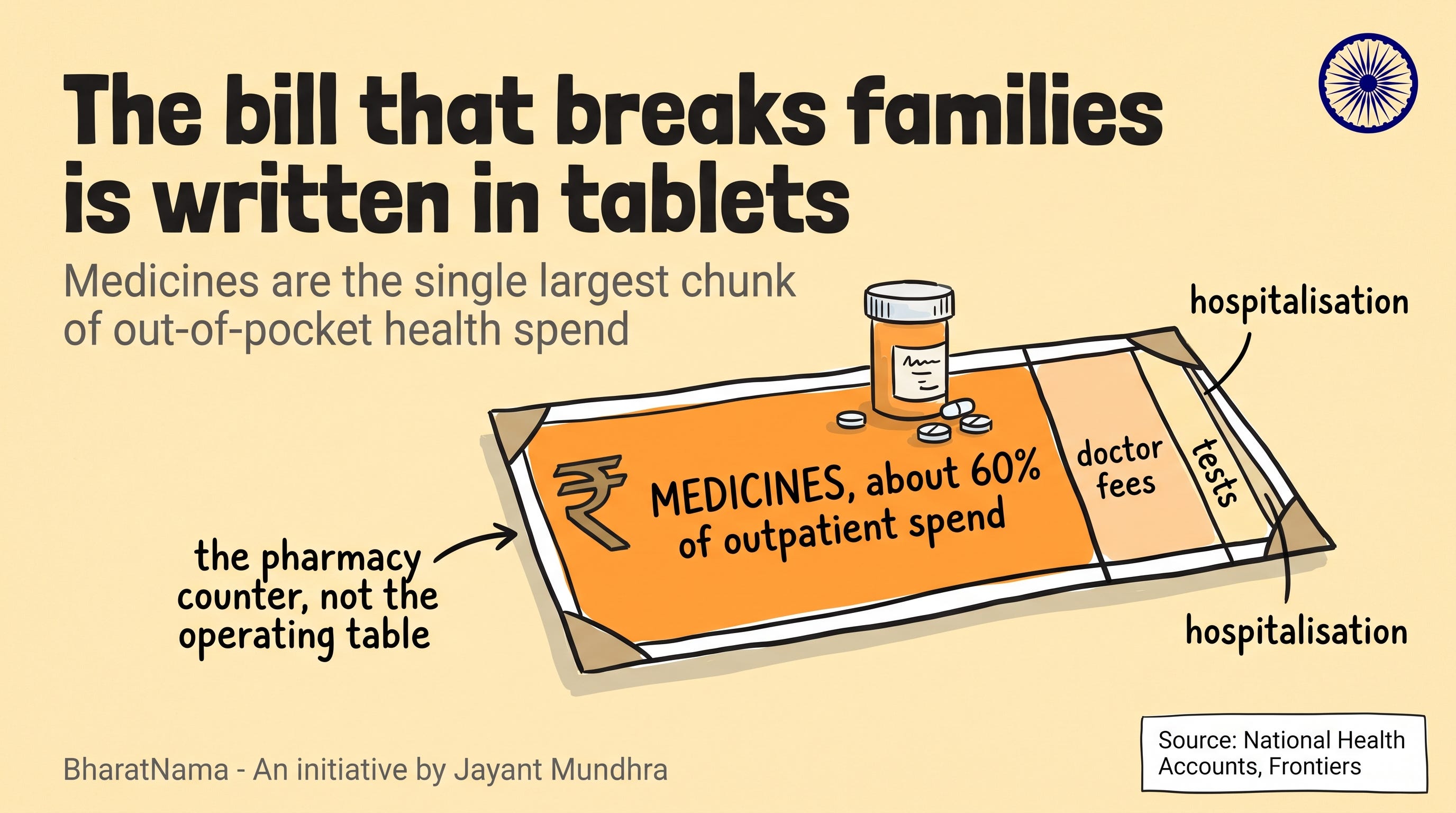
Medicines are the single largest component of household health spending, historically over half of it.10
Medicines make up roughly 60% of out-of-pocket spending on outpatient care.11
Spending on pharmacies alone came to about ₹1.6 lakh crore, or 21.2% of current health expenditure, in FY23.12
This is why insurance that only covers hospitalisation misses the real vector of ruin. The daily, grinding cost of a diabetes or hypertension prescription, bought at a private chemist because the public clinic has run out, is what quietly bleeds a family dry.
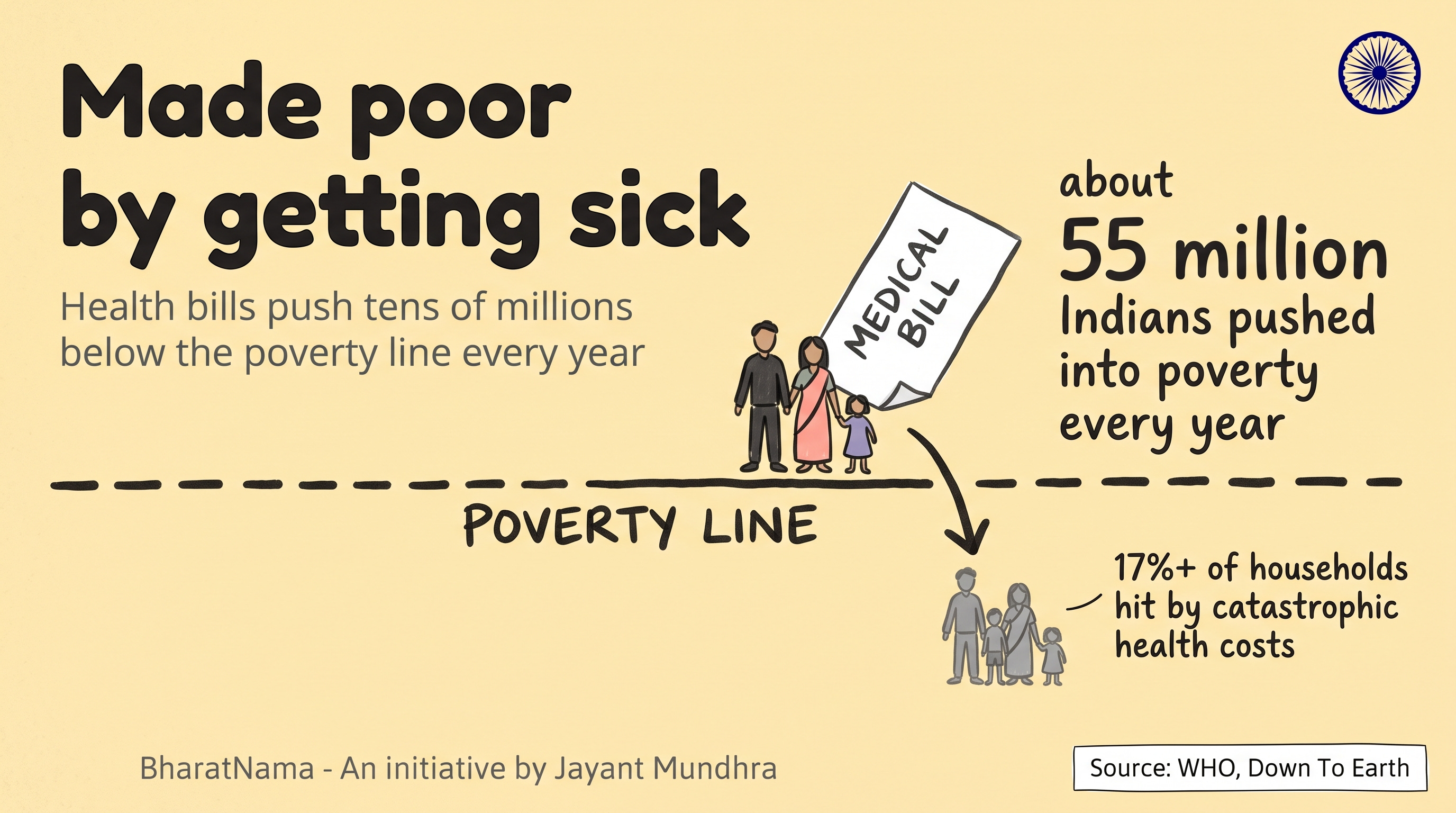
And it does push families under. High OOPE is estimated to impoverish roughly 55 million Indians a year, with more than 17% of households hit by catastrophic health spending.13 Academic work using national survey data finds that the act of paying a medical bill can, on its own, lift the measured poverty rate of a population by two to three percentage points.14 That is not people who were already poor. That is people made poor by getting sick.
India's answer has been Ayushman Bharat, and it has two pillars pulling in different directions.
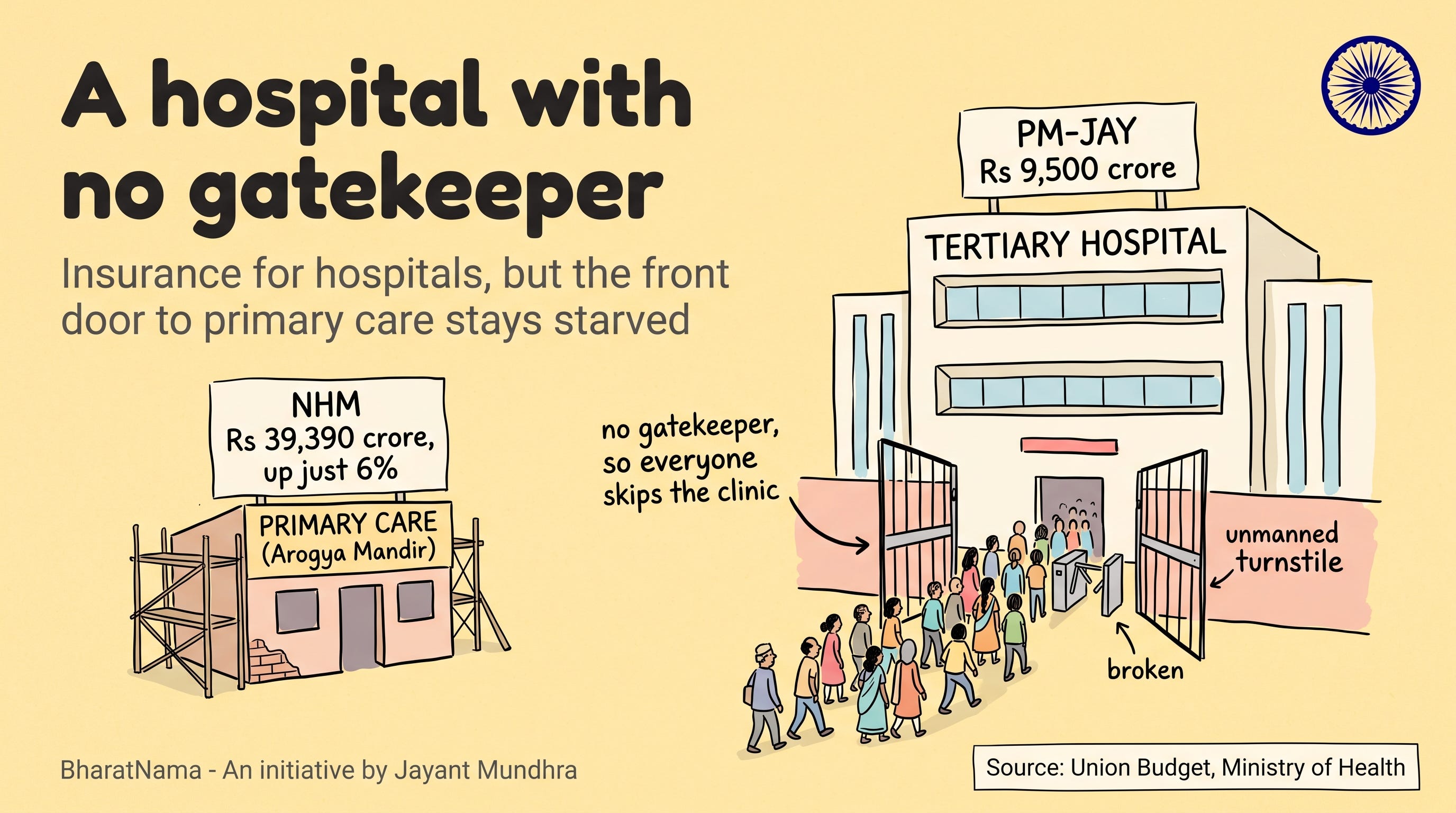
The insurance pillar, PM-JAY, got ₹9,500 crore in the 2026-27 Budget and keeps expanding its cover, now including gig workers and everyone above 70.15 Protecting families from a catastrophic hospital bill is a genuinely good thing.
But PM-JAY has a structural flaw: there is almost no gatekeeping. A patient with a manageable chronic condition can walk straight into an empanelled private tertiary hospital, bypassing primary care entirely. Global experience is blunt about what happens next: expanding tertiary insurance on top of a weak primary base inflates costs relentlessly, because the system rewards over-medicalising routine problems.
Meanwhile the primary-care pillar, the Ayushman Arogya Mandirs, is doing the harder, less glamorous work of rebuilding the base. And on the numbers, it is scaling fast.
Over 1,81,873 Arogya Mandirs had been operationalised as of end-November 2025.16
Surveys of upgraded centres find most now have a community health officer, and the large majority stock blood-pressure machines, glucometers, and at least two essential hypertension and diabetes drugs.16
The problem is the money behind the promise. These centres run on the NHM, and the NHM got ₹39,390 crore in 2026-27, a rise of just 6.17% over the previous year, barely ahead of inflation.15 You cannot build a cost-saving gatekeeper if you keep the gatekeeper structurally starved.
Here is where benchmarking gets useful, because a country poorer than India when it started has already solved this.
Thailand launched its Universal Coverage Scheme in 2001, and the outcomes are the envy of the developing world.
Out-of-pocket spending fell from 34% of health spending in 2001 to about 8.7% by 2019.17
The government now funds roughly 70% of all health spending.17
Medical impoverishment had fallen to around 0.3% of households by 2015.18
And it did all this while keeping total health spending at an efficient 3.8 to 4.5% of GDP.17
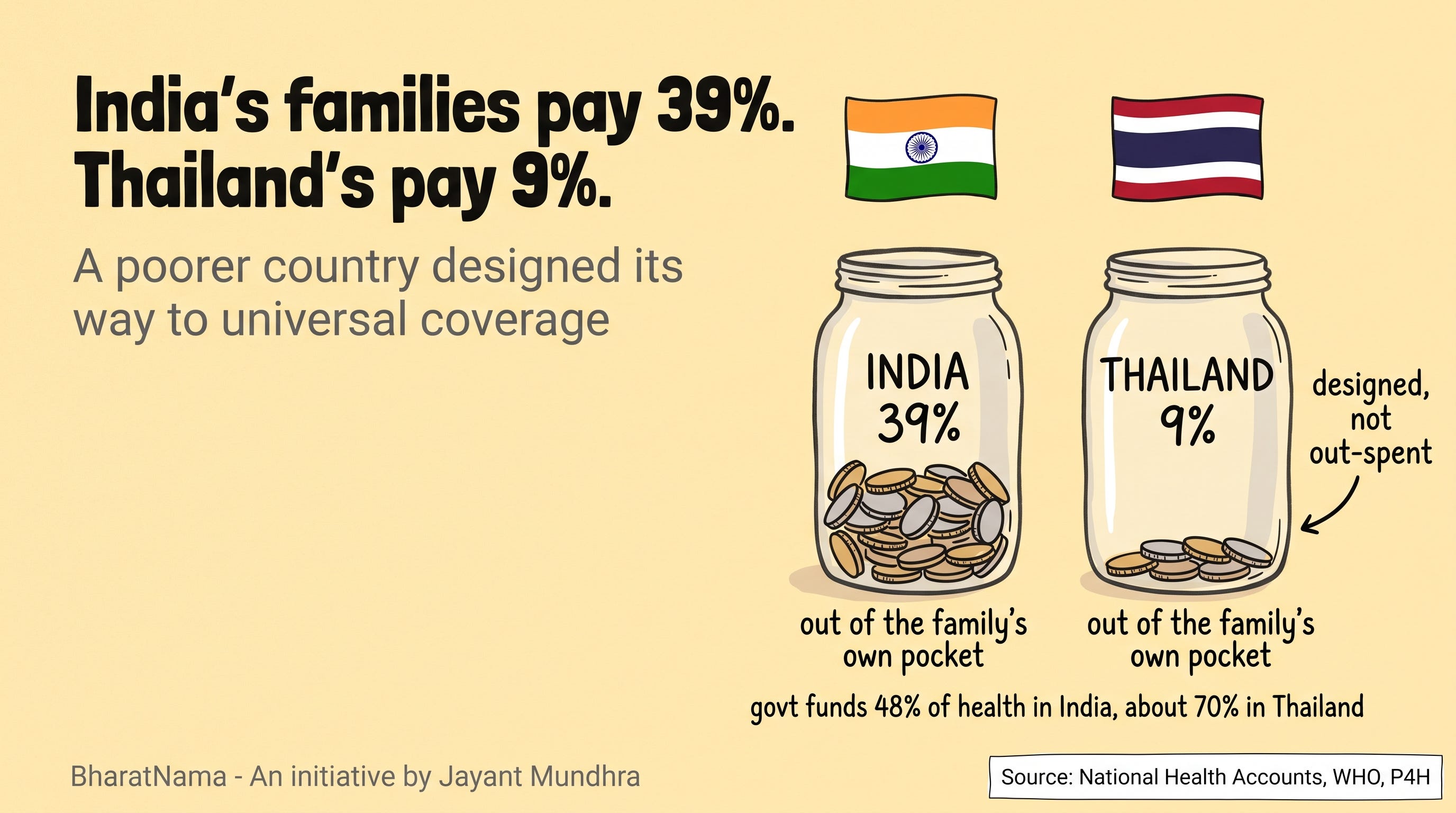
Thailand did not out-spend India into universal coverage. It out-designed it, on two pillars India lacks.
First, ruthless gatekeeping. A patient must go to their registered primary provider first. Skip it and turn up at a tertiary hospital without a referral, and the scheme pays nothing; you foot the entire bill yourself.17 That single rule keeps the expensive infrastructure for the cases that truly need it.
Second, strategic purchasing. Thailand's health agency does not passively pay whatever bill a hospital submits. It pays primary networks a fixed sum per registered person per year, so doctors profit by keeping people well, not by over-prescribing.17 Hospitals are paid flat rates by diagnosis, under a national budget cap. India's PM-JAY, by contrast, still leans toward passively reimbursing tertiary bills, the exact model Thailand proved is four times more expensive per head.17
The lesson is not "copy Thailand". India's scale and federal structure make that naive. The portable part is the sequence: fund and empower primary care first, make it the compulsory front door, and buy health strategically instead of paying invoices.
Whether the 2027-28 Budget finally moves the NHM allocation meaningfully above inflation, or keeps primary care on a starvation diet.
Whether PM-JAY introduces any referral or gatekeeping link to the Arogya Mandirs, the single most important design fix available.
Whether any large state actually clears the 8% health-budget mark and holds it, rather than drifting back down.
Whether the government acts on the 15th Finance Commission's High-Level Group recommendation to shift health to the Concurrent List, which would let the Centre build a genuinely national health system.5
This is the kind of structural thread the BharatNama community exists for, and if benchmarking India honestly against the world and against itself is your thing, come pull these apart with me (t.ly/h2jq1).
India's growth story is real. But a country cannot call itself a rising power while its citizens are still made poor by a strip of tablets. The blueprint for fixing this is written, tested, and sitting next door. What is missing is the will to spend on the front door instead of the emergency room.
And well that is it for today's edition. That said, do check out my core WhatsApp community Biz News+ where I share 4-5 deepdives from the world of business, economics & public economics daily: https://t.ly/h2jq1
And if you want to understand where China stands and what it means for India, do check out my companion newsletter, Decoding the Dragon: https://t.ly/t7uhs
And, do check out my work on the following platforms as well: Instagram, LinkedIn and Youtube
Best,
Jayant
1. National Health Policy 2017, target of 2.5% of GDP: downtoearth.org.in
2. Business Standard, Budget 2026, India's health spending under 2% of GDP: business-standard.com
3. PIB, Economic Survey 2024-25 and National Health Accounts 2021-22: pib.gov.in
4. Economic Survey 2024-25, real GDP growth ~6.4% in FY25: downtoearth.org.in
5. PRS, Report of the 15th Finance Commission 2021-26 (Concurrent List recommendation): prsindia.org
6. PRS, 15th Finance Commission health grants and the 8% target: prsindia.org
7. BusinessToday, states' healthcare budgets fall short of 8% target: businesstoday.in
8. PRS, Demand for Grants 2025-26 Analysis, Health and Family Welfare: prsindia.org
9. NHSRC, National Health Accounts 2021-22, and CAG audit findings on NHM fund flow: nhsrcindia.org
10. Frontiers, Understanding out-of-pocket expenditure in India (systematic review): frontiersin.org
11. Frontiers, medicines as ~60% of outpatient OOPE: frontiersin.org
12. Medical Dialogues, India spent over ₹1.6 lakh crore on medicines (NHA): medicaldialogues.in
13. Down To Earth, high OOPE impoverishing ~55mn Indians annually (WHO): downtoearth.org.in
14. OUP Health Policy and Planning, economic impact of out-of-pocket health expenditures in India: academic.oup.com
15. PIB, Union Budget 2026-27, Ministry of Health and Family Welfare allocations: pib.gov.in
16. PIB, Update on Ayushman Arogya Mandir: pib.gov.in
17. PMC, Political economy of Thailand's tax-financed universal coverage scheme: ncbi.nlm.nih.gov
18. P4H Network, Thailand health financing profile: p4h.world
Comments
Nothing yet. Say the first thing.
Sign in to join the conversation.