
One of the first questions every new reader of the Bhagavad Gita asks is:
Who are Krishna and Arjuna?
Are they historical figures? Are they symbolic characters? Or are they something more? The answer is both simple and profound.
According to the Bhagavad Gita and the Mahabharata, Krishna and Arjuna were real historical personalities. Yet their conversation transcends history. Their dialogue represents the eternal relationship between divine wisdom and the human seeker.
The more we understand who Krishna and Arjuna are, the more we realize that the Gita is not merely a conversation between two individuals—it is a conversation meant for each one of us.
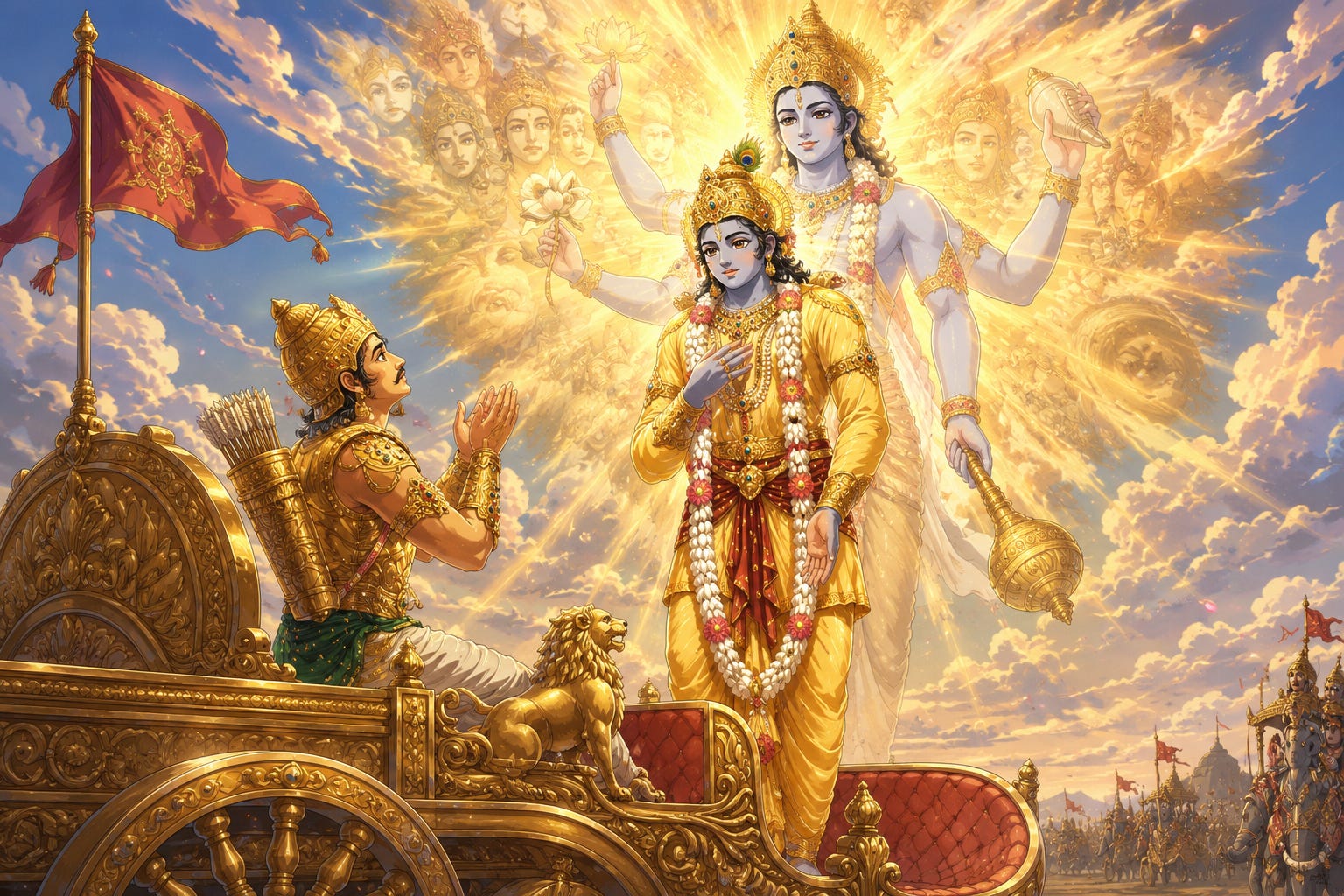
Krishna is the central teacher of the Bhagavad Gita.
Within the Mahabharata, He appears as Arjuna’s friend, cousin, guide, diplomat, and charioteer. Yet as the dialogue unfolds, Krishna gradually reveals His true identity.
He is not merely a wise prince. He is the Supreme Lord who has descended to guide humanity.
Krishna declares:
“Although I am unborn and My transcendental body never deteriorates, and although I am the Lord of all living beings, I still appear in every age by My own internal energy.”
— Bhagavad Gita 4.6
Later, He explains the purpose of His appearance:
“Whenever there is a decline in righteousness and an increase in unrighteousness, O Arjuna, at that time I manifest Myself.
To protect the righteous, to destroy the wicked, and to re-establish dharma, I appear age after age.”
— Bhagavad Gita 4.7–8
These verses reveal Krishna not simply as a philosopher but as the Divine Teacher who restores balance whenever humanity loses its way.
One of the most beautiful aspects of the Bhagavad Gita is Krishna’s humility.
Although He is the Supreme Lord, He chooses not to rule from a throne.
Instead, He becomes Arjuna’s charioteer.
In ancient India, the charioteer guided the warrior through the battlefield. Symbolically, Krishna guides Arjuna through the battlefield of life.
Divine wisdom does not force us. It guides us.
Krishna does not command Arjuna blindly. He teaches, explains, answers questions, and ultimately allows Arjuna to choose for himself.
At the conclusion of the Gita, Krishna says:
“Thus I have explained to you knowledge more confidential than all secrets. Deliberate on this fully, and then do as you wish.”
— Bhagavad Gita 18.63
True spiritual guidance respects human free will.
Arjuna is one of the five Pandava brothers and one of the greatest warriors of his age. He is courageous, disciplined, compassionate, and deeply devoted to righteousness.
Yet the Bhagavad Gita does not begin by showing his strength. It begins by revealing his vulnerability. Standing before the armies at Kurukshetra, Arjuna is overwhelmed by grief and confusion.
His confidence disappears. His bow slips from his hands. He questions his duty, his purpose, and even the value of life itself.
Many readers are surprised by this. How could such a great warrior lose heart? Because Arjuna represents every sincere human being. No matter how capable we are, life eventually presents situations that challenge our confidence.
The Gita begins at precisely that moment.
On a deeper level, Arjuna represents the individual soul seeking truth.
He symbolizes all of us. Whenever we struggle with difficult decisions… Whenever we are torn between emotion and responsibility… Whenever fear clouds our judgment… Whenever we search for meaning… We become Arjuna.
His questions become our questions. His doubts become our doubts. And Krishna’s answers become answers for every sincere seeker.
The relationship between Krishna and Arjuna is built on friendship, trust, humility, and openness.
Notice what Arjuna does when he realizes he is confused. He does not pretend to know everything. Instead, he surrenders his pride and sincerely asks for guidance.
He says:
“I am confused about my duty and have lost all composure because of weakness. I ask You to tell me definitely what is best for me. I am Your disciple. Please instruct me.”
— Bhagavad Gita 2.7
This verse marks the turning point of the entire Gita. The moment Arjuna becomes a student, wisdom begins to flow.
There is a timeless lesson here. Growth begins when we are willing to admit that we do not have all the answers. Humility opens the door to transformation.
Many spiritual teachers explain that Krishna and Arjuna also represent two dimensions within every person.
Krishna represents:
Higher wisdom
Divine guidance
The voice of truth
The eternal Self
Inner consciousness
Arjuna represents:
The questioning mind
Human emotion
Doubt and confusion
The sincere seeker
The individual soul striving for clarity
Every day, these two voices exist within us.
One voice reacts through fear. The other calls us toward wisdom.
One seeks temporary comfort. The other points toward lasting truth.
The Bhagavad Gita teaches us to listen more deeply to the voice of Krishna—the voice of wisdom within.
The dialogue between Krishna and Arjuna has inspired millions because it is not limited by time, culture, or geography.
Every generation faces uncertainty.
Every generation experiences grief.
Every generation wrestles with purpose.
The questions may change in form, but not in essence.
That is why the Gita continues to guide students, leaders, professionals, monks, scientists, entrepreneurs, and seekers across the world. Its conversation is eternal because the human heart remains the same.
Take a few quiet moments and ask yourself:
Where in my life do I feel like Arjuna?
What fear is preventing me from acting wisely?
Am I willing to seek guidance with humility?
Which voice am I following—fear or wisdom?
These questions are not meant to provide immediate answers.
They are meant to begin an honest conversation within yourself.
The Bhagavad Gita is often introduced as a dialogue between Krishna and Arjuna.
But as we begin to understand its deeper meaning, we realize something extraordinary. The dialogue is not only happening on the battlefield of Kurukshetra. It is happening within us.
Every moment we choose wisdom over confusion…
Duty over avoidance…
Faith over fear…
We allow the voice of Krishna to guide the Arjuna within. And that is where the true journey of the Gita begins.
Bhagavad Gita 2.7 — Arjuna surrenders as a disciple and seeks guidance.
Bhagavad Gita 4.6 — Krishna explains His divine nature.
Bhagavad Gita 4.7–8 — Krishna’s purpose in appearing whenever dharma declines.
Bhagavad Gita 18.63 — Krishna encourages Arjuna to reflect and choose freely.
If this article helped you see the Bhagavad Gita in a new light, subscribe for more beginner-friendly explorations of its timeless wisdom. Together, we’ll discover how these ancient teachings can bring clarity, purpose, and peace to modern life. ❤️
Comments
Nothing yet. Say the first thing.
Sign in to join the conversation.