
The word “Dharma” is one of the most important—and often misunderstood—concepts in the Bhagavad Gita.
Some people translate it as religion. Others think it simply means duty.
While this is partially correct, it does not capture the full depth of the word.
Dharma is much more than completing responsibilities or following rules. It is the principle that sustains both the universe and human life. It is living in accordance with truth, righteousness, wisdom, and one’s higher nature.
To understand the Bhagavad Gita, we must understand Dharma, because the entire dialogue between Krishna and Arjuna revolves around one question:
“What is the right thing to do?”
This is the question every human being eventually faces.
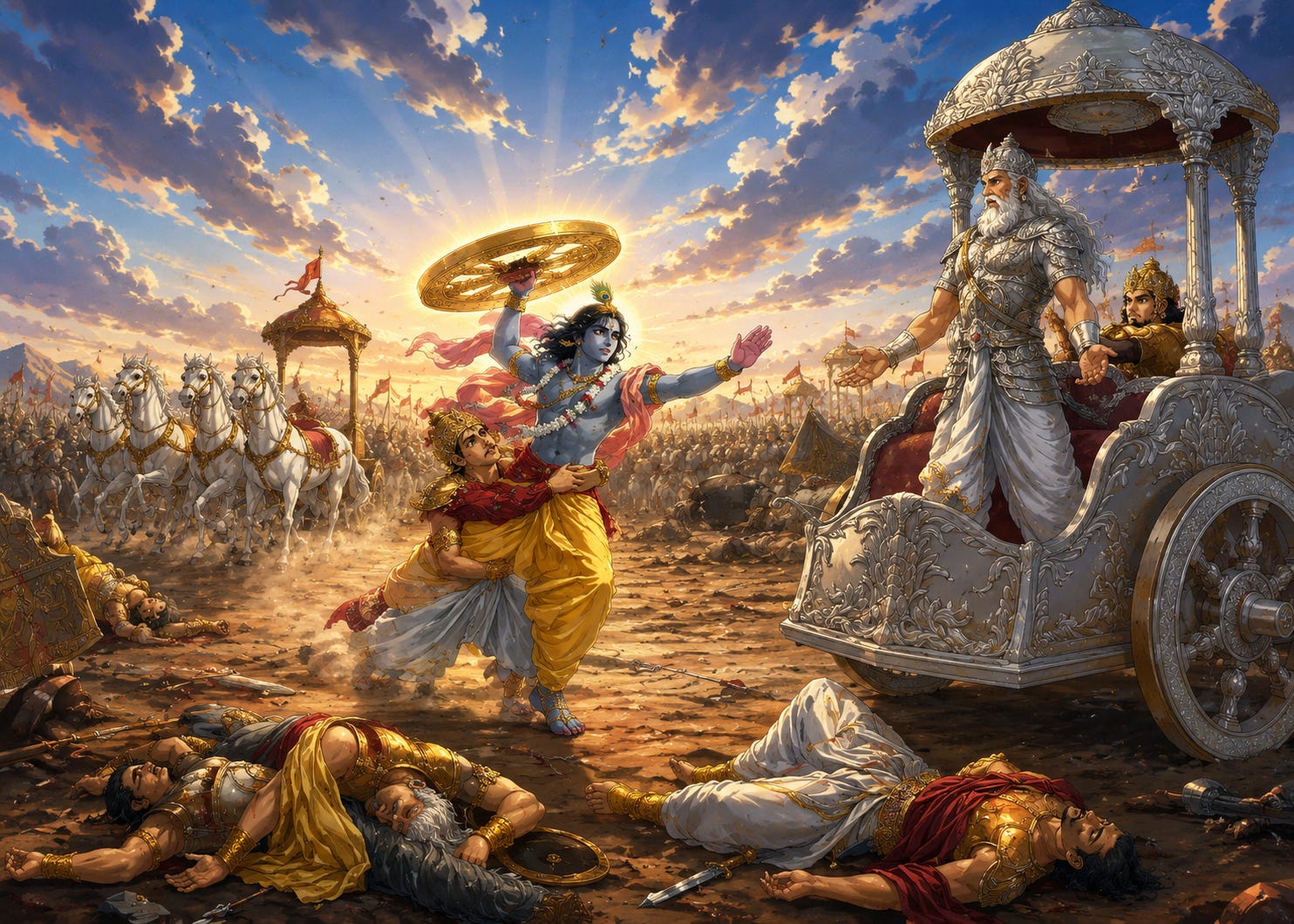
The Sanskrit word Dharma comes from the root dhṛ, meaning “to uphold,” “to sustain,” or “to support.”
Dharma is that which upholds order. It governs not only society but also the individual.
Just as gravity keeps the planets in their orbits, Dharma keeps human life aligned with truth and harmony.
Without Dharma, there is chaos.
Without Dharma, selfishness replaces responsibility.
Without Dharma, temporary desires overpower lasting wisdom.
In simple words:
Dharma is living in a way that supports truth, justice, compassion, and the highest good.
The Bhagavad Gita begins because Arjuna faces a conflict between emotion and duty.
Standing before the battlefield, he sees his teachers, relatives, friends, and loved ones.
His heart fills with compassion.
His mind becomes confused.
He wonders:
“Is it right to fight against my own family?”
“Wouldn’t peace be better than war?”
“What is my true duty?”
His questions are sincere. But Krishna helps him understand an important truth:
Sometimes what feels emotionally comfortable is not what is morally right.
Dharma requires wisdom—not merely emotion.
One of the greatest teachings of the Bhagavad Gita is that Dharma is personal.
Different people have different responsibilities according to their circumstances, abilities, and stage of life.
A doctor’s Dharma is to heal.
A teacher’s Dharma is to educate.
A judge’s Dharma is to uphold justice.
A parent’s Dharma is to nurture.
A student’s Dharma is to learn with sincerity.
None of these duties are higher or lower.
Each becomes sacred when performed with honesty and selflessness.
Krishna explains:
“Better is one’s own Dharma, though imperfectly performed, than another’s Dharma performed perfectly.”
— Bhagavad Gita 3.35
Krishna repeats the same teaching later:
“It is better to perform one’s own duty imperfectly than to perform another’s duty perfectly.”
— Bhagavad Gita 18.47
These verses are often misunderstood.
Krishna is not encouraging mediocrity.
He is teaching authenticity.
True fulfillment comes from living according to one’s own nature—not by copying someone else’s life.
Many people think Dharma simply means career. The Bhagavad Gita teaches something much deeper. Your profession is only one expression of Dharma.
Your Dharma also includes:
Speaking truthfully.
Acting honestly.
Keeping promises.
Showing compassion.
Protecting the weak.
Respecting others.
Controlling harmful desires.
Seeking wisdom.
Every decision we make can either support Dharma or move away from it.
If Dharma always felt easy, Arjuna would never have hesitated.
Often, Dharma asks us to choose what is right over what is pleasant.
It may require:
Saying the truth when lying is easier.
Forgiving instead of seeking revenge.
Remaining honest when dishonesty offers quick rewards.
Acting responsibly even when no one is watching.
This is why Krishna emphasizes courage.
Righteous action often demands inner strength.
One of Arjuna’s greatest obstacles was attachment. His attachment to family clouded his judgment. Krishna does not criticize love. He teaches that attachment should never prevent us from doing what is right. This principle applies everywhere.
Attachment to wealth may lead to greed.
Attachment to praise may lead to dishonesty.
Attachment to comfort may lead to laziness.
Attachment is not love.
Love gives freedom.
Attachment creates fear.
Dharma asks us to act from wisdom rather than attachment.
One of the central teachings of the Bhagavad Gita is that Dharma should be performed without attachment to personal rewards.
Krishna says:
“You have a right to perform your prescribed duty, but you are not entitled to the fruits of your actions. Never consider yourself the cause of the results of your activities, and never be attached to inaction.”
— Bhagavad Gita 2.47
This verse does not ask us to stop caring about our work.
It teaches us to focus on excellence in action while surrendering anxiety about results.
When Dharma is performed with this attitude, work becomes worship.
Every action becomes a spiritual practice.
Many people ask,
“How do I know my Dharma?”
The Bhagavad Gita encourages sincere self-inquiry.
Ask yourself:
What responsibilities has life already placed before me?
What qualities has God blessed me with?
Which actions contribute to the well-being of others?
Which choices bring inner peace rather than regret?
Am I acting from wisdom or from fear?
Dharma is rarely discovered through imagination alone.
It is revealed through honest living, self-reflection, and consistent right action.
You do not need to stand on a battlefield to practice Dharma.
You practice it every day.
When you choose honesty instead of deception.
When you remain calm instead of reacting in anger.
When you keep your word.
When you forgive.
When you fulfill your responsibilities sincerely.
When you help someone without expecting recognition.
These ordinary moments shape extraordinary character.
Dharma is not only found in great heroic acts. It is built through countless small decisions made with integrity.

The Bhagavad Gita teaches that Dharma is not a burden.
It is a blessing.
It gives direction when life feels confusing.
It gives courage when emotions become overwhelming.
It gives purpose when success alone feels empty.
The world changes when people live according to Dharma.
More importantly, the heart changes.
And when the heart changes, life itself becomes a path toward wisdom, peace, and freedom.
If this article deepened your understanding of Dharma, subscribe to continue exploring the timeless wisdom of the Bhagavad Gita. Together, we’ll uncover practical spiritual insights that illuminate everyday life and guide us toward lasting peace and purpose. 🩷
Comments
Nothing yet. Say the first thing.
Sign in to join the conversation.