
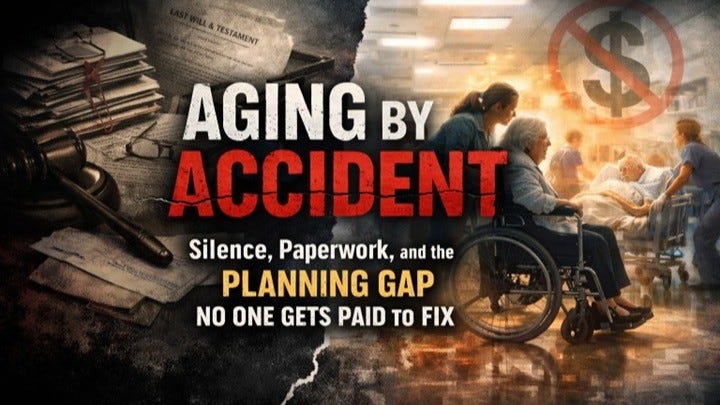
This is the LinkedIn post and the article—Aging by Accident, that Kathy Heery recently posted.
Here’s the snippet from LinkedIn—
Planning for aging isn’t avoided because people don’t care; it’s avoided because the system benefits when they don’t. Estate planning has become a false stand-in for real preparedness, offering legal comfort while ignoring the lived realities of aging: Care coordination, family capacity, hidden costs, and decision-making under pressure.
Aging is predictable, yet we treat it as an unknown because planning forces conversations about vulnerability, dependence, and loss of control. When preparation is deferred, families absorb the labor, stress, and financial risk in crisis, while fragmented systems profit from confusion.
Real aging planning is not about predicting decline or managing fear; it’s about reclaiming agency, voice, and structure before choices are made for you.
Although you should read the entire article.
I’m going to have a two-sided reaction to Kathy’s article. First, she’s right about the preparation and planning side. It’s often overlooked and incredibly important. And Kathy clearly has expertise on this side of the equation.
But there is another side to consider, and I’ll posit it carefully so that Kathy’s message doesn’t get overlooked. Here it is—
The System is Broken
By system, I mean—
Long-term care (Assisted, Memory, Nursing): Cost and Quality of Service
Social Security, Medicare, and Medicaid
Healthcare costs
Pharma costs
Caregiving recognition and financial support
Caregiving – informal support (respite, support groups, learning)
And, depending upon your income level, the harsh truth is…
No level of preparation, planning, and saving can prepare you for the harsh reality that the system, as defined above,
Is Broken
I would argue that all the hoopla around preparation & planning masks this fact.
Now people largely ignore it.
But if they prepare & plan, it masks how broken it is and gives a false sense that they can successfully navigate it without systemic change.
I’d rather we equally focus on advocating for fixing the system. When? NOW!
So, let’s start talking about #3 with the same fervor that we explored #2.
Here’s a link to Kathy’s book—https://www.amazon.com/dp/B0FXFG8197
Take care of yourselves,
Bob.
No posts
Comments
Nothing yet. Say the first thing.
Sign in to join the conversation.