
They Never Met
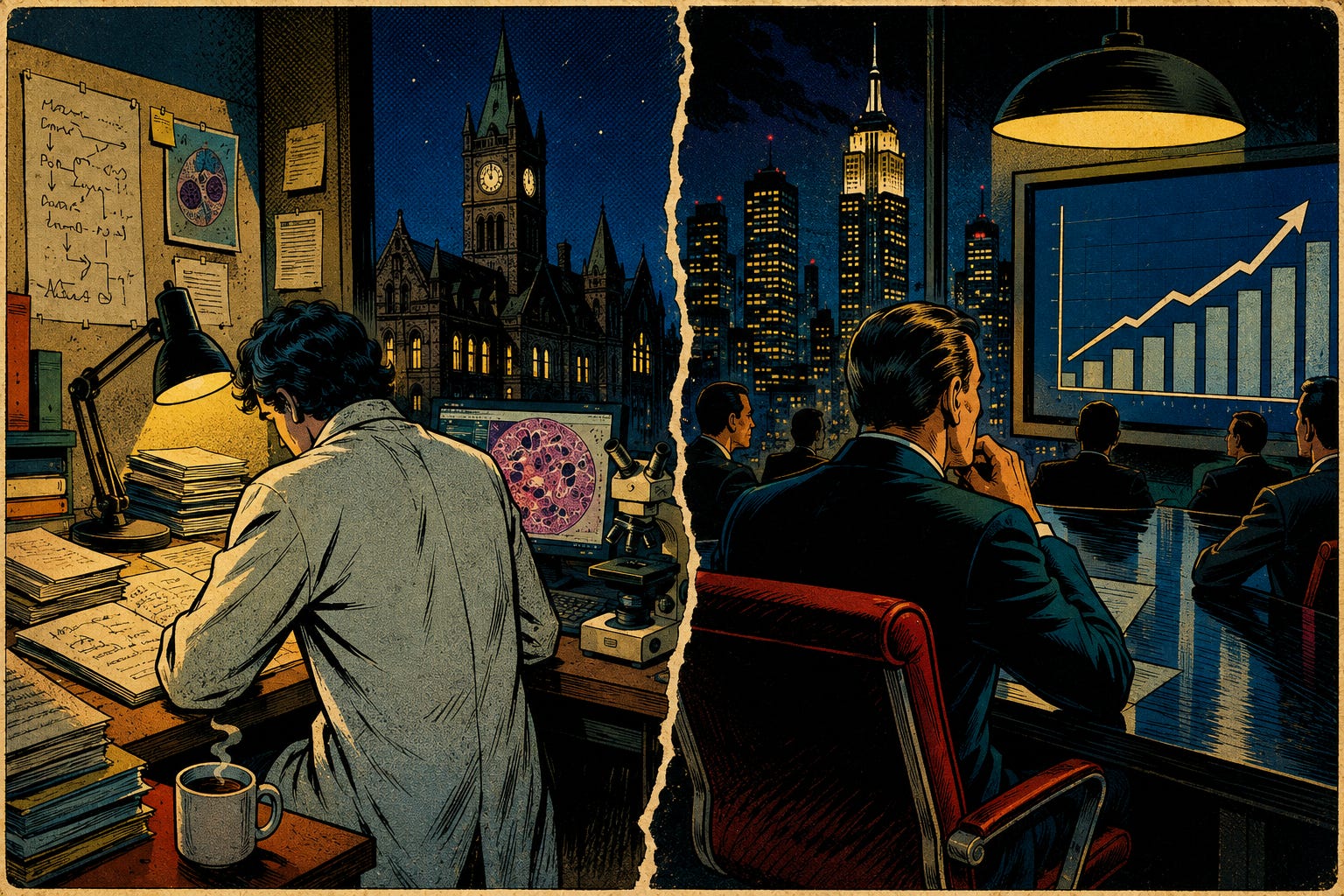
A researcher submitted a manuscript at 2:13 in the morning, lit only by the blue glow of a screen in an empty lab. Six thousand miles away, a few hours later, a committee unanimously approved an acquisition worth several hundred million dollars. Neither one ever knew the other existed.
They worked in time zones that rarely overlapped while awake: one signed emails from a university lab, a hospital’s name printed beneath his signature; the other signed from a high floor overlooking a river that wasn’t his. No shared boss, no shared budget, no shared corporate language.
And yet they ended up fighting for exactly the same thing.
One stockpiled publications, the other stockpiled acquisitions, neither fired directly at the other, and both advanced toward the same target, even if neither could yet name it.
Neither one knew he was at war.
Neither did I.
I understood it much later, once I stopped watching from the outside and found myself walking between both fronts.
This is the story of how I got there (unplanned, unrequested) and why, after crossing the border in both directions, I could never fully belong to either world again.
The Terrain
It took me longer than I’d like to admit to understand what, exactly, both sides were fighting to control. I didn’t see it then. I saw it later, once I’d lived long enough on both sides to recognize the pattern.
For now, this much: it wasn’t the technology, and it wasn’t the talent. It was something quieter, something that had been waiting for both of them for years. And like any contested territory, no one who lingers too long near the border stays neutral for long.
Neither did I. By the time I noticed, I was already walking back and forth across it.
The Side That Taught Me Not to Trust
They sent me to the academic territory first. Nobody taught me the first lesson on purpose. I learned it in a conference room with too many chairs and too little air, watching a colleague, brilliant, honest, exhausted after months of bad sleep, present a model trained in a single hospital, on a single scanner, to a committee that gave him a standing ovation before the last slide finished loading.
Nobody asked what would happen if that same model met a different scanner, in a different hospital, with a different staining protocol. It would have been a reasonable question, and an uncomfortable one. It also would have delayed publication by six months, and in that territory, six months is the distance between being first and being a footnote in someone else’s paper.
At first I thought it was an exception. Then I started listening to the hallway conversations. Over coffee, the question was almost never “does this work?” It was “who else is working on this?” Or “when do we submit?”
That’s when I understood I wasn’t watching different researchers. I was watching an incentive structure doing exactly what it had been built to do.
Like any rookie agent, I’d arrived with the wrong manual. I thought I was entering a world governed purely by scientific curiosity. Instead I found an economy as competitive as any stock market, just denominated in a different currency: the paper, the citation, the h-index, the next grant.
The system wasn’t optimized to produce tools that worked on an ordinary Tuesday, in a hospital with a broken scanner and half the staff out sick. It was optimized to produce a manuscript that could survive peer review before another lab, on another continent, published the same idea a few weeks earlier.
It wasn’t cynicism. It was the incentive structure doing precisely what it was designed to do.
The suspicion became evidence. A letter published in The Lancet, led by researchers at Columbia’s Data Science Institute, audited nearly 2.5 million articles indexed in PubMed and found that AI-fabricated references had multiplied twelvefold in just two years. Nature separately estimated that tens of thousands of 2025 publications may include invalid AI-generated references that were never properly verified.
Nobody designed that outcome on purpose. It’s what happens when an entire system learns to measure production speed before it measures the soundness of what’s produced.
But the speed wasn’t what unsettled me most. It was what the speed was hiding.
Most pathology AI models were born, raised, and proved brilliant inside a single hospital: the same scanner, the same stain, the same workflow. The moment they left, performance often collapsed. The technical literature has an elegant name for it: domain shift. In practice it means something much simpler, the model hadn’t learned to recognize cancer. It had learned, mostly, to recognize the fingerprints of the lab where it was born.
I thought I’d found the enemy.
For a while I believed it was a defect unique to that world: the vanity of publication, urgency dressed up as discovery, a system that confuses speed with truth.
I was wrong. When I crossed to the other side of the wall, I found the exact same defect, wearing a different suit.
The Other Side Said the Same Thing About Us
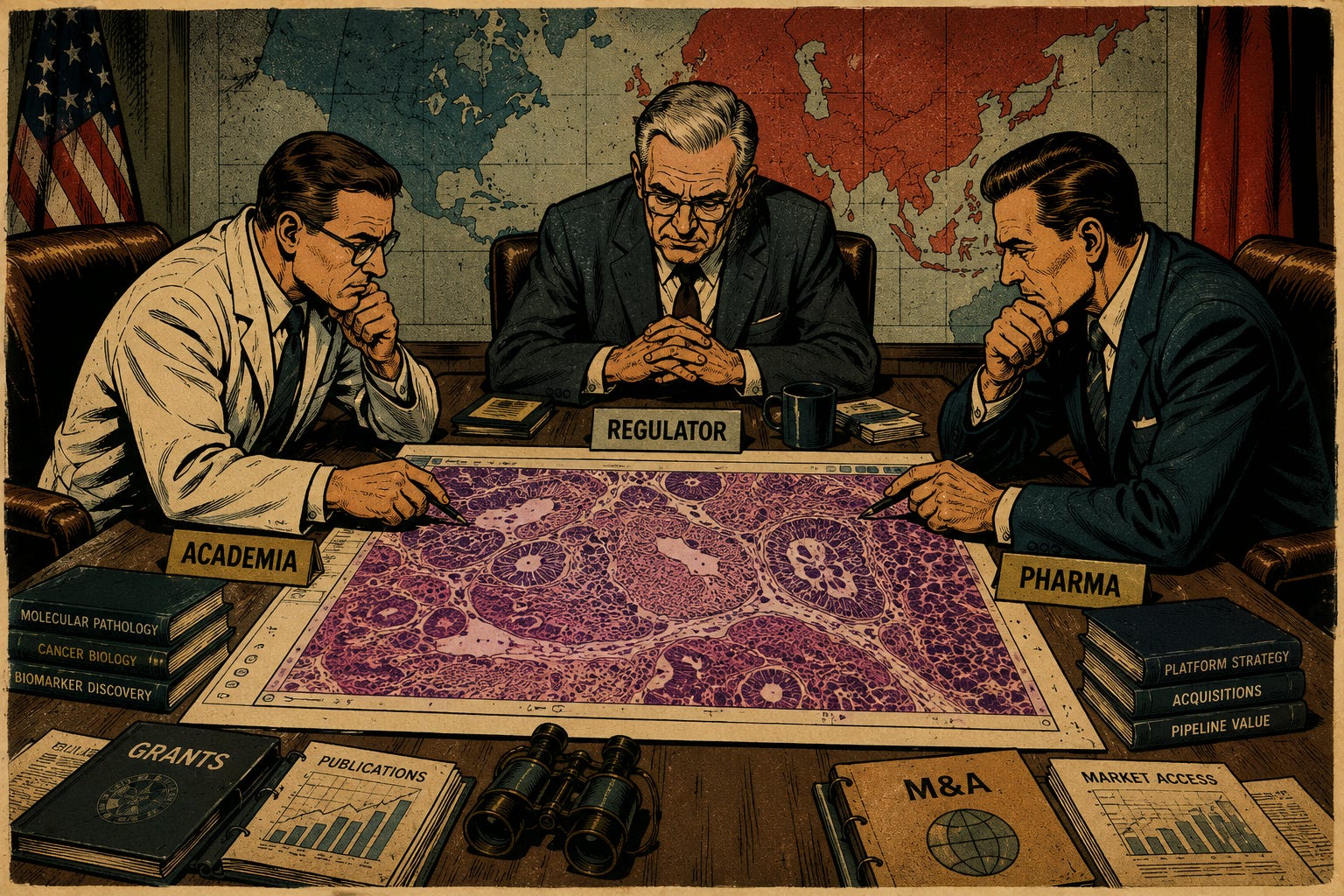
Nobody in the industrial territory talked about publications. They talked about deployment speed, competitive windows, “we can’t fall behind.” The conference rooms had better coffee and worse views, but the tension in the air was identical to the academic committee’s: the same urgency, in different clothes.
In six months I watched a wave of consolidation with no recent precedent in the history of digital pathology. Roche bought PathAI. AstraZeneca acquired Modella AI (4). Sanofi expanded its alliance with Owkin. A new press release seemed to land every few weeks: another acquisition, another license, another strategic deal.
From the outside, it read like a series of carefully calculated bets. From the inside, it felt different.
I watched entire committees approve investments worth hundreds of millions of dollars without anyone in the room able to answer, first, a surprisingly simple question:
Which specific clinical problem will this purchase solve?
The answer almost always arrived later.
A McKinsey survey put numbers to that feeling: 100% of life sciences leaders had experimented with generative AI. Only 32% had taken concrete steps to scale it. Barely 5% claimed to have gained a real competitive edge from it (6).
A hundred percent arm themselves. Five percent know why.
That’s when I realized I’d been wrong. It wasn’t greed. It was fear, dressed up as strategy, the same fear I’d just left behind, only speaking a different language.
I started keeping a mental list of the phrases I heard on both sides of the border: “We can’t fall behind.” “If we don’t do it, someone else will.” “We’ll sort out the details later.” The words changed. The fear never did.
The Basement
That’s where I understood what the territory actually was. It didn’t happen in a meeting, or in front of a slide deck. It happened in the basement of a university hospital.
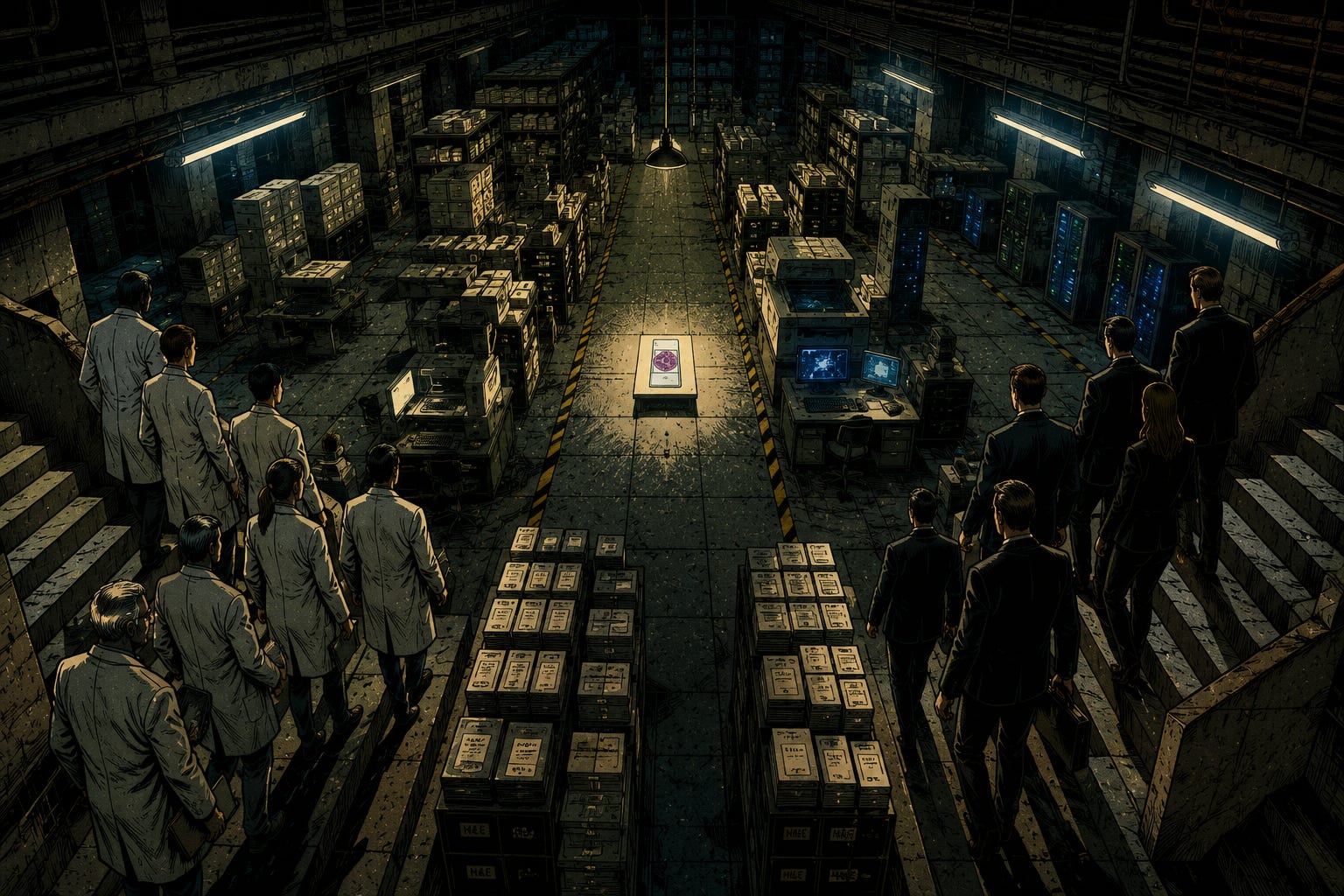
Servers hummed under fluorescent lights. On one side, cardboard boxes of biopsies from another era; on the other, the hard drives meant to replace them. Nobody there talked about artificial intelligence. Nobody talked about war.
They talked about space, about budget, about maintenance, about what to do with fifteen years of biopsies nobody had looked at since the day they were archived.
I remember thinking it was an archive. Then I understood I was looking at something else.
Petabytes of human tissue photographed at microscopic resolution, piling up year after year with no one quite sure what to do with them yet, not because they were useful today, but because everyone sensed they’d be valuable eventually.
And then it clicked: that wasn’t an archive. It was the territory both sides had spent years fighting over without ever admitting it.
A digital pathology archive isn’t a medical record. It’s a territory.
And like any territory, the map never belongs to whoever lives on it. It belongs to whoever manages to control it.
What unsettled me most was that neither side knew the patient whose tissue had been sitting there for years, waiting.
That’s when the war stopped feeling abstract. They weren’t fighting over a technology, or even a market.
They were fighting over millions of biological stories turned into data, belonging to people who will likely never know that their biopsy became the ground on which two different worlds learned to compete.
The First Stray Bullet
Every war, even a cold one, eventually claims a first casualty. This one didn’t bleed. It lost credibility.
On April 18, 2026, the New England Journal of Medicine published the case of an 87-year-old man with bronchial casts after inhaling wildfire smoke. The clinical image spread quickly among physicians worldwide. For eleven days, nobody suspected a problem, until an anonymous reader on PubPeer noticed something almost invisible: the numbers on the measuring tape in the image followed a sequence that was mathematically impossible.
Eleven days later, NEJM retracted the article. The authors admitted they’d used an AI tool to reposition the tape measure, to make the image “neater and more legible”.
It wasn’t fraud in the classic sense. It was something more unsettling: well-intentioned authors using a new tool without pausing to ask where aesthetic editing ended and scientific integrity began.
The AI didn’t lie. It simply did exactly what it was asked to do. And maybe that’s the most uncomfortable part of the whole story.
Stray bullets are never fired by one person. They’re fired by an entire system that has learned to move first and ask questions later, trusting that someone else (the reviewer, the committee, the regulator) will correct course before the error travels too far.
This time it took eleven days. Next time it might not.
Because the real casualty was never that image. It was something much harder to rebuild: trust.
And in any cold war, once trust starts to erode, both sides end up losing more than they think they’re defending.
The Weapon Nobody Fires
Not every collaboration in this war is a trap. But even the ones that work run on the logic of deterrence, not trust.
During the Cold War, nobody built a nuclear arsenal hoping to use it. Its real value lay elsewhere: in the other side knowing it existed. The weapon changed the negotiation long before anyone considered firing it.
Something strikingly similar happens in biomedicine.
The alliance between AstraZeneca, Daiichi Sankyo, and Leica Biosystems developed Quantitative Continuous Scoring (QCS), a computational pathology algorithm for scoring HER2. In the DESTINY-Gastric01 trial, it proved able to predict response to trastuzumab deruxtecan, and a few months later the collaboration expanded to a new biomarker, TROP2, in lung cancer.
It’s a real clinical success. Real patients benefited from that work.
But seen through the logic of this war, the algorithm serves another function too. Every new validated biomarker, every new platform, every expansion of the agreement is also a signal: a public demonstration of capability.
It isn’t built only to be used. It’s built so everyone knows it can be used, and like any arsenal, its mere existence changes how everyone else negotiates.
The large public-private consortia play a different role. BIGPICTURE in Europe (10), or the Cancer AI Alliance in the United States, function like the cities where both blocs agree to sit down and negotiate without ever fully trusting each other: neutral ground where hospitals, universities, and pharmaceutical companies share rules before they share advantages.
That isn’t naivety. It’s a recognition of reality: both sides understand that if nobody builds shared infrastructure, neither one gets very far.
Trust remains limited. Cooperation, meanwhile, becomes unavoidable.
And maybe that’s the strangest lesson of any cold war: non-proliferation treaties never meant the powers stopped arming themselves. They meant both sides had realized that some shared rules were the only way to avoid destroying the very thing they were competing for.
The Desertion
There comes a point when a correspondent stops asking who’s winning, and starts asking whether either side can actually win. That moment came for me long after I’d left both behind.
For years I thought I’d crossed from one side to the other. Today I believe I never left the same conflict.
Academia can’t build the next generation of precision medicine without industry’s infrastructure and capital. Industry can’t build it without the scientific credibility, the samples, and the knowledge that only academia produces.
I thought this resembled Mutually Assured Destruction. It wasn’t that. It was something stranger: neither side could destroy the other, because each depended entirely on what the other produced.
The rivalry was real. So was the interdependence. And maybe that’s the most uncomfortable paradox in this whole story.
The enemy never had a name, a logo, or a bank account. It was an incentive structure capable of making intelligent, honest, well-meaning people defend positions that, seen from the border, looked far more alike than either side was willing to admit.
In academia, I learned to distrust industry. In industry, I discovered they distrusted academia exactly the same way. That’s when I understood neither had ever been describing a different enemy: they were just using different languages to name the same problem.
Desertion didn’t feel like a decision. It felt like a loss.
I discovered I no longer fully belonged to either world. I’d learned both languages, but I could no longer speak either one without keeping the other’s accent.
I didn’t choose a side. I lost both, and stayed on the border, the territory almost no one claims, because almost no one yet knows what to do with it.
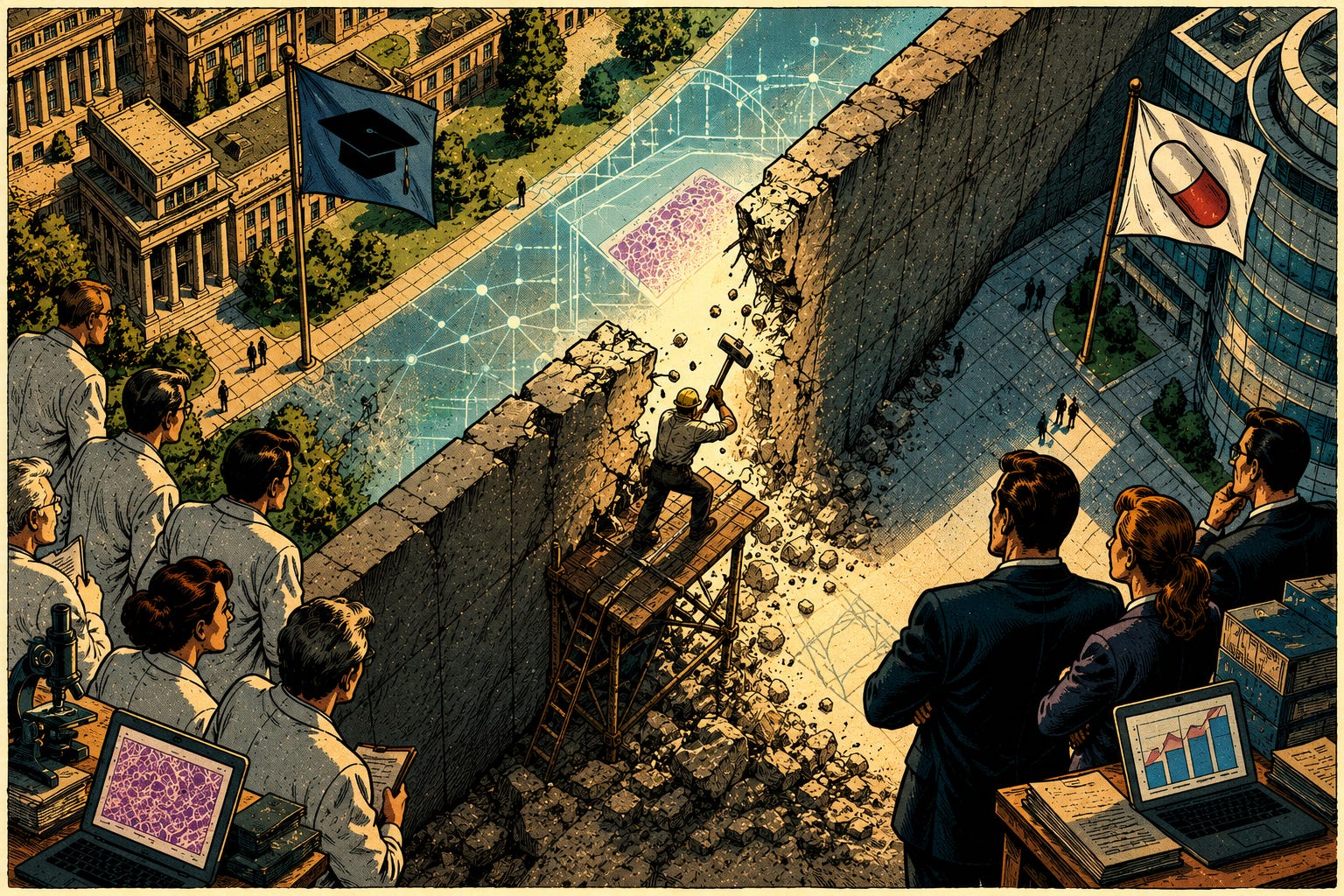
The Cold War of drug development won’t end when one side wins. It will end when we stop building new walls between them and finally start building the bridges that make the border unnecessary.
For years I thought my job was to cross that border and report what I saw from both sides. Today I believe it’s to help others who no longer need to cross it to understand each other.
Maybe that’s every correspondent’s fate: to stop telling the story of the wall, and start drawing the blueprints for the bridge.
I think that’s the work that comes next.
Beyond the Slide is a reader-supported publication. To receive new posts and support my work, consider becoming a free or paid subscriber.
References:
Topaz M, et al. Fabricated citations: an audit across 2.5 million biomedical papers. The Lancet. 2026 May 9;407(10541):1779-1781.
Nature News. Tens of thousands of 2025 publications may include invalid AI-generated references [Internet]. 2026.
Roche. Roche enters into a definitive merger agreement to acquire PathAI to transform AI-driven diagnostics [Internet]. Basel: Roche Media Release; 2026 May 7.
Modella AI. Modella AI announces acquisition by AstraZeneca to advance AI-driven oncology R&D at global scale [Internet]. Boston: Business Wire; 2026 Jan 13.
Owkin. Owkin to build AI agents as part of a multi-year K Pro collaboration with Sanofi [Internet]. New York/Paris: Owkin Newsfeed; 2026 Jun 5.
McKinsey & Company. Scaling gen AI in the life sciences industry [Internet]. 2025 Jan 10.
Wang Y, Mu X. Retraction: Bronchial casts from inhalation of forest-fire smoke. N Engl J Med. 2026;394:1634. DOI: 10.1056/NEJMc2605962.
Retraction Watch. NEJM retracts case study for AI-manipulated imagery [Internet]. 2026 May 1.
Leica Biosystems. Leica Biosystems announces expansion of collaboration to scale precision medicine and develop AI-powered diagnostics with AstraZeneca and Daiichi Sankyo [Internet]. 2026.
IHI Innovative Health Initiative. BIGPICTURE project factsheet [Internet]. European Union; 2026.
Cancer AI Alliance. Federated consortium for oncology AI research [Internet]. 2025.
Comments
Nothing yet. Say the first thing.
Sign in to join the conversation.