
🎧 Beyond the Pass — Operator Podcast (1:44)
Why sold out street stalls still loose money
0:00
-1:44
Prefer reading? The full breakdown is below.
A trader at a London street food market last summer. Crowd-puller pitch, queue down the side of the unit by 12:30 every Saturday. Beef brisket sliders, slow-cooked, hand-shredded, served in a sourdough brioche. £12 a portion. 80 portions sold by close.
Gross takings on a good Saturday: around £960.
He told me, completely seriously, that he was making about £700 a day in profit. He was working four markets a week. By his own maths, he was running a £140,000-a-year street food business.
When we sat down and properly costed it, his actual take-home from that Saturday was closer to £180. Across the week, after every cost was included, he was earning roughly £21,000 a year for sixty-hour weeks of physical, exhausting work. He had no idea, because nobody had ever shown him how to count properly.
This is the most common pattern in UK street food, and it’s not because traders are bad at business. It’s because the structure of street food work makes most of the real costs invisible. They happen at home, in your kitchen, at night, before the market even opens. They don’t feel like work because they’re not on a payroll. But they’re where the entire margin disappears.
The visible part of street food is the market. Six hours on a pitch, serving customers, taking payments. That’s the bit traders count.
The invisible part is everything else. The 4am butchery before a market day. The eight hours of low-and-slow cooking on Friday. The Wednesday sauce-making session. The packaging assembly on Thursday evening. The Sunday morning stock prep for the week ahead. The grocery runs, the supplier collections, the kit cleaning, the deep-clean of the unit, the social media posts, the booking admin, the response to event organisers.
In most street food operations, the prep-to-service ratio is roughly three to one.Three hours of unpaid work to make one hour of paid service possible.
The brisket trader’s Saturday looked like this. Six hours on the pitch. Plus three hours Friday for the cook. Plus four hours Friday night for the shred and the sauce. Plus two hours Saturday morning for packdown, loading, drive-in. Plus three hours Sunday for breakdown, cleaning, restocking. That’s eighteen hours of work, of which six were on the pitch.
When he told me he made £700 in profit from his £960 Saturday, he was looking only at the six hours. He’d never costed his own labour at the other twelve.
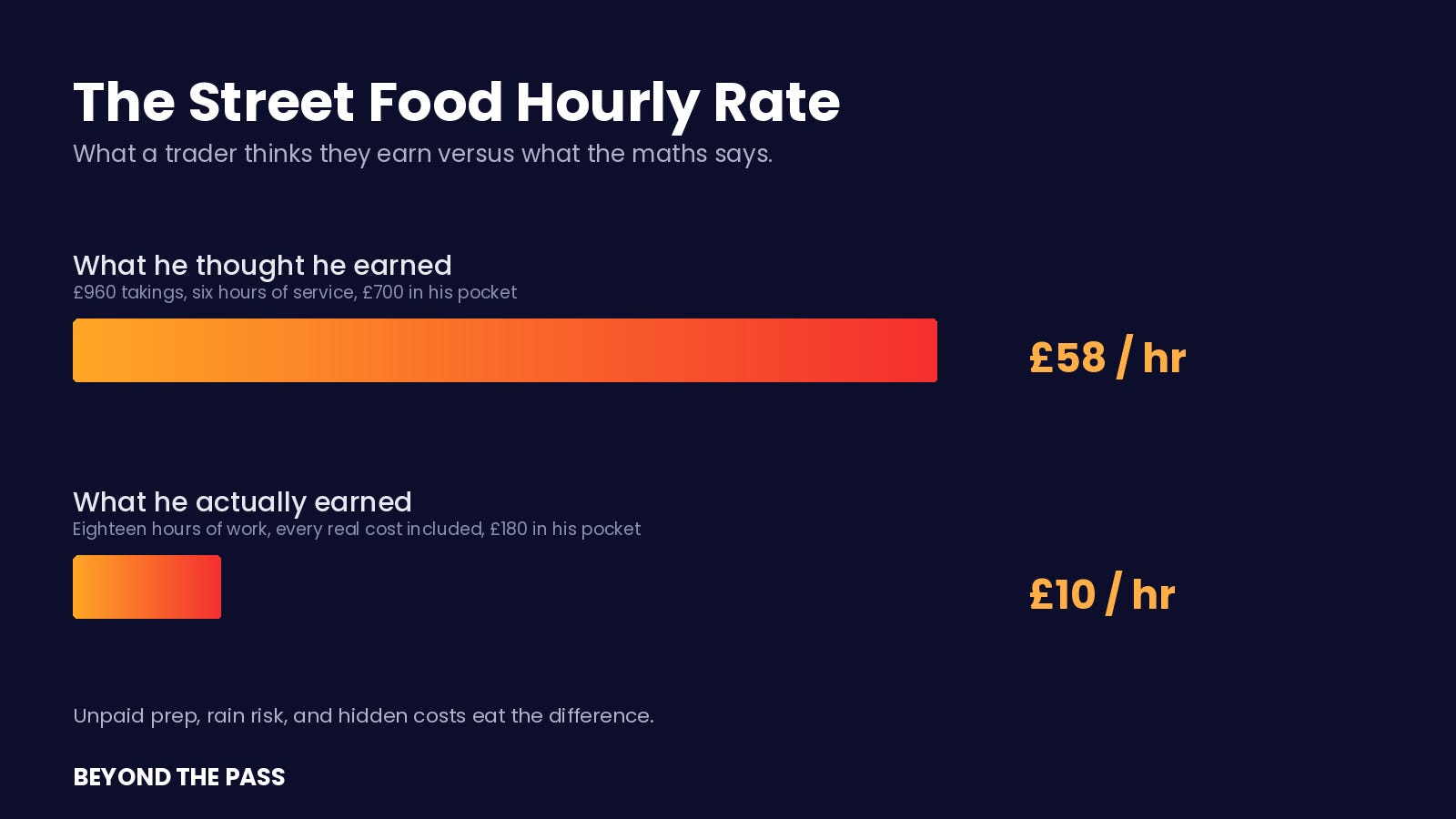
If you charge yourself even £15 an hour for unpaid prep, which is well below minimum wage for skilled food work, that’s £180 of hidden labour cost on a Saturday before you’ve paid for a single ingredient.
Here’s the calculation almost no street food trader runs. It takes about ten minutes. It’s the difference between knowing whether your business actually works and just hoping it does.
Take a single market day. Add up every cost, ruthlessly:
- Pitch fee: what you pay to be there.
- Ingredient cost: the food you’ll sell that day. Be honest, include the over-prep, the spoilage, the unsold stock.
- Variable consumables: packaging, napkins, gas, sauces, sundries. Per portion, multiplied by your expected volume.
- Vehicle: fuel, parking, mileage at HMRC rates if you’re costing properly. A 40-mile round trip in a van isn’t free.
- Equipment depreciation: if your kit cost £4,000 and lasts three years over 200 trading days, that’s £6.67 per day, every day, whether you trade or not.
- Insurance, licensing, food hygiene, electric: annual costs divided by trading days.
- Unpaid prep at £15/hour: every hour of prep specific to that market.
- Service hours at £15/hour: your own time on the pitch.
- Rain risk: the days you go out and take £200 because the weather killed footfall. If one in five market days is a washout at £200 revenue, factor that across your average.
Now you have your true cost per market day. Divide it by your average portion price. That’s the number of portions you need to sell just to break even. Not to make money. To not lose money.
When the brisket trader ran this, his break-even came out at 62 portions a day. He’d been telling himself anything above 30 was a profitable day.
Suddenly the maths made sense. The Saturdays he hit 80 portions were genuinely good days, maybe £200-250 of real take-home after everything was paid. The Tuesdays he hit 35 were losing days he’d thought were modest wins. The rainy Thursdays at 18 were costing him real money to attend.
He’d been running the business for two years convinced he was doing well, and quietly accumulating debt the whole time.
There’s a second pricing trap specific to street food that compounds the prep problem. Customers anchor street food prices in surprisingly narrow bands, and those bands aren’t where most traders think they are.
For a single hot main from a street food unit, customer perception sits in roughly three zones:
- £6-£8: Cheap, casual, treat-yourself category. Customers buy without thinking.
- £9-£11: Premium street food. Customers consider it but mostly accept it for quality product.
- £12 and up: Restaurant pricing. Customers hesitate, compare against alternatives, and many walk.
The trader at £12 with his brisket was right at the edge of the resistance zone. His queue length on weekends was being subsidised by the strength of his product and the affluence of the market location. At a less central pitch, the same brisket at the same price would have sold half as many portions.
Most traders, sensing margin pressure, instinctively push their price up to compensate. They go from £9 to £10, from £10 to £12, telling themselves the customer will absorb it. What actually happens is volume drops more than price rises, and they end up with worse total revenue and the same hidden cost base.
The right move is almost always the opposite. Hold the price, fix the structure underneath. Smaller portion at the same price (3 grams of brisket protein less is invisible on the plate, costs a real fraction of margin recovered), faster service to do more covers in the same hours, leaner prep to cut hidden labour. These compound. Price increases don’t.
Run this on your own street food operation this week
Three numbers. Twenty minutes if you have a calendar and your invoices to hand.
Number 1: Your real prep-to-service ratio.
For one full trading week, track every hour you work on the business. Service hours on pitch. Prep hours. Admin hours. Driving hours. Cleaning. Everything. Divide non-service hours by service hours.
- Under 2:1: Lean operation. You’ve designed prep efficiently.
- 2:1 to 3:1: Normal for street food. Manageable but worth optimising.
- Over 3:1: You’re effectively unpaid for most of your working week. Restructure.
Number 2: Your real break-even per market day.
Use the cost list above. Don’t skip the unpaid labour line and don’t skip the rain risk. The break-even is in portions sold, not in revenue.
Then compare it to your average actual sales. If your break-even is 62 portions and your average market day is 55 portions, you’re running at a loss on most days and don’t know it.
Number 3: Your hourly take-home.
Total weekly profit (real profit, after every cost) divided by total weekly hours worked (every hour, not just pitch hours).
- Below minimum wage: the business doesn’t work in its current form.
- Minimum wage to £15: marginal. You’re earning a low wage for skilled work, with no employer benefits.
- Above £20: the operation is actually profitable. Above £30 is genuinely strong.
The brisket trader, on his £21,000 a year for sixty-hour weeks, was working out at around £6.70 an hour. He’d built himself a job paying significantly below minimum wage and called it a business.
The trader is still going. He moved to three markets a week instead of four (dropped the consistently loss-making Tuesday). He moved his price from £12 to £11.50 and made the portion 15% smaller. He outsourced the Friday cook to a commercial kitchen near him that did the brisket for less than his own labour cost. He stopped doing rainy outdoor events without a £400 guarantee from the organiser.
Same product. Same pitches. Roughly the same gross revenue. About £18,000 more a year in his pocket, and ten fewer hours a week of work.
Street food doesn’t fail because the food is bad or the customers don’t show. It fails because the maths is invisible, the prep is unpaid, and the break-even is never calculated. Run the three numbers and you’ll know within a week whether you’re running a business or a low-wage job dressed up as one.
*Free 15-minute diagnostic that surfaces these numbers for your own operation here.
Thanks for reading Beyond the Pass! This post is public so feel free to share it.
No posts
Comments
Nothing yet. Say the first thing.
Sign in to join the conversation.