
🎧 Beyond the Pass — Operator Podcast (1:33)
Why full covers don’t guarantee a profitable service.
But structure determines whether it actually makes money.
Prefer reading? The full breakdown is below.
The pub had been full every Sunday for over a year.
It was a 70-cover site, busy enough that Sundays had quietly become the anchor of the week. By midday, the first wave of bookings would arrive. Families, regulars, the same tables week after week. The room felt alive, the bar busy, the kitchen already moving before the peak even started.
From the outside, it looked like success.
Seventy covers, sometimes more. A full roast menu. Desserts moving steadily.
If you walked in during service, you wouldn’t question the model. The team was working, the dining room was full, and the energy felt positive.
But behind the pass, Sundays felt different.
The kitchen ran harder than any other day of the week. Prep started earlier, stations filled quickly, and by mid-service, pressure would begin to build. Ticket times stretched slightly, then a little more. Nothing dramatic, just enough for the team to feel it.
The room stayed full. But the margin didn’t.
The Hidden Pressure of a “Successful” Service
Sunday looked strong because of volume. But volume doesn’t always translate into contribution.
The roast menu required significant prep before service even began. Multiple components, batch cooking, finishing work during peak. Each plate carried more labour minutes than the rest of the week.
At the same time, average spend stayed relatively stable. Guests ordered predictably. A main, sometimes a dessert, occasionally a drink. Nothing unusual.
But the structure behind the service told a different story.
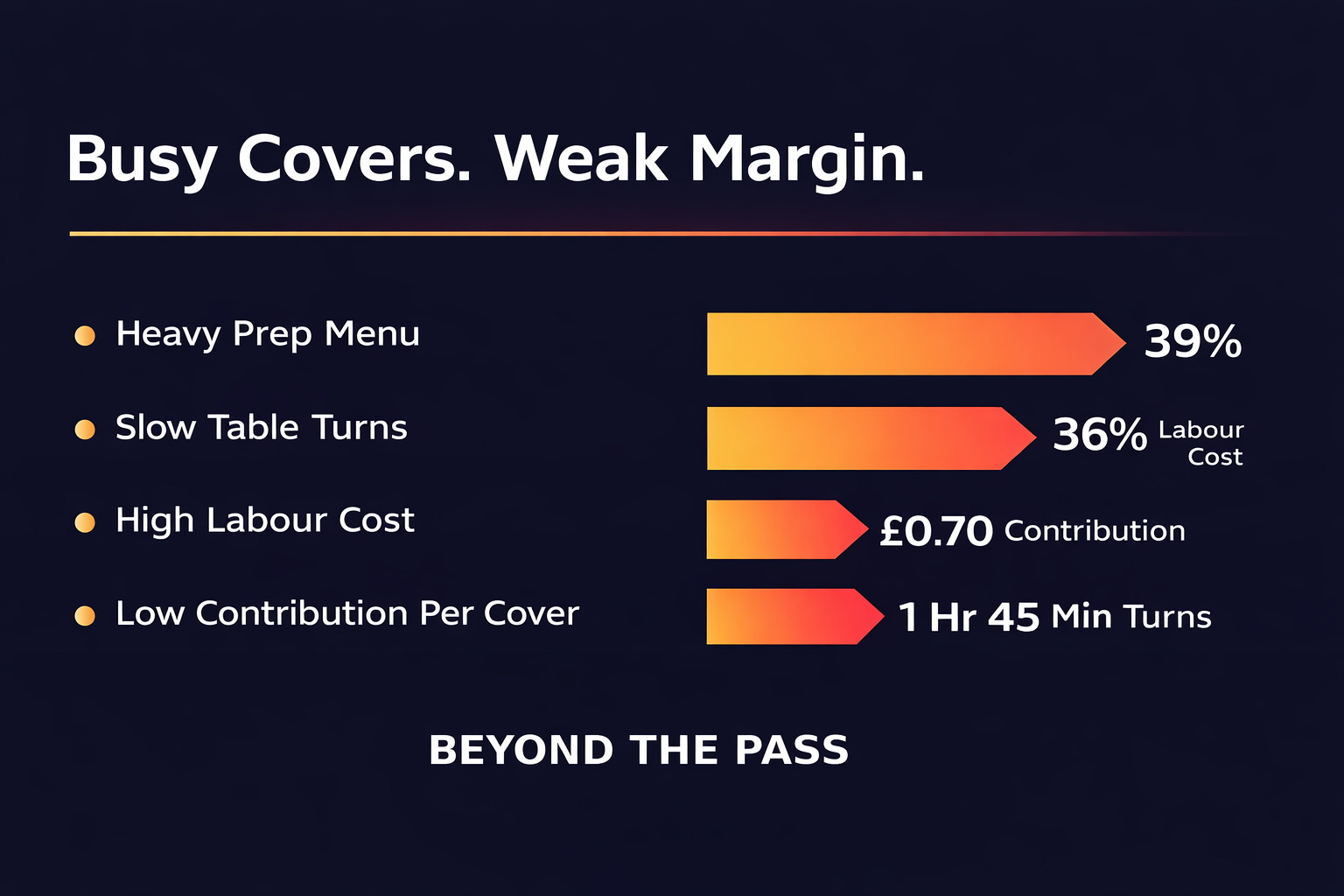
Food cost sat around 39%.
Labour during the Sunday service reached 36%.
Individually, neither number looked catastrophic but together, they compressed the margin.
By the time the service ended, the day that looked strongest on paper was quietly one of the weakest contributors.
On paper, Sunday looked like the strongest day of the week.
In practice, it was the one carrying the heaviest operational burden.
Why Full Covers Can Hide Weak Structure
Busy services often create a false sense of security.
When the room is full, it’s easy to assume the model works. Volume becomes a proxy for profitability. But the real question is not how many covers you serve, it’s how efficiently the kitchen can produce them.
On Sundays, the kitchen needed more labour hours, more prep time, and more finishing steps to deliver the same number of guests.
The system worked harder to produce the same revenue.
And that’s where the pressure sat.
The service looked successful.
But the structure underneath was fragile.
What Changed
Instead of redesigning the menu from a prep perspective, the team looked at Sunday as a service model.
They broke the service down into three questions:
How long does each table occupy a seat?
How many labour minutes are required per cover?
Which dishes slow the pass at peak?
The first issue was table duration.
Sunday lunch averaged 1 hour 45 minutes per table.
That meant the pub could only realistically turn most tables once.
Volume looked strong, but capacity was capped.
The second issue was labour concentration.
Three dishes, all roast variations required heavy finishing at the same moment.
As the dining room filled, the pass slowed because everything landed at once.
The third issue was prep timing.
Most prep was completed early, but final assembly still required multiple touches during peak.
The kitchen wasn’t struggling because of volume, it was struggling because volume arrived in waves.
So the changes focused on flow rather than simplification.
They staggered prep finishing.
They pre-plated certain components earlier.
They adjusted the roast menu to reduce last-minute assembly.
They also adjusted portion structure slightly, not smaller, but more consistent allowing faster plating during peak.
None of this changed the guest experience.
But it changed how the kitchen handled pressure.
The Outcome
Within two weeks, the shift was noticeable.
Prep time for Sunday reduced by nearly an hour.
Stations ran with fewer containers and less congestion.
Ticket times shortened during peak.
The same team handled the service more comfortably.
Labour hours didn’t change. Covers didn’t increase.
But the kitchen processed the same volume with less friction.
That difference translated directly into contribution.
The busiest day of the week stopped being the weakest financially.
The Lesson
The problem wasn’t the number of covers.
It was the number of moving parts required to produce them.
When each plate carries too many components, volume amplifies inefficiency. A full dining room then increases pressure rather than improving margin.
By designing the menu around shared components, seasonal anchors, and predictable prep, the kitchen reduced friction without reducing standards.
The team didn’t work harder.
The system simply stopped working against them.
And the same seventy covers finally started contributing to the business instead of quietly absorbing margin.
If you want to check whether your busiest service actually contributes to your business, you can run the free structural diagnostic here :
It shows whether your busiest periods are generating margin or quietly absorbing it.
Thanks for reading Beyond the Pass! This post is public so feel free to share it.
Comments
Nothing yet. Say the first thing.
Sign in to join the conversation.