
🎧Beyond the Pass — Operator Podcast (1:44)
Fix debt and waste with VAT relief
0:00
-1:44
Prefer reading? The full breakdown is below.
Last week I wrote about what happened when France cut restaurant VAT in 2009. The short version: owners kept about 56% of it, profits rose roughly a quarter, and within a few years the sector was in trouble again and the rate went back up.
The obvious response is that French operators wasted it. I don’t think that’s right, and I think the truth is more uncomfortable. They didn’t waste it. They absorbed it, which is what almost everyone does with money that arrives without a plan attached, and absorption looks exactly like success for the first eighteen months.
So this post is about the practical question the campaign never gets to. If the cut comes, and I hope it does, what should you actually do with it? Because the answer is not obvious, and the default answer is the one France chose.
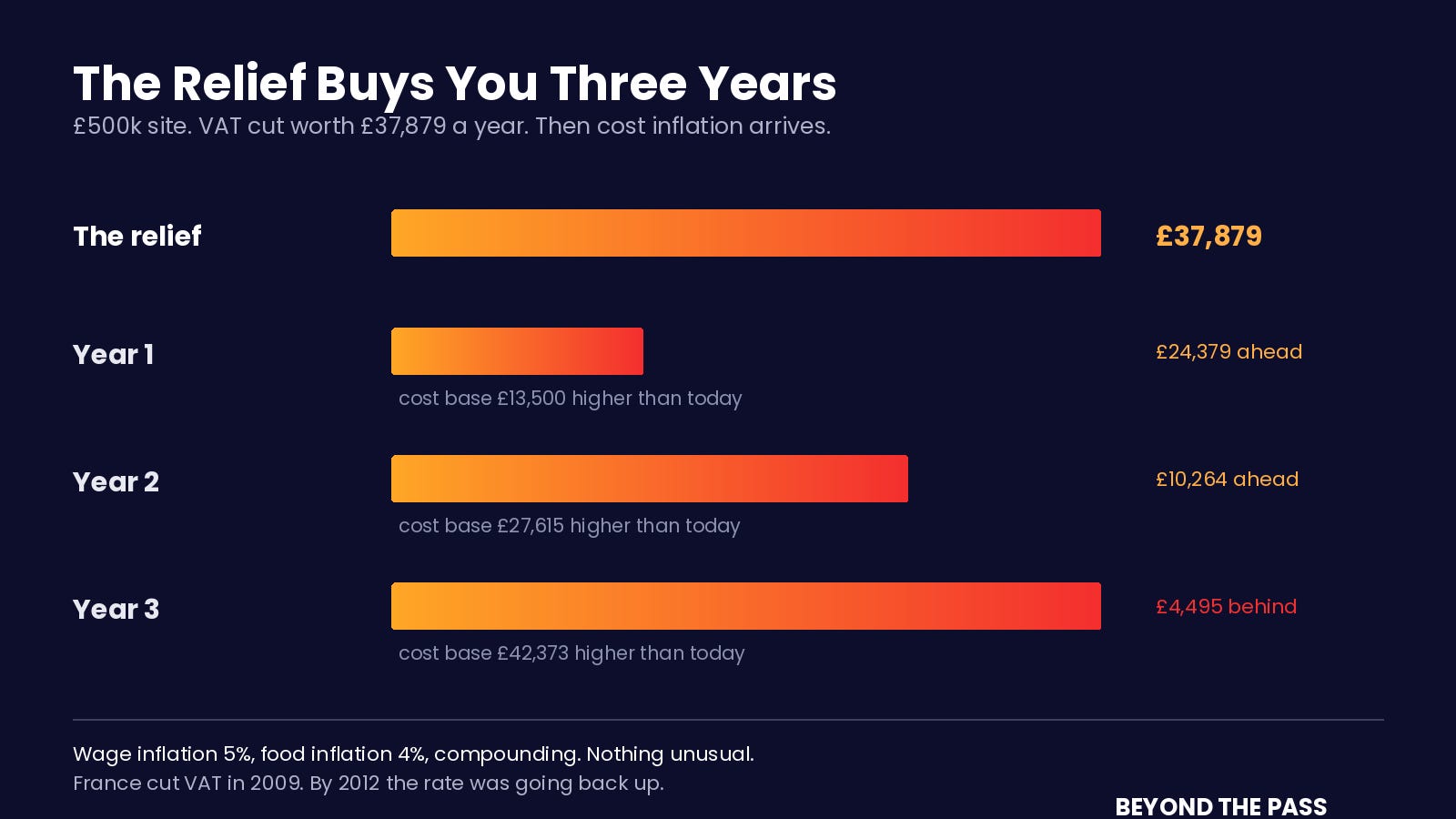
Take a site turning over £500,000 gross. A cut from 20% to 10% is worth 7.58% of gross sales, which is £37,879 a year.
Now put that against what happens to your costs while you’re enjoying it.
If labour is 30% of turnover, that’s £150,000, and a 5% wage settlement adds £7,500 a year. If food is 30%, that’s another £150,000, and 4% food inflation adds £6,000. Combined cost drift of £13,500 a year, before anything unusual happens.
The relief recurs every year, but so does the cost increase, and the cost increase compounds. Run it forward against today’s cost base:
Year one: costs are £13,500 higher than today. You are £24,379 ahead.
Year two: costs are £27,615 higher. You are £10,264 ahead.
Year three: costs are £42,373 higher. You are £4,495 behind where you started.
That is the whole story of the French experiment in four lines. The relief is real and substantial, and on ordinary cost inflation it is fully consumed during the third year. France cut VAT in July 2009. By 2012 the rate was going back up and the sector was no better placed than before.
Push the assumptions around and the answer barely moves. At 6% wages and 5% food it is gone during year three. At 4% and 3%, benign by recent standards, it survives into year four. Whichever way you run it, you have roughly three years.
Three years is not nothing. It is enough time to change something structural, if you decide in advance what that something is. It is not enough to fix anything by accident.
There is a clean test for the difference, and it is worth writing on a wall.
If the relief were withdrawn in three years, would this business be better off than before it arrived?
If yes, you deployed it. If no, you absorbed it, and you spent three years feeling more comfortable without becoming more resilient.
Absorbing is not stupidity. It is what happens when money enters a business through the bank account rather than through a decision. It funds the current loss. It covers the gap. It pays down the overdraft a bit, lets you stop deferring the things you have been deferring, and takes the pressure off for a while. Every one of those is understandable and none of them changes the structure that made the pressure appear in the first place.
Deploying means using the window to make a permanent change to the cost base or the capability of the business, so that when the relief has been eaten, you need less of it.
Four uses, in the order I would take them.
One: kill the expensive debt. If you are carrying a merchant cash advance, invoice finance, a director’s loan funded by a personal credit facility, or anything with an effective annual cost north of 20%, that is the first call and it is not close. Repaying debt costing 40% is a guaranteed 40% return. Nothing else you can do with the money is both that certain and that large. Do this before anything clever.
Two: fix the leaks that are already bigger than the relief. This is the one operators consistently underestimate. A bar doing £8,000 a week with an 8% yield gap is losing £33,280 a year to over-pour, oxidation, comps and breakage. Against relief of £37,879, that single leak is 88% of the entire VAT cut, every single year, and unlike the relief it does not get eaten by inflation because it scales with turnover.
Put plainly: for most sites, fixing wastage properly is worth nearly as much as the whole VAT cut, and you do not need a Chancellor’s permission to do it. If the relief funds the systems and the discipline to close that gap, you have converted a temporary political gift into a permanent structural gain. That is what deployment looks like.
Three: change the structure that makes labour expensive. Not cutting hours, which usually makes things worse. Changing the thing that forces the hours: a menu rebuilt around shared components so prep collapses, batching that takes a three-minute cocktail build down to thirty seconds, equipment that removes a recurring labour dependency. These are one-off investments that lower the recurring cost line permanently. They are also the hardest to do while you are firefighting, which is precisely why a three-year window of breathing room is the right time to attempt them.
Four: build the buffer. Unglamorous and often correct. Most hospitality businesses do not fail because they are unprofitable. They fail because they run out of cash on a bad Tuesday in February with a VAT bill due. Three months of fixed costs in reserve changes which shocks are survivable. If the first three uses do not apply to you, this one almost certainly does.
Do not cut prices. France’s own evidence says customers barely notice, and the reversal evidence says you will not easily get the price back when the rate changes again. You would be giving away the relief to acquire goodwill that does not show up in the numbers.
Do not simply hire back to previous levels. If the staffing model was unaffordable before the relief, it will be unaffordable again in three years, and you will have added the cost of another redundancy round to the problem.
Do not refurbish unless it changes the unit economics. New furniture is not deployment. A new extraction system that lets you run a different menu might be.
Do not do nothing on the grounds that it is only three years. Three years of £37,879 is £113,636. That is enough to transform a small business if it is pointed at something.
There is a live test of all this happening in British tills as I write.
Since 25 June, qualifying children’s meals have carried a temporary reduced VAT rate, and it reverts on 1 September. That is a real VAT cut, in a real sector, with a real end date, and every operator reading this has been running under it for two months.
So I would genuinely like to know: did you drop your kids’ menu prices, or did you hold them and keep the margin?
Both answers are legitimate. If you held, you did exactly what French restaurants did in 2009 and exactly what the UK campaign has said it expects operators to do. If you dropped, I would like to know whether you saw any volume response at all, because the French and Irish evidence says you probably didn’t.
And the more interesting question arrives in three weeks. When the rate goes back up on 1 September, do the prices that came down go back up faster than they fell? In France they rose four to five times faster. If the same thing happens here, in miniature, in our own businesses, that tells us something about what a permanent cut would really do.
Reply to this email or leave a comment. I will write up what operators actually did once the rate reverts, and it will be the only piece of primary evidence in the whole British debate.
Everything in this post is worth doing whether or not the cut ever arrives.
The expensive debt is costing you now. The wastage is costing you now, and for most sites it is costing nearly as much as the relief would deliver. The labour structure is costing you now. The absent cash buffer is the reason a bad February becomes a terminal one.
That is not an argument against the campaign. I signed the petition and I hope it wins. It is an argument against waiting, because the version of this business that survives to receive the relief is the one that started working on all of this before the Chancellor stood up.
If the cut comes, you will have three years. The businesses that are still here in 2030 will be the ones that knew, in advance, exactly what those three years were for.
Free 15-minute diagnostic that surfaces these numbers for your own operation here.
Thanks for reading Beyond the Pass! This post is public so feel free to share it.
No posts
Comments
Nothing yet. Say the first thing.
Sign in to join the conversation.