
🎧Beyond the Pass — Operator Podcast (1:45)
Why VAT cuts failed
0:00
-1:45
Prefer reading? The full breakdown is below.
The UK campaign says 20% VAT is the problem and 10% is the answer, because that is what Europe charges. France has charged a reduced rate since 2009. Its restaurants are failing at record levels.
In the second quarter of this year, the most insolvency-affected single business activity in France was not construction, or retail, or transport. It was restauration traditionnelle: sit-down restaurants. 997 businesses entered collective proceedings in three months, up 6.4% on the same quarter last year.
Those restaurants pay 10% VAT.
They have paid a reduced rate since July 2009. They have had, for seventeen years, precisely the thing that hundreds of thousands of people have now signed a petition to obtain for British hospitality. The campaign’s central argument is that the UK is an outlier at 20%, that the European average is closer to 12.8%, and that matching Europe is what stands between our industry and survival.
Here is the comparison that should give us pause. In the UK, accommodation and food services has recorded the highest company insolvency rate of any sector in the economy every single year since 2015. In France, sit-down restaurants were the worst-affected activity in the country last quarter. Two countries, two different VAT rates, and in both of them hospitality sits at the bottom of the table.
That is not a reason to oppose a VAT cut, and I want to be clear about that from the start, because this is a subject where anyone raising a question gets read as taking a side. A cut to 10% would put real money into real businesses, and I will show you exactly how much further down. But if the industry is going to spend its political capital on one demand, we should be honest about what the evidence says that demand will and will not do. And the evidence here is unusually good, because unlike almost every other argument in hospitality, this one has already been tested at national scale, with proper academic evaluation.
Here is what actually happened.
On 1 July 2009, France cut VAT on sit-down restaurant meals from 19.6% to 5.5%. It was one of the largest sector-specific tax cuts any European government has made, costing the French state somewhere in the region of €2.4bn to €3bn a year.
It was not unconditional. The industry signed a contrat d’avenir with the government, committing to four things: lower prices, better pay and conditions, 40,000 additional jobs over two years, and investment in modernisation. On prices the commitment was specific. Restaurants would pass the cut through on at least seven items from a list of ten, so that a customer eating a full meal would see a reduction of 11.8%.
That 11.8% is not an arbitrary figure. It is the arithmetic of full pass-through. A meal costing €100 including VAT at 19.6% contains €83.61 of value. Leave that value untouched, apply 5.5% instead of 19.6%, and the customer pays €88.21. The price falls 11.8%. Had prices fallen by that much, the entire benefit would have reached diners.
The Institut des politiques publiques evaluated it using company accounts covering roughly half of all French restaurants.
Thirty days after the cut, prices had fallen 1.4%. The IPP calculated that under 10% of the tax reduction had reached customers at that point.
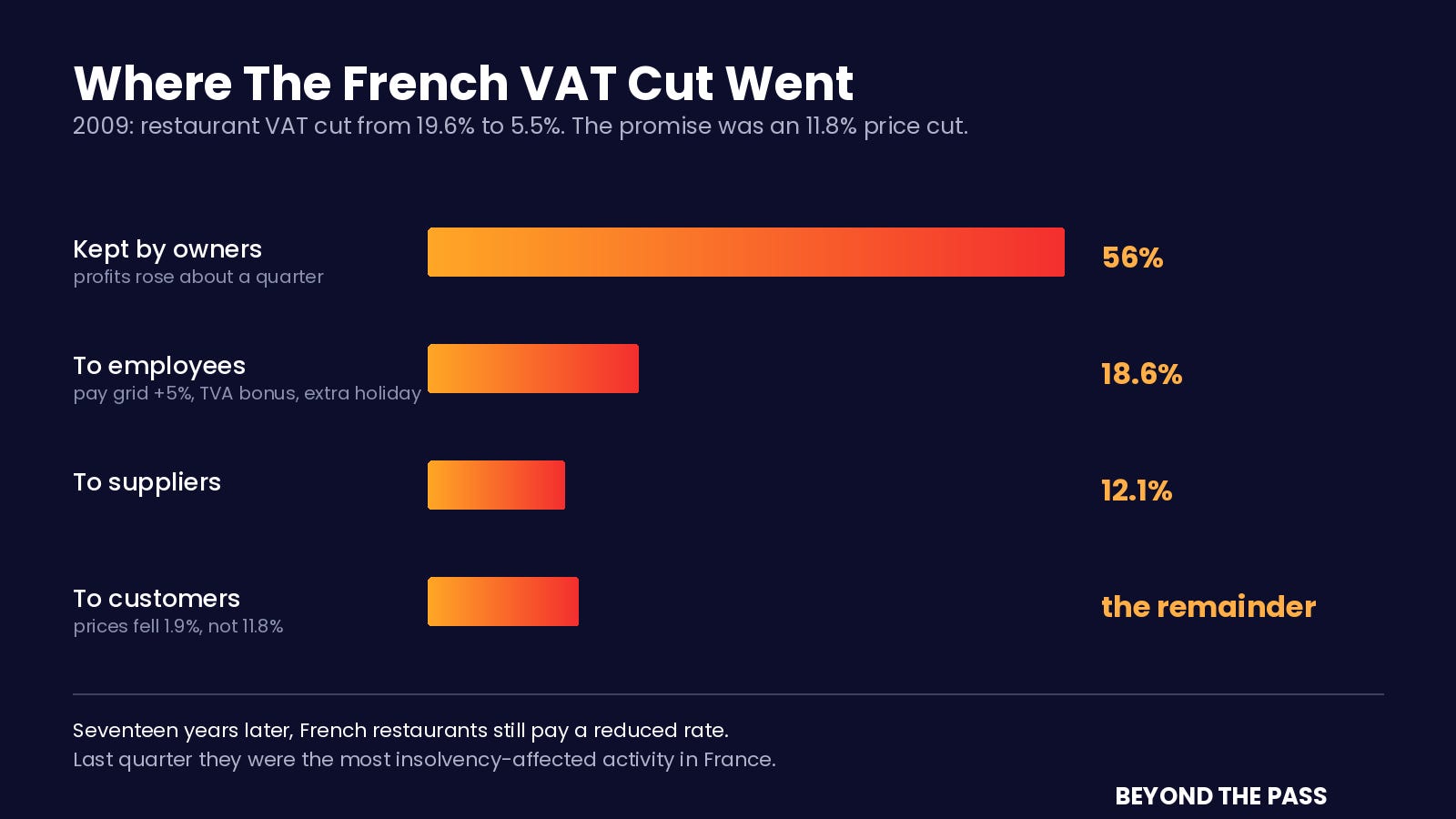
Thirty months after the cut, prices were down by around 1.9%.
The commitment was 11.8%. The delivery, two and a half years later, was under 2%.
Where did the rest go? The IPP tracked the allocation. Roughly 56% was retained by restaurant owners, whose profits rose by about a quarter. Around 18.6% went to employees, which is not nothing: the December 2009 social accord redistributed roughly €1bn a year to sector staff through a 5% increase in the pay grid, a prime TVA bonus and two extra days of holiday. About 12.1% went to suppliers. The remainder, something in the low teens as a share of the total, reached customers.
Then came the reversal, and this is the part that should concern anyone campaigning for a rate that a future government could revisit. When French VAT went back up, to 7% in 2012 and to 10% in 2014, prices rose four to five times faster than they had fallen. Customers absorbed roughly half of each increase almost immediately. The tax came down slowly and quietly. It went back up quickly and visibly.
Ireland’s experience points the same way. The Irish Fiscal Advisory Council found their 2011 cut from 13.5% to 9% was around 50% passed through, their 2020 cut showed almost no measurable pass-through on takeaway prices, and their VAT increases were passed through considerably more strongly than their cuts. Cut it and the customer barely notices. Raise it and they pay.
An operator reading the French numbers might reasonably say: good. The money stayed in the businesses. That is exactly what we want.
And they would have a point, because that is broadly what the UK campaign is asking for. Tom Kerridge is reported to have told a UKHospitality event in June that the sector should absorb the cut rather than pass it to customers, and perhaps pass savings on in two or three years, because the immediate purpose is to stabilise businesses and stop them closing.
That is an intellectually honest position and I have sympathy with it. But it does mean the campaign cannot simultaneously argue that a VAT cut makes hospitality more affordable, drives volume, and pays for itself through growth. If prices do not fall, customers do not get cheaper meals, demand does not rise, and the cut is a producer subsidy rather than a stimulus. It may still be a defensible subsidy. It is not a growth policy, and both the French data and the industry’s own stated intention say so.
Here is the part that matters most for anyone running a pub or a bar, and I have not seen it raised once in months of British coverage.
In France, alcohol is taxed at 20%.
Not 10%. The French reduced rate covers food and non-alcoholic drinks for immediate consumption. Every glass of wine, every beer, every cocktail, every spirit, served on the premises or taken away, carries the full standard rate of 20%. Exactly what a British operator pays today.
Consider what that means for the “in line with Europe” argument. A wet-led community pub in France, the kind of place where the bar is 70% of takings, receives almost nothing from the famous French 10%. The reduced rate is a food rate. If Britain copied the French model precisely, the pub sector, the part of our industry closing at the most alarming rate and among the most prominent in the campaign coalition, would get relief on a minority of its sales.
The campaign asks for 10% across hospitality including pubs and bars, which is more generous than the French system it cites as its benchmark. That is a perfectly reasonable thing to ask for. But “in line with Europe” is doing a lot of work in that sentence, and on the wet side it is not accurate.
There is a second detail worth knowing, because it is what a reduced rate actually feels like to operate. France does not have one hospitality rate. It has three running through the same till. Food and soft drinks for immediate consumption at 10%. Food not intended for immediate consumption at 5.5%. Alcohol at 20%. A €35 set menu including a glass of wine has to be split between its 10% and 20% components on a defensible basis. A cold pre-packed sandwich is 5.5%; toast it to order and it becomes 10%. French accountants describe VAT as the line that generates their most avoidable tax reassessments. Reduced rates are not free. They arrive with a boundary, and the operator administers the boundary.
If a reduced rate were the determining variable, France should be comfortable. Instead:
Failures across French hotels, cafés and restaurants reached 8,714 in 2024 and 9,434 in 2025. In the first half of 2026, 5,032 collective proceedings were opened in the sector, up another 5.4%. Restaurant proceedings in the second quarter alone numbered 1,969, up 9.9% year on year, and close to two-thirds of proceedings across the sector are straight liquidations rather than restructurings. The GHR, the French hospitality federation, has written to the Prime Minister asking not for a further VAT cut, but simply for no new charges in 2027.
Meanwhile the French out-of-home food market hit a record €128.3bn. Turnover at an all-time high, operators failing at record rates. If that pattern sounds familiar, it should. It is precisely what is happening here.
What French operators are actually dealing with is a cost structure moving faster than their prices can. Payroll running at 35% to 42% of turnover in a sector where a cook on €2,200 gross costs the employer around €3,124, an on-cost of roughly 42%. A 2026 reform that removed reduced employer contribution rates on lower salaries. Food inflation that has made technical sheets obsolete: olive oil up 28%, butter up 12%, chocolate up 53%, with two-thirds of French restaurateurs pulling dishes from menus in response. A plat du jour that has crossed €17 and pushed weekday lunch customers into supermarkets. And according to the Banque de France, only three restaurants in ten now qualify for bank refinancing.
That is the same disease we have. Labour cost rising faster than pricing power, input volatility outpacing menu revision, and a customer who has reached a psychological ceiling on what a meal is worth. The tax rate changes the size of the wound. It does not appear to change the diagnosis.
I am an operator, not a tax economist, so treat what follows as suggestions rather than modelled policy. But if the sector is going to spend its political capital on one demand, it is worth asking whether this is the right one.
Start with the arithmetic of the ask. The cost shock hospitality absorbed was around £3.4bn a year: roughly £1.9bn in wages, £1bn in employer National Insurance, £0.5bn in business rates. The VAT cut costs £10.5bn on HMRC’s own numbers, and more once you allow for businesses in adjacent sectors rearranging themselves to sit on the cheap side of a new tax boundary.
So the industry is asking for approximately three times what was taken from it, through a mechanism that reaches none of the 45% of hospitality businesses sitting below the VAT threshold, while delivering an estimated £430m to McDonald’s.
A Chancellor can decline £12bn without much difficulty. Declining £3.4bn, precisely reversing a documented and recent shock, is politically far harder. The campaign may have made itself easier to refuse.
Employer National Insurance relief on younger workers. Hospitality employs 28% of all 18 to 20-year-olds in the country, and workers aged 20 and under are around a quarter of the sector’s workforce. A NIC relief targeted at under-21s or under-25s would be relatively cheap, because the population is small. It would land disproportionately on hospitality without naming hospitality, which avoids the precedent problem of a sector-specific tax rate. It creates no boundary for supermarkets, cinemas or serviced apartments to exploit. And it attacks the actual injury, because what has happened to this sector is a labour cost shock, not a sales tax shock. A labour-intensive industry gets more from a labour tax cut than from a consumption tax cut. That is targeting working properly rather than by accident.
Restoring the business rates cliff. Retail, hospitality and leisure relief fell from 75% to 40% in 2025/26, worth roughly £500m to the sector. It is discrete, recent, identifiable, and hits occupied premises directly. Restoring it is cheap and precise. The honest caveat is incidence: a good deal of rates relief gets capitalised into rents over time, so landlords capture part of it. That argues for structural reform, more frequent revaluations and liabilities that track real rents, rather than permanent relief. But even as a stopgap it is better value per pound than a VAT cut.
Fixing the VAT threshold cliff edge. This is the one that answers the “45% get nothing” problem, and I have not seen the campaign raise it. A business turning over £89,000 pays no VAT at all. Cross £90,000 and it owes VAT on everything. The effective marginal rate at that threshold is punitive enough that operators deliberately close on quiet days, turn away work and cap their own growth to stay underneath it. Tapering the threshold so liability phases in rather than cliff-edging would help precisely the smallest businesses a rate cut cannot reach, and would remove a genuine disincentive to grow. It is smaller, cheaper and better aimed than anything currently on the table.
There is one more thing worth saying, and it comes out of the French data rather than out of tax policy.
The French cut failed in a specific way. It put cash into businesses that did not change how they operated. Owners kept 56% of it, profits rose about a quarter for a period, the cost base kept moving underneath them, and within a few years the sector was asking for something else. The money was absorbed rather than deployed.
That is not a criticism of French operators. It is what happens when relief arrives at a business that cannot see its own numbers clearly enough to put the money somewhere it compounds. An operator who does not know their real labour cost per hour, which dishes are structurally negative, or where their wet margin actually sits after wastage will absorb any relief into the same leaks that were there before it arrived. Give them the money and no better visibility, and in three years they are in the same position, asking for the next intervention.
Whatever the rate ends up being, the businesses that come through this period will be the ones that could see where the money was going. Support that builds that capability, attached to relief rather than instead of it, would do more for the sector’s resilience than the same money handed over unconditionally. France’s contrat d’avenir had exactly this instinct, with conditions on prices, pay and investment. The lesson from 2009 is not that conditions are wrong. It is that conditions without enforcement are decoration.
None of this means a UK cut would be pointless. It would put real money into real businesses, and operators deserve a straight number rather than a slogan.
If prices stay where they are, a move from 20% to 10% is worth 7.58% of your gross sales. Not 10%, because VAT is charged on the ex-VAT price, and this is the single most common error in the discussion.
On £300,000 of annual takings, that is £22,727 a year.
On £500,000, it is £37,879.
On £1,000,000, it is £75,758.
For a site doing £500,000 and running at, say, £15,000 of annual profit, £37,879 is not marginal. It is the difference between a business that survives and one that does not. Anyone dismissing that as trivial has never run a site.
But hold that figure against two others. UKHospitality puts the sector’s recent cost shock at roughly £3.4bn a year. HMRC puts the cost of a 10% rate at £10.5bn a year, with independent analysis suggesting £12bn or more once boundary effects are counted.
And the money is not distributed the way the campaign’s imagery suggests. Around 45% of hospitality businesses are not VAT registered at all. They sit below the threshold, they have been hit hard by minimum wage increases, and a VAT cut does nothing for them whatsoever. Meanwhile the largest single beneficiary would be McDonald’s, at an estimated £430m a year, with Mitchells & Butlers, Whitbread and Wetherspoon each collecting well over £190m. Wetherspoon’s own cost shock is estimated at around £63m; its VAT gain would be roughly £193m, about three times what it lost.
There is a genuine argument for that. Chains employ people, pay rates and keep high streets occupied. But it is not the argument the campaign is making, and the independent pub in your village is not the primary financial beneficiary of the thing it is being asked to campaign for.
I am not against the cut. If it comes, I will be glad, and so will every operator I work with.
What concerns me is the framing. “VAT’s the problem” is a single-cause story about a multi-cause failure, and single-cause stories are dangerous for operators specifically, because they externalise a problem that is partly internal. If VAT is the problem, the answer is to campaign and wait. If VAT is one of several problems, there is work to do in your own building this week, regardless of what the Treasury decides in the autumn.
The French evidence suggests something more uncomfortable than either side of this debate wants to say. A reduced rate is real money and it does help. It also gets absorbed into a cost base that keeps moving, and within a few years the sector is back where it started. France cut restaurant VAT by fourteen points in 2009 and its restaurants are failing at record levels in 2026. That is not an argument against the cut. It is an argument against believing the cut is the answer.
The operators I have seen come through this period were generally not the ones with the best political arguments. They were the ones who knew their real labour cost per hour, which of their dishes were structurally negative, where their wet margin actually sat after wastage, and which services made money rather than which felt busy. None of that is glamorous, and none of it is a substitute for a fairer tax system. But it is available now, and it is within your control, which is more than can be said for the Budget.
Sign the petition. It is a reasonable ask and I hope it succeeds. Then go and run the numbers on your own site, because if it does succeed, 7.58% of your gross sales is going to land in a business you should already understand properly, and if it does not, you are going to need those numbers even more.
---
Sources: Institut des politiques publiques evaluation of the 2009 French VAT reform; Benzarti and Carloni, AEJ: Economic Policy, 2019; Tax Policy Associates, June 2026; HMRC costings via Parliamentary answer UIN 108537; Altares and GHR insolvency data, France 2024 to 2026; Insolvency Service data for England and Wales; UKHospitality cost estimates; Irish Fiscal Advisory Council pass-through paper, 2025.
This is part of the Beyond the Pass series on hospitality economics, the numbers that decide whether a site makes money but rarely show up cleanly in the accounts. If you run or advise a hospitality business, subscribe for the frameworks most operators never get taught.
Next post: VAT: The relief buys you three years.
is public so feel free to share it.
No posts
Comments
Nothing yet. Say the first thing.
Sign in to join the conversation.