
🎧 Beyond the Pass — Operator Podcast (1:41)
Pub pricing math for 70k profit
0:00
-1:41
Prefer reading? The full breakdown is below.
A 44-cover village pub in the Peak District. The owner had been at £14 on his most popular mains for nearly three years.
He was convinced £14 was the ceiling. Everyone in the area was running £12 to £15 on pub mains. Anything above £15 felt like a different category. Anything above £16 felt impossible. He’d watched neighbours try £17 specials and pull them back within two months. The market, in his words, “wouldn’t take it.”
When I asked him how he’d tested this, he went quiet.
He hadn’t. He’d inherited the belief from the pub down the road, from his accountant, from a vague sense that customers would leave if he pushed past £14. It was a ceiling held in place by nothing more than industry folklore.
Eight weeks after we restructured his pricing, he was charging £19 on his slow-cooked lamb shoulder, £21 on his duck, and £23 on his steak frites. Covers were stable. The room felt the same. He was making roughly £1,400 more a week in contribution margin.
Over £70,000 a year, on the same menu the customers had been ordering for three years.
This is the most expensive belief in UK pub economics. The £12 to £15 price band isn’t a customer truth. It’s an operator habit. And it costs more than almost any other single decision a pub makes.
There’s a body of behavioural research dating back to the 1970s that explains exactly how customers process menu prices. The short version: they don’t compute. They anchor.
When a customer looks at a pub menu, they don’t tally individual prices and compare against some internal benchmark. They glance at two or three dishes, form an impression of “what this place costs,” and order. The dishes they use to form that impression are almost always the ones they’re considering ordering, or the ones they recognise from other pubs.
Those are your anchor dishes. Usually three or four items. Almost always the highest-traffic dishes on the menu. Fish and chips. The burger. The Sunday roast. The flagship steak. These are the dishes that set customer perception of your pricing.
Every other dish on the menu, the customer barely registers. They might glance at the duck or the lamb shoulder, but unless they’re considering ordering it, the price doesn’t form part of their judgement of the menu. They register that a duck exists. They don’t register that it costs £21 instead of £18.
This is the entire game. The dishes that drive perception are not the dishes where you have pricing room. The dishes that drive perception are the dishes you must protect at all costs. The dishes that don’t drive perception are where the £70,000 lives.
There’s a simple two-axis model for thinking about menu pricing. Order frequency on one axis. Contribution margin on the other.
Every dish on your menu sits in one of four quadrants.
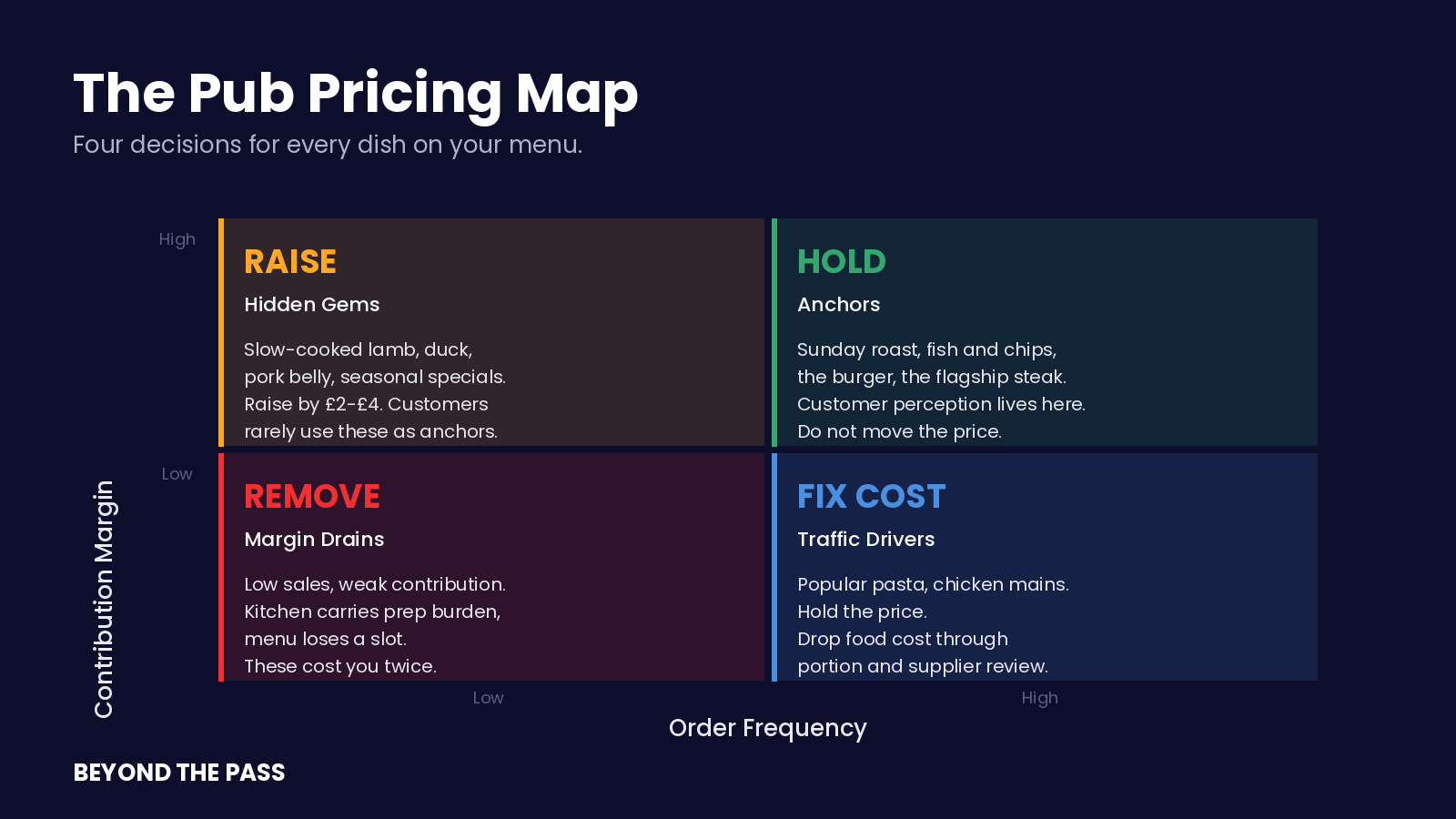
High frequency, high margin: Anchors. These are your traffic-driving, margin-healthy dishes. The Sunday roast, the fish and chips, the burger that customers order three times a week. These dishes pay the rent. Customer perception is anchored here. Do not move the price.
High frequency, low margin: Traffic drivers. Dishes customers order constantly but that have weaker margins. Often the burger, certain pasta dishes, the chicken. These dishes are the reason customers come, not the reason you make money. Price changes here disrupt perception without rescuing margin. Hold the price. Fix the food cost instead.
Low frequency, high margin: Hidden gems. This is where the £70,000 sits. Dishes that sell modestly but contribute well per cover. The duck. The slow-cooked lamb. The pork belly. The seasonal special. Customers barely notice their price because they’re not used as anchors. This is where surgical pricing happens.
Low frequency, low margin: Margin drains. Dishes that don’t sell well and don’t earn well when they do. The kitchen carries the prep burden, the menu loses a slot, the customer rarely chooses them. Remove these. They cost you twice.
Most pub operators run blanket price increases or blanket no-changes. The ones who beat the £14 ceiling are the ones who treat the four quadrants as four separate decisions.
The owner ran the audit with me on a Tuesday afternoon. We listed every dish by weekly sales volume and contribution margin. Twelve mains in total.
The anchors were obvious. Sunday roast at £18.50, fish and chips at £14.50, burger at £14, classic ham, egg and chips at £12. These four dishes accounted for 64% of weekly main sales. We touched none of them.
The traffic drivers were two pasta dishes and a chicken main. Decent volume, weaker margin. We held all three prices flat and started a separate project to bring the food cost down through portion review and supplier negotiation.
The hidden gems were the four dishes that became the pricing project:
Slow-cooked lamb shoulder: £16 → £19
Duck breast with confit leg: £18 → £21
Pork belly with apple: £15 → £18
Steak frites: £19 → £23
The remaining dish was a seasonal trout that wasn’t pulling weight. We removed it.
Eight weeks later:
Total weekly covers: stable (within normal variance)
Anchor dish sales: unchanged
Hidden gem sales: down by roughly 11%
Contribution margin per cover: up £2.40
Weekly revenue: up £1,400
Annualised contribution gain: over £70,000
The 11% drop in hidden gem sales is the part most operators panic about. They see the volume dip and assume the pricing failed. It didn’t. The remaining customers ordering the lamb at £19 were contributing roughly £5.40 more per dish than the customers who’d been ordering it at £16. The volume dropped, the contribution rose.
This is the maths the £14 ceiling believers never run. Even with fewer hidden gem sales, the per-cover contribution increase across the whole menu produced the £70k figure. Because the calculation isn’t about each dish in isolation. It’s about the menu as a system.
Three failure modes destroy this strategy. All three are common, all three are avoidable.
Failure 1: Blanket price increases. The most common mistake. Operator decides prices are too low, raises every dish on the menu by £1 or £2. Customers notice immediately because the anchor dishes moved. Covers drop. Revenue falls. The 38-cover restaurant I’ve written about before lost £14,000 in a single quarter this way. Never raise an anchor.
Failure 2: Anchor pricing changes driven by FOMO. “The pub down the road just raised their fish and chips to £16, so I will too.” This is the slowest possible suicide. The pub down the road has different anchors, different customers, different brand perception. Raising your anchor because someone else raised theirs is the opposite of strategy.
Failure 3: Hidden gem pricing that’s too timid. £16 to £17 on a hidden gem isn’t surgical pricing. It’s hesitation. The contribution gain is too small to justify the operational change. If you’ve identified a hidden gem and decided to raise the price, raise it meaningfully. £3 to £4 on a £16 dish is the right magnitude. The customer who orders the duck at £21 instead of £18 didn’t notice the £3.
Three steps. Forty-five minutes if you have last quarter’s sales data.
Step 1. List every main on your current menu by weekly sales volume. Highest first, lowest last.
Step 2. Calculate contribution margin per cover for each dish. Menu price ex-VAT minus food cost minus a labour minute charge if you have one. This is approximate. Precision matters less than relative ranking.
Step 3. Map each dish to a quadrant.
Top third of sales volume + above-average contribution margin = Anchor. Hold.
Top third of sales volume + below-average contribution margin = Traffic driver. Hold price, fix food cost.
Bottom two-thirds of sales volume + above-average contribution margin = Hidden gem. Raise by £2 to £4.
Bottom two-thirds of sales volume + below-average contribution margin = Margin drain. Remove.
Most pubs find three to five hidden gems sitting at prices that haven’t been touched in two or three years. Each one carries between £600 and £1,400 a year in unrealised contribution. The £14 ceiling doesn’t exist anywhere in the customer’s head. It only exists in the operator’s.
The Peak District pub kept the same staff, the same suppliers, and the same supplier costs for six months after the pricing restructure. No new marketing. No menu rebrand. No customer communication about the pricing changes at all.
Customer perception of “what this pub costs” was untouched because the anchors didn’t move. The hidden gem buyers paid the new prices because their dish was worth it and they weren’t price-comparing against the burger. Contribution rose by 17% on the same cover volume.
The £14 ceiling isn’t a customer truth. It’s an industry inheritance. Most pubs are running it because the pub down the road is running it, and the pub down the road is running it because the pub down its road is running it, all the way back to a belief that nobody can quite remember where they got from.
The customers stopped caring about that ceiling a long time ago. The operators who notice are the ones who collect £70,000 a year nobody else is collecting.
Free 15-minute diagnostic that surfaces these numbers automatically here.
Thanks for reading Beyond the Pass! This post is public so feel free to share it.
No posts
Comments
Nothing yet. Say the first thing.
Sign in to join the conversation.