
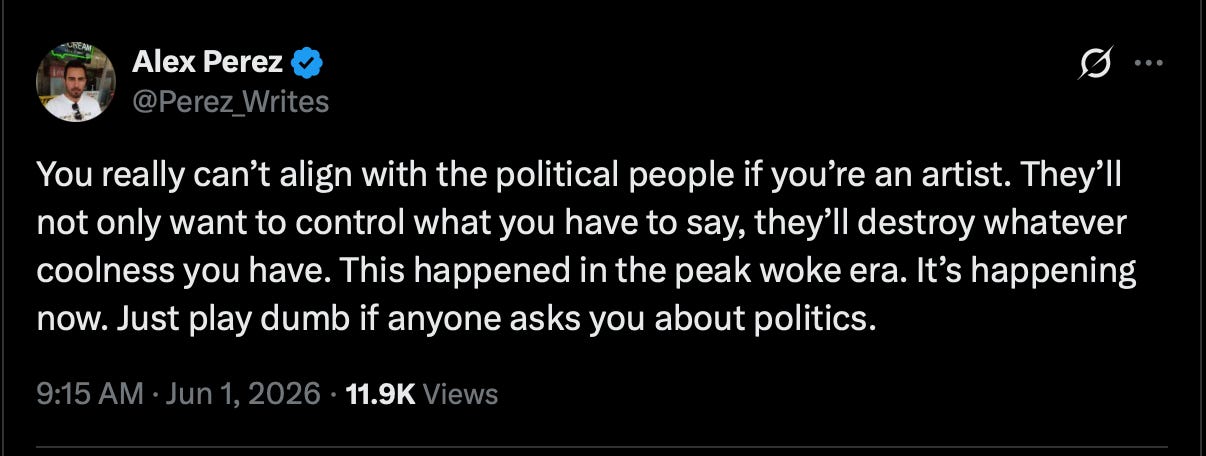
Alex Perez excels at being a lightning rod. Perhaps some day soon he’ll be known as the writer who launched a thousand quote tweets, and with any luck at all, there still will be readers for his fiction too (which, frankly, I’m less familiar with myself, but I’d like to believe I’ll get to it among the ever proliferating number of works I mean to read if given sufficient time). Perez is good at provocations, and I’d never assume that a writer on social media is necessarily espousing deeply considered and serious beliefs as opposed to ‘shoot from the hip,’ shake-the-branch-and-see-what-falls sallies. That might be a little bit of what’s happening in the above tweet, and I guess this piece then probably figures as one more apple falling from branch to soil.
I don’t even believe that Perez is exactly wrong. The stance he’s striking — standing up for the apolitical, the unaligned — has a long history within the arts and literature, and to be sure, I would agree with anyone who argues that for art really to take hold, the work has to shun didacticism and avoid easy binaries, or else risk expiration before anyone even takes it down from the shelf. Activism is activism for a reason, and if I believe I can guess what fiction is going to say before I open the cover, then why engage? I want to be enticed and surprised; to buy into a fantasy of seeing through new eyes — and the fantasy doesn’t have to be sequestered to the dream realm either. Easy to forget sometimes that everything human-made was first dreamed up.
For identity, isn’t it much the same? There are, to be sure, those whose identities are expressly political in the sense of “publicly contested,” or outright denied, usually by those of more traditionally entrenched religious persuasions, itself a form of fantasy for channeling and structuring human passions across the centuries. Put simply, there will always be people for whom the question of whether to “do politics” cannot be avoided because some significant swath of the majority seeks to stifle their brand of self-expression.
Yet the power of lasting art is often in the swerve, what isn’t necessarily stated outright about the work by the author, or what exists off to the side of what is stated for the reader to discover. The recipient of the work has to be left some space to generate a response, to translate feeling to words, and if the work is militant about what the recipient must take away, well, that’s boring, and risks a sort of spiritual authoritarianism, which too often (when arts are reified as state programming) tips toward literal authoritarianism.
As with much else, the practice that Perez is arguing for (political agnosticism, or concerted refusal of alignment) abides as part of a dialectic, for which there is a twinned counterpart in contraposition: Art for the most gifted of artists may live in avoiding political megaphoning, while at the same time we all exist in a society whose shape is determined by political outcomes. To engage that frontier with passion is a choice many have made, especially as writers during times of pronounced technological upheaval.
It is that technological upheaval which I have previously pointed at as the underlying factor —essentially, the new and ever-heightening power structure — for much of what ordinary citizens recoil from when it comes to politics, as those aligned with one party accuse the other of overreach based on what the technology itself facilitates, or even makes inevitable without regulation. You are not reading this, after all, in a printed book or magazine, but on a website that tracks data, and feeds that data to the owner who does with it who knows what, undoubtedly with an eye toward monetization.
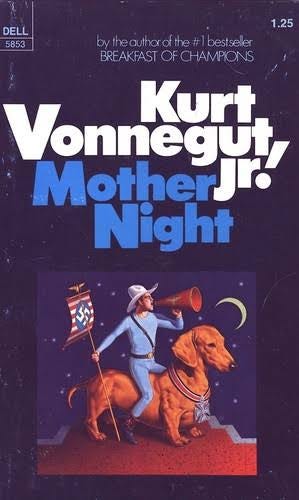
The distribution of wealth is what arguably determines the health of a society, and when there’s too much ballooned at the top, where money makes money, and hard work and focus and drive don’t necessarily help any dedicated striver to break through, the downstream effects become more virulent. At this moment the difference between the wealthiest platform owners who have succeeded at tipping the tables toward their coffers on a scale that truly boggles the mind, and the rampant corruption emanating from the White House, starts to blur, especially since so many of those platform owners have aligned themselves with the president. Going through the motions, I suspect they will claim in any possible post-Trump world, they only meant to gain favorable outcomes for their companies, but as Kurt Vonnegut famously wrote in Mother Night: “We are what we pretend to be, so we must be careful about what we pretend to be.”
Maybe the belief, these days, is that nobody save for a select “elite” of dedicated readers even remembers Vonnegut’s novel anymore?
We are deep in a cultural night. That may be freeing for those who want to work beneath the radar, at the shadowed fringes, as are those, presumably, toward whom Perez intends his advice. Authoritarianism takes hold, however, when citizens cower, when everyday people are so disengaged from political processes that they hold no capacity for public trust. It is the flamboyant flouting of public trust on which Donald Trump has made plenty of hay, and the remarkable thing is that he is not the originator of that gap, but a primary exploiter of it, with the distance between what the public is told and what people believe widening ever since the mid-20th century: Watergate; Reaganism; NAFTA and Clinton-era tech utopian boosterism; W. Bush’s “Mission Complete”; Enron; the Great Recession; Trumpism and the promulgation of A.I. as well-spring of the American economy. (Look to the late 19th century for an earlier American iteration of widespread public distrust: the Teapot Dome scandal from that Gilded Age.)
Perhaps it seems ironic, as a writer of fiction, for me to bemoan this state of affairs. What I’d contend in response is given the French King Louis XIV’s declaration that “L’État, c’est moi,” President Donald Trump seems to believe nothing so much as, “The Fiction is meeeeeeeeee!” Meaning the truth is whatever he tells us, according to him, because the ability to set his fraud in clear relief, he believes, is beyond the general public’s capability, and he and his people appear willing to exert corrupt influence over the levers of democracy to stave off accountability in whatever manner possible. He’s the one on camera, the big boy around whom the world turns, at whose orders the bombs fall and the evidence burns.
Simple fact of the matter? President Trump and his people’s fiction is bad.
It is really, really bad fiction, and what’s most embarrassing of all is how few of them seem aware of that. The kind of fiction that a better read, or more tightly intertwined, general public would immediately laugh off. But the effects of unequal wealth distribution have been taking root for decades now, in the long tail of Ronald Reagan’s presidency: we’ve traded language for image as our primary mode of communication, with literacy rates plummeting as the quality of public education suffers even while, on the other end of the education continuum, adults lack for the uninterrupted time, or quiet, to dive into a book. The wherewithal to read is itself a political outcome, as is the fact that the financially most well-rewarded Americans choose to engage the general public by pouring their wealth into election cycles. It’s a problem (if you see it as a problem) that has been getting worse and worse every four years since the Citizens United decision by the Supreme Court.
What the ultra-wealthy think they are buying is the story the American public will have no other choice but to accept.
Look no further than the $15.9 billion spent on funding the 2024 presidential election cycle.
At the unprecedented $40 million spent by pro-Cuomo, anti-Mamdani superPACs in the 2025 New York City mayoral election.
At the (again) $40 million recently spent in the NY-12 Democratic primary, mainly through PAC spending — the second most expensive House primary ever, not far behind the barely less recent Republican race to oust Thomas Massie in Kentucky.
The even greater sums getting spent in the Senate primary in Michigan between Haley Stevens and Abdul El-Sayed.
I happen to run a small-scale literary magazine whose goal is to engage, however modestly, the general reading public. At this point, we operate on a budget in the low five figures per year; the staff works mainly for free, with the magazine itself functioning something like a charitable organization. As writers look around and decry the present state of affairs where it appears impossible to be paid meaningfully for their work, it seems important to consider just how much money is gushing into media with political outcomes in mind, and how little of that spending, if directed toward culture, would make all the difference in the world.
Notoriously, in the ’60s, the CIA saw fit to direct federal monies to the Paris Review at that magazine’s outset, in what the government apparently then deemed a worthwhile investment. That’s kind of funny now! Imagining an American spy agency taking a concerted interest in literary culture, as if that culture held anything remotely close to the sway it did in mid-20th century America. If the CIA is spending money on culture these days, it’s going, guaranteed, to social media influencers, people working in televisual mediums, but of course it isn’t so much the CIA out there astro-turfing: now, companies whose revenue exceeds the GDP of smaller nations are in on the action too. As are, of course, the political candidates who shill for them.
Is it possible for reading culture to make a comeback? I say it is, and not only because I’m too far gone down that path to entertain hope of an alternative. But any such comeback will arise through the instantiation of values like decent compensation, fair-minded evaluation, and print-based media, all of which have been forsaken in the rush to embrace the new. Eroding, like a rivulet across rock, the underpinnings of what made Norman Mailer or Susan Sontag or James Baldwin or George Plimpton serious national figures, attuned to and in conversation with national politics. Personas known by a broad public and to whom a broad public gives time and respect. That there were, in that same era, authors who eschewed any kind of proximity to politics (Don DeLillo comes to mind, as an example of one who shied from even the remotest appearance of political alignment, even while his novels have deeply political subjects) goes without saying. Again, a dialectic: As passionately as some authors engage, there will be others who refuse the appearance of same. But engagement is still inevitable, a voice offstage whispers.
When the question is Society of the Image versus Society of the Word consider, finally, a line from novelist Adam Levin’s hyper-ambitious, in ways undercooked, but still delightful early novel The Instructions: How reading a novel is akin to entering a defile, “a thin breach through which only one person could pass at a time, a space that an army would have to break ranks in order to trek.”
That breaking of an army’s ranks is reading to a tee. More than a byproduct, it’s the point, one that reaches the independent reader thru a little bit of swerve. To engage with the political landscape, especially in dire times, is not just a nice thing to do with that independence… It’s an absolute imperative.
No posts
Comments
Nothing yet. Say the first thing.
Sign in to join the conversation.