
“Sounds like you’ve been living a Johnny Cash song,” I said.
Always the question of where to begin telling a picaresque.
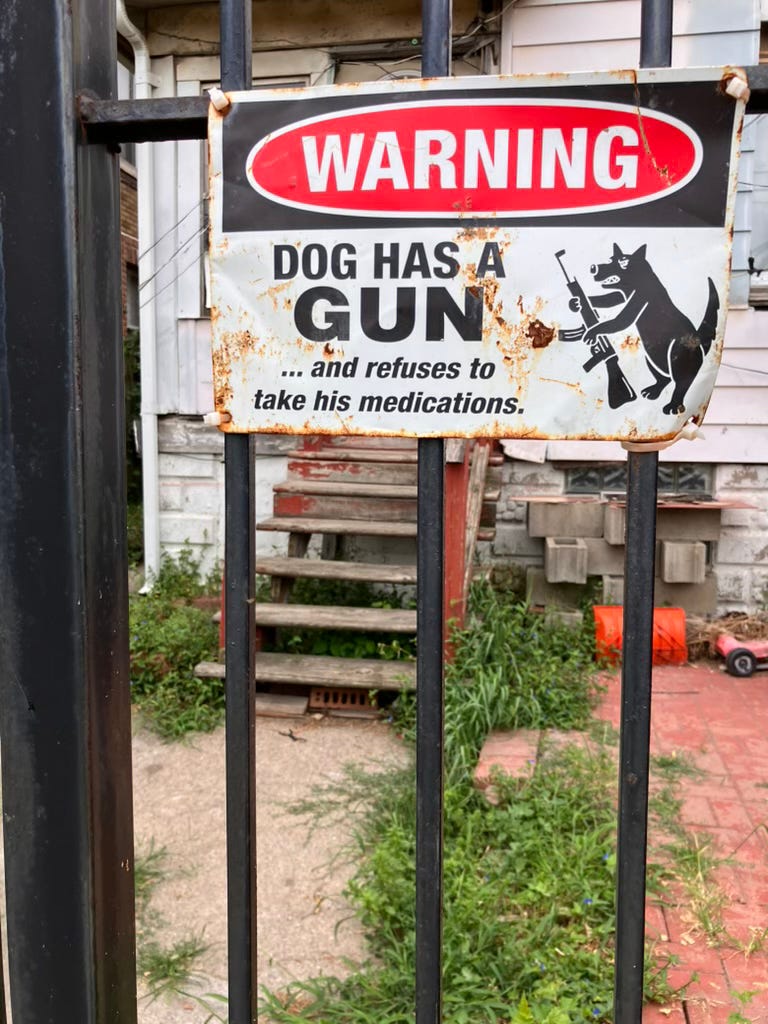
With the 30-year-old guy who momentarily broke from shredding on his electric to speak thru a Ring? “Sorry, I’m working,” he said. The brother caring for his sister in a solitary house surrounded by empty, tall grass-strewn lots, who invited me inside to speak with her where she reclined in front of an old television in a home hospital bed? The middle-aged woman, the first voter I spoke to in Detroit, who said from her back-porch that none of them were gonna vote, because nothing changes, then changed her mind on the spot after I said our slate of candidates are running against the establishment? “Because you showed up here, we’ll do it,” she said. The non-voting father who said he would pass along word to his son as I struggled to make myself understood in rusty Spanish, “Para votar, esta escuela es… el lugar.” The guy who answered his door, big bellied and shirtless, and played dumb until the subject reached Gaza, at which point he said from his stoop with pointed eloquence that he had nothing against Jewish people after I vouched that I am one, but that country is out of control and he would vote for anyone who vowed to stop our tax dollars from going there while they’re massacring kids? With the fifteen or so DSA members from Brooklyn who rolled into Seed the Vote’s headquarters early on Friday afternoon at the same time as I did and sat around me for orientation, so that, from then onwards, other volunteers kept thinking I was DSA too? With the elderly gentleman who said Abdul had visited his church that morning, but still, he remained on the fence because he had seen how Haley can roll up her sleeves and fight, and as a Black man, it’s hard to bet on what’s less than a sure thing? He praised my air of “responsible dedication” and stepped out from behind his latticed grate because he wanted to shake my hand. At the rally that closed out my first day, where I stood in distant proximity to the senatorial candidate himself as he delivered remarks about what Michigan and Michiganders have meant for his desire to be a public servant? The father who called after me from his front porch, “Hey man, you can’t just be going into people’s yards,” after I disregarded a Beware of Dog sign to knock on a screen door behind which I had heard voices? The youngish guy standing in shadows who pointed at the flier I held out and said, word to the wise tone, “No, that guy? He’s into prostitution. That guy? He’s done a lot of nasty stuff. And that guy, he’s just in it for the money.” “Really?” I said. (The lights weren’t on inside his house. His wish seemed to be to sandblast away any shred of idealism I meant to bring to his door, even if each of his assertions landed as dubious at best.) Or with those who didn’t care, as a general practice, to discuss their vote, but who gave hints with either a smile or show of saturnine distance? What about the immigrant father and citizen, keen on voting for the Michigan United Action slate, who startled when he learned that I knew two of his three children’s names because they, too, were listed on the door-knocking app in the palm of my hand? With the unlisted brother of a voter on our list who had recently lost his ID, and of whom our team leader confidently declared, “No, he can’t vote in this primary,” even if, because of Michigan’s recent Voting Rights Act, that turns out to have been false, and he could have voted if one of us had known the facts of the matter. (I had questioned, Are you sure?, and confidently, she said, Yes, even if, like me, she was there from New York City.) With the eerie scarecrow weathervane, jutting out just above a fence-line, with pointing arms oscillating in the wind and the rain? One way, then the other. One way, then the other.
Any of those, or all of those, might have proven a fine enough place to begin this, and with that choice, another would necessarily follow, narrative taking form depending on each sequential decision, which in a way is how it feels to knock on a door and wait and be ready to begin conversation in any number of styles, depending. Then, intake of breath, the encounter begins.
It’s a living thing—could turn out this way, or that, nothing certain—then the day ends, another morning arrives, and eventually the people have cast their votes. Possibility becomes accomplished fact.
And the accomplished fact is Dr. Abdul El-Sayed won the Democratic Senate primary in Michigan despite upwards of 70 million dollars spent against his candidacy (fully an 11-to-1 spending advantage ratcheted up to quash his ambitions), including 30 million from AIPAC, along with endorsements from Governor Gretchen Whitmer, Senate Majority Leader Chuck Schumer, and retiring Senator Gary Peters whose seat is the one in play, for his opponent. As well as accusations of sexism and anti-Semitism that seemed meant to reinforce racist stereotypes about Middle-Eastern men.
What Dr. Abdul El-Sayed had going for his candidacy? The Democratic establishment endorsed his opponent; AIPAC spent 30 million dollars showering her candidacy with spending; people across party lines want money out of politics, and for improvements in cost of living that could be brought about by, say, Medicare for All, or the initiative previously overseen by El-Sayed to distribute free prescription glasses to Michigan school children. A significant population of Muslim Americans in Michigan are primed to return to the Democrat fold following the despair and disillusionment of the ’24 presidential.
Then, too, El-Sayed had legion canvassers, including us, in neighborhoods where Stevens seemingly did not have anyone: no boots on the ground, no fliers, only her copious television and online advertising, which, to be fair, did have reach insofar as anybody was paying attention.
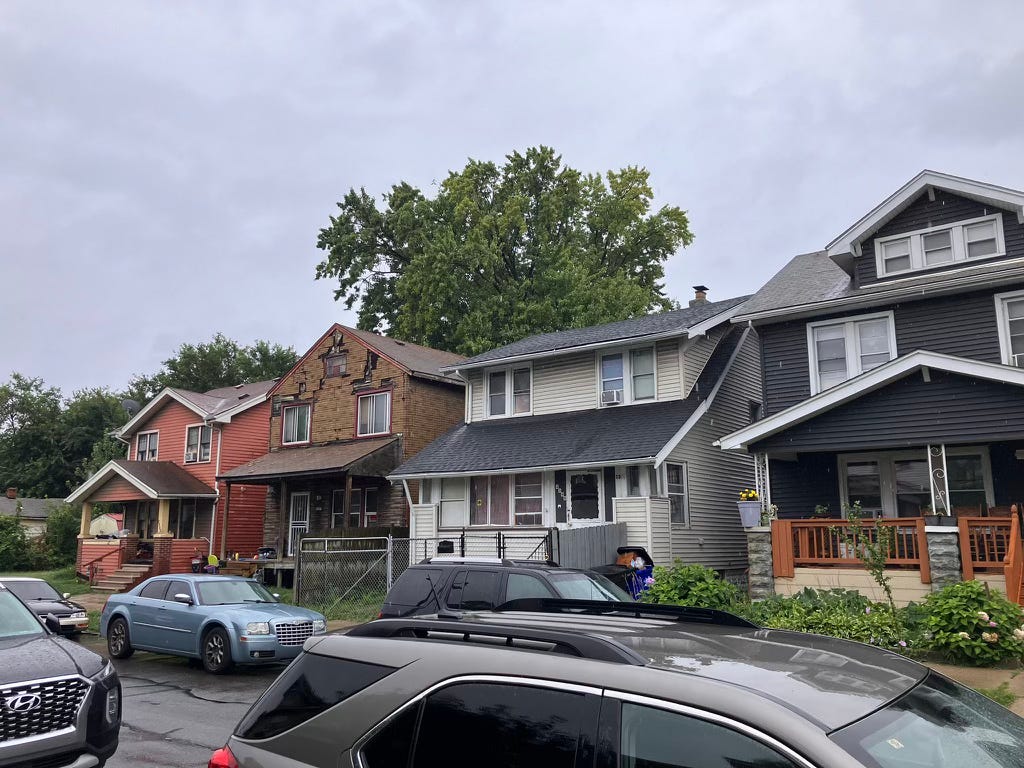
We were in district MI-13, economically the most blighted in Detroit and the entire state, and one of the most sorely challenged in the country (an unwanted top 5 placeholder). Before going out on our first day, we received word about taking care on crumbling stoops, and that warning proved more than merited. Folks repurposed car-seats removed from dead cars as outdoor furniture. Children’s toys lay scattered around here and there like debris of the dream-life. Shake the fence, we were advised, before entering any yard to see if there was a dog loose. And yet even on the most depressed block, even with houses cratered by fire or neglect over time, there were homes well-kept, with teeming gardens out front, and creative outward-facing displays by the family within. American citizens marking a place as their own on this Earth. Heavy wooden furniture that had the look of mid-century Americana, perhaps left behind by owners of a prior era, had migrated, chipped and with glass panelling gone, to front porches where now, rather than porcelain or other displayed finery, the open-air cabinets held potted plants. The final block where I knocked, on Sunday, in Highland Park, featured a neat lane of beautifully designed Tudor houses, which appeared to be mostly Black-owned, representing an old version of Henry Ford’s Detroit and a middle-class majority; it was a sunny afternoon, and the conversations I had there were good, warm-feeling, even among a demographic that the numbers say were Haley Stevens-inclined. Getting carried away, at the end of one such conversation, I paid compliment to the neighborhood, and the resident smiled back at me in a way that said she wasn’t going to contradict my words but that I was perhaps taking too sunny a view, as I discovered on my drive back to headquarters where I beheld, only a few blocks away, partially caved in houses among other outward signs of poverty and want.
We were turning out voters in MI-13, and hearing from them, and perhaps, we hoped, tamping down Stevens’ margins. Widespread refrains at the doors: the older woman in the home hospital bed cared for by her brother said that she had cast her mail-in ballot for Stevens because Stevens had been endorsed by Obama. Which wasn’t true, even if the Stevens campaign had released misleading advertisements to that effect, which I relayed to her, and how Abdul stood for Medicare for All, which she wanted, and she said she would see if she could change her vote on going to correct her ballot, if she could muster the strength to do so (it had been rejected for some formal reason). Those who, especially Black voters, voiced alignment with what Abdul has voiced, but questioned his ability to “get it done,” along with the sense of caution around whether he could win in November against the Trump-aligned Mike Rogers, under whose policies Black voters would be among the first to suffer. Those who, activated by ad hominem attacks against Abdul, questioned his treatment of women, even as he publicly pleaded that online supporters quit it with the schoolyard taunting of Stevens’ manner and speaking style.
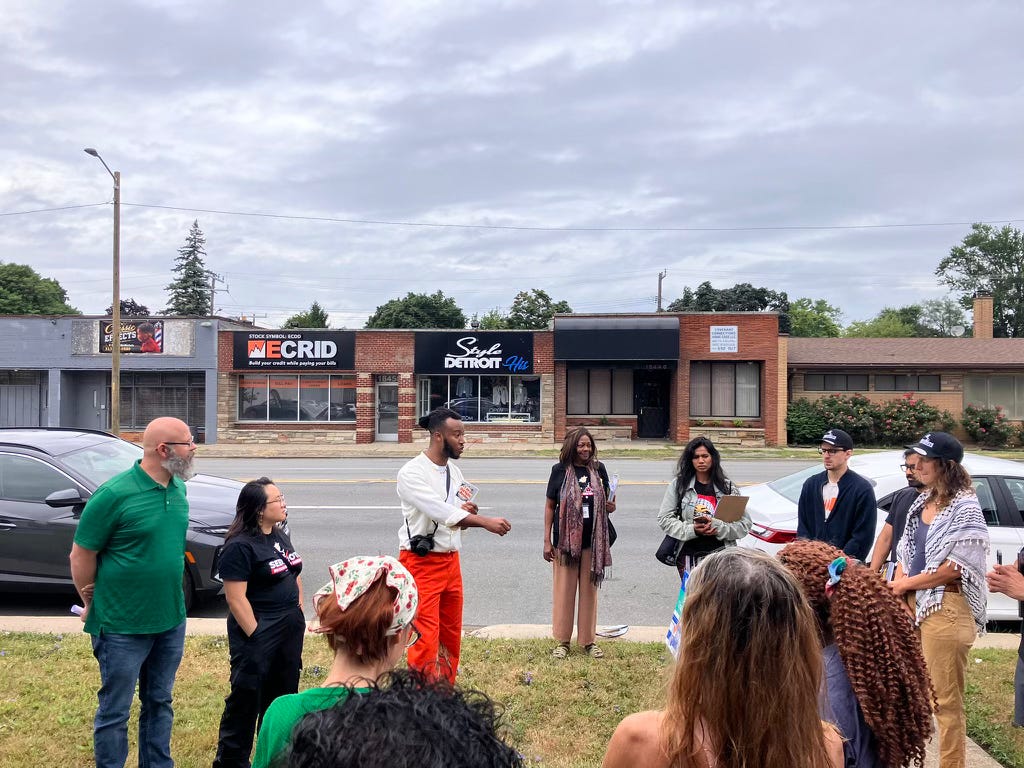
I was out there advocating for the leap of faith. Against cynicism. Against paranoia. Against atomization. Up the steps. Knock-knock-knock-knock-knock [pause] knock-knock (trying to sound a friendly rhythm, shave and a haircut, so as not to be mistaken for police). Face to face. Meeting people where they are. Witnessing their lives on their own grounds. Fighting the good fight in a degraded information environment, speaking to citizens as if on the subject of a shared homework assignment that we’ve all been procrastinating on, but had better fill out before it’s due, “Hey, have you seen this yet? Want to talk about it for a few minutes?”

James Carville appears to have led a pretty nice life, fueled by his work as a political consultant and as a television opinion-maker. His face gets beamed into living rooms far and wide. My understanding is, the youth reflected back at him by any grandchildren in his life, there is no going back in time? (Except, perhaps, through literature or song?) Would not be the first time that grandpa disparaged the ways of the kids even if the ways of the kids are in response to what grandpa has left behind him.
Working class voters exited the Democratic Party because the Democratic Party has mainly failed at delivering for working class voters, and the terms of that failure started to become clear during the Clinton administration through which Carville made his name. Is it beyond the man to envision the DSA as a rational response to our current failure to surmount multiple intertwined crises? Cost of living, public health, environment, the fires, the storms, the endangered crops, collapsing ecosystems, both figurative (information) and literal (coral reefs, icebergs)…
For the DSA, the crisis is real. They roll deep. They meet people on their doorsteps. America, at its best, has always been a pragmatic nation, and if an elderly political commentator can’t see his way to making common cause with any of the DSA’s stated goals, then what exactly has that political commentator been doing for the past thirty years except appearing on television as an end in and of itself?
Hey, nice work if you can’t get it and everything but…
For anybody who believes the future of the Democratic Party will be won in a rout by either centrists or progressives, then the results of the 2026 Michigan Democratic Primary ought to shake them out of that fantasy: there will be no sweep for either side. If AIPAC means to spend for aspiring Trump-lackey Mike Rogers in Michigan this Fall, then first of all, Please, have at, and second, perhaps the stamp of approval from a nation led by genocidal government is one that no Democrat should be seeking, to put it really pretty lightly.
Do I agree with Abdul that the U.S. ought to suspend funding for Israel’s Iron Dome? No, not really, and yet I remain confident that the numbers aren’t close to being there in Congress, even with Abdul sworn in. Did his line, “Hurt people hurt people,” risk coming off as callow, or worse, self-defeating, when the subject is violence against Jewish people, and the candidate’s argument is for universal humanism? Yeah, can see that, but by no means is it a dealbreaker: people learn, people grow, when they put themselves out there. Do I see his stance as rhetorically correct in attempting to rein in the outright war crimes of a young nation led by frothing right-wingers of the sort we have recently seen take power in the U.S. as well? Definitely can get there. The Biden administration will read to history as a cautionary tale about tolerating the excesses and manipulations of a longtime ally, with all the horror that has ensued. Maybe we don’t spend our days trawling X for visual records of destroyed bodies, but Americans sure as hell can’t not see the cost of gasoline spiking from our Netanyahu-provoked adventurism in Iran.
People of good faith are going to find areas of alignment and go from there, and if somebody wants to choose this moment to take the side of the proto-fascists, then we should all ask whether that person wasn’t always prone to reactionary politics? If Mr. Carville wants to choose to despair of organized young people rallying on his side of the aisle, then that says something pretty damning about where Mr. Carville’s priorities have been all along, doesn’t it? Not to mention Mr. Maher. Not to mention MI Rep. Hillary Scholten. Not to mention NJ Rep. Josh Gottheimer, making his voice heard in faux-centrist Bari Weiss’s Free Press, which has done more to advance the tech elitist, Trumpian agenda than just about any other news organ. Be aware of which direction your political allegiance points you, and who is standing at your six.
If he were on the ground in Michigan, and not in a television studio, Mr. Carville would know by conversation that many in the NYC DSA contingent joined after Kamala’s loss in ’24 for want of an effective organizing vehicle and community against a dire future.
He’d know, too, that no matter how the results might have looked on Tuesday night/Wednesday morning, many who voted for Stevens did so out of fear.
Well, in November, let’s hope, the time for fear is over. Time, instead, to be brave. Time instead to stand up for what is possible, and get out of our collective protective crouch. Lock arms. Move forward.
Let me end where I said I was going to begin.
With a Michigander I’ll call Val. The one to whom I mentioned Johnny Cash’s songs.
A sign on the window in Val’s front door identified her as a senior citizen and relayed that the bell didn’t work, so to knock loud and wait on her covered porch.
When she opened and stepped out to join me, I saw a flinty woman who appeared to be in good health. She carried maybe three quarters of a century on her frame.
I shared what I was there for, and whose candidacy we were championing.
“I don’t vote,” she said.
“Did you ever?” I asked.
“Not for a long time,” she said. Then started to share her story. One of thirteen children raised in Detroit. When her father got sick and passed, her mother moved them back to her own native Kentucky, and I could hear the drift in Val’s accent from flattened Michigan directness toward the occasional Kentuckian flourish, all that history in her singular voice. She had moved back to Detroit to raise a family of her own. Only one son, now in his late 30s, with as yet no children. Shortly after his birth, she confronted her husband, who was a good man when she married him, but developed a bad drinking problem, got abusive, and finally, she put her foot down and said one night in the kitchen, “You gotta go, or one of us is leavin’ this room in a body bag.” She was electrified with the retelling of that moment, like somebody detailing the origin of a tattoo.
He left. Of her thirteen siblings, only six are still living, but Val couldn’t even be sure of that number. She hadn’t spoken to any of them in years. One brother used to sleep on the sofa in the house that she owned and on whose porch I was standing, but he got caught up with the wrong people, couldn’t stop drinking and asking her to borrow money, and finally she said she had to cut him off. That was years ago, and she hadn’t seen him since.
Didn’t even know whether he was still around. He didn’t even know that she was sick. “Sometimes you have no other choice but to cut people off,” she said.
I told her that she sounded like a strong person. Made mention of Medicare for All.
Not enough time left, she said, to help her.
“There isn’t anything…?” I said, and her eyes glimmered in a way that said she’d been working on the imminence of her own mortality, nothing else to be done, or hoped for in that respect. And yet there we were, talking, on an afternoon with nice summer weather.
She wanted to bring me a water, but I already had one, a bottle supplied by the organizers tucked in my pocket.
“Maybe for your son,” I said, alluding again to the vote. “For the generation that follows. No way to be certain. But something could potentially come out of it.”
Because of the Michigan Voting Rights Act, all she had to do was show up at her polling place on Tuesday, and they would register her, and she could vote.
Val said she might be taking a walk up that way, and would see about it.
“OK, well,” I said, leaving her with our flyer, “I hope that you do.”
Maybe, she said, “something good could still come of this.”
No posts
Comments
Nothing yet. Say the first thing.
Sign in to join the conversation.