

For four decades, the 60–40 portfolio was the default solution for balanced investing. Equities delivered growth, bonds provided defence, and the combination produced exceptional risk-adjusted returns.
That success, however, was not timeless. It was the product of a very specific macro regime: the globalised, disinflationary era from roughly 1980 to 2020.
Both equities and bonds benefited from falling inflation and declining interest rates, and, crucially, their correlation turned negative. When equities struggled, bonds typically provided an offset.
That dynamic has now changed. Bonds and equities increasingly move together, particularly during periods of inflation stress. More broadly, three forces have fundamentally altered the macro backdrop.
Yet many portfolios remain rooted in an approach designed for that earlier era. What is required instead is a portfolio structure that can adapt as regimes shift.

Inflation is no longer stable
First, inflation has become structurally more unstable. Many of the forces that pushed inflation steadily lower for decades — globalisation, expanding labour forces, the peace dividend — have stalled or reversed.
In this environment, inflation shocks are more frequent and less predictable. That matters because it limits the ability of central banks to cut interest rates aggressively when growth slows. When inflation is sticky, rate cuts are no longer a reliable stabiliser for markets, and bonds cannot be relied upon to hedge equity risk in the way they once did.
Debt has reached a tipping point
Second, public debt levels may have reached a tipping point. The current combination of high public debt and high equity valuations is unprecedented in the post-war era.
US Debt/GDP Ration versus Shiller CAPE 1960-2025
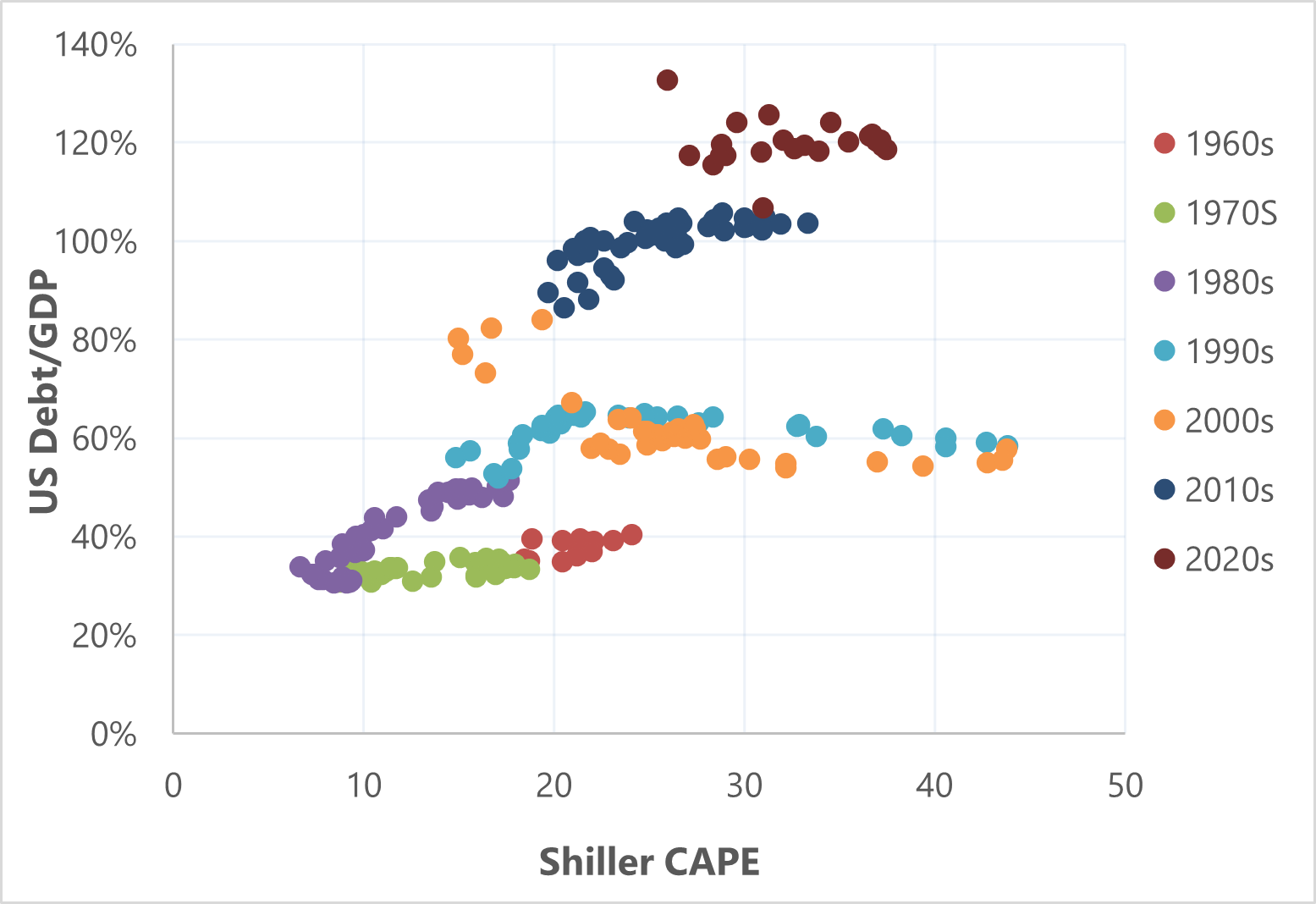
US equities are as richly valued as they were in 2000, but the fiscal backdrop is entirely different. At the peak of the dot-com boom, US debt-to-GDP was roughly half today’s level and the government was running a surplus. Today, debt levels are far higher and deficits are structural.
At the same time, the US economy has become increasingly sensitive to equity markets. Households hold over $40 trillion in equities, creating powerful wealth effects when markets rise — and sharp negative feedback loops if they fall.
Every recession since the war has pushed debt-to-GDP higher. Another downturn could be the one that brings bond market discipline back into focus, pushing yields higher even as growth weakens.
Policy credibility is under pressure
The third fracture compounds the first two: the erosion of central bank independence.
In a world of high debt and low political tolerance for austerity, central banks may increasingly come under pressure to contain rising bond yields rather than inflation. This is the essence of fiscal dominance — and it represents a material shift in the policy regime investors have grown accustomed to.
Taken together, these forces imply a macro environment that is structurally less stable than the one investors enjoyed in the 2010s.

The Limits of Conventional Diversification
For investors, the implications are clear. Many portfolios are still built for the world of the last decade rather than the one ahead. They appear diversified but are dominated by exposures that rely on benign growth and stable inflation.
Once you look through asset labels and focus on underlying economic drivers, the lack of true diversification becomes obvious. Credit, high yield, emerging market debt and even many so-called alternatives tend to behave like equity risk when stress arrives.
In effect, they are designed for stability, not regime change.
A more resilient architecture requires three components, not two:
• growth exposures for long-term wealth creation
• diversifying assets that behave independently when the cycle turns
• adaptive strategies that respond to changing conditions rather than holding static positions
The third category is the one most under-represented in traditional allocations.

The missing piece: adaptiveness
Adaptive strategies, such as systematic trend following and global macro, expand the opportunity set. They can go long or short, shift exposure dynamically and operate across equities, bonds, commodities and currencies.
A useful way to think about them is as the midfield of the portfolio. Growth assets are the forwards; diversifying assets like bonds or gold are the defenders.
Adaptive strategies operate between them, behaving more like growth when trends are favourable and becoming more defensive when conditions deteriorate.
They bring responsiveness and adaptiveness to the overall portfolio. That responsiveness is critical when the macro regime is shifting but the precise path forward remains uncertain.

A Regime-Adaptive allocation
The Regime-Adaptive Portfolio sets out a different approach to structuring multi-asset allocations for a world where inflation, correlations and policy constraints behave differently from the last forty years.
It differs from conventional approaches in four ways:
1. It groups assets by regime behaviour rather than asset label. Labels like traditional versus alternative reveal little about how exposures behave when growth weakens or inflation surprises.
2. It gives adaptive strategies a meaningful share of total portfolio risk. They are treated as a core component, not a small hedge or satellite.
3. It uses capital-efficient instruments, primarily futures, to construct a more balanced risk mix. This avoids the equity-dominant outcome common in a fully capital-constrained framework.
4. It allocates by risk, not capital weights. This gives greater balance to the portfolio and less sensitivity to a narrow range of macro outcomes.
The objective is not to forecast regimes but to build a structure that can function across them. Growth exposures remain essential, but they sit alongside genuine diversifiers and adaptive strategies that can shift the portfolio’s stance as conditions evolve.
The real risk
The dominant risk today is not volatility. It is relying on portfolio structures built for an environment that no longer exists.
A behaviour-based, regime-aware approach offers a more robust foundation for the decade ahead. It recognises that correlations are regime-dependent, that inflation risk can no longer be ignored, and that adaptiveness is no longer optional.
The full white paper expands on this framework and the practical implications for portfolio construction and can be accessed here: The Regime Adaptive Portfolio.
Comments
Nothing yet. Say the first thing.
Sign in to join the conversation.