


With equities continuing their relentless rally after another strong year, the question taxing investors is: how long can it continue?
Yes, valuations are high, but valuations tend to be a poor predictor of the near-term path of the market. And with productivity growth now picking up, it has become popular amongst commentators to draw a parallel with the booming equity markets of the 1990s.
Although the dotcom boom ultimately turned to bust, the rally continued much longer than many envisaged. Could the current backdrop be closer to 1995 than 1999 as the optimists seem to believe?

The similarities with the 1990s
Certainly, there are obvious parallels with the 1990s. A new technology is spurring hopes of a fundamental change in how the economy operates. Back then it was the internet, this time it is AI. The effect on sentiment is the same: a fear of missing out and the belief that high multiples are justified continue to support equities.
But it isn’t just AI hype supporting stocks. Hundreds of billions of dollars of investment have poured into chips, data centres and AI infrastructure, like the capex boom in internet infrastructure of the 1990s. AI related capex has been a significant driver of US growth in the last year and has materially boosted earnings for stocks like Nvidia.
Productivity is another element. In the 1990s greater use of personal computers powered strong productivity growth and Greenspan’s new paradigm economy. To date, the productivity gains from AI have been more anecdotal but strong US productivity numbers in Q3 have raised hopes of a more meaningful trend.
And there are parallels in monetary conditions. Equities dipped in 1994 when the Fed raised interest rates aggressively before recovering and then accelerating with rate cuts in 1995. Similarly, the 2022 rate hiking cycle triggered a meaningful correction in equities but once the tightening was done the market recovered. The rate cuts in 2024 and 2025 have supported the rally.
Equally, in retrospect the Fed was arguably overly easy with policy, cutting rates amid capital markets concerns after the Russian debt default in 1998. Then monetary easing provided a final fillip for the bull run. Now, with the Fed easing policy even with inflation above target, the suspicion is policy may also remain supportive.

What is different this time
Yet, while the comparison with the 1990s is seductive, the reality is that a unique set of circumstances and a particular macro regime drove the extraordinary gains in stocks in the late 1990s.
Although economic growth has been solid, we’re not yet in anything like a new paradigm with growth of 4%+ like we had in the 1990s. With US labour market slowing and payroll growth falling to an average of about 50k per month, growth of 2-3% seems more realistic.
A bigger issue is that the economy is much more unstable and vulnerable when one looks beneath the surface. Much of the growth in the US economy has been driven by large and ever-rising deficits. In contrast, in the mid/late 1990s conservative fiscal policy and a strong US economy saw the fiscal deficit trend down and ultimately a fiscal surplus was produced in 2000.
What’s more, the US economy is increasingly imbalanced, K-shaped and levered to the performance of the stock market. US households own $40trn of equities but those holdings are concentrated in the hands of the wealthy. Rising equities translates into a meaningful wealth effect, boosting sentiment and wealth levels for the top 10%. That has kept the economy moving even as lower income households battle with the affordability crisis.
US Debt/GDP Ration versus Shiller CAPE 1960-2025
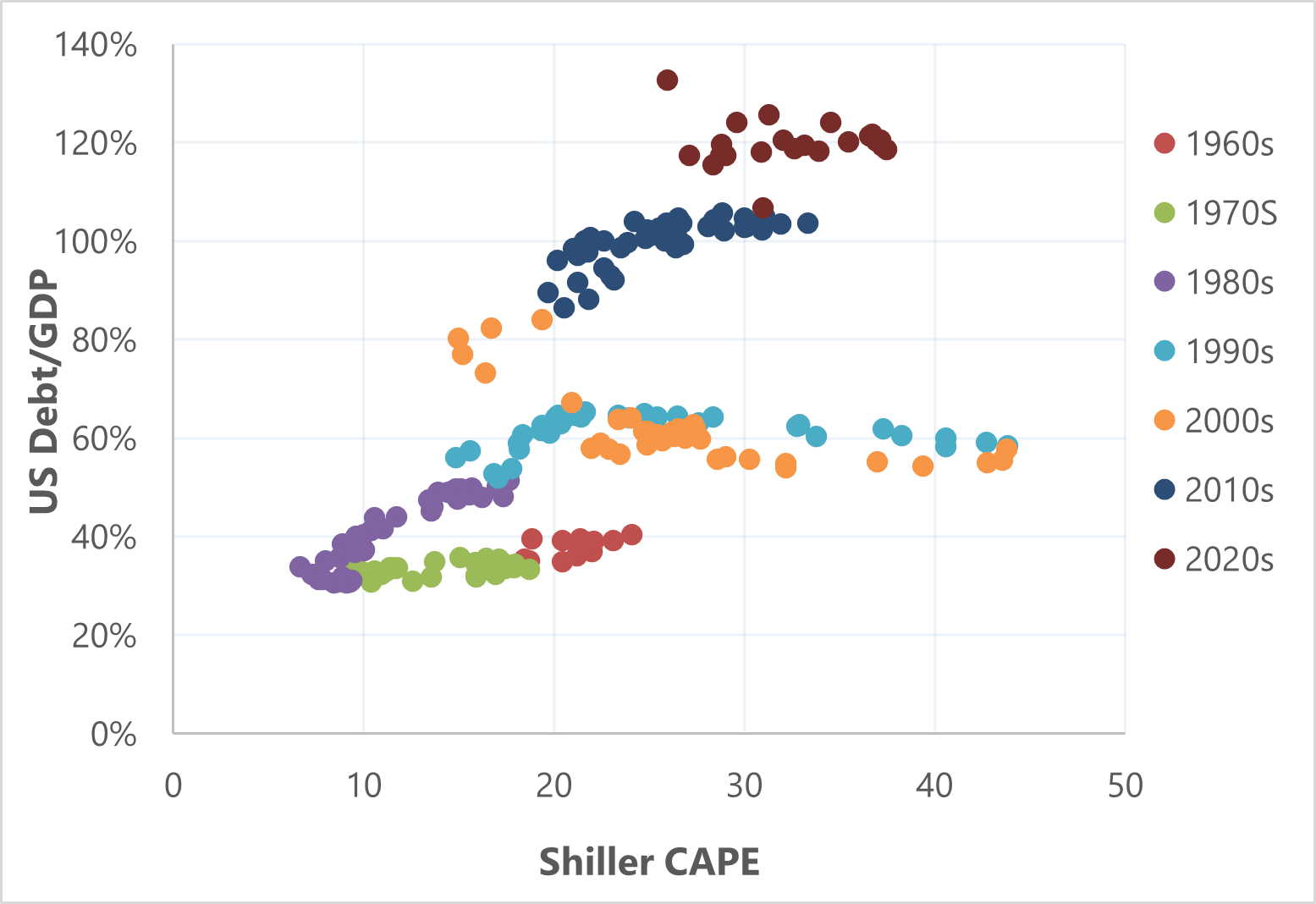
The coincidence of high debt at a time of high asset valuations creates an inherent vulnerability for the economy. If ultimately the AI spend weakens and equities turn down, the impact on consumer demand and economic growth could be materially greater in this cycle in the past. The wealth effect would go into reverse at a time when the economy might already be grappling with reduced investment spending.
After the dotcom bust the Bush administration cut taxes to help support the economy. But in 2000 the US debt/GDP ratio was 54%, now it is about double that. Should we see a downturn now there would be much less fiscal space.

The macro regime is fundamentally different
That fragility matters because we are in a fundamentally different macro regime in 2025 than we were in 1995. It’s an environment where policy is more constrained and driven less by sound economic imperatives.
In the mid-1990s, globalisation and disinflation gave central banks considerable freedom to ease policy in times of stress. After the dotcom downturn, the Fed cut rates meaningfully from 6.5% in 2000 to 1% in 2003 to reignite the economy. At the time the Fed was starting to consider the threat of deflation which justified the aggressive move. Today, rates already have been reduced from 5.4% to 3.6% and although inflation has come down, it remains somewhat sticky and above trend.
In the 1990s economic and monetary policies were more conservative and more credible. Bill Clinton won the confidence of the bond markets with higher taxes and the US ultimately ran a fiscal surplus in 2000. Meanwhile, at the Fed, Alan Greenspan was arguably the most influential policymaker on the planet, respected by both the market and political classes.
Today, that credibility is weaker. The political will or ideology doesn’t exist for sensible policies to tackle the deficit and we have a Fed Chair under criminal investigation and about to be replaced, potentially by somebody subject to influence by the administration.
Indeed, the administration is running up against the constraints of its own ideology. It wants to lower costs but lowering the cost of money risks accentuating inflationary pressures. It wants less immigration that means a smaller labour force and lower trend growth. It is loath to address the deficit given the political cycle but ongoing high deficits risk tipping the economy towards debt unsustainability. It wants a weaker dollar to promote manufacturing but a stable dollar to attract buyers of Treasuries.
An economic downturn would accentuate all of this potentially ramping up the tension between the administration and the Fed, exposing the lack fiscal space and increasing the bias towards more money printing and spending.
In short it could be the momentum when policy flexibility runs out and fiscal dominance steps in.

Back to the 1970s
Viewed from that perspective and the appropriate parallel may be more with the late 1960s than the 1990s. Like now, a set of high-quality stocks, the Nifty Fifty, were driving the equity market. Just as now they were highly profitable companies that investors “had to own”. But valuations became stretched, particularly when the benign macro environment of the 1960s was replaced with the macro volatility of the 1970s.
For sure, the structure of the economy now is not the same as the 1970s. There is less unionism and less reliance on oil and the economy is more service oriented. But the failure of the 1970s was not structural but political. Policymakers repeatedly deferred difficult decisions, allowing imbalances to build.
Just like now, the late 1960s and early 1970s saw a President increasingly desperate to deal with rising domestic costs. Nixon initially tried price controls and interest rate caps but ultimately released them. Fed Chair Arthur Burns was cajoled and bullied into maintaining easier policy. Speaking at the end of the 1970s, Burns bemoaned the lack of political will during the decade to truly tackle inflation.
The Dollar’s central role in Bretton Woods became increasingly unsustainable given the trade deficit and the US’s inability to maintain the link with gold. Ultimately Nixon had to let the USD float.
The 1970s ultimately saw a payback for the fiscal largesse of the 1960s. Inflation and a weaker US Dollar were the valves where the pressure was ultimately released, but the impact was felt in the bond market and in a lost decade for equities.
Navigating the new macro regime
Now, it is again the unwillingness to make the tough fiscal decisions which hangs over the market like a sword of Damocles. The hope is AI can raise productivity sufficient to boost growth, keep the deficit in check and justify the equity valuations. But the range of estimates of how much AI can boost productivity range from minimal to transformative. And even some AI advocates doubt whether Large Language Models can truly realise the optimism invested in them.
For investors the key to keep in mind is not that there may be parallels with the 1990s, there certainly are and they could certainly keep the market elevated. The issue is the current macro regime is inherently less stable, policy flexibility is much more diminished, and the risks of fiscal dominance are more meaningful.
That calls for building portfolios that can participate in the equity rally if the good times continue but still be adaptive and flexible to navigate a more uncertain set of macro conditions. That philosophy is behind our Regime-Adaptive Portfolio which we introduced in our recent paper available here.
For investors, the risk this time is not that the music suddenly stops, to use Chuck Prince’s oft-quoted analogy. It is that a period of calm gives way to a rising crescendo of volatility. What begins as a familiar lullaby slowly builds into something louder, faster, and harder to interpret, until the melody is lost in a cacophony of noise.
Comments
Nothing yet. Say the first thing.
Sign in to join the conversation.