

With equities at record highs, investors face a familiar dilemma. The long-term rewards from equities are compelling, but so too are the risks, from stretched valuations to rising debt levels. The Shiller CAPE is edging close to an all-time high.
Warnings of overheating have been sounded for years, yet the market keeps grinding higher. The real danger may not be the next short-lived correction — like those in 2020, 2022 and 2025 — but a more prolonged and damaging downturn.
Is there a way of participating in the upside yet managing the downside risk?

Managing equity risk
Averaging into the market with regular investment is one approach. For regular savers or pension contributors with long time horizons this make sense. If the market rises you gain on existing holdings, if it falls you invest more at lower levels.
Somebody considering a lump sum investment could take a similar approach, spreading the investment over say a year. But that can be risky too. You could scale into a rising market but complete the investment just before the market turns down.
Diversifying across a portfolio of stocks internationally is another suggestion. US exceptionalism has translated into US outperformance in the last decade but there are signs that is changing. However historically when equities fall, they tend to fall in unison.
Historically, the advice was to blend equities with bonds. The 60-40 equity/bond portfolio is the industry standard in this respect. On the surface this seems sensible. Equities for growth, bonds for defence.

Shifting correlations
Between 2000 and 2021, the correlation between the S&P 500 TR and the TLT ETF (long duration US treasuries) was -0.3. The negative correlation translated into a meaningful reduction of volatility when mixing equities with bonds. The 60-40 portfolio realised 8.7% annualised volatility versus 14.5% for the S&P 500 providing a smoother ride for investors.
But 2022 showed they can fall together, especially when inflation rises. Between January and September 2022, the S&P 500 declined by -22% but the TLT ETF declined even more (-30%), producing a -26% fall for the 60-40 portfolio.
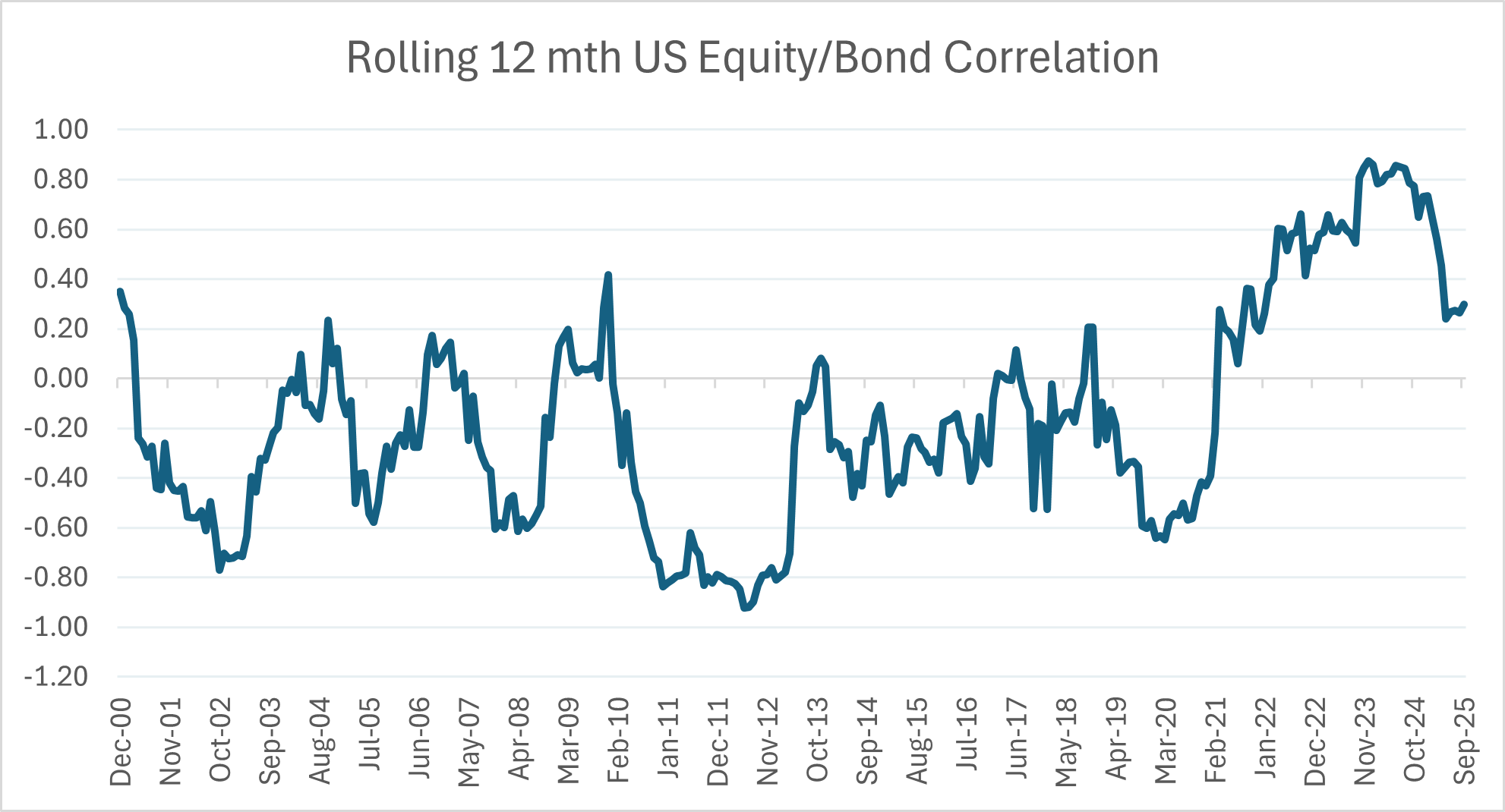
Since 2022 the correlation between SPY and TLT has averaged 0.6 and the annualised volatility of the 60-40 portfolio has been over 15%.
What’s changed? Inflation concerns. In an environment of structurally higher inflation central banks cannot ease policy as readily in response to a slowing economy and that can weigh on equities without any offsetting support from bonds.
There are plenty of reasons to suggest inflation could be more of a challenge for investors going forward putting a question mark over how much of a diversifier long duration will be for equity holdings in the years ahead.
The premise of many multi-asset funds is that they are more diversified and provide upside participation with less downside risk. In reality, many multi-asset funds behave just like the 60-40 portfolio. A wide range of assets—from equities to high yields bonds to emerging markets -tend to perform just like equities. They do well when the economy is solid, but in a deep recession, they typically underperform together.
In fact, when you adjust for volatility across asset classes, equities typically account for more 60% of total portfolio risk in a multi asset portfolio.
Equally, many assets—from long-duration bonds to equities—do well when inflation is contained and interest rates are falling. What about a regime of rising inflation or even stagflation (rising inflation when the economy is weak). Most portfolios are still ill-prepared for either a severe downturn or a stagflationary environment.
These concerns have fuelled an interest in more innovative solutions - particularly alternative investments
The promise and reality of alternatives
But what are alternatives, and can they really live up to the promise of offering something genuinely different?
Broadly, they come in two flavours – alternative assets and alternative strategies. Private equity, infrastructure, venture capital and private credit are in the alternative asset side. While there can be a solid case for these, they should be thought of as alternative growth strategies rather than diversifiers. In a severe downturn don’t expect them to provide much of an offset to equities.
That’s where alternative investment strategies come in. These are trading strategies that can go long or short in markets. That gives more flexibility to respond to market moves. They can go short and profit from falling equity prices and they also often trade markets like commodities, typically underrepresented in many portfolios.
One set of alternative investments that deserves attention is systematic or rules-based strategies.
Investors might find systematic strategies intimidating, often lumping them under “quant” investing and assuming they rely on opaque, black-box algorithms. But some systematic strategies provide a disciplined rules-based alternative—removing emotional bias, sidestepping macro speculation, and dynamically adjusting to market shifts.
Systematic trend-following, for example, buys assets that are rising, sell those that are falling. That’s it. It doesn’t try to predict macro events; it simply reacts to price movements.
The really interesting and valuable aspect of alternative strategies is that some, like trend-following, have delivered strong returns during periods of major market stress such as 2022, 2008 and during the dot.com bust, making them a powerful complement to equities.
The benefit of this can be appreciated if we compare a 100% investment in the S&P 500 versus an 80% allocation combined with a 20% allocation to the SG Trend Index, an index or leading trend-following manager performance.
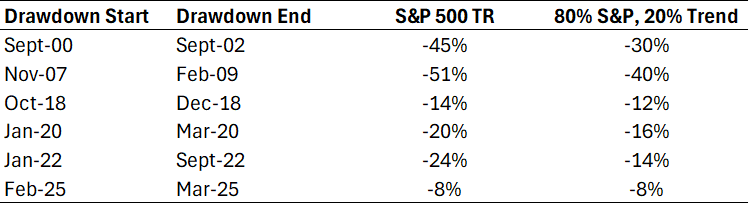
The annualised return of the combined portfolio since 2000 at 7.62% versus 7.8% but the volatility is significantly less (12.2% versus 15.3%). Importantly the allocation to trend-following helped reduce the portfolio drawdown during the major equity drawdowns since 2000.
In particular, in 2022 the drawdown of the combined portfolio was 10 percentage points less than the S&P 500.
Of course, no strategy is perfect. Trend-following struggles in choppy, directionless markets, where false breakouts and sudden reversals can erode returns.
Yes, these strategies are increasingly being seen in multi-asset and asset allocation funds as the need for greater diversification is increasingly recognised.
Allocating 5% or even 10% to an alternative strategy often doesn’t move the needle — especially if it runs at low volatility. In diversification, size matters as much as selection.

Managing Uncertainty, Not Eliminating It
At its core, investing isn’t about eliminating uncertainty—it’s about managing it intelligently.
While equities will likely continue to deliver strong returns over the long term, the path forward will be unpredictable. In 1996 Alan Greenspan famously warned about irrational exuberance only for the market to rise for another three years before the dotcom boom turned to bust.
For investors grappling with the current investing dilemma, diversification makes sense.
The next correction is inevitable — we just don’t know when, how deep or how long. The goal isn’t to avoid risk altogether, but to build a portfolio resilient enough to withstand it. True diversification means looking beyond the traditional mix of equities and bonds to strategies that can adapt when markets change.
Comments
Nothing yet. Say the first thing.
Sign in to join the conversation.