
PEACE-3 is a randomized phase III trial evaluating whether the addition of radium-223 to enzalutamide improves outcomes in patients with metastatic castration-resistant prostate cancer (mCRPC) and bone metastases. Patients were assigned to enzalutamide alone or in combination with six cycles of radium-223, with radiographic progression-free survival as the primary endpoint and overall survival as a key secondary outcome.
The final overall survival results of the PEACE-3 trial suggest that adding radium-223 to enzalutamide improves outcomes in mCRPC with bone metastases. At first glance, the message seems straightforward: combine early, treat aggressively, improve survival. But that interpretation rests on an assumption that the trial does not actually test.
Radium-223 is not a novel intervention in this setting. Since ALSYMPCA, we already know it prolongs survival in patients with bone-predominant mCRPC. The clinically relevant question is therefore not whether radium-223 works, but when it should be used. Should it be incorporated upfront in combination with an androgen receptor pathway inhibitor, or reserved for later in the disease course? PEACE-3 appears to address this question, but on closer inspection, it does not.
The trial compares upfront combination therapy versus enzalutamide alone, yet provides limited insight into what happens after progression. While post-progression treatments are reported, the use of radium-223 in the control arm is not clearly described.
What is reported is telling: chemotherapy accounts for roughly three-quarters of subsequent treatments, while the category of “other therapies” remains small. Given that radium-223 is not explicitly listed, the most plausible interpretation is that relatively few patients in the control arm ultimately received it, despite being a life-prolonging treatment option.
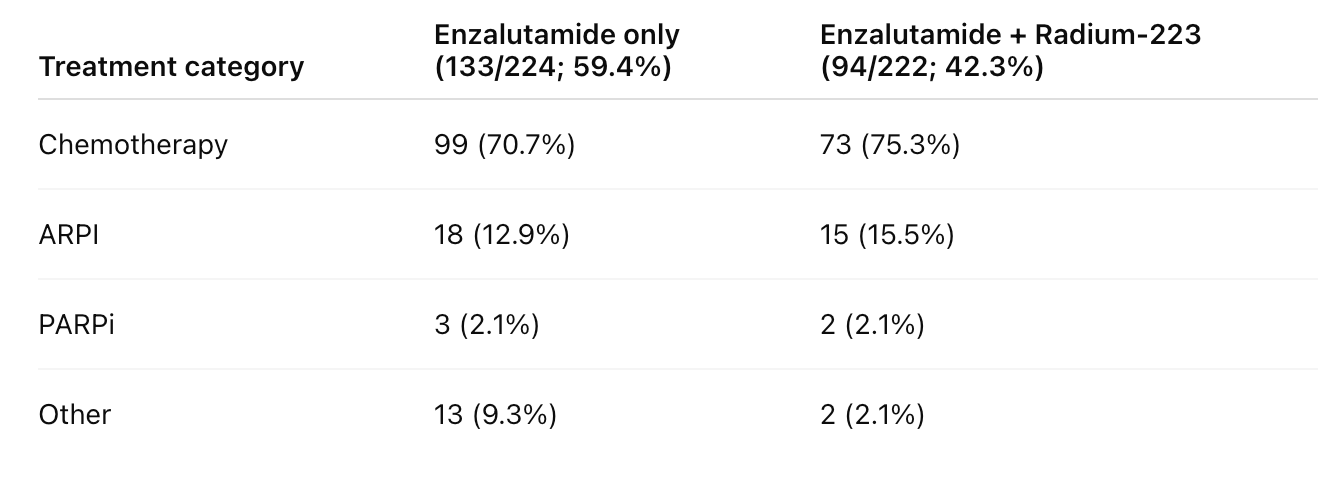
If that is the case, the trial does not primarily compare early versus delayed radium-223. Instead, it compares patients who received radium-223 at some point with those who likely never received it at all. This distinction matters because the observed overall survival benefit—numerically compelling, with a hazard ratio around 0.69—may therefore reflect the impact of radium-223 exposure itself, rather than the timing of its administration.
In other words, PEACE-3 may be telling us that radium-223 should be used, not necessarily that it should be used early.
The shape of the survival curves reinforces this uncertainty. The curves cross at approximately 18 months, followed by a delayed separation.
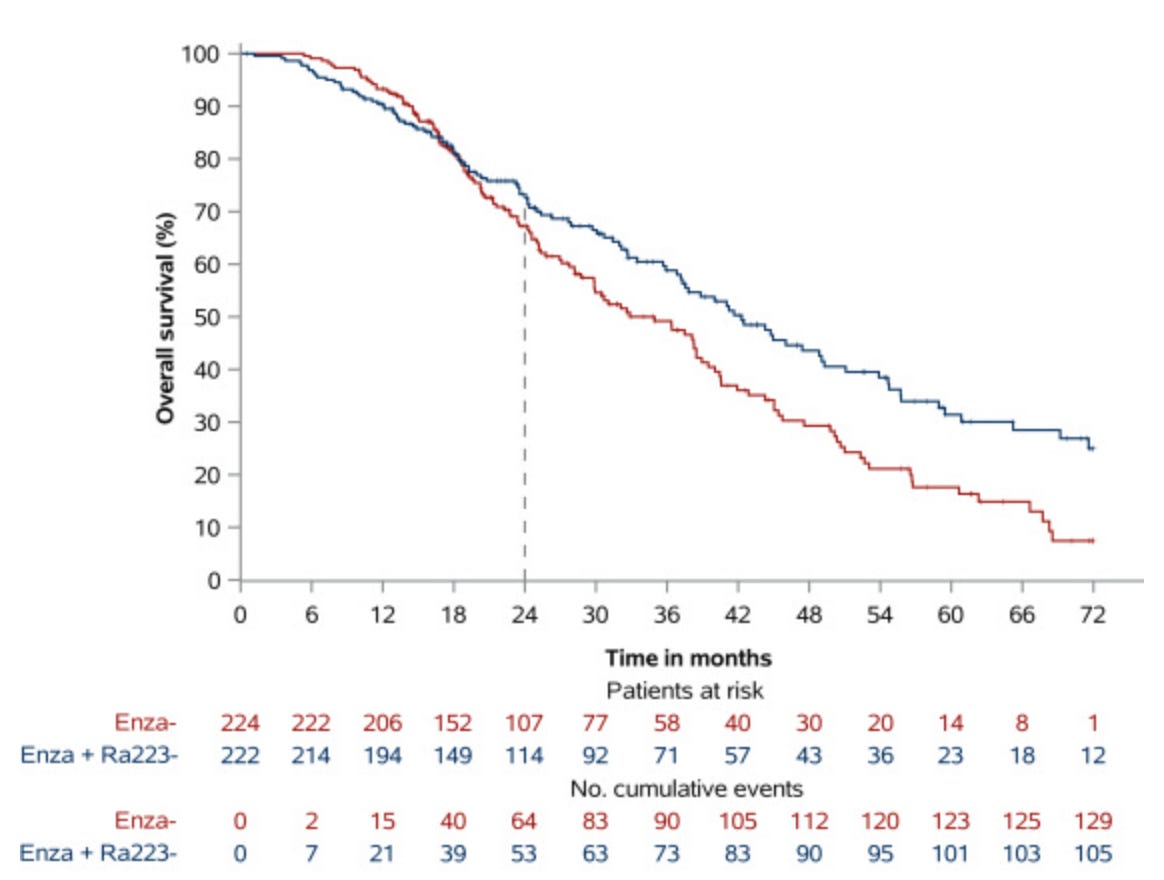
This pattern suggests a time-dependent treatment effect, with limited early benefit and a more pronounced impact later in the disease course. Such dynamics are consistent with the biology of bone-targeted therapies and raise a plausible alternative explanation: that the benefit of radium-223 emerges over time and might not depend on immediate upfront administration.
This is not a trivial nuance. Upfront combination therapy commits all patients to early exposure, with added toxicity and reduced flexibility in sequencing. A strategy that reserves radium-223 for selected patients with persistent bone-predominant disease could, in theory, capture much of the same benefit while avoiding unnecessary treatment in others. PEACE-3 does not allow us to distinguish between these approaches.
None of this diminishes the importance of the trial. PEACE-3 clearly supports the role of radium-223 in mCRPC and demonstrates that combining it with enzalutamide is feasible. But it leaves a critical clinical question unresolved: does earlier use improve outcomes—or does simply ensuring that patients receive radium-223 at some point drive the benefit?
PEACE-3 confirms that radium-223 matters.
It does not establish that earlier is better.
And until sequencing is directly tested, that distinction should not be ignored.
No posts
Comments
Nothing yet. Say the first thing.
Sign in to join the conversation.