
The recently published SAKK 08/14 trial evaluating metformin in metastatic castration-resistant prostate cancer caught our attention because, once again, the results were negative.
While reviewing the study, we realized this was not an isolated finding. Across the prostate cancer disease continuum, randomized trials evaluating metformin have consistently failed to demonstrate meaningful oncologic benefit despite years of biological enthusiasm and promising observational data.
That observation prompted us to put the available randomized evidence together and write an editorial in European Urology Oncology discussing what the metformin story can teach us about drug repurposing in prostate cancer.
For nearly two decades, metformin was one of oncology’s favorite repurposing candidates.
The story sounded compelling. A cheap, globally available diabetes drug appeared to inhibit tumor growth through AMPK activation, mTOR inhibition, and downstream metabolic effects on insulin and IGF-1 signaling. Laboratory studies looked promising. Retrospective analyses hinted at improved cancer outcomes. And because metformin was already widely prescribed and generally well tolerated, enthusiasm spread quickly.
In prostate cancer, the hypothesis became particularly attractive. Could a familiar metabolic drug enhance androgen receptor–targeted therapy? Delay progression? Improve survival?
The latest randomized evidence suggests the answer is probably no.
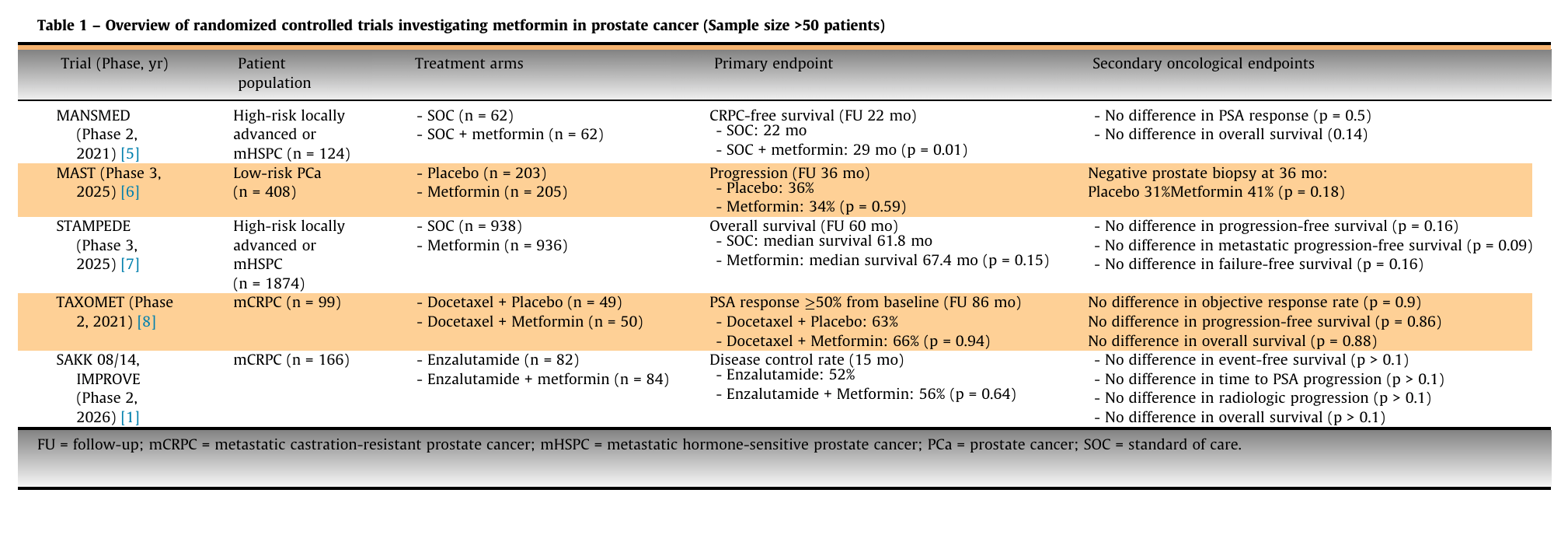
Published in European Urology Oncology, Gillessen and colleagues reported the SAKK 08/14 trial, also known as IMPROVE, a randomized phase 2 study evaluating enzalutamide plus metformin versus enzalutamide alone in metastatic castration-resistant prostate cancer (mCRPC). The study enrolled 166 patients and tested whether adding metformin could improve disease control at 15 months.
It did not.
Disease control rates were nearly identical between groups (52% vs 56%), with no significant differences in event-free survival, PSA progression, radiographic progression, or overall survival.
SAKK 08/14 is not a practice-changing trial. It is another negative metformin study.
But that is precisely why it matters.
Across localized disease, hormone-sensitive metastatic disease, and now mCRPC, randomized evidence has become increasingly consistent: metformin repeatedly fails to deliver meaningful oncologic benefit despite years of biological enthusiasm and promising observational data.
And at this point, it is becoming difficult to argue that metformin’s anticancer promise was anything more than an observational mirage.
The metformin story in prostate cancer has now been tested across almost the entire disease continuum.
The MANSMED trial initially generated optimism by suggesting improved castration-resistant prostate cancer–free survival when metformin was added to androgen deprivation therapy in hormone-sensitive disease. Yet the study was small, and the signal never translated into improved overall survival or stronger secondary endpoints.
Then came the larger studies.
The phase 3 MAST trial (on which I previously wrote here) evaluated metformin in men on active surveillance for low-risk prostate cancer. Again, no meaningful reduction in progression was observed. Intriguingly, obese patients receiving metformin even appeared to experience more pathological progression in a prespecified subgroup analysis.
The STAMPEDE platform then addressed the question in a much larger and methodologically rigorous setting: nearly 1900 men with metastatic hormone-sensitive disease starting androgen deprivation therapy. If metformin truly had clinically meaningful anticancer effects, this was the type of trial where they should have emerged. However, no improvement in overall survival or progression-related outcomes was noted.
In mCRPC, the TAXOMET trial similarly failed to demonstrate benefit when metformin was added to docetaxel. And now SAKK 08/14 extends that same negative pattern to enzalutamide combinations.
At some point, repeated neutral trials stop being disappointing and start becoming informative.
The metformin story highlights a recurring problem in oncology: we consistently overestimate the clinical relevance of biologically plausible interventions.
Retrospective studies created the initial momentum. Patients taking metformin often appeared to have better cancer outcomes. But those datasets were deeply vulnerable to confounding. Metformin users frequently differ from nonusers in obesity, diabetes severity, healthcare access, cardiovascular risk, and overall metabolic health.
In retrospect, many of these analyses likely measured patient selection rather than drug efficacy.
This is not unique to metformin. Oncology has repeatedly seen promising repurposed agents fail once subjected to randomized testing. Vitamin D. Statins. Aspirin in several settings. The pattern is familiar: strong mechanistic rationale, enthusiastic observational data, disappointing phase 3 reality.
The deeper issue is that biological plausibility is not the same as therapeutic relevance.
Cancer metabolism is extraordinarily complex. Altering systemic glucose or insulin signaling does not necessarily translate into clinically meaningful tumor control, particularly in advanced prostate cancer, where multiple redundant survival pathways dominate.
To be fair, SAKK 08/14 did generate one potentially interesting signal.
Patients with PTEN-expressing tumors appeared to experience delayed PSA progression with metformin, whereas PTEN-negative tumors did not.
But this finding should be interpreted cautiously.
Post hoc biomarker analyses in negative trials are notoriously unreliable. Oncology is littered with subgroup signals that never replicated. The temptation after a negative study is always the same: search for the subgroup where the drug “works.”
Still, the PTEN observation reinforces an important principle: if repurposed therapies are to succeed, they will likely require biomarker-driven selection rather than empiric treatment of unselected populations. That may ultimately be the most useful lesson from metformin’s long journey in prostate cancer.
Clinically, the message is now fairly straightforward.
There is currently no convincing evidence supporting metformin as an anticancer therapy in prostate cancer — not in localized disease, not in hormone-sensitive metastatic disease, and not in castration-resistant disease.
That does not diminish metformin’s value in diabetes management. Nor does it invalidate the broader concept of drug repurposing. But metformin increasingly looks like a mature negative example of how enthusiasm can outpace evidence.
And perhaps that is useful in itself.
Because oncology does not only advance through positive trials. Sometimes progress comes from learning which hypotheses — despite elegant biology and years of optimism — simply do not translate into meaningful benefit for patients.
No posts
Comments
Nothing yet. Say the first thing.
Sign in to join the conversation.