
Firstly, if you’re reading this in Australia, and the stats tell me about 15% of you are, please book to donate blood with Lifeblood today, if you’re eligible. There’s no point speaking any more power into evil, but you can always control the good you choose to do in the face of it. That’s standing advice wherever you’re reading this, to be clear.
Anyway, back to the cricket.
Globally, the prevalence of left-handedness sits at approximately 10.6%. Both Australia and the UK fall within this normal range (the most precise estimates I could find put the UK at 10.4% and Australia at 10.3%). However, were you to trace left-handedness through the history of Test cricket, you’d never know it, presuming instead that a good chunk of the UK population had arbitrarily had their left hands removed.
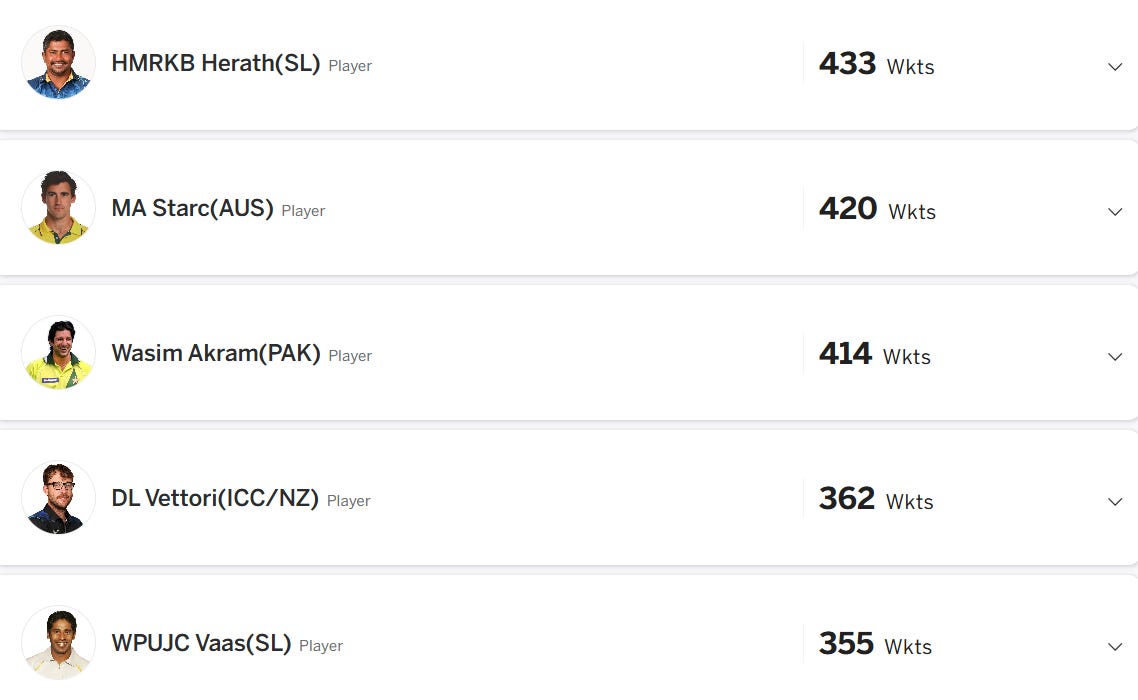
Recently, with Mitchell Starc surpassing Wasim Akram’s record as the all-time leading wicket taker among left-arm fast bowlers in Test cricket, and now only 13 shy of Rangana Herath’s record for all left-arm bowlers, I have been thinking.
When Josh Hull was selected for England to face Sri Lanka last September, the decision to vault a 20-year-old bowler with (at the time) just 16 wickets at 62 in first-class cricket into the Test team was roundly criticised as another example of BazBall Gone Wild.
The rebuttals from the English camp were straightforward: he bowls with his left arm and is 6 foot a million; we’ll figure the rest out eventually. On paper, I’m not sure either camp was wholly wrong. Selecting a seamer with a first-class average of 60 is always going to send a confused message, to put it kindly. Then again, that raw physical package is unbelievably enticing at the highest level, especially when you see two similar physical specimens, Marco Jansen and Mitchell Starc, duking it out in a WTC final mere months later. To be clear, I still believe Hull’s selection was, on balance, ridiculous. With that caveat, my aim by the end of this article is to ensure you’re slightly more sympathetic to England’s underlying logic (read: sheer desperation to finally have a left-arm Test seamer of their own).
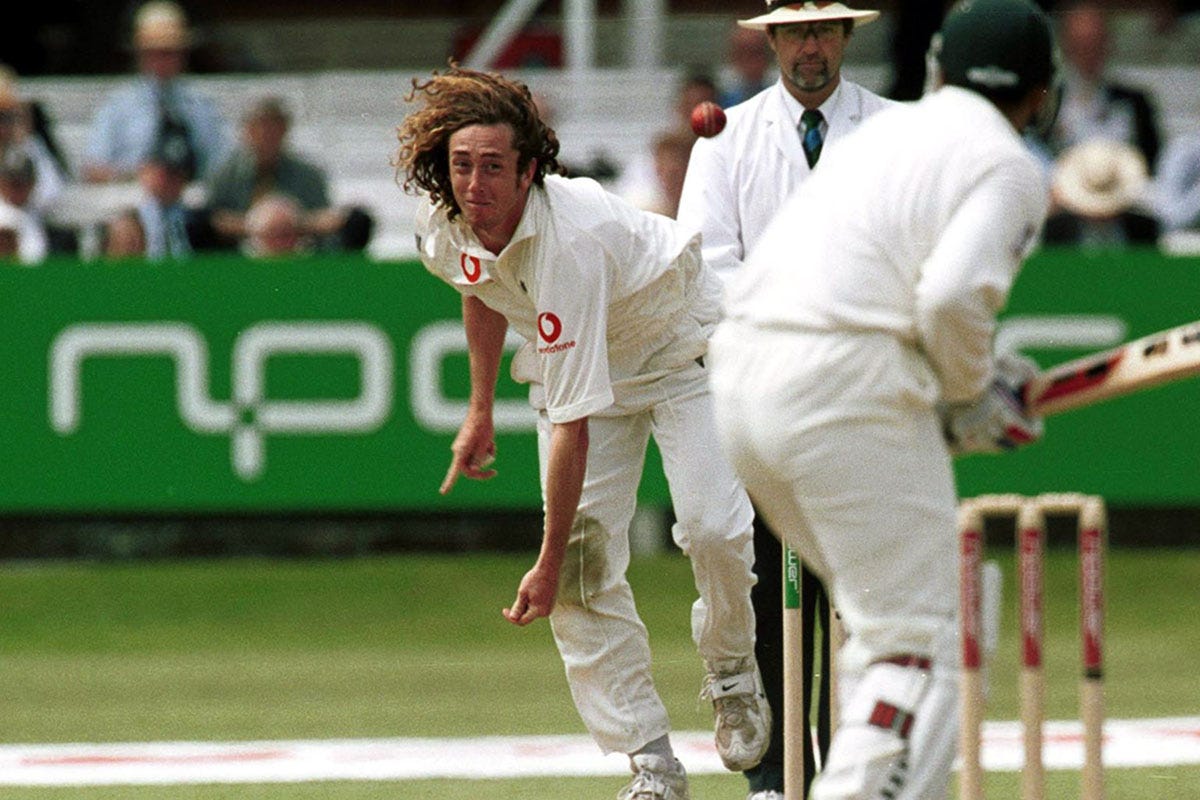
Here’s the crux of the issue: despite the endless backroom planning England appear to do for the Ashes, often at the expense of other marquee series, they have once again turned up to Australia with a pace attack consisting exclusively of right-arm bowlers.
Nevermind what Mitchell Johnson did in 2013/14, nor Mitchell Starc being the second-top wicket taker in the past two home Ashes, to go with his superlative start to this series, England have again shown up without a left-armer of their own.
I say this as though it’s revelatory. However, this should come as little shock, really, given that, among the first eight nations to gain Test status (up to Sri Lanka in 1982), England are the only team that have failed to produce at least one left-arm fast bowler who has taken over 100 Test wickets.
Left-Arm Seamers With 100+ Wickets By Country:
Australia: 4 (Starc, Johnson, Davidson, Reid)
Pakistan: 3 (Akram, Shah Afridi, Amir)
New Zealand: 3 (Boult, Wagner, Collinge)
India: 3 (Khan, Ghavri, Pathan)
Sri Lanka: 1 (Vaas)
South Africa: 1 (Goddard)
West Indies: 1 (Collins)
South Africa will inevitably add to this list shortly, with Marco Jansen currently sitting on 89 Test wickets, while there is a decent chance Sri Lanka’s Vishwa Fernando (currently on 81, with 29 of those coming in 2024) will get there before long, too.
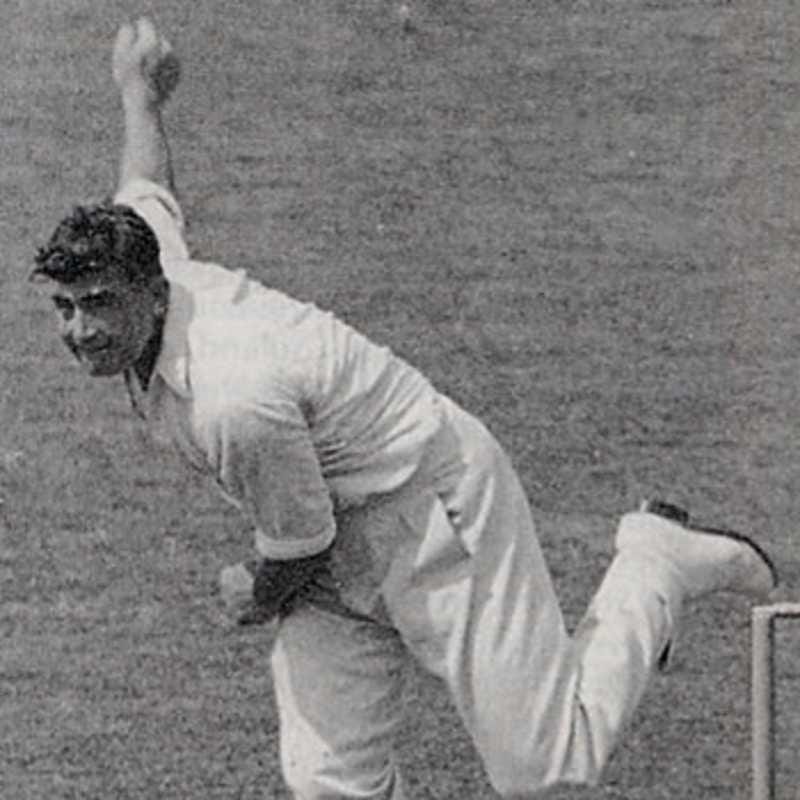
The closest England has ever gotten is Bill Voce, who played his final Test in 1947, taking 98 Test wickets. Behind him, you will find Ryan Sidebottom, John Lever, and Alan Mullally as the Englishmen with 50+, along with George Hirst, who played back in the 1890s. Sam Curran sits on 47.
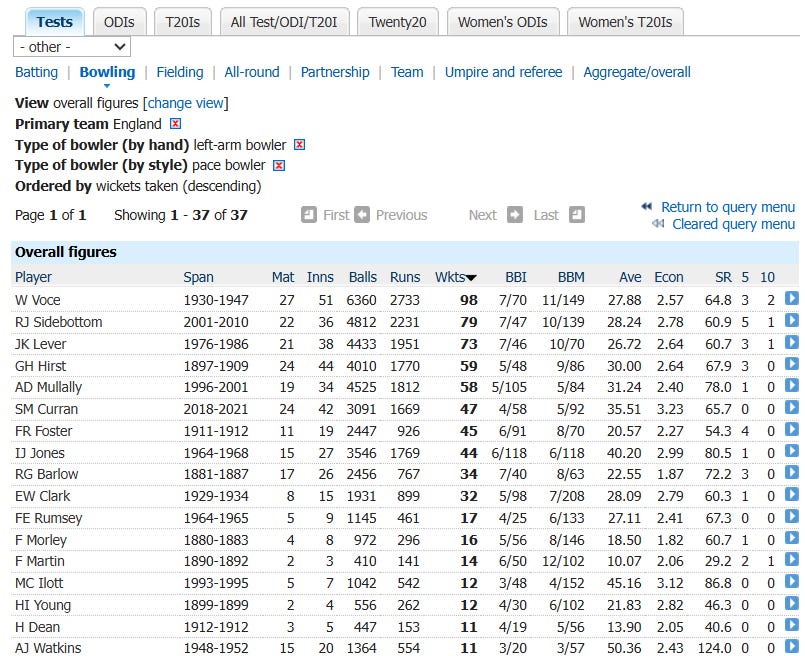
From the above list, there are five bowlers who played in the 1800s, and only three who played any cricket in the 2000s.
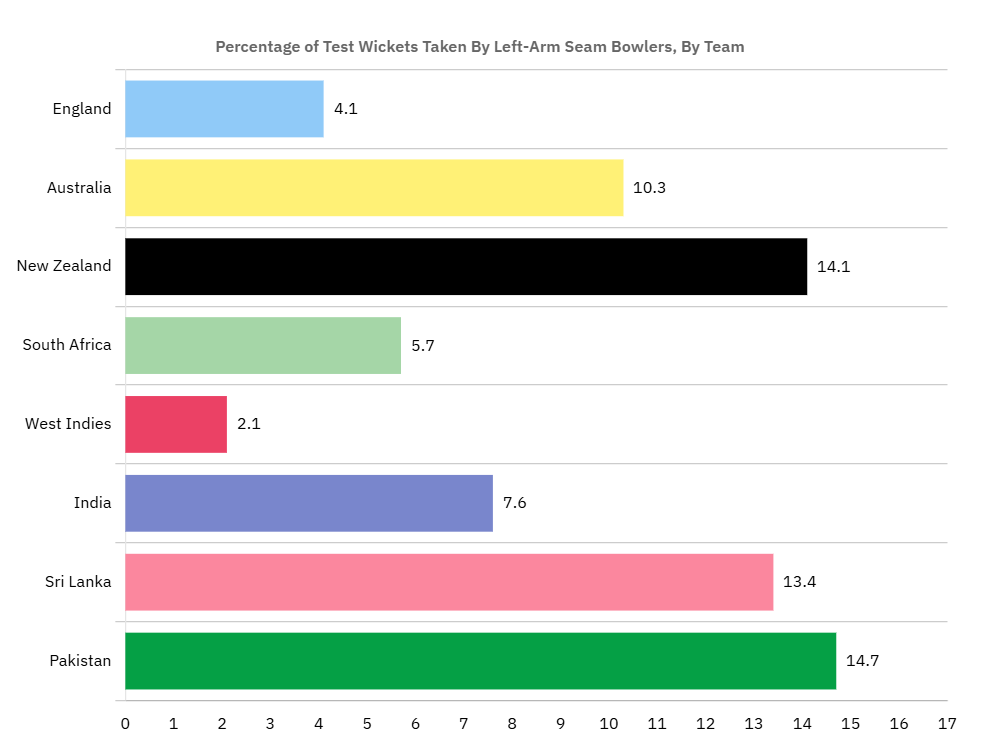
The issue isn’t just that England haven’t produced a left-arm seamer who has taken over 100 Test wickets. They barely produce them at all. All time, just 4.1% of England’s Test wickets (697 out of 16,786) have been taken by left-arm fast bowlers. For Australia, the equivalent number is 10.3% (1482 out of 14381). Pakistan leads the way on this metric with a whopping 14.73% of their Test wickets taken by left-arm fast bowlers. Even South Africa, which, like England, has produced just one left-arm seamer to take 100+ wickets, is at 5.7%. Only the West Indies, at just 2.1%, are lower than England.
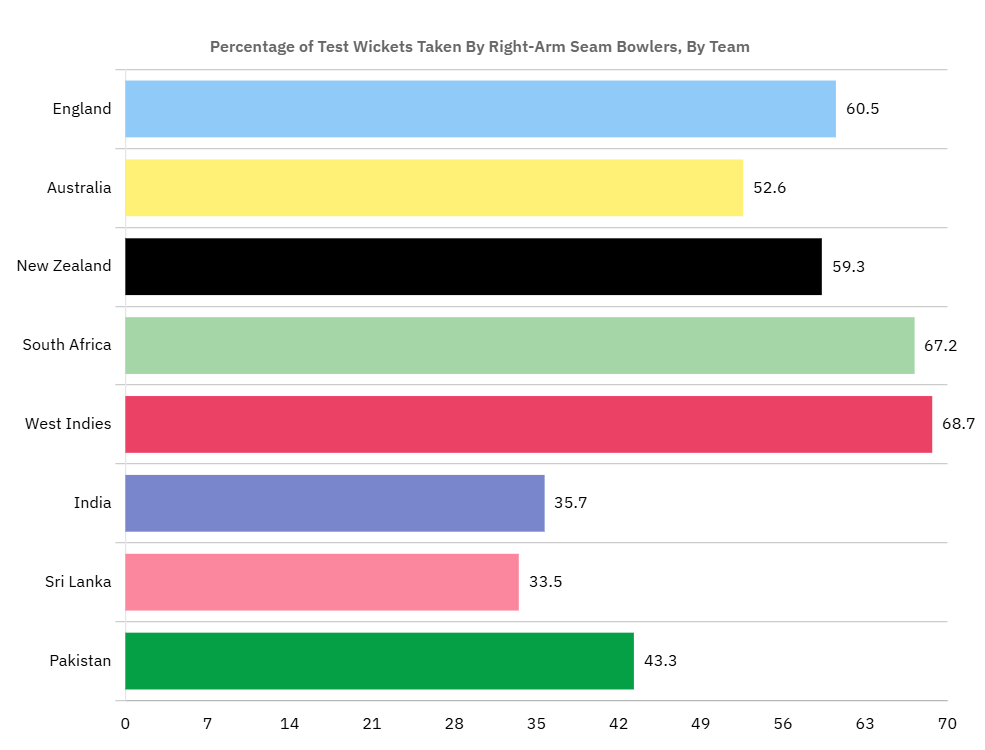
If we flip this metric on its head, England have taken 60.5% of their Test wickets via right-arm seam bowling over history. Only the West Indies (68.7%) and South Africa (67.2%) are higher. For context, Australia sits at 52.6% of their Test wickets taken by right-arm pace, with Sri Lanka the lowest at just 33.5%.
Notably, England has had no problem finding left-arm Test spinners. In fact, if we look at the percentage of Test wickets taken by all left-arm bowlers, not just left-arm quicks, England vault from 4.1% right up to 18.3%. India and New Zealand lead the way at just over 27%, with the West Indies trailing at 11.7%.
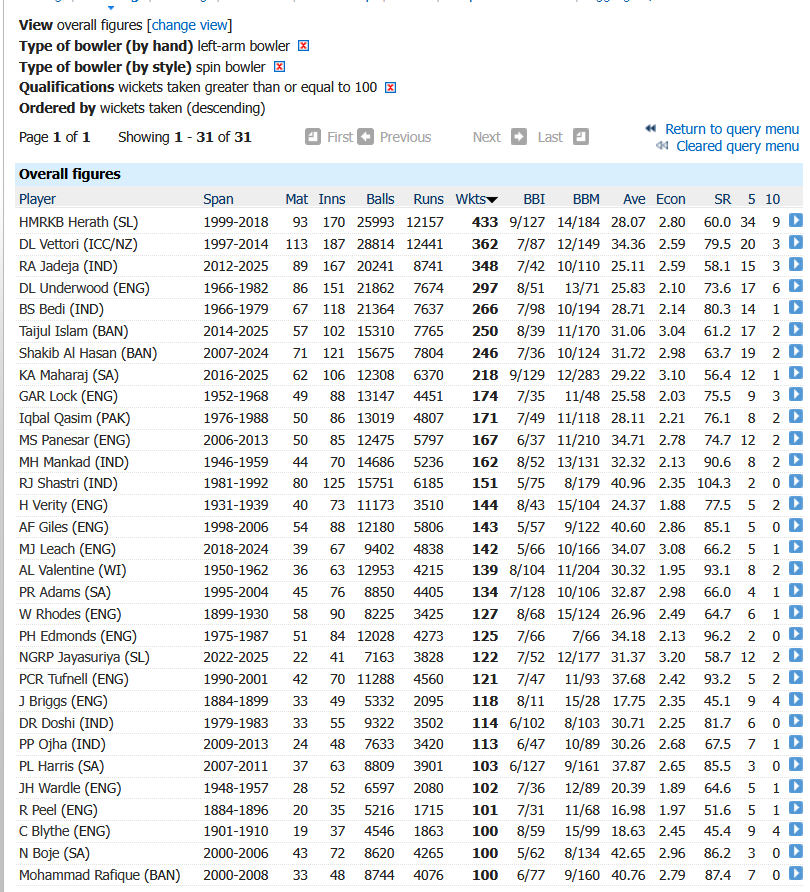
Over the years, England’s left-arm spinners have taken more than three times as many Test wickets as their quicks: 2,274 vs 697. Of the 31 left-arm spinners to take 100+ Test wickets, 13 (41.9%) are English. India, with six, contributes the next-most. For the team that invented the game and got a significant head start, this is more in line with what you’d expect, statistically.
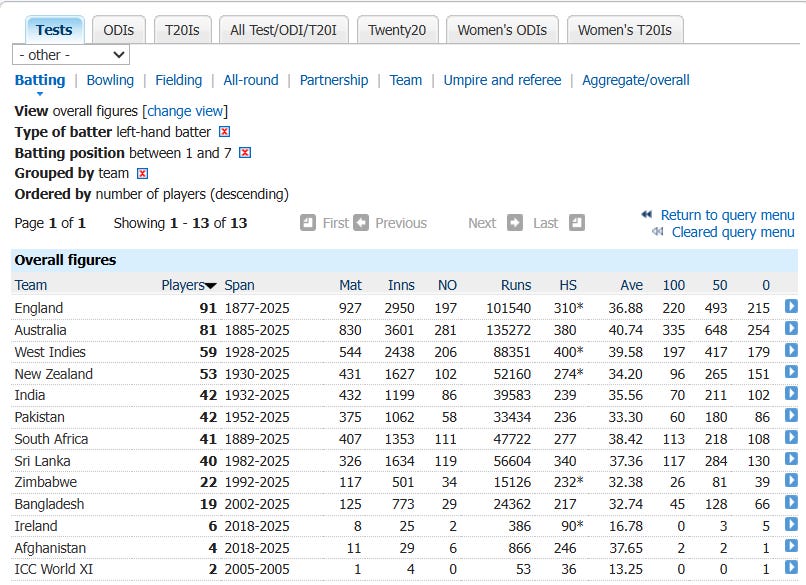
So, clearly, producing left-arm bowlers is no particular issue for England. Nor is producing left-handed Test batters. Even allowing for their significant head start, no country has produced more top-order (1-7) left-handers than the 91 from England (albeit, Australia’s left-handers average over 40). However, producing left-arm fast bowlers remains a significant issue.
Among left-arm seamers in ODI cricket, England only have David Willey (stuck on 100 exactly) with 100 or more wickets, with Alan Mullally the other over 50. Reece Topley (47) may yet get there, but with his injuries, you wouldn’t guarantee it.
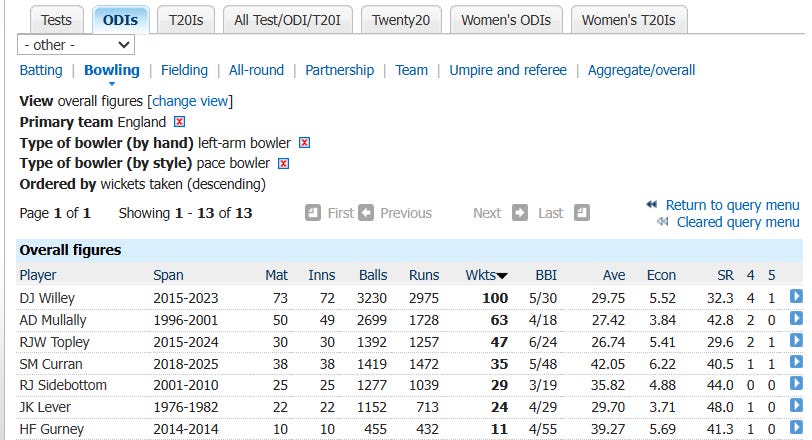
Going through the County Championship Division One squads for this past season, I found the following left-arm seam bowlers:
Paul Walter (a batting allrounder with 31 FC wickets).
Tom Lammonby (a batting allrounder with 14 FC wickets).
Sam Curran (who took 9 wickets this past season).
Sean Hunt (11 wickets at 16 this past season, but only from three games).
Vishwa Fernando, an overseas signing for Warwickshire.
Khaleel Ahmed, an overseas signing for Essex.
That’s it.
There are just two English cricketers in Division One—Sam Curran and Sean Hunt—for whom bowling left-arm seam is their primary role. There are two other left-arm all-rounders in Paul Walter and Tom Lammonby, who barely have 50 first-class wickets combined.
Expanding the search to Division Two adds:
Luis Reece (a 35-year-old all-rounder, who admittedly topped the Div Two wicket tally last season with 50 at 19).
Matt Taylor (18 wickets at 44 this past season).
Ollie Sutton, who has played just one first-class game so far.
Josh Hull (19 wickets at 30.6 this past season).
Noah Cornwell, who has played just six first-class games so far.
Michael Cohen, an overseas signing for Kent.
Liam Guthrie, an overseas signing for Northamptonshire.
All up, across the 18 County squads last year, there were just six English players for whom bowling left-arm seam is their primary role, and even that might be a stretch depending on how highly you rate Sam Curran’s batting these days. If we say that Curran is also an allrounder, then Matt Taylor has taken 236 first-class wickets, while the other four specialist left-armers (Hull, Cornwell, Sutton, and Hunt) have taken 132 combined. Taylor is 31 with a first-class average of 34. Cornwell made his first-class debut just a week before Hull’s Test debut. Sutton’s only came this April. Curran and Hull may as well be different species, height-wise. In that light, it almost makes sense that, if England are dead-set on developing a left-arm Test bowler (and they probably should be), when they made the selection last September, it basically had to be Hull. Note: I also welcome any County fans schooling me on the long-term prospects of Sutton and/or Cornwell in the comments.
Then again, it is also not great when the best thing I can say about a player is that they were essentially selected by default.
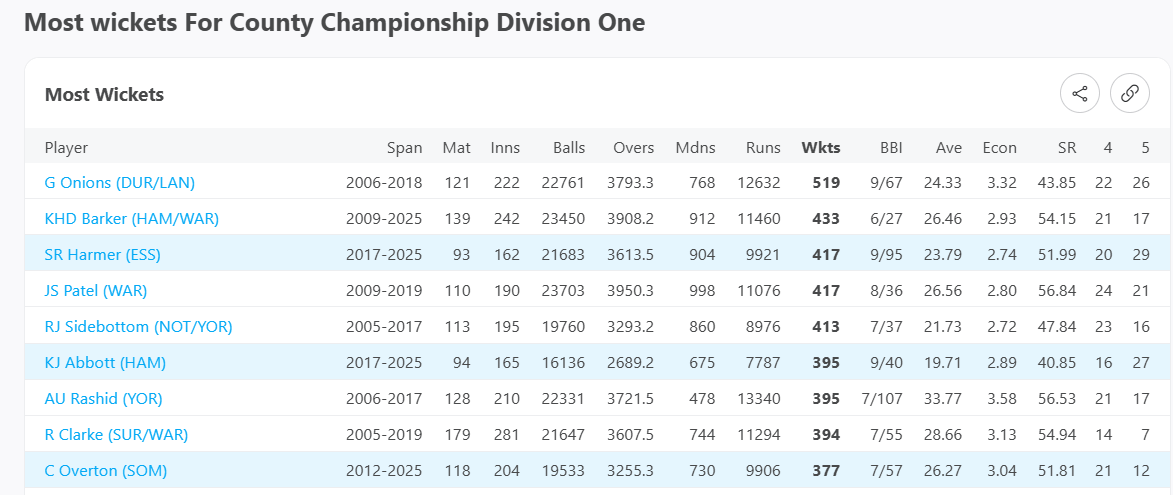
Compounding the mystery is the fact that, in the era for which we have complete ball-by-ball data (roughly 2005 onwards), the second and third highest fast-bowling wicket takers in Division One of the County Championship have been Keith Barker and Ryan Sidebottom, both left-arm seamers, proving that English conditions are no inherent impediment to left-armers.
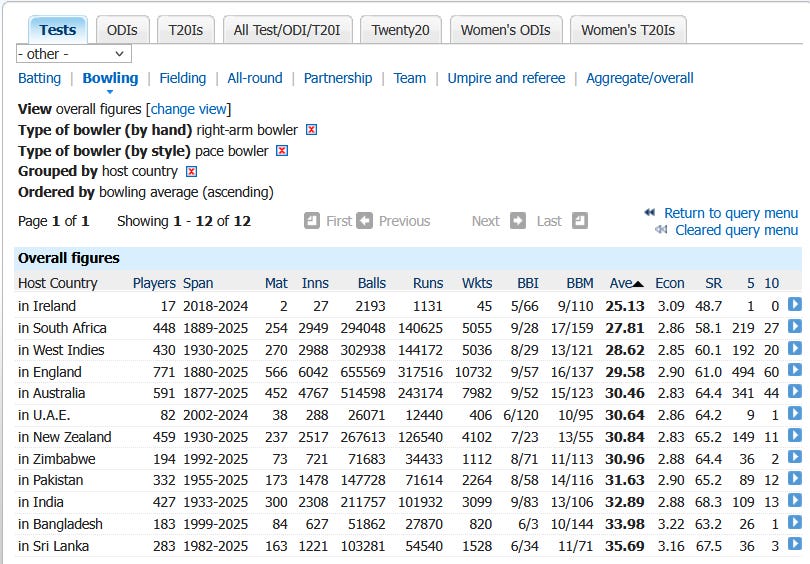
Nor is it impossible for left-armers to succeed in England internationally, with many holding very respectable Test averages, as you can see below. Goddard’s combination of an average of 22, a strike rate of 74, and an economy of 1.8 is truly a thing of beauty.
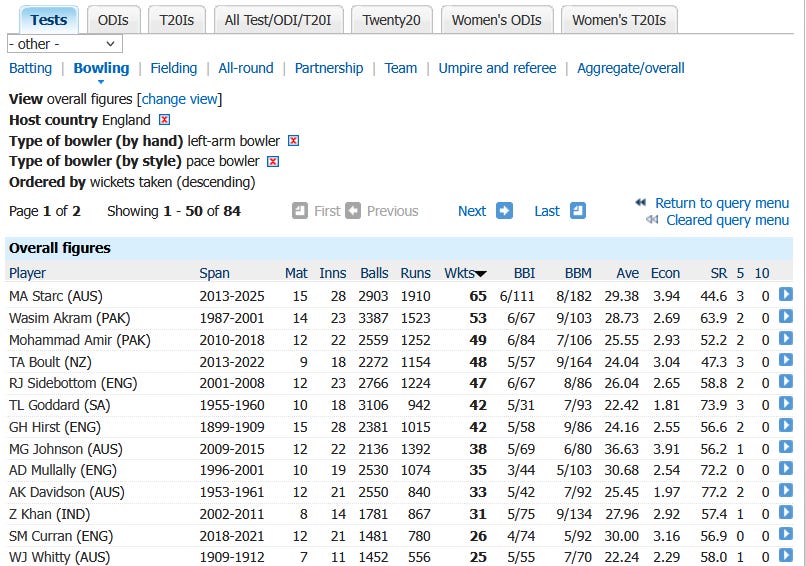
However, this does hit on something: only two left-arm seamers have taken over 50 Test wickets in England. In fact, overall, left-arm seamers average 30.7 in England across Test history. Of the regular Test nations, only India, the West Indies, and Pakistan are less kind to the southpaws.
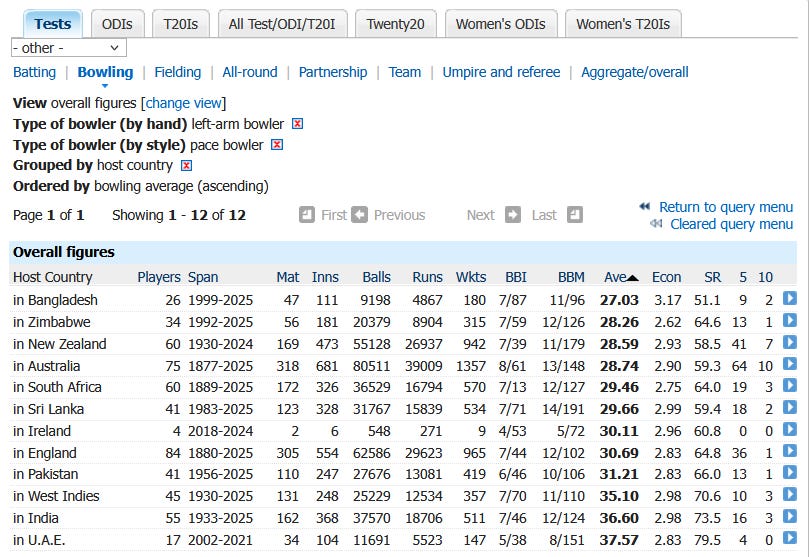
On the other hand, and perhaps unsurprisingly, English conditions are among the most favourable for right-arm seamers, averaging 1.11 runs fewer per wicket than their left-handed counterparts, while also taking their wickets 3.8 balls sooner on average (SR 61 vs 64.8).
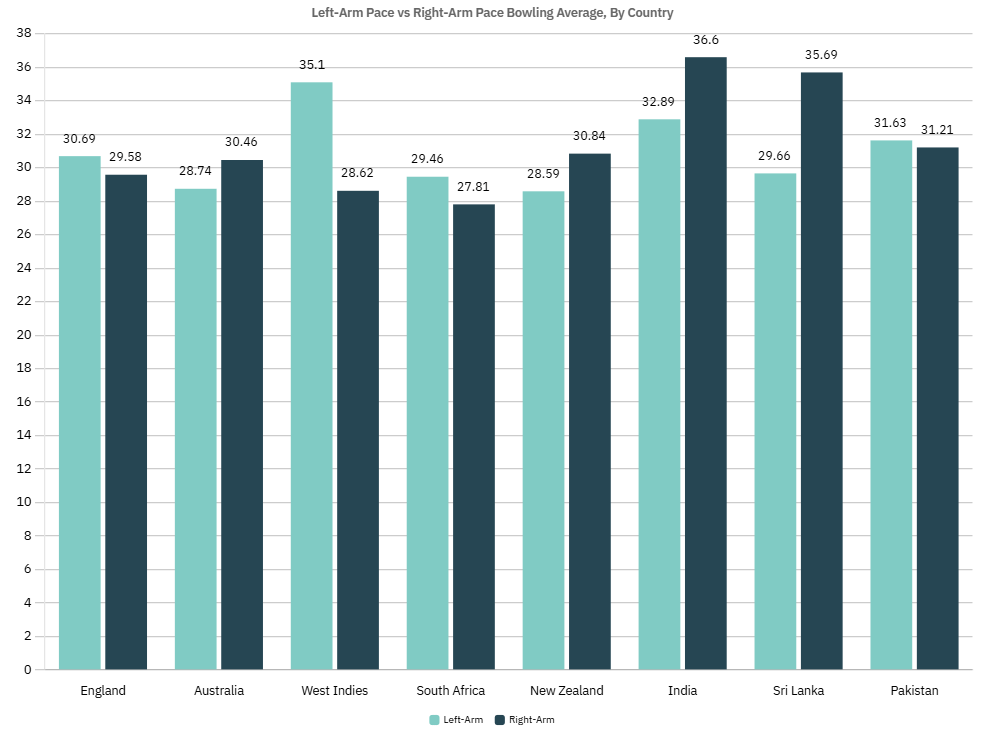
Accordingly, a reasonably clear divide emerges. These are the Test nations where left-arm seamers average less than right-arm seamers:
Bangladesh (+6.95)
Sri Lanka (+6.03)
Zimbabwe (+2.43)
New Zealand (+2.25)
Australia (+1.72)
Pakistan (+0.42)
And these are the Test nations where right-arm seamers average less than left-arm seamers:
West Indies (+6.48)
Ireland (+4.98)
India (+3.71)
South Africa (+1.65)
England (+1.11)
This makes sense. Think back to the list I shared at the beginning of this article. The West Indies and South Africa have also only produced one left-arm seamer who has taken over 100 Test wickets. While India has technically produced three, two of those (Ghavri and Pathan) were all-rounders, selected in the team as much for their batting as their bowling, with Zaheer Khan being the only specialist left-arm fast bowler India has produced to take 100+ Test wickets.
Honing in on this further, Sri Lanka leads the way in terms of the percentage of wickets to fall to left-arm pace by country, with 11% of Test wickets falling to southpaw quicks in Sri Lanka. New Zealand and Australia are next with 9.5% of Test wickets falling to left-arm seam in both countries. Pakistan also isn’t far behind at 8.5%.
South Africa is at 7.1%, India is at 5.8%, and England is at 5.7%. Again, only the West Indies trails England, at 4.4%, also correlating with the above figures.
On the other hand, 63.5% of Test wickets fall to right-arm pace in England. Only South Africa, at 63.8%, is marginally ahead by this metric. Even the West Indies, which has consistently led the way for right-arm seam throughout this article, trails England, with 62.3% of Test wickets falling to right-arm seam in the West Indies over Test history. Australia sits at 55.9%.
So, when we focus particularly on the Ashes, we are talking about a country where, historically, left-arm seamers have been more effective to the tune of +1.72 runs per wicket (Australia), playing a country where right-arm seamers have historically been more effective to the tune of +1.11 runs per wicket (England).
If they even play, in England, left-arm seamers average 3.16 wickets per Test. In Australia, that climbs to 4.26 wickets per Test, while they also have to bowl 5 fewer balls on average to claim a wicket (SR 59.3 vs 64.8). To add insult to injury, over the past 15 years, England have also lived through Australia’s two most successful left-arm quicks back-to-back.
Don’t be too shocked if, in about a decade, you add Jarrah Reidy, who just took 6/28 for South Australia in the National U19s final, aged just 16, to that lineage. And if not Reidy specifically, my broader point is that Australia continues to produce promising left-arm seamers (i.e., Liam Haskett, Spencer Johnson, Oli Patterson has just signed with the Heat at 19, Campbell Thompson recently played for the PMs XI, etc), while England simply doesn’t.
Given it is significantly easier to find right-arm bowlers than left-arm bowlers in general, Australia are therefore, typically, far better positioned to shape their attack to suit English conditions, than England is to all of a sudden find a left armer who can dominate in Australia, when they’ve never produced one of those in nearly 150 years of trying.
Having said that, if England are serious about ever winning a series in Australia again, encouraging more left-arm seam throughout County Cricket—to both ensure batters are more used to facing it, and to identify suitable left-arm bowlers for the national setup—would be one of my top priorities. Forget sacking the captain and coach, forget blaming the Hundred, forget using Kookaburra balls or playing Day-Night County games: focus on developing more left-arm fast bowlers. Even if that just means importing more of them at first, so batters get more used to facing it.
The best part? Instead of throwing the baby out with the bathwater, as is tradition after an Ashes flogging, this is actually actionable advice that may demonstrably improve things in a cricketing sense, rather than just calling the team weak. There’s more where that came from, if anyone at the ECB wants to get in touch…I know you like having Kiwis in the backrooms, and I am indeed a Kiwi!
Ultimately, I feel I’ve probably only scratched the surface of this subject, so I’m very interested to hear your theories in the comments: what gives? Why does England produce such a dearth of left-arm fast red ball bowlers? My current working theories include:
Do left-armers get overlooked at the lower levels? Or even, are talented left-armers encouraged to bowl spin more than seam in England?
Is the standard of coaching lower for left-arm bowlers, given there are so few of them?
Are ‘typical’ English conditions simply so helpful for right-armers that there has been less need to develop left-armers, as opposed to say, Pakistan, where conditions are so extreme that you need the left-arm variety?
Or, inversely, do left-armers get so much natural assistance in England that they don’t have to work as hard to develop other skills, which gets found out at higher levels, especially away from home?
Does the typical left-arm angle ‘across’ a right-handed batter take the stumps out of play too much in England?
Does the lower bounce in England make it more difficult for left-armers to threaten the edge of the bat?
Do left-armers struggle more than right-armers to swing the ball, which is compounded by a bias towards swing bowling within English cricket?
I’m fascinated to hear your theories. Please share them in the comments.
Thanks for reading! This is also the part of the article where I’d usually plug my Buy Me A Coffee. If you were gonna do that, please go donate it to a good cause instead. There is no shortage of them right now.
Just keen to keep reading about cricket? Same! If you liked this article, you might also enjoy:
Comments
Nothing yet. Say the first thing.
Sign in to join the conversation.