
Forget, if you can, England’s batting woes so far this Ashes. It shouldn’t be too difficult, given they seemingly have only three shots in their repertoires on this tour: the seventh stump waft on the up, learned from Virat Kohli last year, the lofted drive back to the bowler, and the chop-on. No, as much as England’s batting has been deeply questionable, it belies more pressing truths: namely, bowlers win Test matches, and England have lost 1,500 Test wickets from the side in the past two years. Have we underestimated quite how big an impact that has had?
For all the attention that BazBall’s flashy innovations and rapid scoring rates have garnered over the past three and a half years, the true genius, when executed correctly, was England’s ability to consistently take 20 wickets. Of course, it helps when you have the two most prolific seamers of all time to call on, and, as we’re learning currently, it hurts when you don’t.
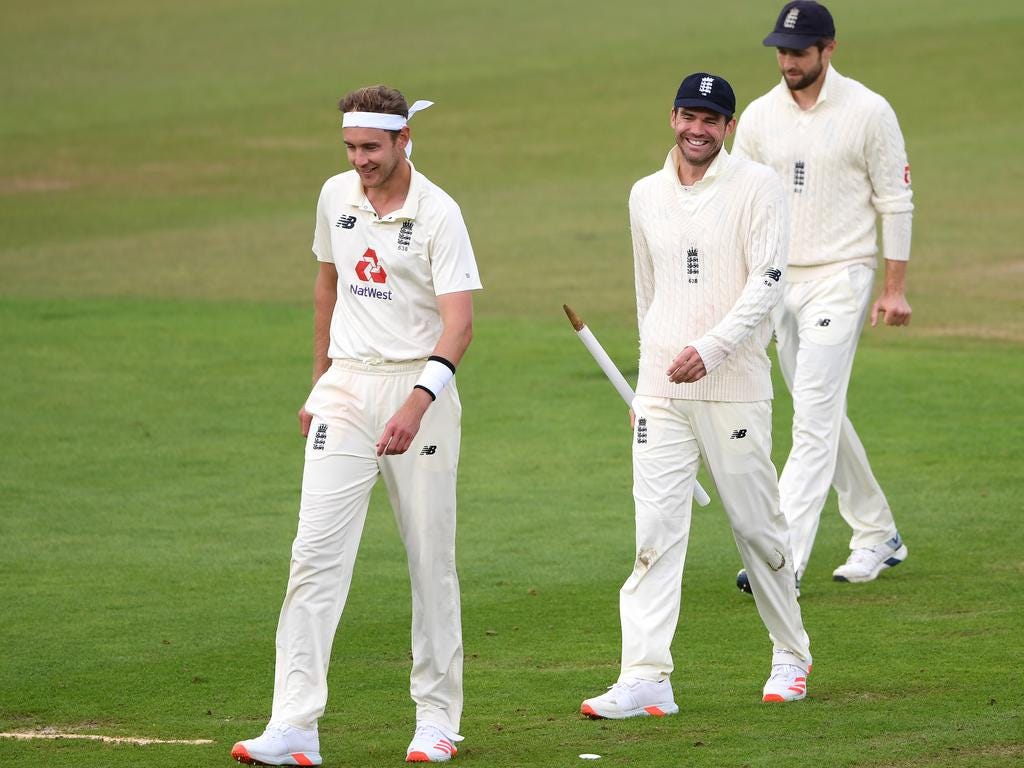
Think back to the inception of BazBall during New Zealand’s tour to England in 2022. Yes, the series is best remembered for Johnny Bairstow’s twin hundreds, but also, James Anderson took 11 wickets at 18.6, while Potts took 14 wickets at 23.2. Bairstow and Root got the headlines, but England don’t win the series 3-0 without those efforts.
In the following series against India, Joe Root averages over 100, but England don’t escape with a 2-2 draw if not for Anderson taking 21 wickets at 22 and Ollie Robinson taking 21 wickets at 21.
In the next series against South Africa, Broad, Anderson, Robinson, and Stokes all average below 17 with the ball.
The tour to Pakistan is remembered as Harry Brook’s announcement party in international cricket, but again, England don’t win 3-0 without Anderson taking 8 wickets at 18 and Wood taking 8 at 20.
When England return to New Zealand after that, Anderson and Broad take 10 wickets apiece, at 16 and 26, respectively.
Then there’s the previous Ashes, where Woakes was the player of the series for his 19 wickets at 18.
When England sweep the West Indies 3-0, Atkinson takes 22 wickets at 16, and Woakes snares 11 at 21.
When England won in New Zealand last year, Carse took 18 wickets at 17. Surely you get the picture?
So far, over the first two Tests of The Ashes, England’s two leading wicket-takers, Carse and Stokes, are also bleeding runs at 5.4 and 4.8 an over. Jofra Archer has 3 wickets at 57; Atkinson has 3 wickets at 78.
The batters may be the face of BazBall with their flashy stroke play, but the bowlers are the heart and soul of the endeavour, taking BazBall from a novel innovation to (initially, at least) a runaway success. McCullum and Stokes have both mentioned on numerous occasions that one of their key philosophies is scoring faster with the bat to give the bowlers more time in a Test to take 20 wickets.
Well, it turns out, it is significantly harder to take those 20 wickets without the services of James Anderson and Stuart Broad, the two most prolific seamers in Test history, as well as Chris Woakes, the player of the series in the previous Ashes.
As obvious as this should have been, I feel it bears emphasising, as it has gone underdiscussed so far in this series, and I get the sense that England (or, at least, some English fans) almost expected to carry on business as usual without the services of these three great bowlers; particularly the way their pace cartel was being talked up heading into Perth. There was almost an air of ‘we don’t need those guys anymore, have you seen how quickly the new crop can bowl?’ Great, but can they take wickets?
However, few sides in Test history could expect to lose 1,500 Test wickets within 739 days of each other and carry on unaffected. Between Broad’s retirement in 2023 and Woakes’ retirement earlier this year, England has lost an average of two Test wickets per day. Perhaps only when McGrath and Warne retired simultaneously in 2007, and Ambrose and Walsh retired in close proximity in 2000-2001, have Test teams previously lost such a massive concentration of wickets in such a small period.
If you’re still not quite on board with this premise, in a moment, I will show you some graphs to that effect. First, I’ll get the necessary disclaimer out of the way that correlation is not causation, and Test cricket is a far too complex and intricate sport to solely blame any result on the presence or absence of one player. However, I do still believe these numbers are broadly illustrative:
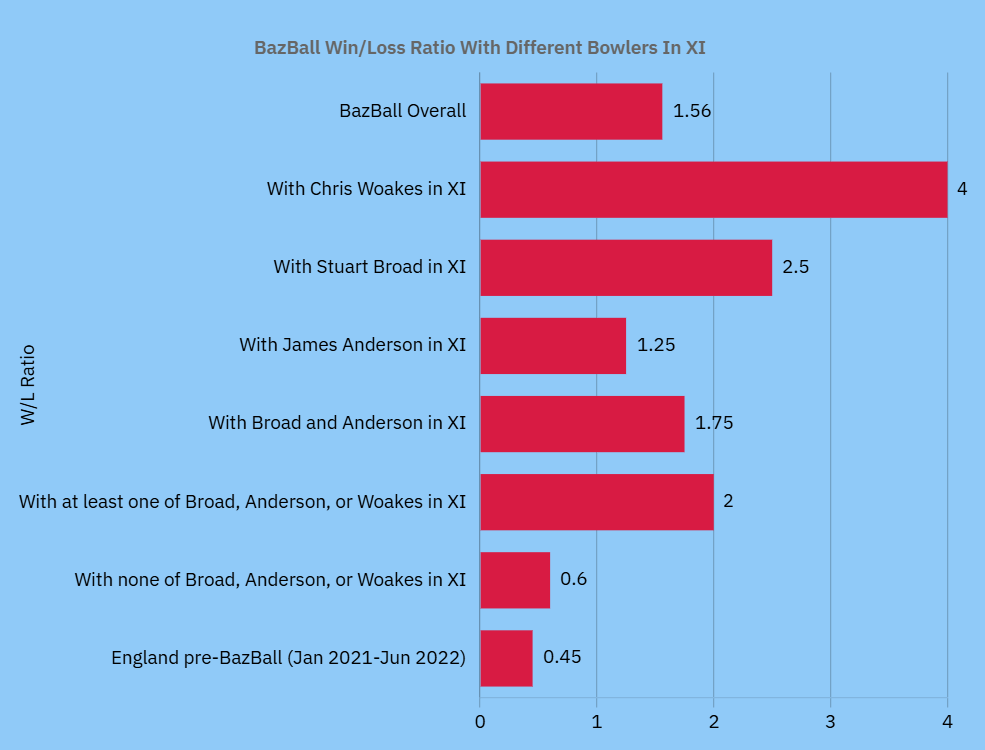
Since Brendon McCullum took over as coach, England have won 25 Tests, lost 16, and drawn 2 for a win/loss ratio of 1.56. They average 31.5 with the ball, concede runs at 3.4 an over, and strike every 55 balls.
When Chris Woakes played in the team under McCullum, England won 12, lost 3, and drew 2 for a W/L ratio of 4.0. In these games, they averaged 31.2 with the ball, conceded runs at 3.5 an over, and struck every 53 balls.
When Stuart Broad played in the team under McCullum, England won 10, lost 4, and drew 1 for a W/L ratio of 2.5. In these games, they averaged 28.4 with the ball, conceded 3.2 runs an over, and struck every 53 balls.
When James Anderson played in the team under McCullum, England won 10, lost 8, and drew 1 for a W/L ratio of 1.25. They averaged 30.6 with the ball, conceded 3.2 runs an over, and struck every 56 balls.
When Broad and Anderson were both in the team under McCullum, England won 7 and lost 4 for a W/L ratio of 1.75.
When both Broad and Woakes were both in the team under McCullum, England won 2 and drew 1. The same is true when Anderson and Woakes were in the same team under McCullum.
Broad, Anderson, and Woakes only played in the same team twice under McCullum, winning one and drawing one.
When at least one of these three bowlers has been in the team under McCullum, England have won 22, lost 11, and drawn 2 for a W/L ratio of 2.
Are you ready for the kicker? When none of these bowlers are in the side under McCullum, England have won just three and lost five, for a W/L ratio of 0.6. That is the version of BazBall we currently see: a pale imitation. In these games, they average 32.4 with the ball and concede 3.66 runs an over. The only silver lining here is that this is still better than England was doing in the 18 months prior to BazBall, when they had a W/L ratio of 0.45.
However you slice the numbers, when any of Anderson, Woakes, or Broad were in the side under McCullum, England won more Tests than they lost. Without them, they’re losing nearly two Tests for every one win.
Again, correlation isn’t causation (in the 17 Tests that Woakes plays under McCullum, Root averages 70 with eight tons, for example, making this difficult to unpick), but it is hard to look at those numbers and wonder if Chris Woakes wasn’t quietly BazBall’s crown jewel all along, the glue that kept the whole thing on track?
Because, for all the unending hype around Jofra Archer and Mark Wood, the simple fact is that we’re talking about two bowlers whose Test averages and ages are both north of 30. In many ways, they are bowlers in their captain, Ben Stokes’s, image. Just as Stokes is a player of great innings, rather than being a consistently great batter in Tests, as an average of 35 attests, so too are Jofra and Wood bowlers of great spells, rather than being consistently great Test bowlers. That some fans tried to select Archer over Hazlewood in pre-series combined XIs was truly staggering.
For all the talk about the age of Australia’s attack, in Brydon Carse, England has yet another fast bowler older than 30, who averages 32.5 in first-class cricket, and only barely below 30 so far in Tests. Never mind Matthew Potts and Josh Tongue on the sidelines, both with far superior first-class records to Carse, averaging 25 and 26 respectively, and both also far more suited to current Australian conditions.
I’ll say it until I’m blue in the face: with the bowling attack they selected, England were planning for the last few Ashes in Australia when pitches were much flatter, and pace was vital, not this current series. It is a consistent mistake they never seem to learn from: England always appear to be playing catch-up, trying to learn from their mistakes in the last Ashes series, while Australia are busy planning ahead for the next.
Perhaps the greatest irony is that Anderson, Broad, and Woakes would have never bowled in more suitable conditions in Australia across their careers than on the current, more seam-friendly surfaces with the reinforced Kookaburra seam. I can only imagine how Jimmy felt breaking his back on road after road in Australia over the years, only to see the pitches suddenly change in his favour, and that’s when the selectors tap him on the shoulder? We say that if you’re good enough, you’re old enough as a way to justify selecting young players. I think as cricket fans we need to get it through our heads that, for older players, if you’re fit enough, you’re not too old. Can anyone seriously look at what has been going on and not suspect that Anderson still would have been England’s best bowler (at worst, one of their best three and good enough to justify a place in the XI) had he come on this tour?
There has also been a knock-on effect on the English batting without these three in the lineup, perhaps partially attributable to the side missing Woakes’ handy lower-order runs, though more likely because the English batters have faced more challenging match situations without these bowlers keeping them in the game. In games with at least one of Anderson, Broad, or Woakes in the lineup under McCullum, England average 35.9 with the bat and strike at 72. In the eight matches without any of these bowlers in the lineup, they average 27 with the bat and strike at 69.5.
Whatever happens for the rest of this series, and 5-0 looks increasingly likely, I do believe that England should broadly stick with this methodology and resist throwing the baby out with the bathwater. In 2020, New Zealand went to Australia and lost 3-0 by embarrassing, historic margins. The team then went on to sweep their home summer 6-0 and win the WTC final 6 months later. Would that have happened if NZC had overreacted and sacked Kane Williamson and Gary Stead as captain and coach after that tour? Doubtful.
Maybe, just maybe, England needs to finally overcome the urge to judge the entire success or failure of their men’s cricket program on the outcome of a tour to a country where visiting sides are historically cannon fodder? Oh, and setting more realistic expectations after losing 1,500 Test wickets in the past two years couldn’t hurt either. You don’t replace that overnight, nor even in two years. But maybe by 2027, if the baby hasn’t already disappeared with the bath water…
Thanks for reading! Like my work? Please consider supporting me via a paid subscription or Buy Me A Coffee. For more info on how your support helps me produce this work and what your contributions go towards, see my About Page!
Like my work, but not that much? Fair enough! If you still want to support me, the best thing you can do is share this article far and wide: whether that’s with friends and family, teammates at your local club, on Reddit, or in your obscure cricketing discord server, I cannot emphasise enough how helpful every single share is.
Just keen to keep reading about cricket? Same! If you liked this article, you might also enjoy:
Comments
Nothing yet. Say the first thing.
Sign in to join the conversation.