
The golden generation is dead; long live the golden generation.
Since Kane Williamson debuted in Test cricket in November 2010, through to his abrupt retirement last week, New Zealand won exactly one (1) Test against WTC opposition without any of Kane Williamson, Tim Southee, or Trent Boult in the side—that being the third Test of the remarkable sweep of India at the Wankhede in 2024. Last week, at The Oval, they doubled that tally.
In fact, you can take this a step further: before this Test at The Oval, at least one of Boult, Southee, or Williamson had featured in 120 of New Zealand’s previous 122 Tests against WTC opponents. The last time New Zealand played consecutive Tests against WTC opponents without any of those three in the XI was the home series against Pakistan in 2009. Salman Butt, Mohammad Asif, and Mohammad Amir all played for Pakistan in that series, 9 months before what was to come at Lord’s. It was a lifetime ago.
So consistent have those presences who formed the core of New Zealand’s golden generation been, that it’s almost difficult to remember life without them. Yet, for years now, ever since Boult started stepping back from Test cricket and Rosco and Watling stepped away, I’ve had this nagging voice in the back of my head: ‘Remember how abysmal we were in the 90s? Remember the constant batting collapses of the 2000s? This generation has been fun while it lasted, but when Kane goes, we’re heading straight back to the Bad Old Days™.’ And, somehow, that attitude still makes me one of the more optimistic Black Caps’ fans.
As such, whether I liked it or not, that was the lens through which I was watching this first Test of the post-Williamson era. Without Kane to steady the ship, would we immediately hit an iceberg? Would the team spontaneously combust, as we learned that Kane was literally holding the batting order together? Was Williamson’s beard actually giving our bowlers magical powers? Would they all look a bit deflated and lacking in belief without their masterful number three? Would they even remember how to play cricket without him on the field?
Well, if this performance is any indication of what life is going to be like for the Black Caps post-Williamson, I, and many other Black Caps fans, can breathe a sigh of relief. Let’s dig into how the Black Caps kicked off the post-Williamson era with a thumping win, analyse where England got it badly wrong, and look ahead to tonight’s decider, with the Crowe-Thorpe Trophy on the line.

Matt Henry Is The Best Test Bowler In The World Right Now, Bar None—Prove Me Wrong
Obviously, that’s a pretty huge statement given the other main contender is Jasprit Bumrah.
However, in my defence, I present Exhibit A, a graph of everyone who has bowled at least 2,000 balls in Test cricket since 2024, ranked by strike rate and bowling average:
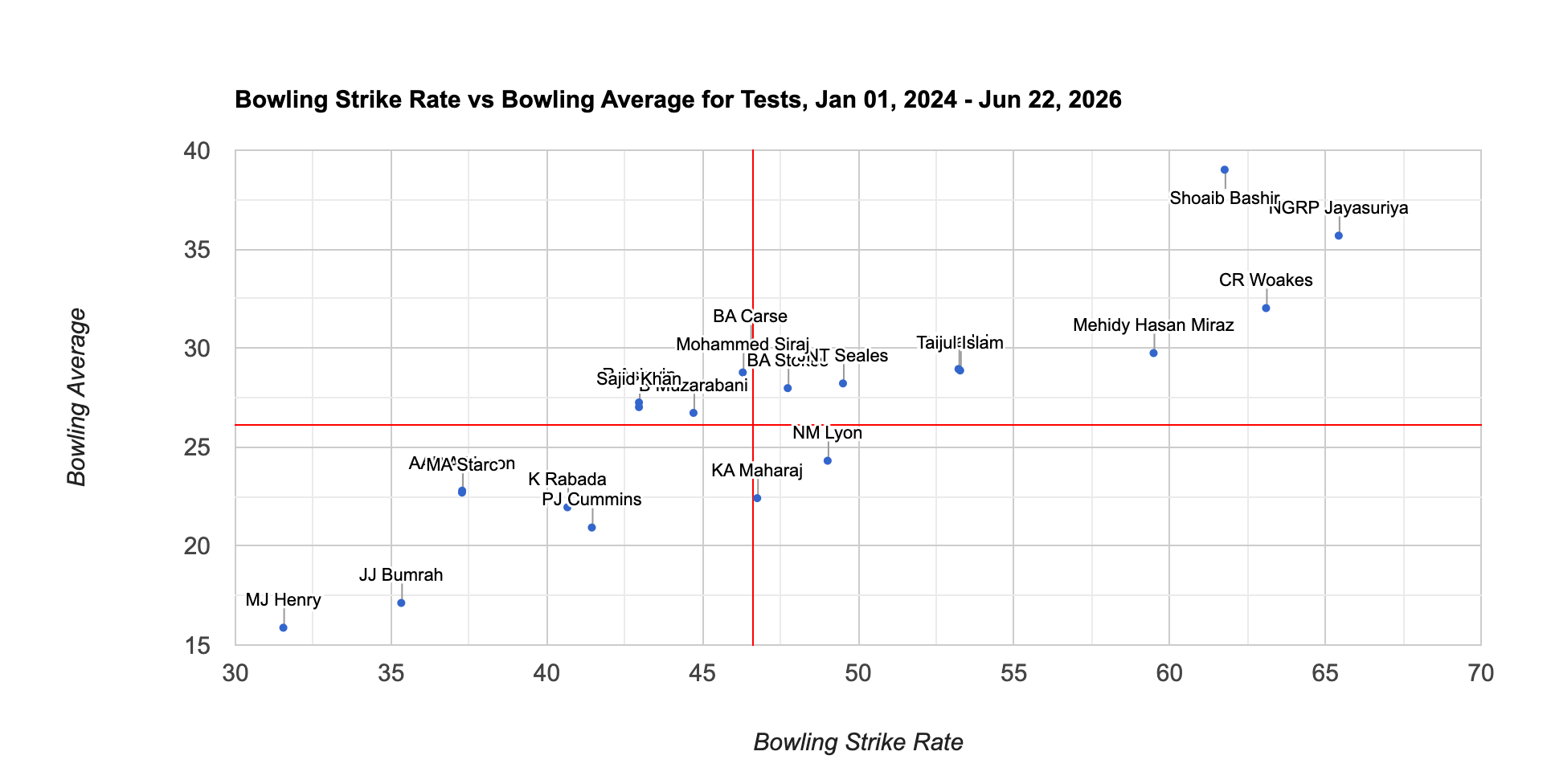
Fairly compelling, no?
And if that doesn’t convince you, perhaps this will?
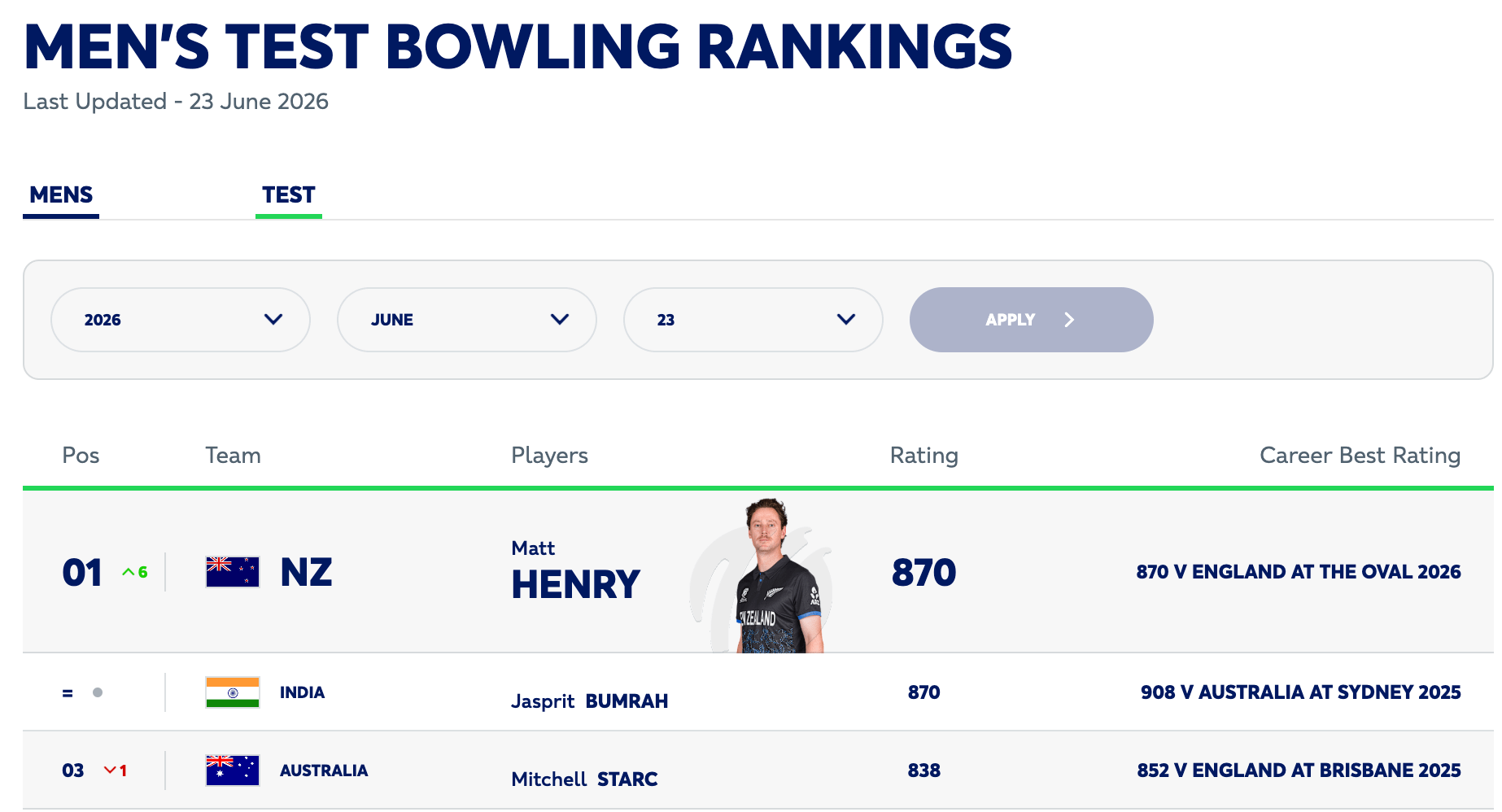
If you want the raw numbers, since 2024, Henry has taken 80 wickets at 15.87 while striking at 31.5; Bumrah has taken 102 wickets at 17.12 while striking at 35.3; and Hazlewood, who missed the 2,000-ball cutoff on the above graph, has 51 wickets at 14.96 while striking at 34.
If Matt Henry isn’t the best Test bowler in the world currently, he is at least on a very, very short list of contenders. And boy, did he show all of those skills—and emphasise just how much New Zealand missed him at Lord’s—during his player of the match performance in this Test.
By now, you probably know the stats: Henry’s best bowling figures in Tests, the best bowling figures by a New Zealander in England, surpassing Dion Nash’s previous record of 11/169 at Lord’s in 1994, and the 8th-best bowling figures for a New Zealander in Tests, full stop.
For all of Henry’s skills, from varying his pace to moving the ball both ways, the thing that always stands out to me the most about Henry’s bowling is his unerring, unrelenting accuracy. There’s no real way to prove this, but I would put good money on Henry being one of the most consistently accurate Test bowlers we’ve ever seen, up there with Cummins and McGrath. Once Henry homes in on a spot that is troubling a batter, he is harder to move than a Sumo wrestler stuck in quicksand. Just look at his pitch maps from this Test: all of Henry’s wickets came from a line of off stump or just outside, with 8 of 11 coming from good-length or short-of-a-good-length deliveries. Of the other three wickets, the two fuller balls are almost certainly the LBWs that trapped Root and Brook in the first innings. The yorker is most likely Cox’s first innings dismissal, which was a bit of a bonus.
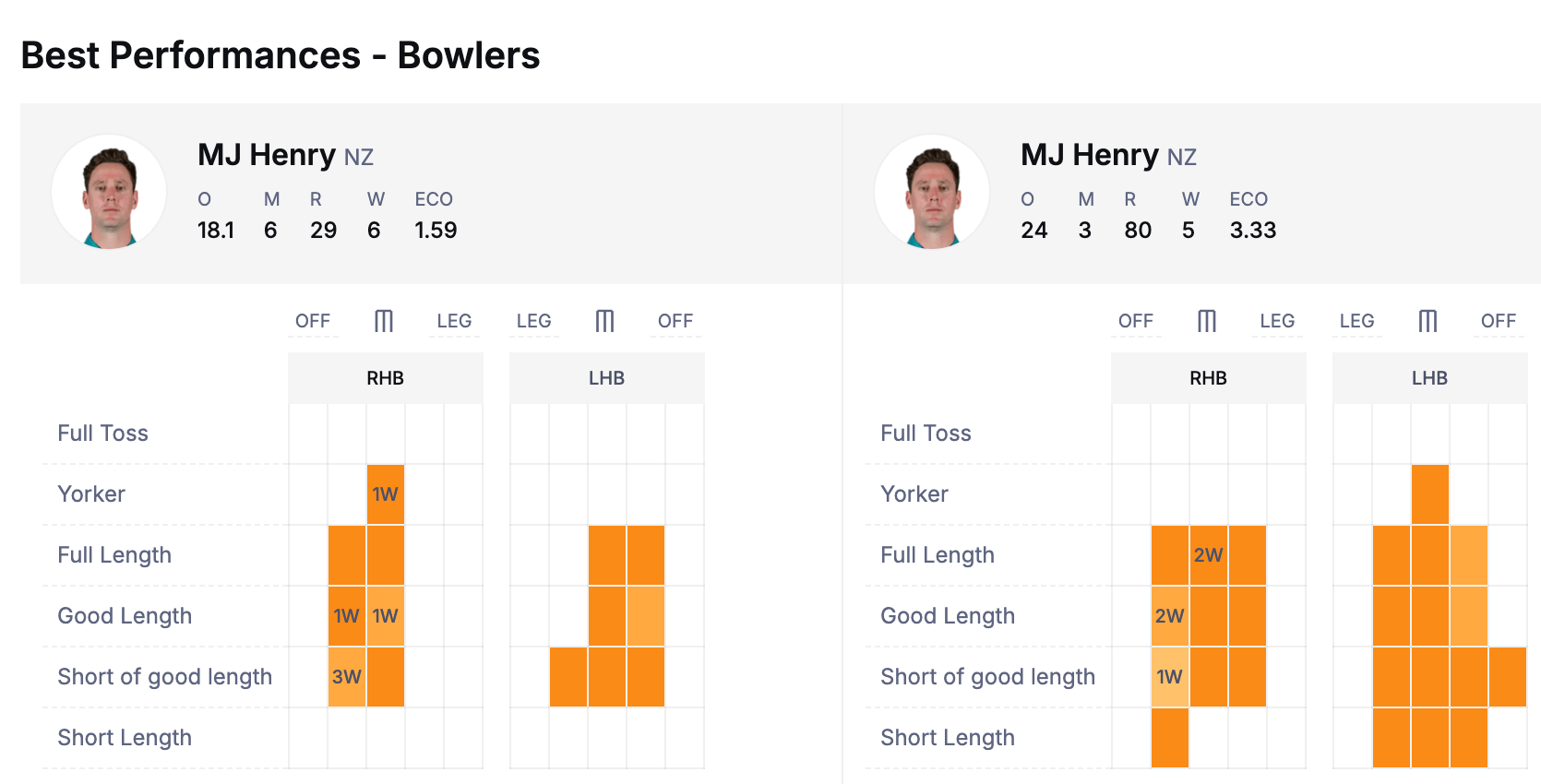
There’s no great secret to how Henry takes his wickets, but good luck trying to stop him.
Blundell’s Otherworldly Keeping
While we’re discussing Henry’s performance, it’s worth emphasising that Tom Blundell deserves significant credit for helping to create several of Henry’s wickets by standing up to the stumps and trapping batters (namely, Root and Brook) on the crease.
After the previous Test, I lightly criticised Blundell’s keeping, given he let through 20 byes (how quaint that seems after this Test), saying:
“20 byes is quite obviously too many in any Test under basically any circumstances, but it is even more inexcusable in a Test decided by 115 runs, during which time Blundell only had to spend 574 balls, or just over 95 overs, keeping.
With the pressure already mounting on Tom Blundell’s place in the side between his age—he’ll be 36 in September—poor recent form outside of his hundred in Ireland, and the fact that Mitchell Hay is waiting in the wings and performed well on debut, he can ill afford to let his standards drop with the gloves as they have with the bat in recent years.”
My goodness, did he respond, and then some. I don’t claim to be an expert on the technical intricacies of wicketkeeping; however, it doesn’t take a genius to realise that it takes a superhuman level of skill and hand-eye coordination to successfully keep up to the stumps to a bowler like Henry, who’s bowling at around 135kph and moving the ball both ways.
There really aren’t enough superlatives for Blundell’s keeping in this Test. It was quite simply one of the most impressive, skilful displays of wicketkeeping to seam that I can remember watching in a long, long time (or, at least, since the last time Blundell kept up to the stumps against BazBall, WHICH WAS BEFORE CAREY DID IT IN THE ASHES, AND NOT THE OTHER WAY AROUND).
The highlight was certainly his catch off Henry to dismiss Archer, as was obvious from Blundell’s elated, seemingly disbelieving reaction. However, as alluded to above, he also deserves partial credit for messing with the English batters’ footwork and creating several of Henry’s wickets.
Add in his vital, gritty first innings 51 after walking to the crease at 4/107, and Blundell delivered a timely reminder that class is permanent and he remains the best pure wicketkeeper in the country, and one of the best in the world.
Latham Goes To the Top
It wasn’t a great Test for Tom Latham with the bat—although I thought his first innings 27 (75) was an underrated contribution given how much the new ball was doing early, which ultimately paved the way for the likes of Mitchell, Blundell, Phillips, and Jamieson to cash in. It’s not an innings that will go down in the record books, but I do think there was value in Latham chewing up 75 balls, seeing the shine off the new ball, and tiring out some of England’s bowlers.
However, more to the point, winning this Test saw Tom Latham go outright first on the list of most Test wins for the Black Caps (48), having previously been tied with Williamson and Southee (47).
Say what you will about Latham’s record against the Big Three, but personally, I think you have to be doing a lot right to win the most ever Tests for your country (hot take, I know).
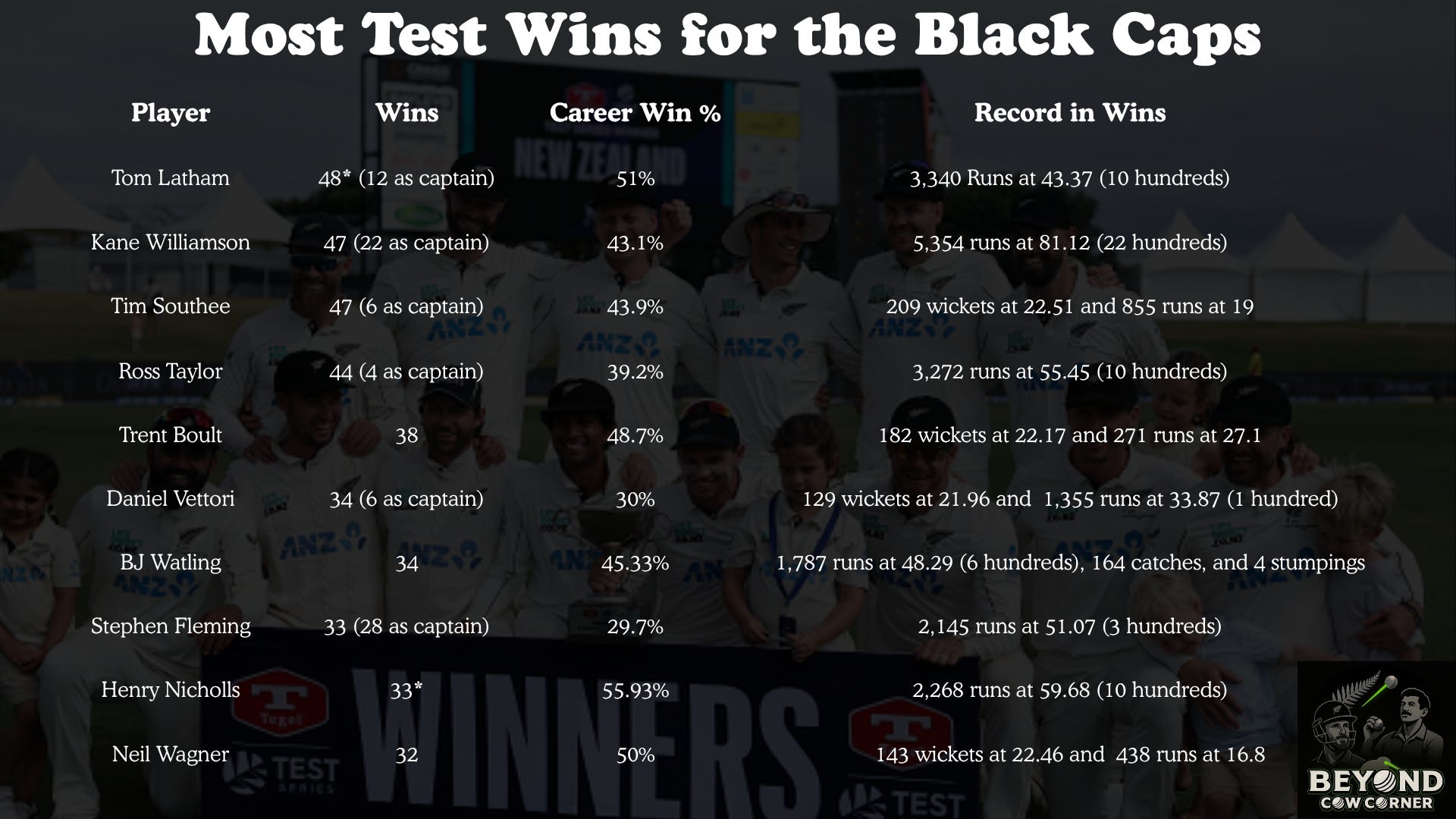
Congrats, Tom Latham—now carry on and put the record out of reach.
Phillips Comes of Age
How apt was it that Glenn Phillips scored his first Test century in the first Test of the post-Williamson era? If ever there was a symbolic ‘passing of the torch’ moment for this batting lineup, that was it.
I’ve been banging on for a while now about how I think Phillips needs to move up the order, writing the following after the first Test, and this innings only served to further that case:
“It was also a good match for Glenn Phillips with the bat, and one that underscored exactly why I will continue to beat the drum that PHILLIPS MUST BAT HIGHER THAN 7 IN THIS NEW ZEALAND ORDER. In both innings, Phillips counterattacked nicely, scoring 34 and 44*, but in both cases, he quickly ran out of partners. It is becoming a familiar story for Phillips, who has accumulated 6 not outs in 31 Test innings so far, along with many more instances where he has been the last man out chasing quick runs. The simple fact is, we still haven’t really seen what Glenn Phillips is capable of as a Test batter, because we haven’t yet given him the opportunity to be a pure Test batter, instead shoehorning him into the allrounder role at 7 (where he has performed admirably). With Mitchell and Blundell’s recent form being on the slide, I see no reason why Phillips couldn’t move up one or even two spots in the order to 5 or 6 to allow him the opportunity to show what he’s capable of as a batter at this level, rather than constantly having to bat with the tail.”
As fun as it was to watch Matt Henry desperately try to play within himself to get Phillips through to a hundred, it would be much better for my heart rate going forward if Phillips did finally get a chance to shuffle a spot or two up the order and show what he’s capable of when batting with fellow top-order players. Because as much as it pains me to say it, Kane’s retirement isn’t going to be the last in the next little while for New Zealand, and, at 29, Phillips will be a vital batter to help bridge the gap to the next generation of talent. It’s time he started getting experience batting up the order now, rather than when it’s too late and we’re left scrambling after further retirements.
On Phillips’ hundred itself, which made him the third New Zealand batter to score hundreds in all three international formats after Guptill and McCullum, I’m not sure there are too many more superlatives I can add that haven’t already been widely covered. He was sublime, particularly having walked to the crease with the team still in trouble at 5/188. The thing that particularly stood out to me about Phillips’ hundred was his sheer natural timing and power. There were several times where Phillips pushed what appeared to be a simple, regulation defensive shot behind point, only to discover it was actually racing away to the boundary and picking up speed as it went.
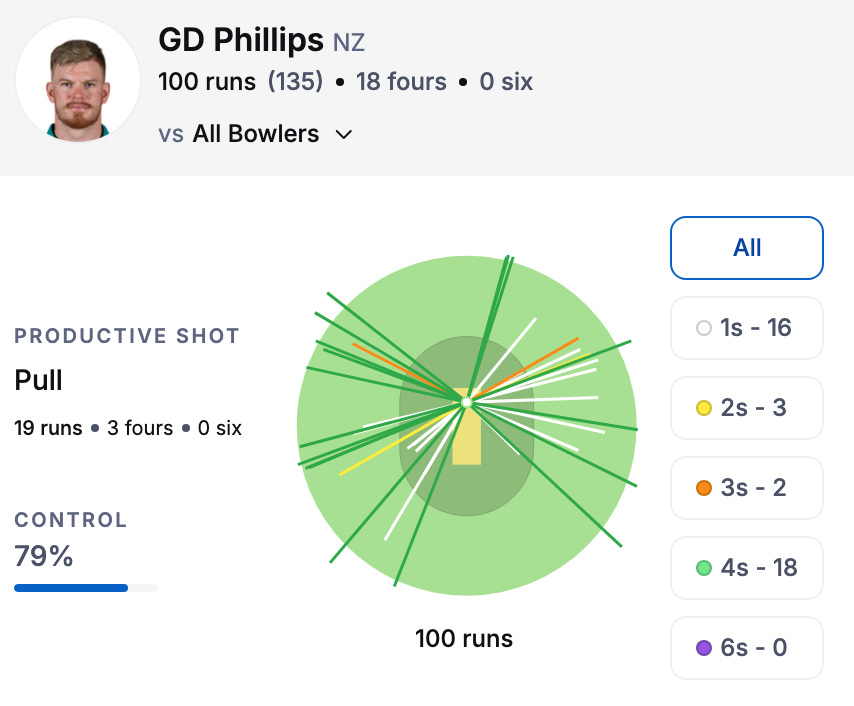
The other thing I would add here is that, in hindsight, I don’t think England and Archer got it right by targeting Phillips with the bouncer strategy. As entertaining as it was to watch at the time, my theory is that, if anything, that battle actually helped Phillips to lock in and focus even harder, as you could see on his face that he was absolutely relishing the challenge of facing Archer. It’s a bit like sledging: there are some players whose skin you can get under by sledging, and others for whom you want to stay silent, as sledging them simply helps to motivate them for the contest. I’m pretty sure that Phillips falls into the latter camp.
Err…I mean…definitely try bouncing Phillips again this Test, please England, you were so close!
Welcome Back, Henry Nicholls
When Henry Nicholls was finally dropped from the New Zealand Test team in December 2023 after the second Test against Bangladesh, his Test career was, for all intents and purposes, over. He was 32 and had spent his last 14 Tests, spanning 2022 and 2023, averaging just 28.47. Daryl Mitchell had burst onto the scene and taken Nicholls’ spot at number 5, and Will Young had seemingly overtaken Nicholls as the spare batter in the squad.
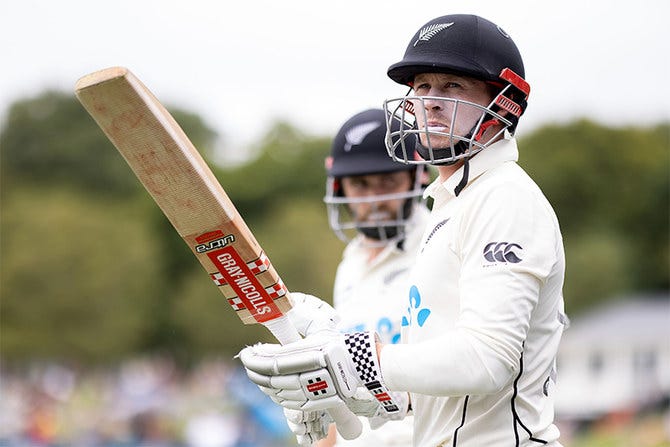
The only thing is, no one seemed to tell Nicholls that it was all over. Instead, Nicholls did exactly what you’re supposed to do when you get dropped: he went back to domestic cricket, worked on his weaknesses, and scored so many runs that he simply made himself impossible to ignore.
Since being dropped from the Test team in 2023, Nicholls has played 13 Plunket Shield matches for Canterbury over three seasons. In these, he has scored 1,411 runs, including 5 hundreds and 7 fifties, at an average of 83. If you include the three Tests Nicholls has now played since being dropped (two against Zimbabwe last year and this one at The Oval) and his 6-match stint for Worcestershire in 2025, in all first-class cricket since March 2024, Nicholls has scored 1,920 runs at 61.93 with 7 hundreds and 7 fifties.
Put simply, Nicholls has scored such a volume of runs since 2024 that he has achieved that rarest of feats: earning a Test recall as a batter after being dropped in your 30s. How many other batters can say that? I can think of Usman Khawaja, and then it’s a pretty short list after that.
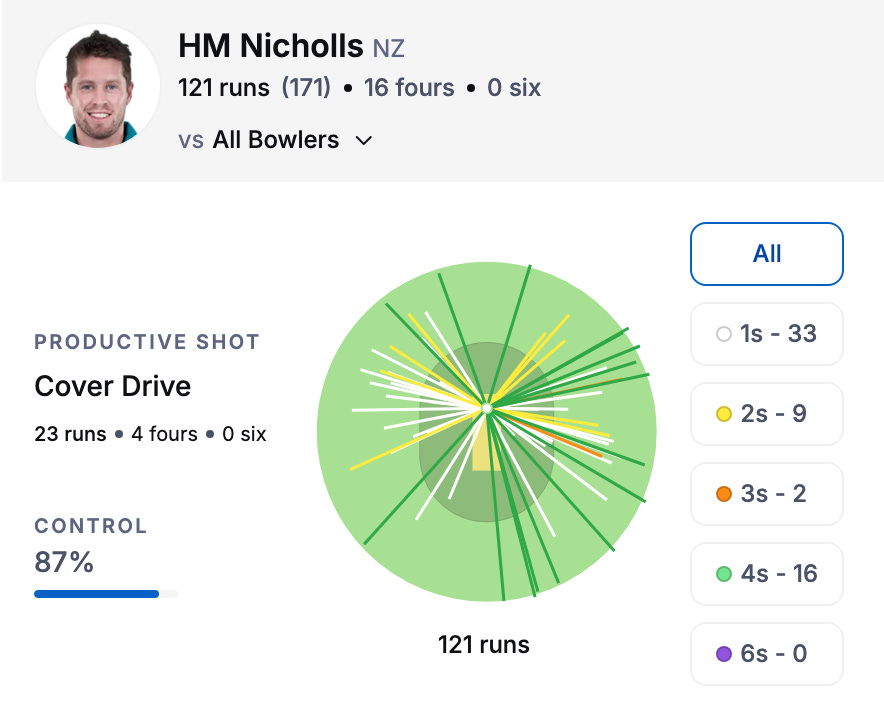
And all of those skills and more were on display during Nicholls’ outstanding third innings 121, with some of his play through the offside being particularly easy on the eye. Crucially, Nicholls looked much clearer-headed at the crease than in 2022/23, where it was starting to become obvious that his continued poor form was weighing on him, leading to indecision, as he frequently got bogged down and struggled to rotate strike. This time, Nicholls looked like someone who has been averaging 60+ in first-class cricket over the past few years and, most importantly, who understands their strengths and weaknesses inside and out.
As a long-time Nicholls defender, I’m absolutely thrilled that he has made it back this far and am looking forward to seeing what more Nicholls 2.0 has to offer.
England’s Generosity
England aren’t always known as the most generous hosts. Just ask any country that’s tried to retrieve their stolen artefacts from the British Museum over the years (too soon?), anyone who’s currently trying to seek asylum in the UK, or, you know, basically any Commonwealth country. But, for this Test at least, England decided to make up for lost time and were exceedingly generous.
England were kind enough to gift the Black Caps 53 (!!!!!!) extras in the first innings—the 46th most in an innings in Test history—and another 18 in the second, for a total of 71 extras for the match, including 31 byes. They also felt giving enough to drop Kyle Jamieson, Henry Nicholls, and Rachin Ravindra at various crucial points throughout the match (looking at you, Duckett and Rew).
That alone would be plenty, but England also gave New Zealand a helping hand with the first innings run out of Duckett just as things were ticking along nicely for them, and the odd decision to pick a bowling attack with a combined 29 Tests of experience composed of four right-arm seamers who all bowl roughly between 135 and 145kph.
And it doesn’t even stop there, as England then decided to bowl Jofra Archer into the ground yet again against New Zealand, to the point that he couldn’t take the new ball on the crucial second morning and Jacob Bethell ended up bowling with it before Archer. Let me repeat that: JACOB BETHELL USED THE SECOND NEW BALL WELL BEFORE JOFRA ARCHER ON A CRUCIAL SECOND MORNING, BECAUSE HE HAD BEEN BOWLED INTO THE GROUND THE NIGHT BEFORE.
Oh, and if all that wasn’t enough, England were also kind enough to bowl Root, Brook, and Bethell for a combined 33 overs in this Test.
And that’s without even touching on the frankly farcical situation with Stokes and Atkinson.
Now, it appears that England are doing it again, with The Telegraph reporting that England have left a fit-again Ollie Robinson, who was POTM in the first Test, out of the side, instead opting “for what McCullum was labelling ‘airspeed’ in cricket’s latest buzzword.” As we all know, faster bowlers inherently perform better in seaming English conditions. It’s a famously good thing when your three seamers all bowl at roughly the same pace and with the same arm, while there’s no way excluding a fit bowler who averages 21 in Test cricket from the XI could backfire in a must-win Test where jobs might be on the line. Flawless logic.
New Zealand were excellent and absolutely deserved to win this Test, but England certainly gave them a few helping hands along the way.
Stray Thoughts
It didn’t matter much in the grand scheme of things, but this was another Test where Rachin Ravindra got two good starts without fully capitalising on either. It’s not the worst problem to have, but 21 of Ravindra’s 42 Test innings have now been scores of between 10 and 80. I don’t doubt that he’ll get there, but his biggest current work-on is finding a way to consistently convert his starts into meaningful scores at the Test level.
He hasn’t been rewarded with a bag of wickets yet, but my goodness, I enjoy watching Will O’Rourke bowl. I don’t think there are many bowlers in world cricket whose best ball is better than O’Rourke’s.
With Tom Latham announcing that Kyle Jamieson will be rested for this third Test to manage his workload, it will be interesting to see if Blair Tickner comes into the equation or if Mitchell Santner is preferred, given the current heatwave.
Thanks for reading! Keen to keep reading about cricket? I know the feeling. If you liked this article, you might also enjoy:
Preview: Black Caps Set To Embark On Legacy-Defining 14-Test Run
Responding To The Telegraph’s 30 Greatest Fast Bowlers In Test History
Enjoy my writing? Please consider supporting me via a paid subscription or Buy Me A Coffee. For more information on how your support helps me produce this work and what your contributions go towards, see my About Page!
Like my work, but not that much? Fair enough! If you still want to support me, the best thing you can do is share this article far and wide.
Comments
Nothing yet. Say the first thing.
Sign in to join the conversation.