
In the immortal words of Justin Marshall: “me oh my I have enjoyed that—yes boy!” If you’re reading this and don’t know who Justin Marshall is or what on earth I’m talking about, you’re welcome:
Not even watching that semi-final in three parts—first, from 11:30-12:30 last night before falling asleep, then a few more overs during breakfast this morning, then the rest surreptitiously on my third screen at work—could take the sheen off that result.
As you doubtless already know, the Black Caps have reached yet another ICC final, while South Africa have once again failed to learn their lessons in ICC knockout matches.
Here’s how it unfolded.
Cole Mc-Who?
Smarter bloggers—those who care about glamour metrics like ‘reads’ and ‘subscribers’—would have kicked this off by analysing Finn Allen’s masterclass. Pfft. We’ll get there, that’s dessert. But first, it’s McConchie time.
If you knew who Cole McConchie was in January 2026, congratulations, we have the same brain disease. Now, barely a month later, he’s made himself a household name in cricketing circles.
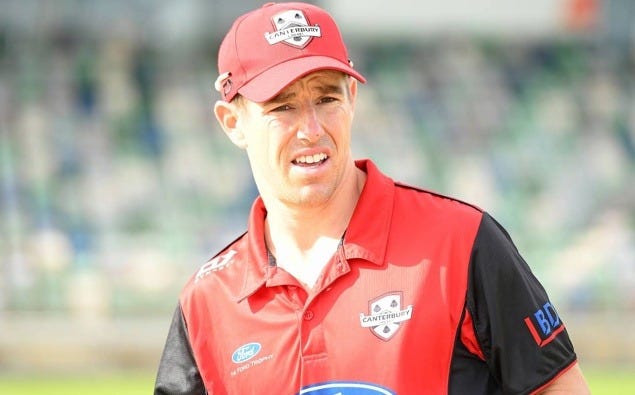
If you’d told me that a month ago, I’d have been shocked, but I would have at least assumed this newfound recognition would be for McConchie’s batting exploits, which makes it all the stranger that, today, McConchie’s star turn came with the ball.
For the majority of his career, McConchie has been a part-timer with the ball, averaging 13.6 balls per T20 match, or slightly over two overs. To put that into context, this is a similar usage rate to Roston Chase, who averages 14.7 balls per T20, and Moeen Ali, who averaged 12.8 balls per T20. McConchie is slightly better than a part-timer, but he’s not a bowler you can rely on to consistently deliver four overs a game.
Not only that, but McConchie’s numbers had been trending in the wrong direction, as in 2024 and 2025, he posted his two highest career economy rates—8.79 and 8.47, respectively.
And yet, so far in 2026, Mujeeb Ur Rahman is the only offspinner to have taken more T20 wickets than Cole McConchie’s 14. Forget Mujeeb’s mystery and Tariq’s stop-start action, turns out all you needed to dominate T20 cricket was a good, solid Canterbury boy rolling his arm over with some offies.
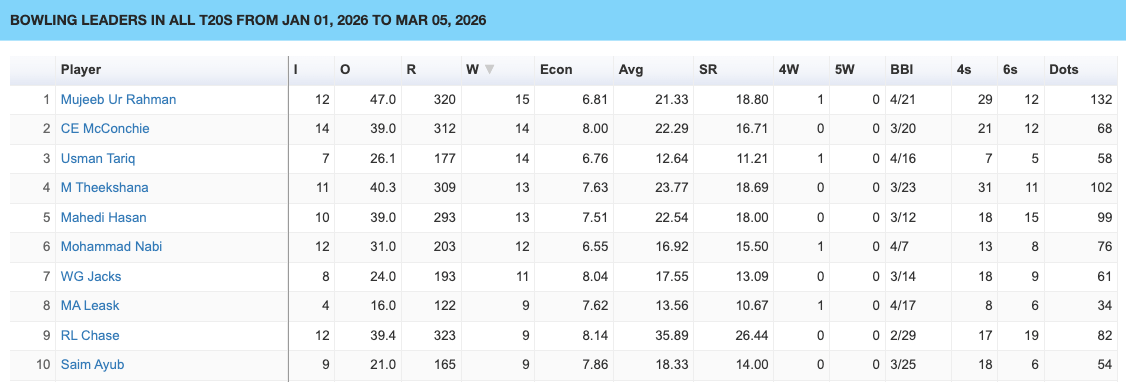
This is already McConchie’s highest wicket tally in a calendar year, with his previous best being 13 in 2021, and we’re not even a quarter of the way through the year. In fact, McConchie has already bowled more overs this year (39) than he did in 2024 and 2025 combined (31.1), and, in all likelihood, will never take two more important wickets than the scalps of QDK and Rickleton that he claimed today.
You also have to give the New Zealand selectors significant credit for selecting a 34-year-old McConchie out of nowhere—he last played a T20I for NZ in April 2024 when our regulars were at the IPL. Equally, it is an indicator that the Super Smash isn’t necessarily as weak as we generally assume, given McConchie’s call-up came off the back of outstanding bowling form this season, finishing as the 4th top wicket taker with 14 at 18.7.
Turn it Like Rachin
Speaking of a period of supreme bowling form coming out of nowhere, I’m starting to think that the ‘Ravindra’ part of Rachin Ravindra was named in Ravi Jadeja’s honour. Pre-tournament, I doubt most bookies would have even offered odds for Ravindra to be New Zealand’s top tournament wicket-taker, but here we are.
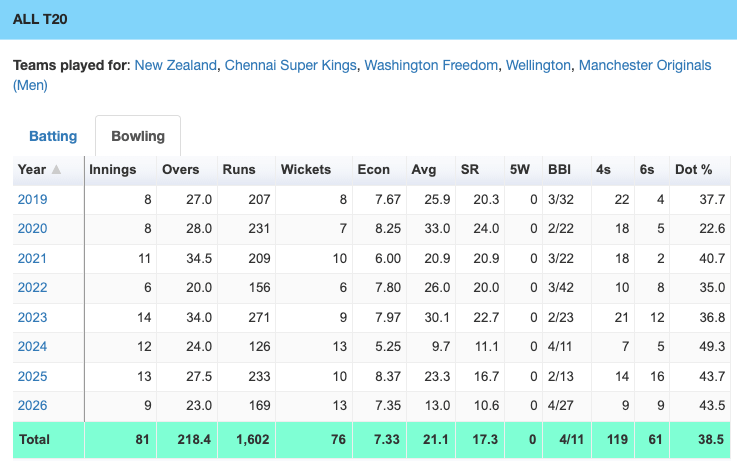
In fairness, there have been some indicators that Ravindra’s bowling has been improving: from 2019-2023, Ravindra took 40 T20 wickets at 26.9, while from 2024-present, he has taken 36 T20 wickets at 14.66. Perhaps the biggest difference is that Ravindra has increased his dot ball percentage markedly: from 2019-2023, it hovered at approximately 34.5%, while from 2024 onwards, his dot ball percentage has increased to 45.5%.
Why exactly is this happening? My working theory is simply that Rachin is spinning the ball further than the other Kiwi spinners.
You’ll have to take my word for it, as I don’t have the time or tech skills to bypass Amazon Prime’s screenshot blocking software, but they’ve showed several times on the broadcast throughout this tournament that Rachin Ravindra has turned the ball more than any other New Zealand spinner on average, ripping it more than 5 degrees in the previous game against England at Colombo, which was significantly more than the likes of Rashid, Santner, and Sodhi.
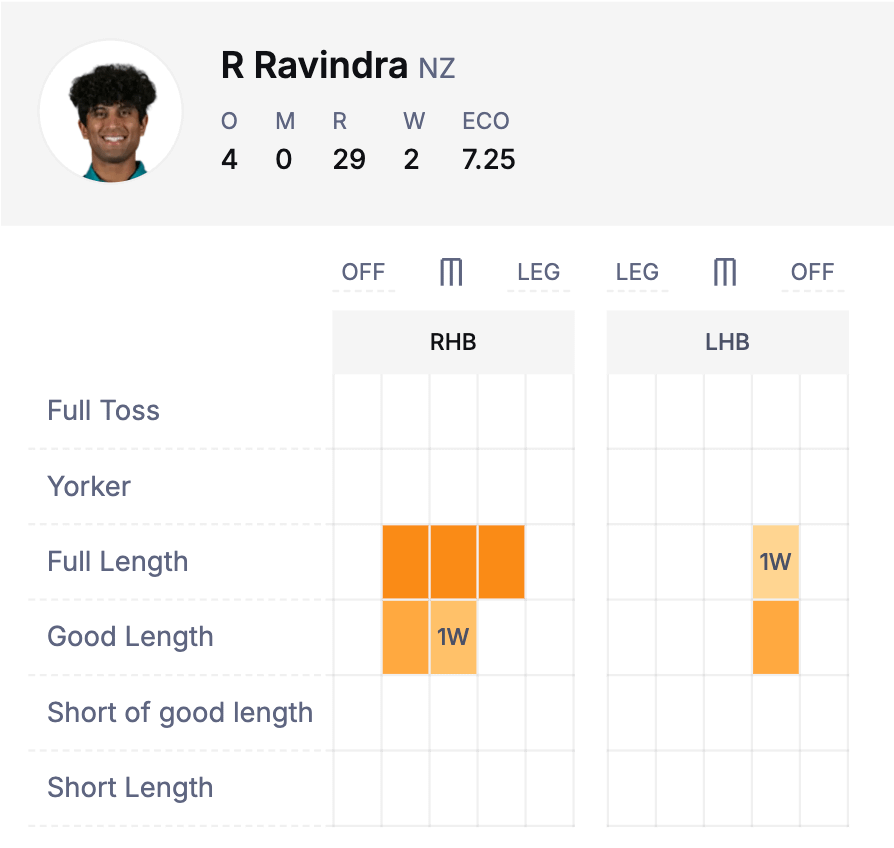
Often, part-time spinners will sacrifice spin for greater control and accuracy, but Ravindra, the T20 bowler, is more like Joe Root, the Test bowler—he really rips the ball in search of wickets, and is less concerned with landing six deliveries in the same spot. As you can see below, Ravindra didn’t exactly hit a consistent line in this game, spraying it either side of the wicket to the right-handers, but was very consistent with his lengths:
There will be plenty of days where Ravindra’s bowling gets pounded but, when it all clicks, he can be a match-winner.
Does South Africa Never Learn?
Without wanting to be too harsh, the main thing that lost South Africa last night’s semi-final is the same thing that lost them the 2024 final and the same thing that has cost them in just about every ICC event ever: THEIR BATTING STOPS AT NUMBER 6.
Let me repeat that because it never seems to sink in: South 👏 Africa’s👏batting👏stops👏at👏number👏6👏.
Accordingly, if they lose early wickets, like today, their top order goes into their shells, and we witness what Jarrod Kimber has dubbed the Evan Gulbis effect. Essentially, this theory posits that the shallower your batting order, the more likely your batters are to play within themselves, leading to sub-par totals. On the other hand, even if your numbers 7 and 8 (in this case, Evan Gulbis, but you could just as easily call it the Nathan McCullum effect in an NZ context) don’t face many balls, the psychological effect on the top order of knowing they have that batting depth can be immense.
And we saw this exact pattern play out again today. Yes, I know Jansen ultimately scored a 50, but he averages 17 in T20Is. The top order looks at that number and starts getting nervous—especially after losing two wickets in the second over—and you saw it on full display:
Markram - 18 (20)
QDK - 10 (8)
Brevis - 34 (27)
Stubbs - 29 (24)
Miller - 6 (6)
The Evan Gulbis effect was most evident in Markram’s innings, going from being the fastest scoring opener in the tournament before this game (not anymore!), to bearing the brunt of the rebuild and not even striking at 100.
It’s the same old story as Miller putting the brakes on and scoring 21 (17) in the 2024 final, also with Jansen batting at 7. It’s the same story as when they lost to the Netherlands in 2022, with Wayne Parnell batting at 7—Miller scored 17 (17) and Bavuma 20 (20). It’s the same story as the 2011 ODI World Cup QF, when SA had Johan Botha batting at 7, and their numbers 7-11 combined for 13 runs, after cruising at 4/121 chasing 221. Before that, Kallis crawled to 47 (75).
This is not an accident; it is a consistent structural choice in the way that South Africa sets up their teams, which consistently backfires on them. In fact, over the last decade of T20I cricket among the Test-playing nations, only England has a worse average return from their numbers 7 and 8 batters than South Africa.
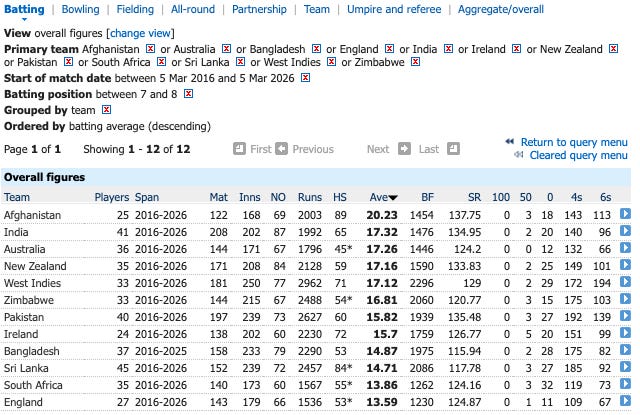
Just look at how deep the other semi-finalists bat: NZ had McConchie listed at number 9 today, England have had Dawson at 9, and India bats to Axar at 8. At best, for those other three sides, Jansen would bat at 8—he’s not overtaking Jacks, Santner, or Dube.
This was not another choke, but it was another eminently predictable chapter in the book of South Africa’s ICC failures. The definition of insanity is trying the same thing repeatedly and expecting a different result. So, I repeat, does South Africa never learn?
Pure Finnsanity
I had to get to it eventually. How do you even analyse an innings like that from “Big Bash star” Finn Allen?
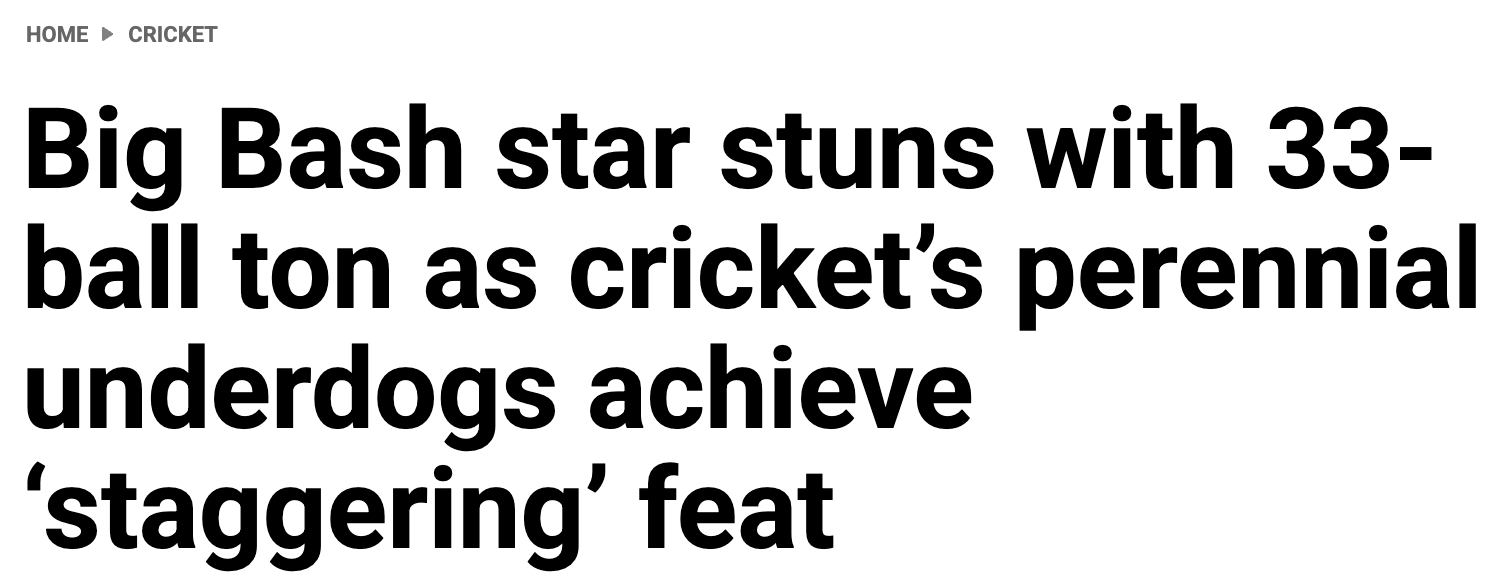
When I saw that New Zealand’s innings only lasted 1 hour and 7 minutes on Amazon’s replay, I knew there were only two possible outcomes—we collapsed quickly, or chased it quickly—and it immediately became apparent which one.
Did Allen also have a post-game flight to catch, like Matt Henry after the England game? Because he sure did seem to be in a hurry at the end there.
Really, I’m not sure I have a lot to add here; that was pure entertainment from Allen, an innings worth letting wash over you. In fact, what on earth are you doing reading this? Go and watch the highlights again—I know I will be.
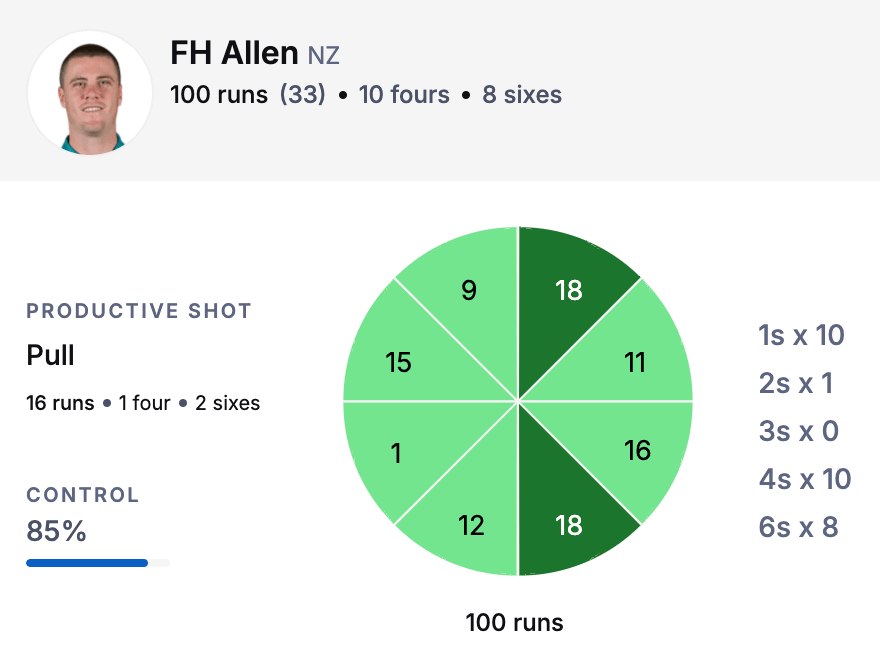
Anyone still here? In that case, I guess I’ll do my best. Perhaps the most impressive part of Allen’s innings, from my perspective, is that even within a 33-ball hundred, he still found time to be watchful against the threat of Kagiso Rabada, taking him for just 7 (5). This shows excellent foresight and clear planning from Allen, in stark contrast to the ‘swing at every bowler’ approach we saw earlier in his career. Despite being watchful against Rabada, Allen knew he had oodles of time to catch up, given his power, and was brutal against all other bowlers, taking Bosch for 29 (8), Ngidi for 8 (4), Maharaj for 25 (9), and Jansen for 31 (7). Even within a whirlwind, record-breaking hundred, there is still room for strategy.
The other impressive aspect was how Allen scored all around the ground—well, except for the solitary run he scored through the covers. Far be it from me to tell the South African bowlers how to do their jobs, but it’s hard not to look at that wagon wheel and think that wide yorkers might have been worth a shot.
Perhaps the funniest part is that, despite Finn’s record-breaking hundred and Seifert and Allen chasing 175 in 15.2 overs against the UAE, the two have actually lost their place at the top of the list of fastest-scoring T20I opening partnerships (min. 10 innings) over the course of this tournament, falling ever so slightly behind Malaysia’s pair of Aslam Khan and Syed Aziz.
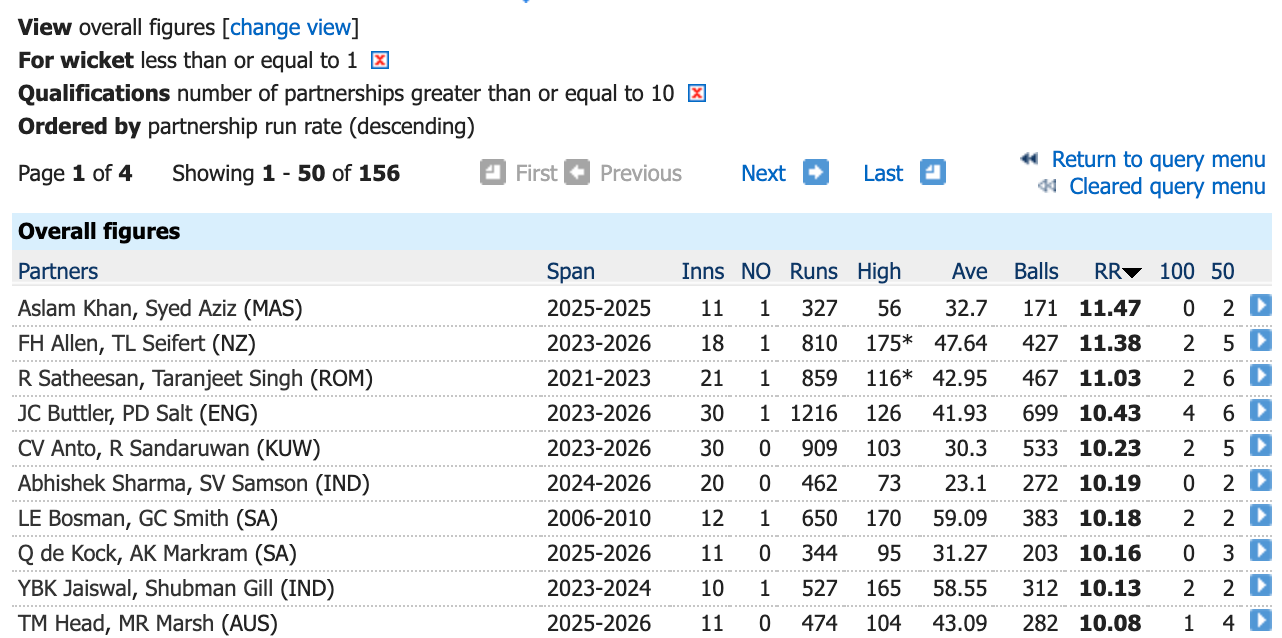
In fairness, they’ve boosted their pre-tournament average from 44.66 to 47.64, so I think that’s forgivable…this time. Note also how all but one of these top-10 fastest-scoring T20I opening partnerships have batted together since 2023—clear evidence of the game’s trajectory.
What Will The Final Bring?
If history is anything to go by, more heartbreak and me getting about four hours of sleep on Sunday night, if I’m lucky.
From a tactical perspective, I’d consider strengthening the bowling by replacing Neesham with Duffy, but I think it’s unlikely they’ll tinker with a winning formula.
Most likely, we’ll run into the home team again, just as in the 2015 and 2019 World Cup finals. With absolute certainty, whoever we’re playing will receive ~95% of the pre-match attention and coverage, while I’m setting the over/under at how many times we’re described as ‘Dark Horses’ between now and Sunday at a very, very generous 278,695,413.5—I’m backing overs. Someone will inevitably mention that we’re punching above our weight, despite making more ICC finals than just about anyone else over the past decade, and Simon Doull will probably deny climate change again (ok, maybe not, but I like to remind people he did that as often as possible).

Maybe, just maybe, there’ll even be a period where I allow myself to dare to dream, despite the warnings of every rational bone in my body…
I wouldn’t have it any other way.
Thanks for reading! Like my work? Please consider supporting me via a paid subscription or Buy Me A Coffee. For more info on how your support helps me produce this work and what your contributions go towards, see my About Page!
Just keen to keep reading about cricket? Same! If you liked this article, you might also enjoy:
Comments
Nothing yet. Say the first thing.
Sign in to join the conversation.