
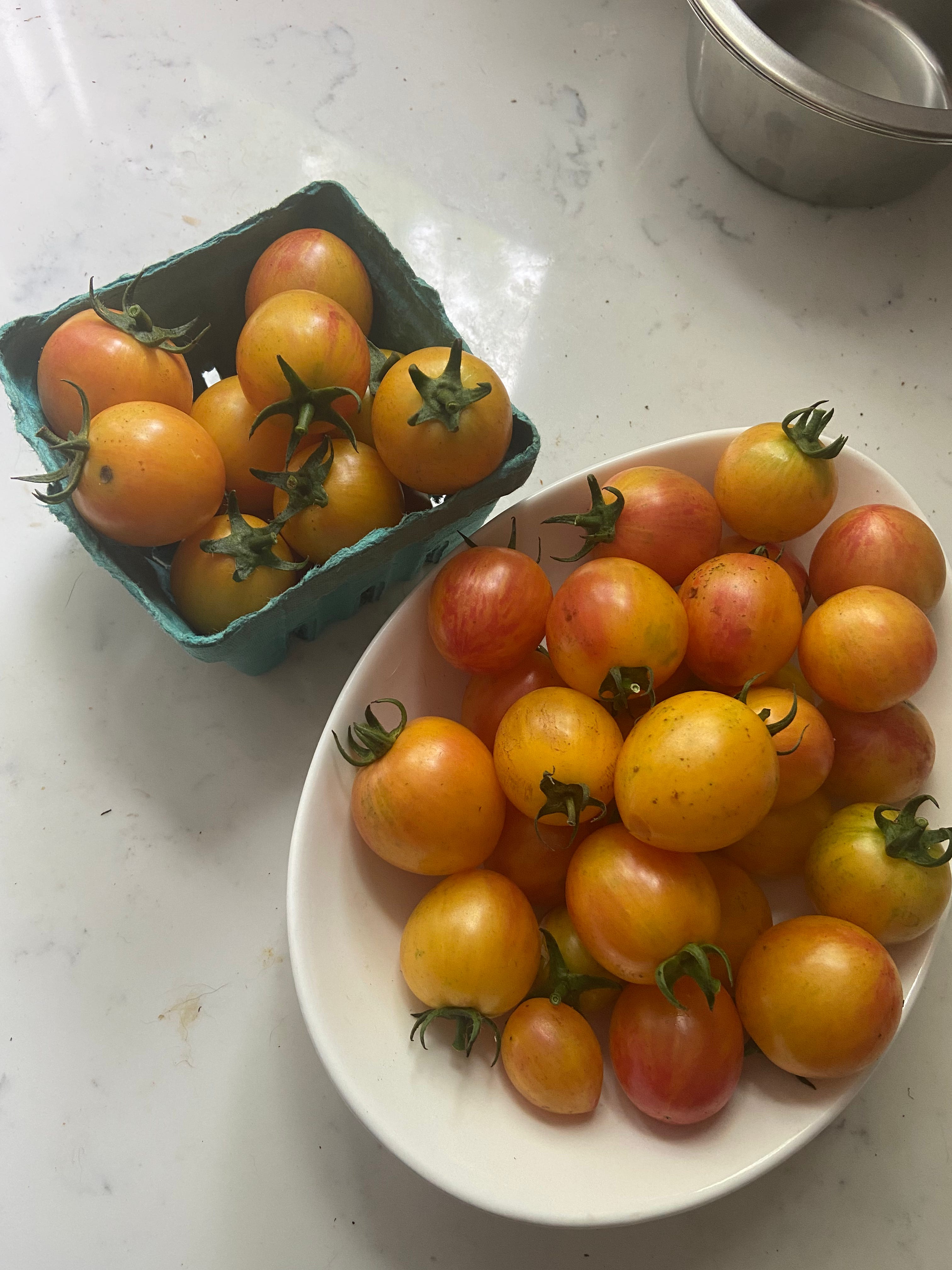
I sat on my therapist’s couch with a tiny carton of orange/yellow tomatoes and said nothing. She knew what I was feeling when she saw the carton in my hands in the lobby. The tomatoes were the same exact strain a friend planted in my yard two years ago: Sunrise Bumblebee. I had stumbled upon them at a farmer’s market. The tears came and did not stop. Crying at a farmer’s market over tomatoes is such a silly thing to do, but heartbreak can find you anywhere.
“What if you cooked something for one of your friends?” she asked.
“What am I supposed to do?” I asked back, “Call someone up and say, ‘I’m crying over the strain of tomatoes that my former best friend grew in my yard, can I make you something with them?’”
She sat steady in a silence that told me, yes, that is what I am supposed to do.
Elizabeth arrived at my house with very little. An old dog. A couple of suitcases. A lot of tears. And tomatoes. I told her she could stay as long as she wanted. I meant it.
The tomatoes were seeded by her late husband. He had just passed. He started them and she was hellbent on finishing them, like his last act of life. She put the tomatoes in the windows of my sunroom at first. It was still cold enough for frost and deep enough in the heart of the pandemic that we found ourselves getting our first boosters in a Best Buy.
The tomatoes eventually went up in my front yard, sometimes nibbled on by the deer that run in suburban-rural New York. They climbed a trellis, getting higher every day, reaching towards summer. She took care of them and learned new hobbies. She went on long walks. She learned to bake milk bread. She mastered stained glass. I still have the piece she made me, not hung in my house, but nestled against my mother’s ashes, my wedding invitation, a love letter from my twenties. It’s placed in a box like my own little graveyard of lost loves. Sometimes, when I miss her, I pull it out.
*
I made Elizabeth meal after meal in my house. I don’t think I ever told her that before she came, my boyfriend and I had started eating alone. One night, when he was working late, she said, “I thought it would be hard living with a couple, but you two barely touch.” She didn’t think that might mean something was wrong, but I actually hadn’t noticed that about my him. “You’re so intentional,” she said later. “I just thought you wanted it that way.”
When she told me, I started to notice it. He sat on the other end of the couch. I moved closer. We switched sides. He never held my hand. He didn’t hug on his way out the door. I started trying to squeeze in between the space that had been carved between us and I couldn’t.
The tomatoes grew taller until they burst with fruit. Then fall came and the branches dried. Her grief was a constant presence in my home. The space between my boyfriend and me grew wider. From April to October, she lived with us, and I did my best to love her the way I knew how: giving her the space for her grief and cooking for her.
I cooked with the tomatoes. Rich, red sauces just touched with olive oil and salt, mostly. Panzanella. Gazpacho. But also humble tomato toast, which we ate almost every morning. Mine had butter. Hers had mayo. My ex-fiancé ate the toast plain, without mayo, or butter, or tomato. Just bread. In the end, I knew she was getting better when one morning she woke up and made milk bread for BLTs. It was soft and pillowy. It was made as an act of grace during one of my hardest days–like I will take care of you and you will take care of me.
I mistook what we had for siblinghood.
*
When she left, I stopped cooking. My relationship got tighter around me. He stopped coming to bed as we were planning a wedding. They say there are always signs–and there were. I just thought they were fixable. I slept on my side of the bed, hoping he would come to sleep. It’s now so ingrained in my body that even when I try to sleep in the middle of the bed, I move to that side by morning, years later.
When she was in my home, I sometimes felt stifled. I didn’t realize it was because I was used to living alone, even though I lived with a man. He and I were so far apart. I spent most of my hours in the sunroom waiting for the sight of his car. When she left, I missed her presence so much that I kept going to the place she moved to. I just wanted to hug her. I just wanted to tell her I loved her. I just wanted to watch her life unfold in her new house with her new lover and her new dog.
When she left, the tomatoes died. I tried to plant them again the following summer. Nothing grew.
Two years later, my boyfriend was now my ex-fiance. When I called her to tell her, snot bubbling out of my nose and wails bumping off the walls in my house, she got to the house faster than seemed humanly possible. She brought armfuls of protein shakes, knowing that in times of deep sadness, it was all I could eat. That same day, we got U-Haul boxes. That same day, she booked movers. That same day, we packed half the kitchen.
We spent Valentine’s Day together during my final days in New York. It was tender and surreal that she gave up spending it with her girlfriend to spend it with me. We found the record that played on my second date and broke it over my knee. We popped NA champagne. I burst into tears for no reason and she wrapped her arms around me. We burned my wedding vows. I walked alongside her in the worst moment of her life–she was walking with me in the worst moment of mine.
We spent around 10 days together packing and moving and unboxing my life. Elizabeth drove me home across the country, communicated with my ex, and booked the halfway hotel stop in Chicago. She did countless things I am sure I did not know she did. She passed on the word that I had left the home so my ex could come back to find bookshelves ripped of most of their contents and a kitchen he built for me nearly empty. I can’t imagine what it must have felt like for him to arrive there, a house gutted and not cleaned, a book left on his pillow. I felt more love from her in those weeks than I had felt from him in a long time.
I took Elizabeth to my favorite restaurants upon my arrival in my hometown, Bar la Grassa and Modern Times. I wanted to show her a part of my life. When I asked her if she wanted to look at the menu at BLG, she said, “Show me your world.” I did. Red wine spaghetti and cauliflower and orange gnocchi were sandwiched between courses of goat cheese bruschetta and gjetost cheesecake. It was dreamy in that restaurant that night, warm. It felt like the end and the beginning of my life.
We came at the tail end of a blizzard. The city was cold and white, not yet brown from oil slicks and dirt. All of my friends came over the night I arrived. They wrapped their arms around me, most of them meeting my cats for the first time. Tender, gentle, careful, they said, “Welcome home.” Then to her, they said, “Thank you.”
Elizabeth promised she would come visit one day, when I had a big house like the one I left behind. But by the time I had that house, just three months later, I knew she never would.
*
In the early days of being single, I dated frantically. I was looking for a distraction. Most of my friends knew this and were delicate with me, smiling while sitting across from me at restaurants and understanding that my way through grief and pain was doing things. My friends back home had known me for over a decade. Each of them had seen heartbreak in my life. Each of them also knew how I lived while alone. They knew the fervor with which I lived, the gusto. They also knew those parts disappeared in my last relationship, not because he stifled them, but because I thought maybe I could hold onto him if I was a different person.
Those parts came roaring back at their highest pitch when I left. Imagine finding your violin after years of not playing it, how it might be tenuous and chaotic, but also might make you feel alive. This was me in those days, not with a violin but with life.
This is a thing I know about grief, having seen enough people in my life face it, including Elizabeth. You have this period of absolute chaos where you gather all the parts you lost into a little pile. You put them on like garments, all at the same time. It’s a shitty little outfit that clashes. Her frenetic energy went into things like stained glass and gardening. It felt poised. Mine went to, honestly, being quite messy and making mistakes and delaying my heartbreak that I didn’t see coming.
You put all the grief garments on, and then some come off. But that first part? The really messy part? That’s where the healing happens. You have to do it. You just have to.
*
The calls Elizabeth made became further apart. Text messages went unread. The tone of her voice turned from loving her friend to someone I didn’t recognize. I stopped talking for a while, hoping that would help, and she filled in the void with her own challenges in love and friendship. I didn’t talk about dating unless she asked.
Once, she said it was like I cried wolf with love, that I fell too often, or too hard. What she meant was that after first dates, I had hope. I wished I could be with her in person, hold her hand, and say, “Not all of us meet our great loves at bus stops or at conferences, as much as we wish we did. Some of us have to suffer through dozens of first dates, and for that, we need infinite hope.”
Other times, I felt anger. Did she not remember the chaotic and wild days of her current relationship, where the woman she dreams of a life now with was married? I wanted to sit with her in a park in the city she lived in and say, “Look, I love you, and that time was a little wild. You called and texted me all the time, sometimes yelling or in all caps, about your feelings. Sometimes you texted me mid-argument on the phone. Or frenetic on a train. I just listened. I didn’t love you less because of it. I loved that you shared it with me. Can you not love this part of me, too?”
*
When I returned to New York for the first time after the end of my engagement, I asked if she would go to the waterfall where I was supposed to be married. At first, she said yes. Then, she was tired and didn’t want to. It was the whole reason for our trip to the Hudson Valley: the promise of pilgrimage. I had planned to talk to her on that trip, too, about our friendship, how much I loved her. But in the car on our way to the train, Elizabeth ran into a gas station. A mutual friend of ours turned to me and said, “We’ve been talking about it and you’re just going through,” their eyes got big, “A LOT right now.” Then they shared a detail only Elizabeth knew about my life.
I imagined them getting coffee in a city I didn’t live in, gossiping about my pain. I decided not to say anything when she got back into the car. Four months had passed and we didn’t recognize each other anymore.
I went to my wedding site alone, standing on the banks of the place where I was supposed to be married. I dropped flowers in the water. I didn’t cry. What was supposed to be a pilgrimage with my best friend was something I did alone. As I dropped flowers in the water, I dropped some for her.
I grew resentful. She grew resentful. I tried to hold on. She did, too. It was destined to break. In the same way she couldn’t say the hard things, I couldn’t either. I think that neither of us could do it because we knew if we did, it would end.
In one of her last messages to me, she said she missed the friend who cared. I found myself standing in my kitchen, looking at the message, thinking about going to that water alone. I thought about how she did not realize at that moment that the choices she made in the hardest part of my life would impact our friendship forever. The calls left unanswered, the texts left unread, the waterfalls left unvisited, sent me calling others, texting others, asking others. They picked up, texted back, came with. I cried out in my house, to a cadre of cats, “I can’t love you the way you want me to if you won’t love me that way, too.”
When I left my therapist’s office with those tomatoes in my hand, I called a friend and I said, “I’m crying about tomatoes, and I know this sounds crazy, but can you come over and can I make you something with the tomatoes?”
She did not ask why. She came. We sat at my bar counter eating tomato pasta and I told her all about my grief. “It’s so stupid,” I said, “I’m triggered by tomatoes.”
“Triggered by tomatoes would be a good band name,” she said.
We laughed.
Then she said, “You can call me for anything. I can’t promise I will always be able to come over for dinner, but I will always call you back.”
Over two years, friends showed up for me in the ways only the greatest of partners might. One went to get a mammogram with me on their birthday and said, “There’s nothing else I would rather be doing on my birthday.” When I laughed and said, “Liar,” they looked me dead in the eye and said, “I mean that.”
Another made me eat on days when it was hard–just bits of tomatoes here, a slice of bread there. She brought me homemade cordials and jams, fresh produce, things she thought I might be enticed to eat.
The same friend who brought me to the mammogram brought me to surgery that might help prevent cancer one day. Other friends stayed over at my house after that surgery, assembling a makeshift team of caregivers who figured out a meal train, dog walks, and cat care. One friend, new at the time, insisted on being in that care team.
On the day Elizabeth was set to be the person delivering the meal on my meal train, it didn’t arrive. A friend of mine had quietly noted the slot she was in and asked me if food had arrived during that time. When I said no, she didn’t just send some, she showed up with burgers and said, “Turn on 90 Day Fiancé.”
When my phone went off with a string of apologetic messages from Elizabeth and a fresh dispatch of food, my friend stuffed her mouth full of cold fries and said, “You get to be mad that she forgot.”
I wasn’t, though. Just like in my last relationship, I kept hoping the love would come back if I was the right person for her. Maybe if I didn’t talk about dating or my heartbreak, maybe if I only asked about her life and didn’t share mine, or maybe didn’t ask for too much, our friendship would blossom again. I didn’t yet know that when you start to shield part of your light and also your mess from people you love, it’s already over. I didn’t yet know that not everyone can come with you as you grieve.
This year, I’m not holding tomatoes from a farmer’s market. I’m holding tomatoes I grew myself, not in my yard but on my bright, bright roof. When all of my friends had tiny shoots, mine were growing like weeds. It wasn’t just the tomatoes but the dill and the nasturtium and the edible flowers and my first blueberry plant. I planted these things expecting them to die–and all of them are lush enough that after dinner, friends stop by my roof to take things home. I have too much for myself.
I thought I wasn’t a talented gardener. That I killed everything I touched. Now, in the mornings, I go out and water these plants with no idea how they are thriving. Friends ask me, “What did you do?” I don’t know. Except for the constant sun and the constant trying.
The first tomato picked off the vine went right into my mouth. There was no one I wanted to tell more than Elizabeth. Instead, I told my friends that I grew something I thought I couldn’t. I found myself on this deck, wondering if maybe the house and the dirt were trying to tell me something in New York. Not: you are a bad gardener. But: nothing is meant to grow here for you. Not tomatoes, not herbs, not love, and not your friendships. I wonder if the house in New York was quietly telling me to go, like this one is telling me to stay.
I sent a photo of that first tomato to my boyfriend at the time. I said, “I grew something.” I still have an entire patch of nettles I can’t seem to kill, and weeds that won’t go away, and ivy that needs to come down away from the gutters. I don’t have a green thumb, just a little luck maybe, and a lot of sun and a good year of rain. I feel like my house is saying, “Vegetables won’t die here. Love won’t die here. Friendship won’t die here.”
I wonder if Elizabeth felt a shudder when I picked that first tomato from the vine. I wonder if when she eats tomatoes, she thinks of me, like someone who was once beloved to her, too. Sometimes things end, like love or friendship, but the love you shared can still live on inside of you. Not every ending needs spite or anger. Sometimes, it’s just… time. One of the things that Elizabeth grew to resent about me is how deep, how hard, I love. I’m not sure she ever paused to think about how deep that love was, too, for her. I didn’t start gardening with tomatoes because I thought they might be easy. I started with tomatoes because they remind me of her.
Comments
Nothing yet. Say the first thing.
Sign in to join the conversation.