
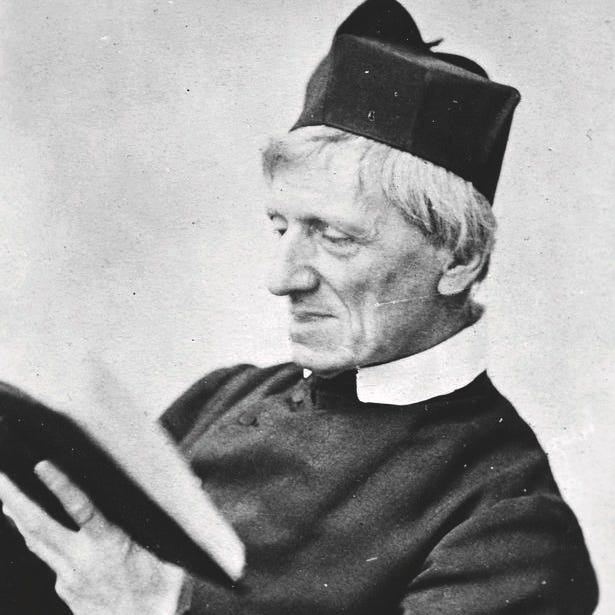
This week was the anniversary of the death of the newest Doctor of the Catholic Church, John Henry Newman. Newman is one of my own personal intellectual heroes, as he combined intellectual brilliance with artistic sensibility and a gentleness that comes through in every page of his.
Whereas Aquinas can sometimes read like a philosophy and theology machine, everything that Newman writes has a distinctly human character. His brilliance, combined with a serious moral character, make his views attractive even before his argumentation makes it clear.
You should read him. Not only are his books great, but they are widely available for free if you are willing to read on your computer (you can find links to his works on my Free Resources page).
But Newman was a famously prolific author. What should you read first?
That’s where I come in. Here are 5 books that anybody could pick up to start learning from one of the greatest thinkers of the 19th century.
I started Aquinas and Beyond to help everybody better understand Catholic philosophy. This is a free post, but premium subscribers are becoming thoughtful, well-formed Catholic intellectuals through:
A guided tour through the ENTIRETY of Thomas Aquinas’s Summa Theologiae. Don’t miss out on forming your mind according to the Universal Doctor of the Church!
Founding Members get a FREE copy of my Catholic Philosopher In A Year Reading Plan, my ultimate reading list to get up to speed in Catholic Philosophy.
Blogs on the philosophy of religion (God, evil, free will, etc.) like this one about art and the problem of evil.
Reader’s Guides on the great works of Catholic philosophy, like this guide on Jacques Maritain’s Art and Scholasticism.
Further reading recommendations on many posts, including this one!
Stop feeling confused in deep Catholic conversations and start thinking like a Catholic philosopher.
This was the first book I read by Newman, and I am convinced that it should be the first one that anybody reads.
The Apologia Pro Vita Sua is Newman’s personal intellectual autobiography, which he wrote to explain how and why he converted to Catholicism from Anglicanism. Newman’s reputation was in tatters after his conversion, as Catholics suspected the sincerity of his conversion and Anglicans suspected him of having been a secret Catholic for a long time prior to the announcement before his conversion.1
This book, however, both explained the process of his conversion and gave the reasoning behind his decision. It ended up repairing his reputation completely.
This book is a phenomenal introduction to John Henry Newman as a man and as a thinker, like Scott Hahn’s Rome Sweet Home but 100 years older.
Quick self-promotion: one of the first things I ever published at Aquinas and Beyond was a reader’s guide to this very book. You can read it here:
As far as I can tell, Newman is the first canonized saint to have written novels, and this one is the fictionalized account of his own conversion. In it, he details more intimately the psychological and personal costs of conversion.
The novel follows Charles Reding, a young man who arrives at an Oxford embroiled in theological and historical debates around what the Anglican Church is to be. Through his own study, discussions with friends and prayer, Reding finds himself slowly, reluctantly drawn to the Catholic Church.
This was the first work published by Newman after his conversion, and it offers a window into Newman’s thought about the psychological factors that lead to conversion.
Something I only discovered while looking through the Wikipedia page for this novel is that it was written in response to another novel that had sought to discourage prospective Catholic converts by Elizabeth Harris, who had converted to Catholicism and then returned to the Anglican Church after facing a serious case of disillusionment.
For all of his brilliance, Newman is not the patron of philosophers, essayists, novelists or converts. Instead, he is the patron of poets, and this book, which you can get in a high-quality free ebook version from Standard Ebooks, is a collection of many of his greatest poems, including “The Dream of Gerontius,” “The Pillar of Cloud” (Lead Kindly Light), “Snapdragon” and others.
If you are a poetry person, you definitely check these out.
If you are not a poetry person, you should still definitely check these out. Most are fairly short, very well-done, and not too hard to follow.
Newman was a philosopher and historian, but I have largely avoided his academic works for the simple reason that I do not think that only philosophers can or should read Newman. That being said, Newman undoubtedly had significant intellectual abilities, and reading his serious work is highly rewarding in its own right.
If you are looking to read something a little more intense, you could do much worse than The Idea of a University. Newman was, of course, an Oxford professor and scholar, and these lectures came as Newman was organizing a new Catholic university in Ireland.
In them, Newman outlines his theory of true Catholic scholarship, as well as the proper attitude, as he sees it, of Catholics to secular study. It might surprise you — though it shouldn’t if you are a regular reader of mine — to find out that Newman was utterly uninterested in siloing Catholic study from secular sciences. In fact, he thought that Catholic universities should openly interact with non-Catholic scholarship for the enrichment of everyone’s understanding of the world, science and revelation.
This is an excellent collection of writings on education, and is beneficial to virtually anybody learning OR teaching. Also, I wrote a reader’s guide for this book, too:
Finally, while this is not a collection of Newman’s essays, this collection gives you an insight into Newman’s skills as a short-form writer. It is also a nod to Newman’s time as an Anglican clergyman, though these sermons were re-published by Newman after his conversion.
Many of these sermons are also a commentary on the relationship between faith and reason, and include topics such as the relation between natural and revealed religion, the philosophical attitude as it is encouraged in Scripture, and the development of doctrine.
If you are looking to really learn from Newman, but do not have time to invest hours parsing his complicated reasoning, this collection is especially helpful. The sermons can be read in a single sitting, but showcase Newman’s beautiful writing and deep thought in a briefer context.
I’ve included some more online resources to better understand John Henry Newman here for paid subscribers. To see them, upgrade your subscription:
I put a reader’s guide together to make you an amateur Catholic philosopher in just a year. Reclaim the intellectual tradition of your faith:
As someone who has defended the immorality of lying in print, I find it amusing that Anglicans accused Newman of being willing to be dishonest because Catholic moral theology at the time had been exploring the extent to which deception was permissible in the context of saving priests from martyrdom in England. In any case, it is actually a pretty good example of why it is important to refuse to lie: it is hard to have anyone trust you if lying is fine with good enough reason.
Comments
Nothing yet. Say the first thing.
Sign in to join the conversation.