
This is the Guided Tour of the Summa Theologiae, a project for all paid subscribers of Aquinas and Beyond. In it, we are carefully reading through St. Thomas Aquinas’s masterpiece, with help from experts on Aquinas, to think like the universal doctor of the Church. Stop feeling intimidated by Aquinas, and subscribe so you can read along!
One of the most important ideas in Western philosophy is that of forms: the idea that our identity is based on something that is in some way prior to our existence, and that our existence is also directed to something beyond its current state. The idea of forms is found in its earliest state in Plato, and early Christian philosophers developed Plato’s idea to say that the forms of Plato are actually found in the mind of God. This is found most famously in the thought of Augustine and his followers.
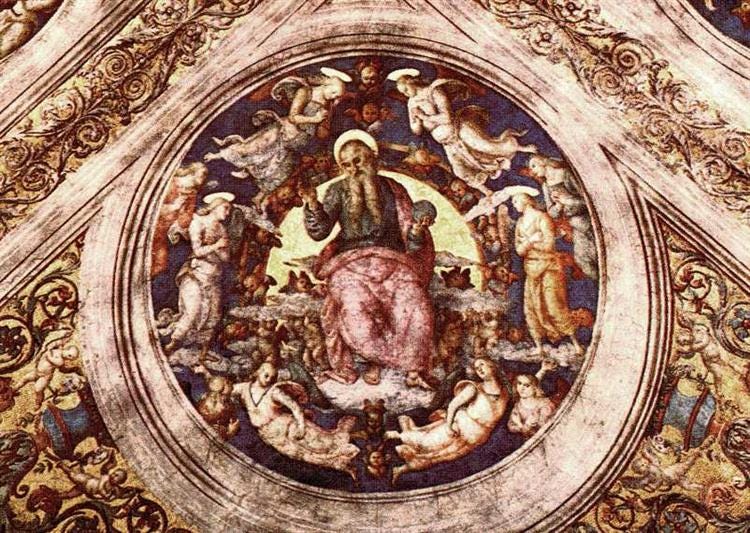
In this question, Aquinas adapts Augustine’s theory into his own, and outlines what God’s ideas are and how we should think of them.
As always, here are some resources you might find helpful as we move forward:
The Summa Theologiae itself. Buy Prima Pars here, and the whole Summa here. Read it for free here.
If you have never read the Summa, it can be a little intimidating. But I put together a roadmap so that anybody can read it and understand it. Get it here.
Here is the commentary I will be using from Walter Farrell, O.P. Note: the next few questions do not have explicit coverage from Fr. Farrell, so I will be including only commentary from Fr. Davies. But do not worry! Fr. Farrell will return!
Here is the commentary I will be using from Brian Davies, O.P.
Now, let’s dive into God’s ideas.
Plato famously argued that all things proceed from external beings called forms, and that the traits and species we share with other beings come from those forms. This relationship is known as “participation.” So I share humanity with other human beings because we all participate in the Platonic form of humanity.
Obviously, that is a super simplified version of Platonism, but it has some intuitive force as an explanation for how multiple beings with shared traits can be said to have the same trait. One problem among others, however, is that it is not clear how those forms actually interact with the beings that participate in those forms.
This brand of Platonism ends up saying that there is nothing in the being itself that makes it a human being; just the resemblance between that being and the Form. But that does not seem right; surely there is something in me that makes me human rather than just some true humanity I resemble.
Aristotle ended up rejecting Plato’s forms entirely, claiming that forms were found only in the being itself. But while that provides a kind of realism, it also loses a lot of what made Platonism’s forms appealing in the first place!
One thing that Scholastic philosophy did was to claim that Plato’s forms did exist, but as ideas in the Divine Mind. Even before you existed, God had an idea of you in His divine mind, and your creation came from that idea. Aquinas takes this to be clear from the fact that God made you intentionally rather than chance. Since, to do anything intentionally, you have to have some idea of what you are doing, God must have had ideas of the things he was going to do.
Here is Davies’ explanation:
[T]he forms of various things are in God, as God knows what God brings about. In knowing God’s effects, says Aquinas, God has their forms immaterially. He also argues that the forms of God’s effects can be likened to patterns in the mind of human makers and, therefore, amount to exemplars. Here Aquinas uses the example of architects who conceive of the buildings they intend to construct and who build with a view to their conception. Like architects, God has a conception of something to be produced and this, in God, is an idea.1
This is a free preview of the Guided Tour of the Summa. To read the rest, join other premium subscribers who are becoming thoughtful, well-formed Catholic intellectuals through:
A guided tour through the ENTIRETY of Thomas Aquinas’s Summa Theologiae, which you are reading right now! Don’t miss out on forming your mind according to the Universal Doctor of the Church!
Founding Members get a FREE copy of my Catholic Philosopher In A Year Reading Plan, my ultimate reading list to get up to speed in Catholic Philosophy.
Blogs on the philosophy of religion (God, evil, free will, etc.) like this one about art and the problem of evil.
Reader’s Guides on the great works of Catholic philosophy, like last month’s guide on Jacques Maritain’s Art and Scholasticism.
Further reading recommendations on many posts, including free posts.
Stop feeling confused in the face of deep Catholic conversations and start thinking like a Catholic philosopher.
Comments
Nothing yet. Say the first thing.
Sign in to join the conversation.