

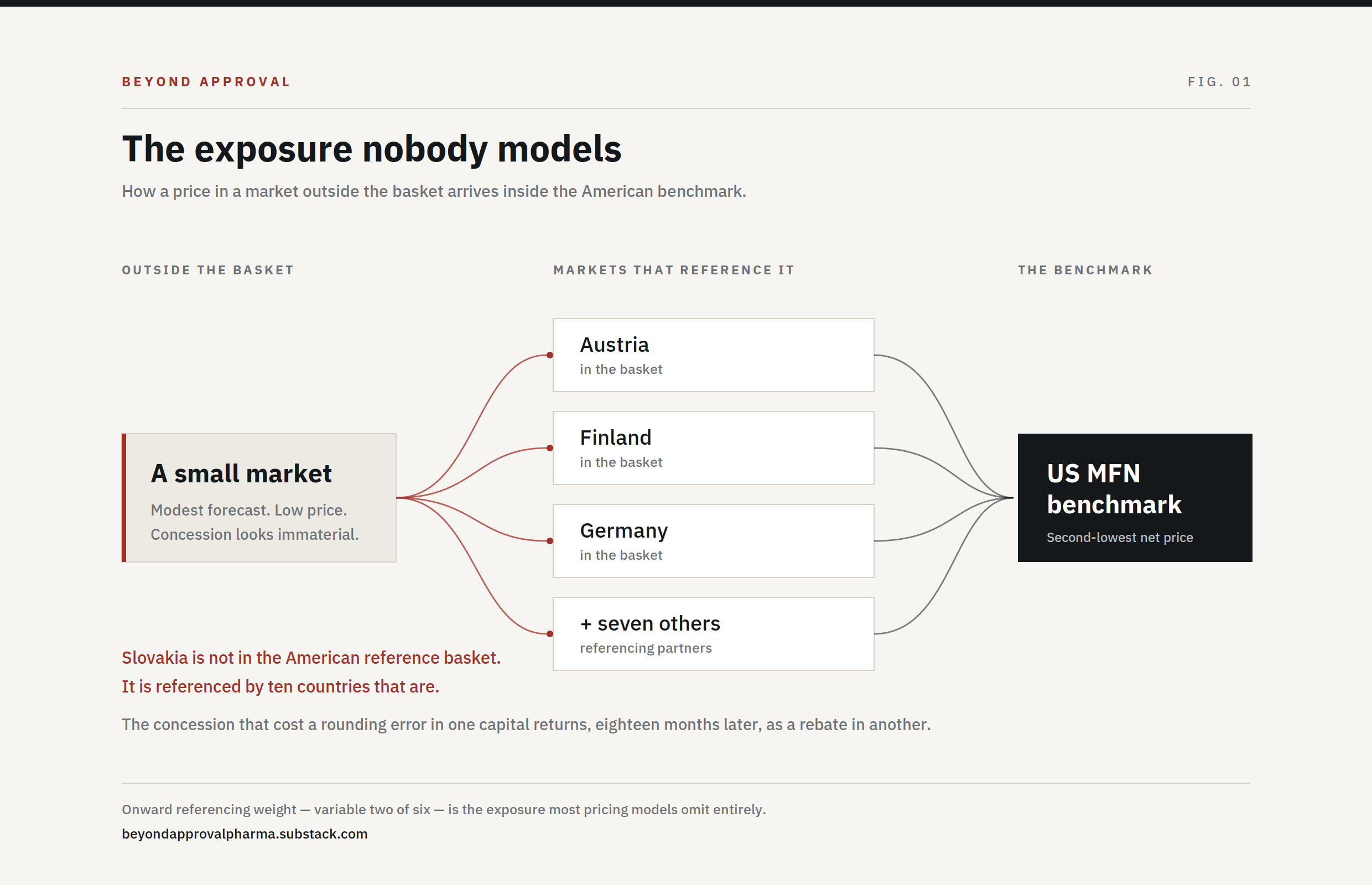
Slovakia is not in the American reference basket. It is referenced by ten countries that are.
Hold that sentence for a moment, because it contains the whole problem. A pricing team looking at Slovakia sees a small market, a modest forecast, and a price concession that costs almost nothing. What it is actually looking at is an input to the price of the same molecule in Austria, Finland and Germany — each of which is an input to the benchmark that will set the American price. The concession that appeared to cost a rounding error in Bratislava arrives, eighteen months later, as a rebate in Baltimore.
This is not a pricing problem. It is a topology problem — and almost nobody is drawing the map.
For a year, this publication has traced what most-favoured-nation pricing is doing to individual countries: Japan discovering its price-cutting machine has no reverse gear, Britain raising its cost-effectiveness threshold as the price of a trade deal, Germany under formal trade investigation for paying too little, France trapped between a Treasury that cannot pay more and a Washington that will not let it pay less. Diagnosis, five times over. What follows is the instrument — a way to score any market before you enter it, and to know which of the five stories you are about to become part of.
The old launch sequence rested on an assumption so basic that nobody wrote it down: a price agreed in one country stayed in that country. Sequencing was therefore a revenue optimisation — enter the high-price markets first, build a reference ceiling, take the smaller markets as they came, and treat any single national concession as a local matter with local consequences.
That assumption is now false, in both directions at once.
The American framework ties US prices to the lowest prices found in comparable developed markets. The Medicaid model uses the second-lowest manufacturer-reported net price from a basket of eight — Canada, the United Kingdom, France, Germany, Italy, Japan, Denmark and Switzerland. The broader executive-order definition reaches any OECD country with GDP per capita of at least 60% of the American level, which produces a reference basket of roughly twenty-five countries, running from Luxembourg and Switzerland down to Slovenia and Lithuania. And the methodology cuts both ways: one route uses published international list-price data, another invites manufacturers to submit net prices voluntarily, with the higher of the two benchmarks used to calculate what is owed.
Meanwhile, Europe’s own referencing systems have not gone anywhere. Each national price still feeds the countries that reference it, which feed the countries that reference them. The American system and the European systems now interlock — and they read different numbers. Washington’s models reach for net prices. Europe’s cascade mostly runs on list prices. Manage your exposure to one and you can quietly enlarge your exposure to the other.
Every national price is now an input to every other national price. There is no local decision left.
What follows scores a single market on a single asset. It is deliberately crude — a five-point scale on each variable, scored fast, revisited annually. Precision here is false comfort; the point is to rank markets against each other and force the conversation before the price is set, not to produce a number to three decimal places.
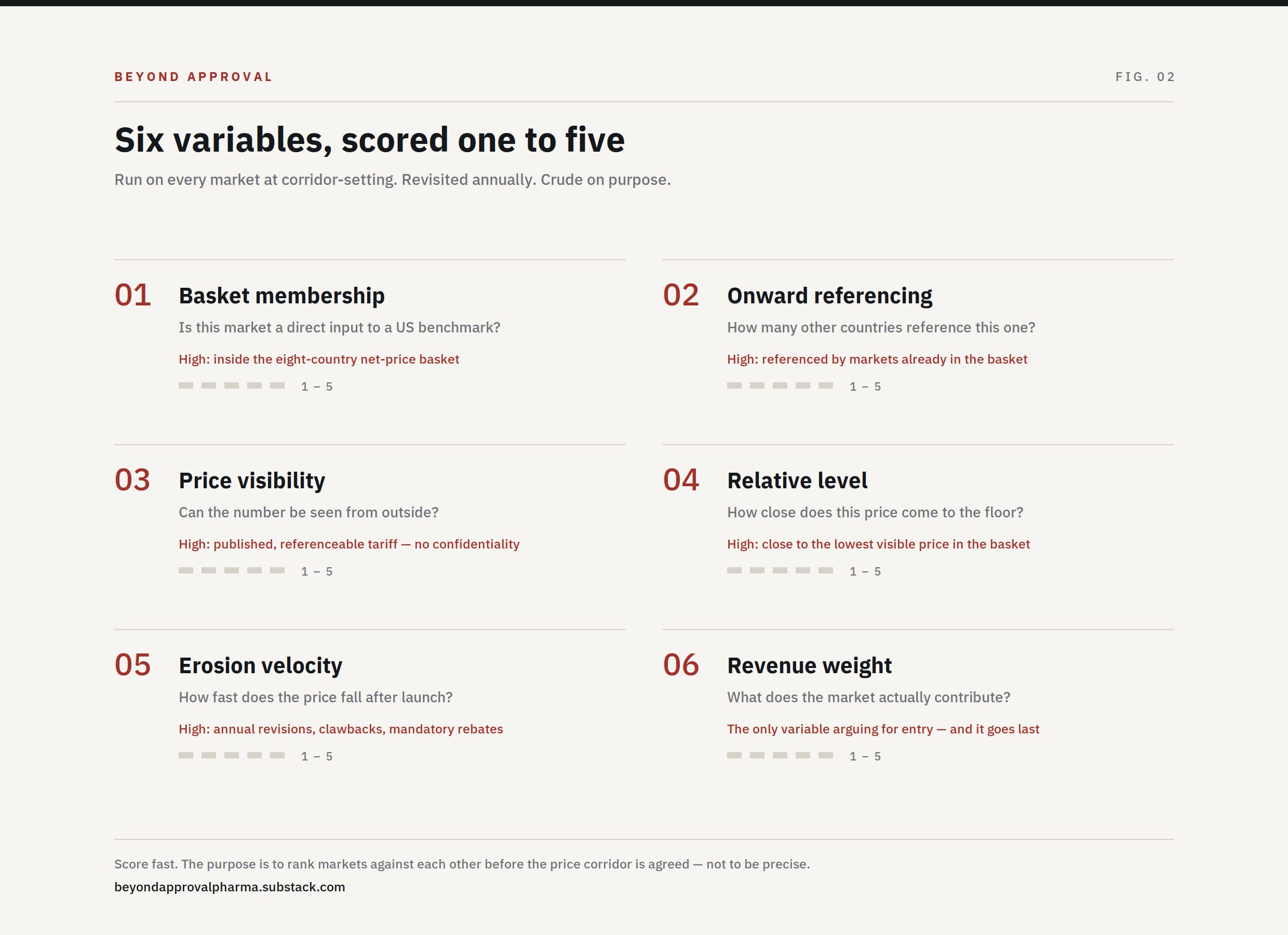
One: basket membership. Is this market a direct input to an American benchmark? The eight-country Medicaid basket is the sharpest exposure; the wider OECD definition is broader and softer. A market inside the narrow basket is a market where every euro of concession is legible in Washington. Score it high.
Two: onward referencing weight. How many other countries reference this one? This is the variable almost every model omits, and it is the one that produces the Slovakia problem. A market can sit outside every American basket and still be one of the most dangerous prices you set, because ten referencing partners will carry it inward for you. Count the referencing partners, weight them by whether they are themselves in a basket, and score accordingly.
Three: price visibility. Can the number be seen? A published, referenceable tariff is an exposed price. A confidential net price behind a managed entry agreement is a shielded one. This variable has quietly become the most valuable in the whole framework — which is precisely why Washington opened a trade investigation into Germany’s confidentiality discount rather than into a headline price. The United States is not only objecting to low numbers. It is objecting to numbers it cannot see.
Four: relative price level. Where does your intended price sit against the rest of the basket? A market is dangerous in proportion to how close it comes to setting the floor. The question is not “is this price acceptable here” but “if this becomes the lowest visible number in the basket, what does it cost across the portfolio?”
Five: erosion velocity. How fast does a price fall after launch? This is the variable teams consistently underweight, because they price the launch and not the decade. Japan surveys the gap between market and reimbursement prices every single year and corrects it downward, taking around 3% annually before any other mechanism engages, with a repricing rule that can cut a successful product by up to 66.7%. France has stripped roughly €13.5 billion out of its medicine prices since 2010. Germany has legislated a further round of mandatory rebates. A price is not a point. It is a trajectory, and the trajectory is what gets referenced.
Six: revenue weight. What does the market actually contribute? This is the only variable that argues for entry rather than against it, and it belongs last, not first — because the entire failure mode of the old model was letting this number decide alone.
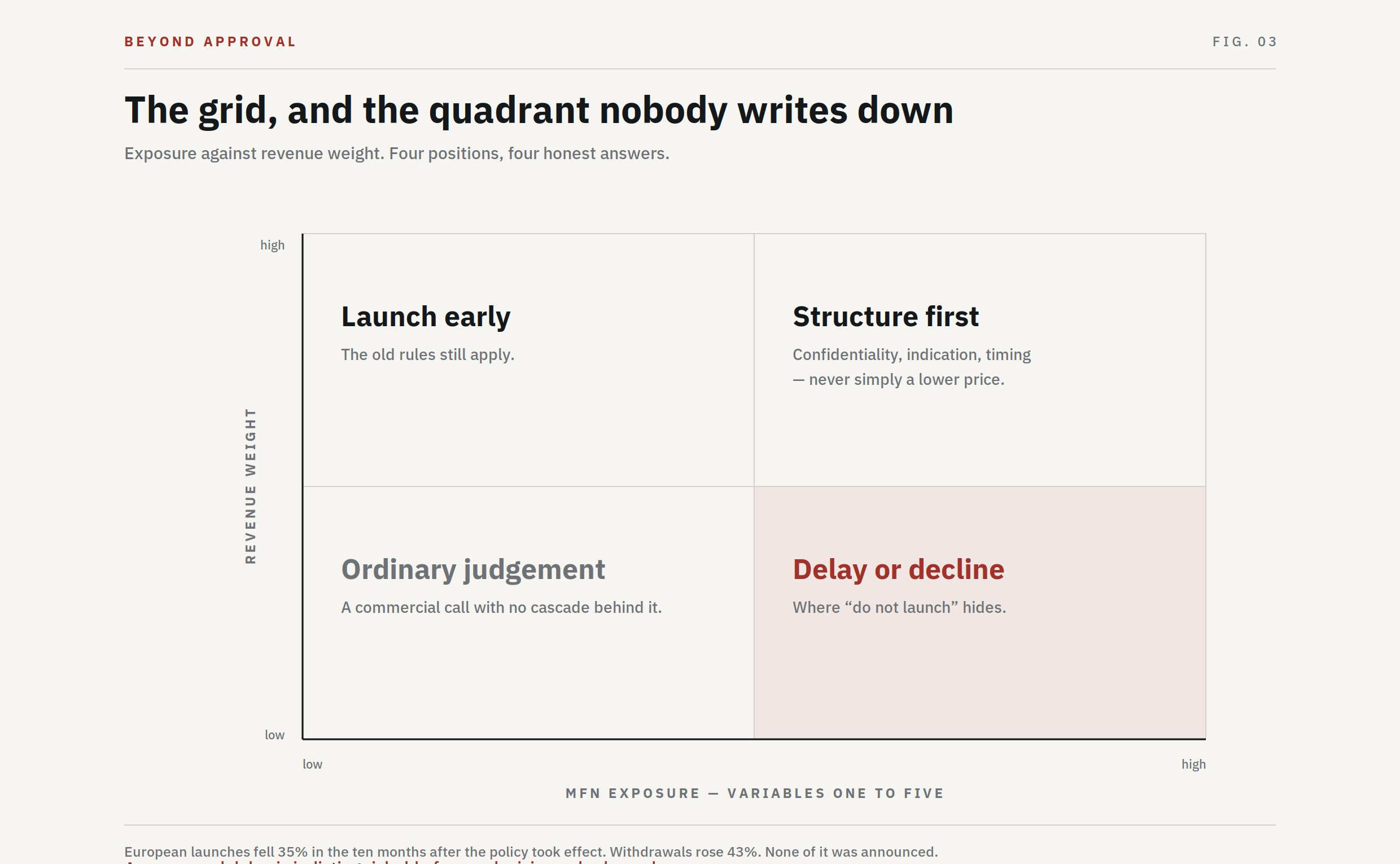
Plot exposure against revenue weight and four positions emerge, each with a different honest answer.
Low exposure, high revenue is the easy quadrant: launch, and launch early. Low exposure, low revenue is the quadrant of ordinary commercial judgement, which is to say the only place the old rules still apply.
High exposure with high revenue is where the real work sits. These markets cannot be skipped and cannot be entered casually. The answer here is almost never a lower price; it is a structure — confidentiality first, then indication strategy, then timing. The objective is to enter without leaving a visible number behind.
And then the fourth quadrant: high exposure, low revenue. Small markets, low prices, heavy onward referencing. Here the arithmetic says something nobody wants to put on a slide — that the rational move may be not to launch at all, or to launch so late that the benchmark is set elsewhere first.
Which brings us to the part of this framework that matters more than the framework.
First, this analysis is almost always run too late. By the time a market access team is scoring exposure, the global price corridor has usually been agreed, the forecast built on it, and the launch sequence drafted. Exposure scoring belongs at the point where the corridor is set — years before submission — or it is documentation rather than strategy.
Second, “do not launch” is a recommendation almost nobody writes down. It is career-limiting, it is difficult to defend internally, and it reads badly in any document that might one day be read aloud. So it does not get recommended. It gets executed instead as delay — a slipped timeline, a deprioritised filing, a market that stays “under review” until the question answers itself. And delay, unlike refusal, has no author. Nobody signs it, nobody owns it, and no patient is ever told it happened.
This is why the retreat from Europe is measurable in aggregate and invisible in every individual decision. New launches across Europe fell 35% in the ten months after the American policy took effect, and 37% in the countries inside the reference baskets. Withdrawals rose 43%. Around 92% of medicines newly approved in 2025 reached the United States first. Not one of those numbers is the result of a decision anyone announced.
Third, confidentiality now outranks price level. Given a choice between a lower confidential net and a higher visible list, the visible number is usually the more expensive one across a portfolio. This inverts the instinct of a generation of pricing teams trained to defend the number rather than to hide it — and it explains why the confidentiality fight, not the price fight, is where the trade pressure is now landing.
Fourth, the map has an edge, and patients live past it. Lithuania qualifies for the American reference basket on GDP per capita. It is also a market where, as of early 2025, around three-quarters of EMA-approved medicines were simply not available, with a median wait to market of 859 days. The United States is anchoring its prices to countries where the medicine, in practice, does not arrive. Score that market on exposure and it looks like a liability. Score it on need and it looks like something else entirely. The framework will not resolve that tension for you. It will only make it impossible to claim you did not see it.
The instrument is simple; the discipline it demands is not. Three things follow.
First, run exposure scoring on every market at corridor-setting, not at launch. The variable that determines both American revenue and European access is the sequence, and the sequence is decided long before anyone submits a dossier.
Second, model the second-order path explicitly. Onward referencing weight is where the surprises live, because it is the one exposure that arrives from a market nobody was watching. If your model has a column for basket membership and no column for who references whom, it is measuring the visible half of the problem.
Third, name the delay. If the honest output of the framework is that a market should not be entered yet, say so in writing, with the reason and the revisit date. An unnamed delay is indistinguishable from a decision nobody made, and it is the mechanism by which a continent loses access to medicines without a single person choosing it.
Launch sequencing used to be a question of where the money was. It is now a question of where the number lands, who reads it, and what it drags behind it. The map is not complicated. What is difficult is putting the fourth quadrant in writing — and the entire measurable retreat from Europe is what happens when nobody does.
Every price you set is now a price somewhere else. The only real choice left is whether you draw the map before the launch, or reconstruct it afterwards from the damage.
Beyond Approval publishes weekly strategic intelligence on market access, HTA, pricing, and regulatory shifts that reshape how medicines reach patients.
No posts
Comments
Nothing yet. Say the first thing.
Sign in to join the conversation.