
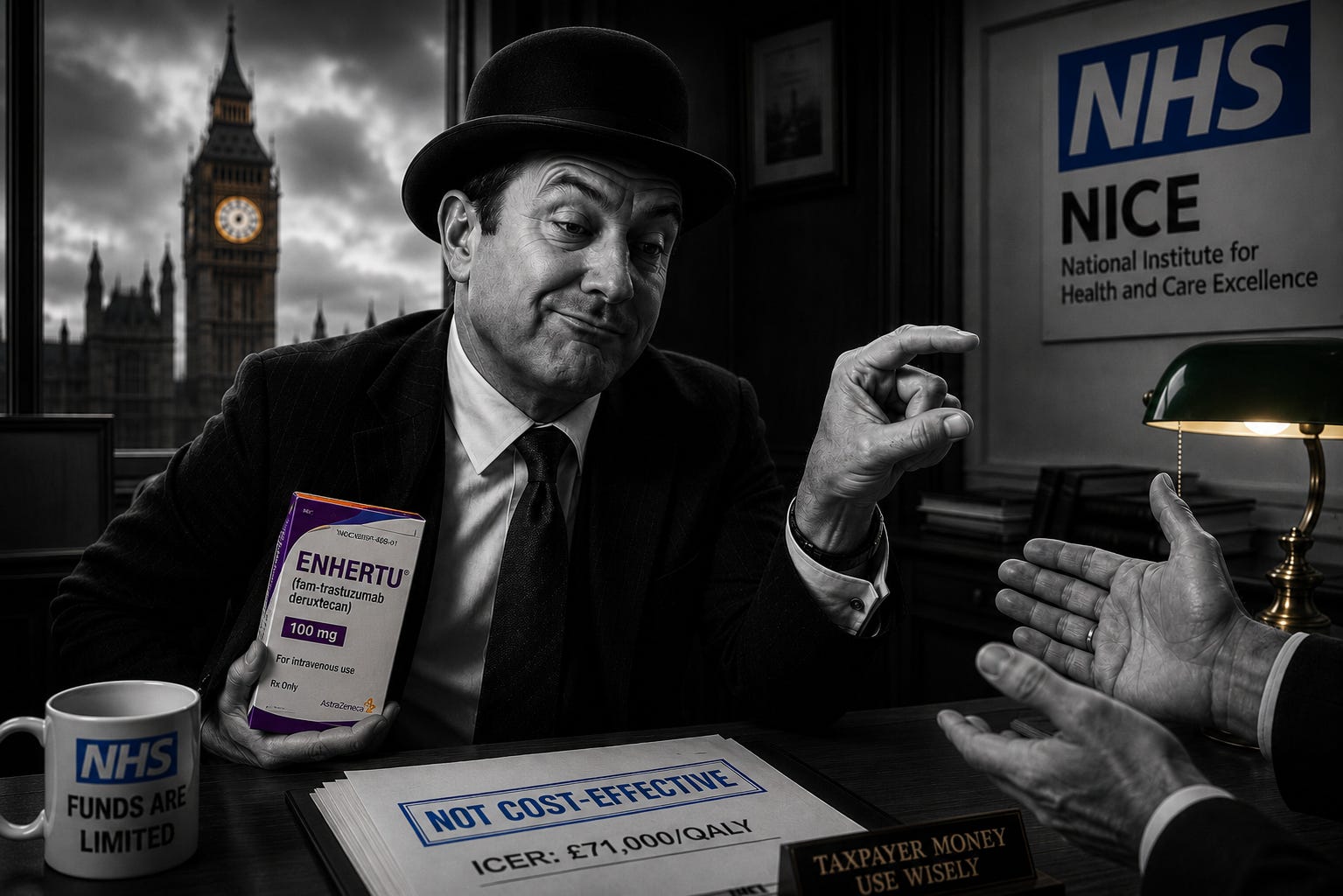
In 2024, England’s cost-effectiveness watchdog looked at a breast cancer medicine called Enhertu and said no. Not because it lacked approval, and not because it lacked benefit — the drug extends the lives of women with HER2-low metastatic breast cancer by around six months — but because, at the price on offer, it cost too much for the good it did. It was the first breast cancer treatment NICE had rejected in years, ending a run of twenty-one consecutive positive recommendations in the disease. Roughly a thousand women in England and Wales were left without it, while their counterparts in Scotland and across two dozen European countries received it as routine care. Some spoke openly of moving to Scotland to reach the drug before they died.
In 2026, the same medicine — the same trial, the same molecule, the same six months — is about to be funded.
Nothing about Enhertu changed. What changed was the number NICE uses to decide.
This is not a story about a drug that became better value. It is a story about the meaning of “value” being rewritten — and about who rewrote it, and where.
What “not cost-effective” actually meant
Start with the thing the public discussion never quite says out loud: Enhertu was never rejected on the science. In its pivotal trial, DESTINY-Breast04, it delivered a median overall survival of 23.9 months against 17.5 for chemotherapy — an extra 6.4 months — and 4.8 months of additional progression-free survival, in a disease with few remaining options. That is a real, meaningful benefit, and NICE never disputed it.
It was rejected because of an equation. At the offered price — a list price of £1,455 per vial before confidential discounts — and under NICE’s methodology, the cost per quality-adjusted life year landed above the threshold NICE will pay. And that methodology included a “severity modifier” that rated metastatic breast cancer only “moderately severe”, which quietly lowered the price the system was willing to pay in the first place. AstraZeneca’s own chief executive called that modifier a technical detail that, in his words, drives willingness to pay. A technical detail helped decide whether a thousand women got the drug.
This is the draft truth of market access, and it is worth stating plainly: cost-effectiveness is not a property of a medicine. It is a relationship between clinical benefit, the comparator, the assumptions in the model, the price, and the threshold it is measured against. Change any one of them and the verdict can flip. A negative HTA is never a scientific judgement on a drug. It is a judgement on a particular proposition, at a particular price, under a particular ruler, at a particular moment.
“Not cost-effective” was never a fact about Enhertu. It was a fact about the ruler NICE measured it with.
The ruler moved — and Washington moved it
Here is what turns a familiar market-access lesson into something sharper.
In 2024, the Enhertu talks did not just stall; they collapsed. Three rejections, and even the direct intervention of the Health Secretary could not produce a deal. What reopened them in 2026 was not new clinical evidence, and — on the reporting — not primarily a new price. It was that in April 2026, the government raised NICE’s cost-effectiveness threshold, from £20,000–£30,000 to £25,000–£35,000 per QALY: the first increase in more than two decades. Almost immediately, drugs that had been rejected as poor value began to clear the new bar — a brain cancer therapy, a stomach cancer therapy, and now, in active negotiation, Enhertu.
And the threshold did not rise because the health economics of opportunity cost had been recalculated. It rose as part of a trade deal with the United States — a bilateral arrangement to gradually align British drug prices toward American ones, under a President who objects to Americans paying more so that Europeans can pay less. Britain agreed to pay more for a year of life, and at that higher price, Enhertu became worth funding.
We wrote about that threshold rise when it happened. Enhertu is what it looks like in a single patient’s chart.
The drug did not clear the old bar. Britain raised the price it would pay for a year of life — and did so under pressure applied from an ocean away.
The real product, and the curtain in front of it
The operational lesson the draft draws is correct, and worth keeping: the thing an HTA body judges is never merely the molecule. It is the whole proposition — the evidence, the positioning, the comparator, the economic model, the uncertainty plan, the commercial offer, and the threshold all of it is measured against. A company can hold an excellent drug and still bring an unfundable proposition. And the same drug can travel from rejection to reimbursement with no new molecule, no new mechanism, and no new result, because the proposition changed — or because the ruler did.
But confidential discounts mean the public will never see which lever did the work. When the deal is announced, the headline will read that NICE and the companies have reached agreement on Enhertu, and the natural inference will be that the system worked: the drug proved its worth, value was objectively established, the process delivered. In truth, three things moved at once — the price, behind a confidential curtain; the threshold, by political decision; and the pressure, from a trade negotiation — and no outsider will be able to say which mattered most. The opacity does not just hide a number. It manufactures the appearance of objectivity.
The public will be told the system found Enhertu’s value. What actually happened is that the definition of value was renegotiated — partly in Whitehall, partly in Washington, and partly behind a discount no one outside the room will ever see.
The part no one in this story will say
And there is a harder truth still, which neither the campaigners, nor the companies, nor the government has any incentive to state.
Raising the threshold was not free. A fixed NHS budget that agrees to pay more per QALY for Enhertu is a budget that will buy fewer QALYs somewhere else — the operation that waits longer, the service that goes unfunded, the diagnostic never bought. By the very opportunity-cost logic the threshold is supposed to encode, a higher bar means the system knowingly purchases less total health, and moves it from patients no one will ever name toward patients who are — rightly, visibly, sympathetically — named, photographed, and campaigned for.
This is not an argument against funding Enhertu. For the thousand women involved, the drug is a genuine extension of life, and that matters more than any abstraction about thresholds. It is simply an observation that “cost-effective” was always a statement about trade-offs, and that moving the line moved the trade-off onto people who will never learn they paid it.
Enhertu becoming affordable did not create the money to pay for it. It moved the money — and the health — from somewhere, and someone, unnamed.
What this means
Three things follow.
First, for market access, the most important variable in a UK submission may no longer sit inside the dossier at all. It is the threshold — and the threshold has just been shown to be a moving, politically set number, adjustable by trade policy. Model access against a value line that can rise or fall with the geopolitics, not against a fixed methodology that pretends the geopolitics isn’t there.
Second, “failed NICE” was always lazy shorthand, and Enhertu is the proof. The drug did not fail. A proposition failed, at a price, under a threshold, at a moment. When the moment changed, the verdict changed — with no new molecule in sight. Stop reading a negative HTA as a settled scientific fact about a medicine; it is a snapshot of a negotiation under a rule that can move.
Third, and least comfortably: if the price of a year of life can be raised by a trade deal, then it was never a purely technical number — it was always partly political, and everyone inside the system knew it. Enhertu did not reveal that negotiation shapes access; that was always obvious. It revealed that the ceiling itself — the supposedly fixed anchor of the entire method — is negotiable, and can be moved by a foreign government.
For a thousand women, the news is good, and it deserves to be said without hedging: a drug that could give them more months with their families is finally within reach. But it is worth being honest about how it arrived. Enhertu did not become more effective. It did not, on the evidence, even become much cheaper. It became “cost-effective” because Britain agreed — under American pressure, as the price of a trade deal — to pay more for a year of life. The medicine was always the same. The only thing that changed was what a life is worth, and who got to decide.
And that was never a number in the dossier. It was a number in a negotiation.
Beyond Approval publishes weekly strategic intelligence on market access, HTA, pricing, and regulatory shifts that reshape how medicines reach patients.
Comments
Nothing yet. Say the first thing.
Sign in to join the conversation.