
The seed packets for this stretch of the season live in an old tea tin on the kitchen table. I dump them out and sort by when they’re allowed to happen. Four weeks before last frost. Two weeks before. After all danger of frost has passed.
Lady puts her head on my knee while I work, which she does whenever I get absorbed like this, as if this kind of attention requires a witness.
The peas went in early.
There are three kinds this year: sweet peas, which are flowers and purely devotional—no one eats them, they exist only to be excessive, to smell like something you have to sit down for. Snap peas, warm from the sun, which I’ll eat directly off the vine before anyone else can get to them. And English peas, which require the most faith—shelling them for what seems like hours, you begin to question the entire endeavor, and then suddenly there’s more than enough.
All of them climb. All of them need something to hold onto before they know they need it.
The trellis goes in first.
I cut the bamboo stakes to roughly the same height as I did the past few years, though I didn’t measure. My hands know the length without asking. I push them into the ground at intervals—a foot apart, roughly, though again, no ruler. One of them always goes in a little crooked.
Then the twine.
I start low, near the base, tie it off without thinking—just a knot my hands know—pull it across to the next stake, wrap it once, pull again so it holds, not tight exactly, not loose either, something in between that feels right in my fingers, even if I couldn’t explain it.
One section dips a little, another pulls tighter than I meant it to, and I notice it but I don’t stop, the line just continuing from wherever it is because by the time I think to fix it I’m already moving up to the next pass.
By the time I reach the top, the whole thing is there—a kind of scaffolding. Slightly uneven, already settling. A frame with nothing in it yet.
The bed is still empty while I do this—only turned earth, dark and cold, smelling of compost and whatever the ground smells like before anything has started. There’s no visible reason for any of it—nothing reaching, nothing yet that would require the structure I’m building.
I plant the seeds. The peas usually come. They usually climb. They usually find the twine without being shown and they go up it, usually, with a confidence that looks like trust.
By June it’s usually covered. The snap peas will be loaded with pods to devastate before dinner. The English peas will be quietly doing their thing, requiring faith and working hands. The sweet peas will be lovely and smelling like they’re trying to prove something.
Or they won’t. The structure stands either way. I build it in April, in the cold, when there’s nothing here yet to justify it.
Something will come looking for this.
Or it won’t.
I went out to the run for eggs and the flock was already mid-chaos.
Hen Affleck was leading a hostile takeover of the upper left quadrant, and Emily Chickinson, the yard’s new soft-boned poet, had somehow become both victim and witness. Benechick Cumberbatch was dust bathing with a level of commitment I found concerning. Feather Locklear was ricocheting between them all like a feathered missile.
And then there was Eggward Norton. Not thriving, not struggling, not secretly brilliant or covertly deranged. Just—fine. Persistently, stubbornly fine.
At one point she sat down.
I thought, here we go.
Then she stood back up.
If the others are a symphony, Eggward is the sound a couch makes when you sit down. Technically present. Structural. Not something you’d ever applaud, but remove it and the whole situation collapses.
While the other chickens have rich inner lives that drive the dynamics of the coop, Eggward can typically be found standing. Sometimes she is standing near the waterer. Sometimes she is standing away from the waterer.
And here’s where it becomes personal: I don’t trust her.
A chicken should have a thing. A quirk. A vendetta. A niche interest—like a specific patch of dirt she defends with her whole being, or a preference for bucatini over other noodles. Even Emily Chickinson, delicate little transcendentalist that she is, arrived with a full emotional backstory and immediate social consequences.
Eggward arrived like a shrug.
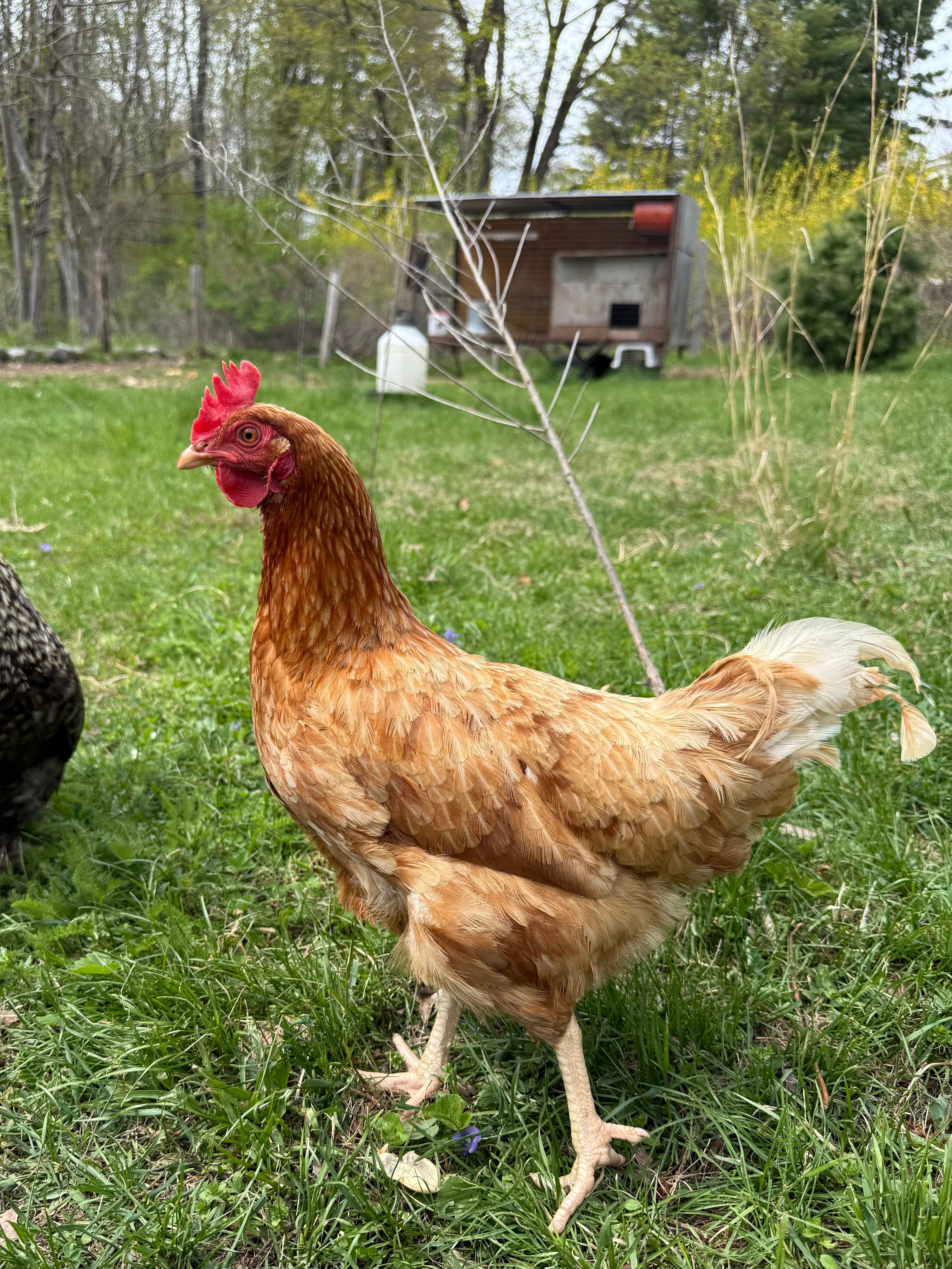
I’ve tried to provoke her into narrative. I offer blueberries. I rearrange yard objects. I introduce mild chaos (a drill, briefly, from a distance, as a test). The others respond accordingly—inquisitiveness, outrage, panic, brief interpretive dance.
Eggward, meanwhile, shifts her weight by maybe half an inch and continues being alive at a perfectly acceptable level.
I find myself circling her, waiting for a tell. A crack in the facade—some indication that beneath the aggressively adequate exterior lies something feral and worth the ink.
No. She just exists like a screensaver.
The longer I watch her, the more destabilizing it becomes. Not because I see myself in her—please—but because she appears to have opted out entirely. She is not building toward anything. She is not processing. She is not becoming.
She is simply maintaining.
It’s possible that what I have mistaken for mediocrity is actually completion. A final form. A closed loop of chicken.
Either way, she remains out there as I write this, standing in a place that can only be described as “somewhere,” doing something that can only be described as “whatever.”
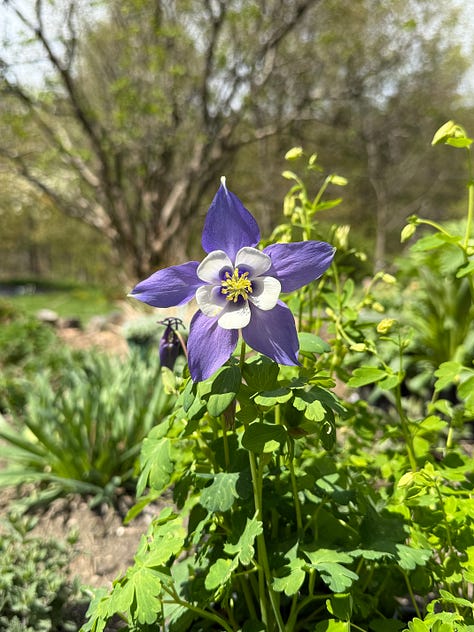
For the premiere of this extremely serious and necessary section, let’s talk about columbine.
I first met them on an episode of Gardener’s World, which is where I meet most of the plants I later ask for by name at the garden center, as if we’ve been introduced. Monty Don called it aquilegia, so I immediately began calling it aquilegia, with great confidence, no audience, and a British accent of questionable origin. I felt extremely sophisticated until I realized that in real life, if you say aquilegia, people look at you like you’re speaking Latin. So: columbine.
These, importantly, are not from the seeds I started in milk jugs late this winter, which I tended with mild care and misplaced optimism and which rewarded me with absolutely nothing. These were already thriving in my garden, unbothered by my involvement.
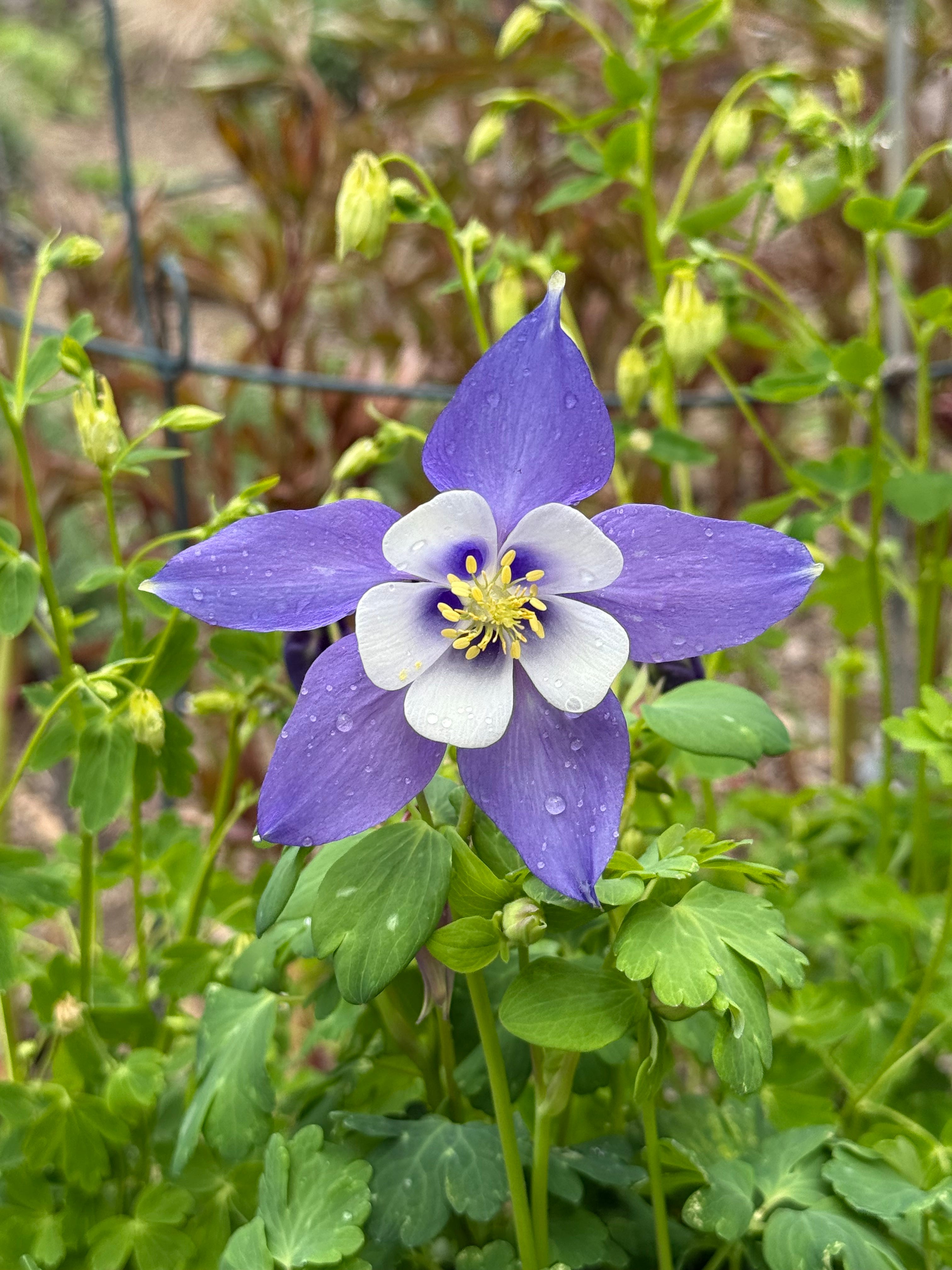
Five petals held out in a deliberate star, the precise white center gathered in on itself, while the outer edges drift into a soft, almost unreasonable blue. There are little spurs tucked behind that you don’t notice at first, as if the plant is in no rush to impress you.
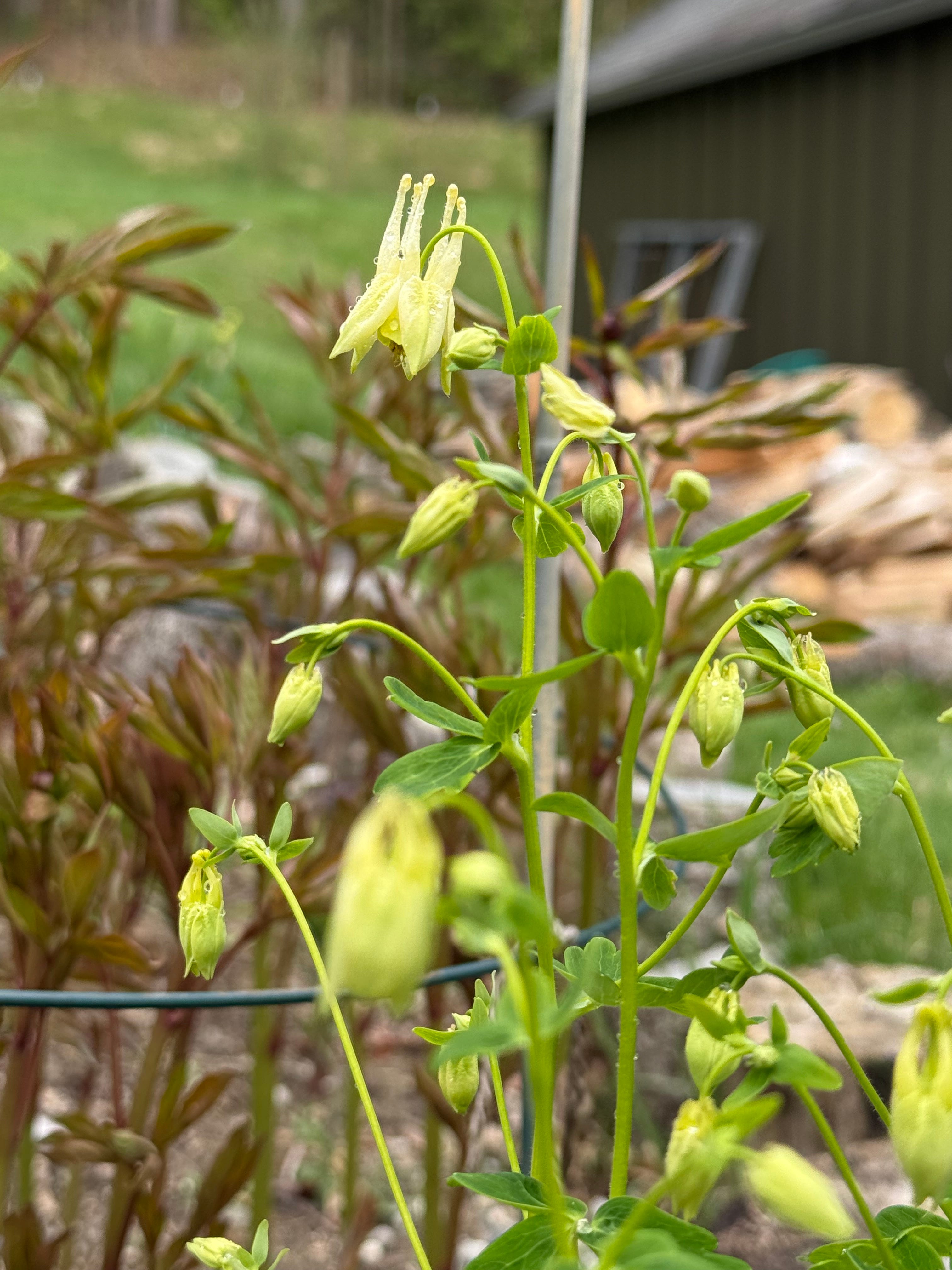
Where the blue holds itself open and faces you directly, this yellow one nods, petals loose, like it’s mid-curtsy. It’s the kind of plant you’d find at the edge of a meadow and not immediately know what it was.
From certain angles the blue stops you. The yellow, from most angles, softens at the edges, its shape less fixed. From any angle, columbine look like small, elaborate hair ornaments that have come to life and chosen to stay.
I am very glad they’re here.
Pear and peach trees, tulips, columbine
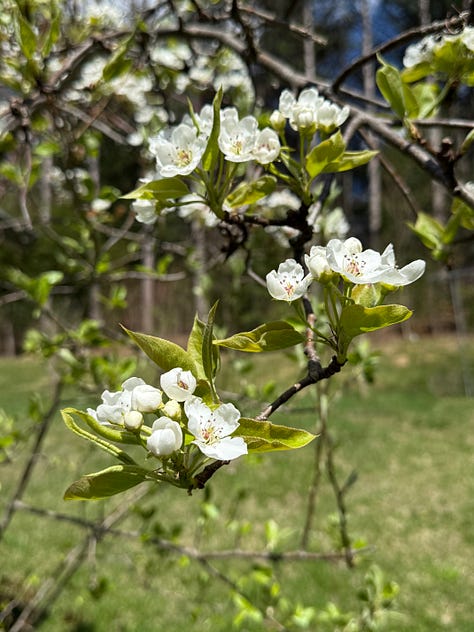
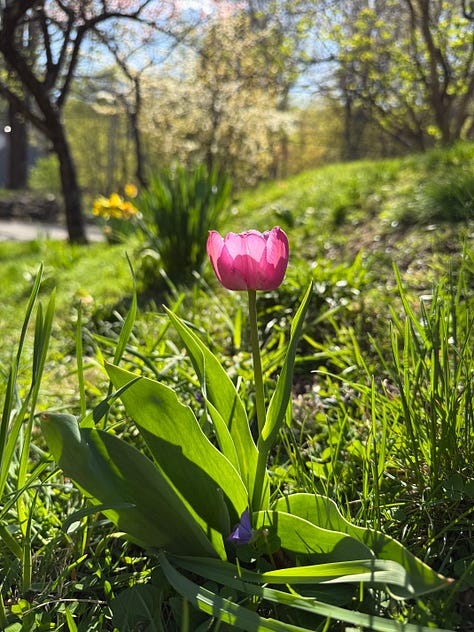
The low, steady hum of bees working the peach blossoms
It’s been one month since I put up my solar-paneled WiFi camera bluebird house. Last week, I received my first push notification from the app connected to the camera.
Movement detected.
This was, in theory, the moment the entire project had been building toward. The alert arrived with a tone that suggested significance. Something is happening. Something has entered the box. Life, at last, is occurring within the carefully measured 1.5” threshold.
I opened the app immediately, like a person who is fully okay with the fact that her life has been overtaken by a wooden cube.
And there it was—
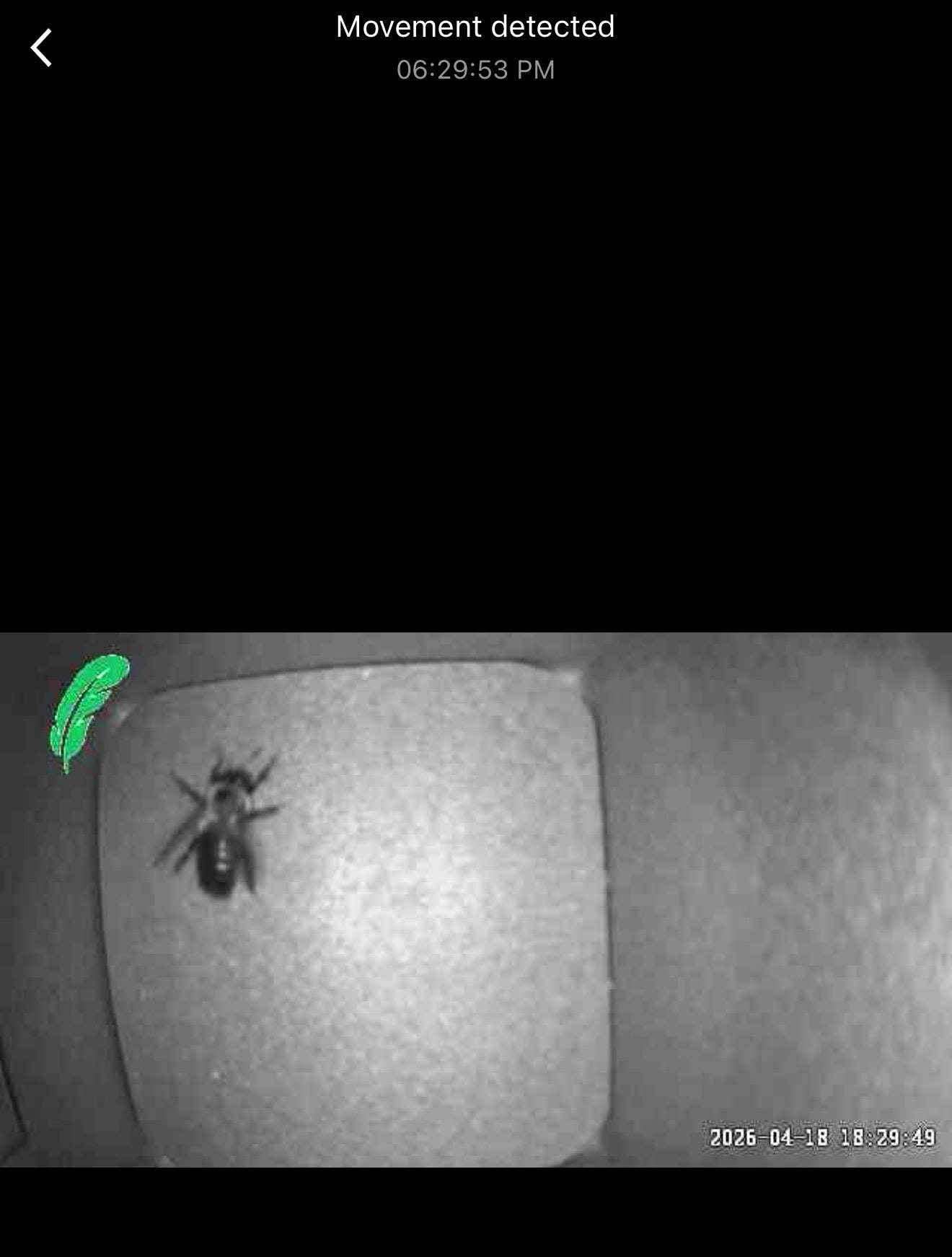
Not a bluebird. Not even, frankly, a bird-adjacent situation. Just a single, ambiguous creature, perhaps a bee, we may never know, sprawled across the floor.
No sense of occasion. No awareness that this space was designed with specific intentions that don’t include whatever it had decided to do in there. No respect for the North American Bluebird Society, of which I’m now proudly a member.
The non-bird lingered for several seconds, moved slightly, and continued to exist in a way that felt both deliberate and completely unbothered by me, the architect.
I have, through uncharacteristically careful planning, modest financial investment, and a series of increasingly destabilizing decisions, created premium housing for a bug. Which, to be honest, does feel thematically consistent with the rest of the garden.
He has since moved out.
A song that moves like something inevitable and already in motion. Something like April.
Comments
Nothing yet. Say the first thing.
Sign in to join the conversation.