
Calmness is one of the most universally desired human experiences, and yet our understanding of it in the literature is surprisingly lacking. Our models of wellbeing have overinvested in high-energy positive states like excitement, enthusiasm, and joy, and systematically undervalued lower-energy ones: calm, peace, and contentment.
The science tells us that calmness isn’t merely the absence of stress and anxiety; it is a positive state in its own right, with both a psychological and a physiological dimension. It’s distinct, significant, and almost universally sought. As wellbeing professionals, the frameworks we work from shape what we notice, what we measure, and what we help people build. If our models of wellbeing are missing something, so is our practice.
We need to reframe how we think about calm, not as the absence of distress, but as a resource to actively cultivate for the betterment of health, wellbeing, and relationships.
This is a two-part series. In Part 1, we look at how researchers have considered calm and key theoretical underpinnings, why the evidence suggests it deserves more attention, and what global data reveal about who actually gets to experience it. In Part 2, we’ll cover evidence-based strategies for building it.
How wellbeing research has historically overlooked low-arousal positive states like calm, and why this matters
What Affect Valuation Theory tells us about how culture shapes what we want to feel
What global data reveal about who values calm, who experiences it, and why the gap exists
Why the East vs. West story is more complicated than it sounds
What this means for how we practise
To understand calm, we first need to understand the difference between high- and low-energy positive states.
James Russell’s Circumplex Model of Affect (1980) proposes that emotions can be mapped along two dimensions:
Valence — how pleasant or unpleasant something feels
Arousal — how activated or energised it is
This framework helped us move away from thinking of emotions in terms of “positive” and “negative” and instead consider the quality and intensity of feelings. From this lens, we can distinguish:
High-arousal positive states (HAPS), including emotions like excitement, enthusiasm, elation, joy
Low-arousal positive states (LAPS), including emotions like calmness, peace, relaxation, contentment
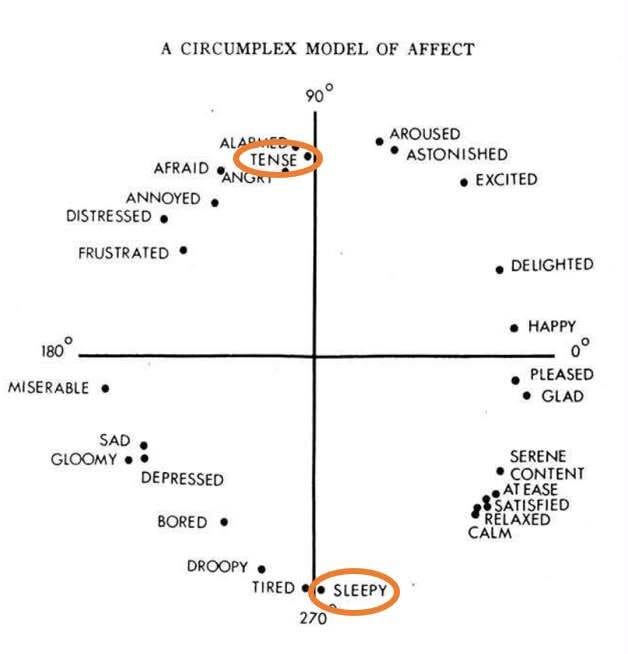
Low arousal doesn’t mean worse. It means a different kind of good. This distinction matters because, as we’ll see, not all positive emotions have been treated equally in the research.
Much of the research into positive emotions has focused either on broad operationalisations of positive states (like “happiness”), or specifically on high-arousal positive states like excitement and has largely underscored the importance of low-arousal positive states like calm. In the broader positive psychology and wellbeing literature, calm tends to appear embedded within broader constructs like psychological safety, emotional stability, and flourishing, rather than as a standalone focus or distinct area of inquiry.
Common wellbeing measures tend to be biased toward HAPS, prioritising excitement over calm or contentment and often excluding LAPS entirely.
When researchers use the word “happiness,” it has been used to capture HAPS roughly eight times more frequently than LAPS.
With research focusing on HAPS over LAPS, our understanding of positive emotion has largely been built on only part of the equation, and may not be representative of people’s actual experiences. The question is: does it reflect what people actually want?
Researchers studying happiness around the globe asked people from 12 countries on five continents to define happiness. Their findings showed that people are more likely to describe wellbeing in terms of low-arousal positive states than high-arousal ones. LAPs qualities, such as peace of mind, harmony, and contentment, were mentioned in roughly 30% of descriptions, while HAPS qualities such as joy, vitality, and enthusiasm, were mentioned in around 14%
Further research has found that LAPS don’t just matter to people, they also predict wellbeing outcomes beyond HAPS states. In one key study, LAPS uniquely explained a significant portion of the variance in life satisfaction, feeling good, depression, anxiety, stress, and mindfulness after the variance explained by HAPS had already been accounted for.
In Be Well Co’s own recent peer-reviewed research, including 122 international experts across 11 wellbeing disciplines, calmness reached 75.5% consensus as a core component of wellbeing and was included in the taxonomy of mental wellbeing. In other words, global experts consider it a unique dimension that, in its own right, contributes to what it means to feel well.
The evidence that calmness matters to people is unambiguous. LAPS are fundamentally important, both in how people perceive a good life and in predicting their wellbeing outcomes. Neglecting them gives us an incomplete picture.
So why has research consistently overlooked them?
Jeanne Tsai’s Affect Valuation Theory (AVT) offers a possible explanation. AVT distinguishes ideal affect (how much someone wants to feel a certain state) and actual affect (how much they actually feel it). Actual affect shapes our day-to-day emotional experience. Ideal affect shapes the activities we pursue, the choices we make, and our broader conceptions of what it means to feel well.
Critically, people tend to get more enjoyment from activities that match their ideal affect. If someone wants to feel calm, they’ll derive more from a quiet walk than a high-energy social event, even if both are deemed enjoyable. And what someone ideally wants to feel is shaped by their culture.
Tsai’s research found that Western cultures tend to idealise HAPS (excitement, enthusiasm, energy), while East Asian cultures tend to idealise LAPS (calm, contentment, peace). Tsai’s analysis of cultural products like children’s books, political speeches, and popular media found that Western cultures consistently model and reward high-arousal states, while East Asian cultural products modelled low-arousal ones.
The argument is that cultures create emotional ideals not just through explicit messaging but also through their stories, music, and the faces of admired leaders. And this shapes our values as individuals. Furthermore, individualistic and collectivist cultures have different value sets: individualistic cultures often prioritise influencing others (an active, high-arousal orientation more inclined to HAPS), while more collectivist cultures prioritise adjusting to others (a more attuned, passive one more inclined to LAPS).
Western culture has a complicated relationship with calm, often equating work ethic, individualism, and productivity with our moral worth, and dismissing the importance and power of peace and calm. For many people, calm doesn’t signal ambition, effort, or success. More recently, digital culture and, for example, the glorification of “the hustle” have amplified this pattern of speed and energy further.
This difference in potential values has a direct implication for the research gap. Nearly all research on HAPS has been conducted in North American or European countries (around 91%). If the researchers, institutions, and funders behind wellbeing science are predominantly Western, and Western cultures idealise HAPS, then LAPS will naturally be underrepresented. This led to an assumption that calm is more of an Eastern preference, and that its absence from Western research reflected a difference in what people value. But global data tells a more complicated story.
A landmark study of over 121,000 people across 116 countries (Lomas et al., 2024) asked people if they prefer a calm life or an exciting one. Across all but two countries, a majority of people chose calm.
Interestingly, counter to common stereotypes, the preference for calm was slightly higher in the West (71.6%) than in the East (69.8%), and this is largely explained by enormous variability within the East. Within “the East,” the picture is far from cohesive. East Asia showed the highest regional preference for calmness of any region (85.4%), yet South Asia recorded the lowest (56.1%). Two regions sitting within the same broad cultural category produced near-opposite results.
This study demonstrates the problem with broad generalisations across varied cultures. Calmness is valued differently across the world, and LAPS may be more valued in Western countries than often appreciated in the research. The neglect of LAPS in research isn’t because calm is a niche cultural preference. It’s a blind spot in the research culture itself, one that doesn’t reflect what people, including Westerners, actually want.
The most significant finding from this study wasn’t regional at all, but rather was economic.
People in poorer countries were consistently more likely to want calmness, yet were less likely to actually experience it. Nepal illustrates this: 86.8% preferred a calm life, but only 34.4% experienced it on a given day. The gap between wanting and having was starkest where material security was precarious.
Conversely, the countries with the highest “satisfied calmness” — where people both want calm and actually experience it — were diverse: Nicaragua, Finland, Tanzania, Mongolia, and the Dominican Republic. Eastern and Western. Richer and poorer.
Calmness is an ambiguous concept. Experiencing it may be both an inner state, and a commentary on one’s life and circumstance.
The key pattern we see is this: access to safety and security matters in experiencing calm.
If we want LAPS outcomes, which people appear to globally value, it’s important we don’t focus on them simply as individual qualities, but also on the social conditions facilitating them.
We’ve built wellbeing science overemphasising HAPS, while LAPS
Calmness is a globally valued and sought-after quality across cultures, continents, and economic contexts.
Access to calm is shaped by safety and circumstance as much as psychology or culture.
Comments
Nothing yet. Say the first thing.
Sign in to join the conversation.