
If you ever have the chance to walk into a Gothic cathedral, Exeter in England for example or Notre Dame de Chartres in France, your attention will be lifted from your guidebook and something like awe will transport it upward. For a few moments, you will be dazzled by the windows, their fragments of glass the colours of rubies, sapphires, amber and emeralds.
Then, your gaze will follow the stone ribs of the vaulted ceiling as they rise from clustered columns, splaying outward before arriving at the apex. The voluminous space is almost too large for your eyes to hold. And, it echoes with the hushed silence of private prayer, the low timbre of congregational voices, and the tidal swell of choral sound filling the vault from wall to wall.
In those few moments, you have fallen under the architect’s spell.
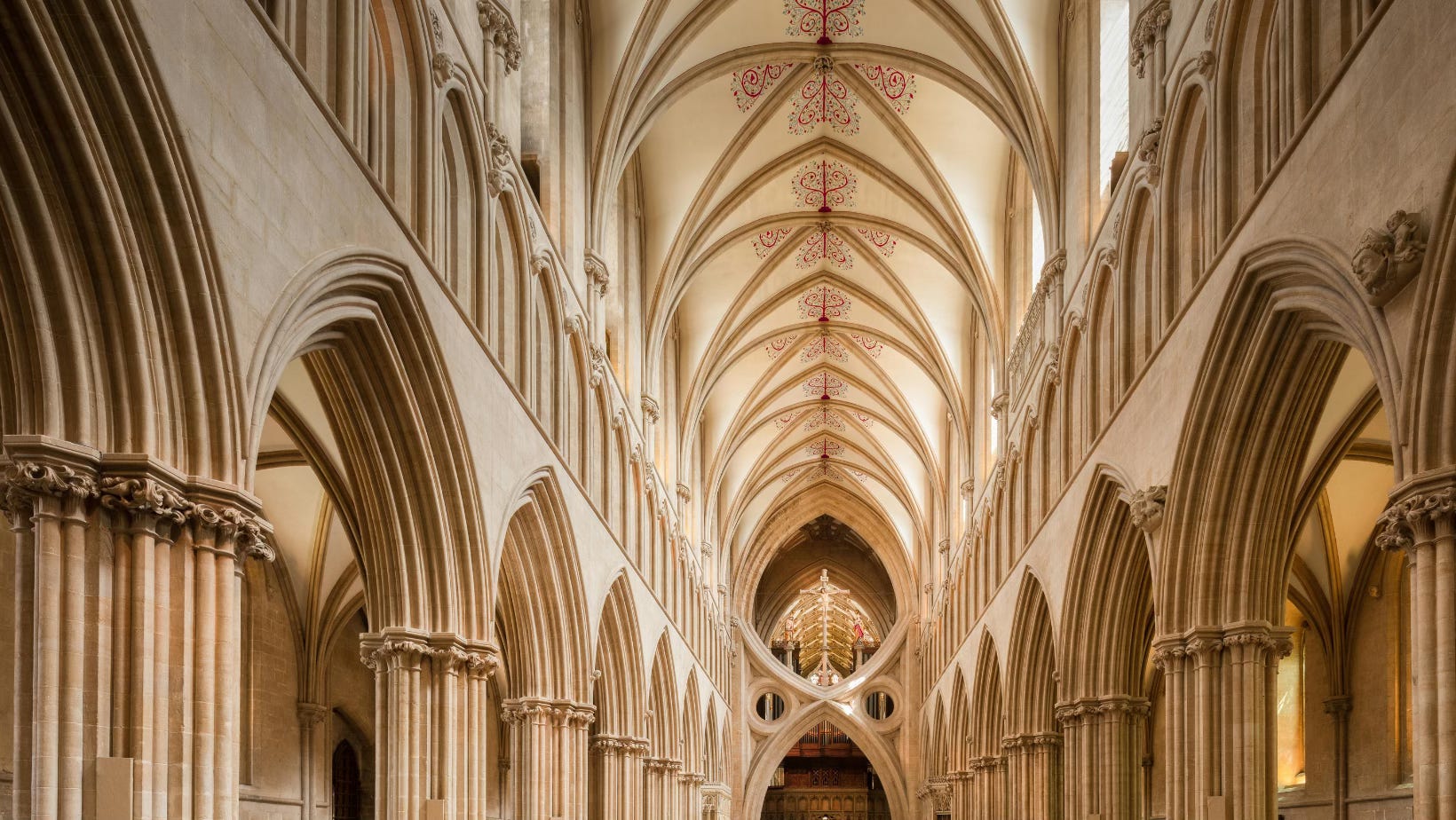
The bony architecture of your body has a similar structure where arcing bones create a vault-like space for your breath.
The rib cage is the collective term we use for twelve pairs of curved bones that travel laterally from your thoracic spine before sweeping forward and downward to eventually find anchorage on your sternum. Together they form a canopy for your heart and lungs. Ribs 1-7 are named true ribs as they attach directly to your sternum via their own costal cartilage joint, while the costal cartilage of ribs 8-10 indirectly connect to the sternum by merging together ultimately with that of ribs 7 and 6. For this reason they are known as false ribs. The lowest two pairs, 11 and 12, end freely in the posterior abdominal wall where they provide protection for your kidneys and adrenal glands as well as attachment points for muscles like the abdominal obliques and the quadratus lumborum. These are your floating ribs.
This framework of bone, cartilage and space optimises the rib cage for lightness, stability and flexibility - all that we need to carry our breathing with us everywhere, unconsciously.
LANGUAGE OF LIMITATIONS
While cage is the most commonly used descriptor for this structure, it doesn’t completely render its nature or function. A cage restrains. We use one to hold an animal, to restrict its movement, maybe to isolate it when it’s sick or to transport it from one place to another. The word implies confinement as its primary function and nothing about what lives or happens inside.
Sometimes, the collection of ribs is called a basket, which conveys a more malleable mesh-like weave of bone and connective tissues. Again, though, there is a sense of a structure for holding things, which is still only one aspect of its function. And when we remember just how many joints there are in the rib cage, even the basket image falls short.
I recall a conversation with where we sought to tot up the actual number of joints including the posterior connections to the spine, the anterior connections at the breastbone, and the intrinsic bony/cartilaginous joints. I think we arrived at a number somewhere between 100 and 150 depending on whether we include the ligamentous connection of ribs 2-9 to the intervertebral discs. Still more, if we include all the vertebral joints themselves. That, the amazing Amy Matthews would say, is most definitely a setting for “a little bit of movement in a lot of places.” And, for me, that is why the words cage or basket don’t do justice to the architectural design.
CAGE, BASKET, OR HOLLOW SPACE?
The word cage has its roots in the Latin cavea meaning a hollow space or enclosure. I find this important. It describes both a structure and a space simultaneously, and in architectural terms the principle of form follows function is immediately evident. Embryologically, your ribs arise from the midline and their direction of development is to reach forward and around in order to enclose your heart and lungs. They are required to create a shaped space that will adapt continuously to changes in pressure and movement among its contents.
Feeling dissatisfied, I sampled terms across different languages to see whether other cultures offered a different lens, since how we name things matters. In French, cage thoracique uses the same cage metaphor as in English. Spanish shifts to box rather than cage with caja torácica. Arabic with qafas sadri, and Hindi with pasliyon ka pinjara are both reaching for cage, although the Hindi seems to specifically suggest a birdcage. In German, the structure becomes a basket in der Brustkorb, the breast basket. And in Mandarin Chinese, xiōng kuò, we apparently find the descriptor for space and amplitude rather than container. I’d welcome as ever any corrections and additions from other language speakers. In the meantime, maybe rib-space might serve better.
Cavea was also the word for the curved seating area of a Roman amphitheatre, a space designed to receive and amplify sound. The rib cage then as cavea is both a hollow space and an acoustic vessel. This aligns more with the lived experience of the rib cage as an interior space that changes as you breathe than a complex sequence of movements through a multitude of tiny joints.
In the same way, the stone architecture of a cathedral serves its interior function: to produce an experience of height, of light, to accommodate fullsome silence and soaring, resonant sound. There is also something in both structures that no description quite exhausts. I have a sense it has to do with the creative impulse that precedes both their function and form. Whatever it is, your rib cage and a medieval cathedral are both more fully themselves from within.
BREATHE
Pause. Take a moment to tune into your breathing. You don’t need to do anything else. Then, place your attention in the interior space of your chest. Track an inhalation as it swells to fill the widening, deepening vault like the prayer of a supplicant. Then, notice the turning of the breath before the exhalation begins. And follow the sensation as the space begins to empty, as the prayer fall into stillness. This small prayer happens tens of thousands of times a day, without effort or instruction.
What fills a cathedral’s cavea is sound, specifically the slow sustained composed sound that stone spaces were built to receive – prayer, affirmation, chant and song. What fills yours is breath. These observations are less separate than they first appear and in the Companion Notes, we will pick up what happens when breath becomes shaped, when it becomes imbued with sound, and how we feel vibration in our bones. We will also unpack a little more this feeling that there is more to the rib cage and cathedral spaces that anatomists and architects can’t quite answer, and there’ll be two guided audio practices and a sample playlist to help you explore these themes.
So, that’s it for now. Thank you for reading (or listening) - I really do appreciate your time and attention when so much is calling for it.
Sending warm wishes from Cambridge as ever,
Beverley
PS - If you would like to explore the ribs more fully with me. I am running an online Body Lab on 5th June: Container - the Fixed Fluidity of Your Ribs. It is a 90-minute live session on Zoom, recorded and available for 30 days, open to all. Details and booking here.
Share Field Notes From The Body
Comments
Nothing yet. Say the first thing.
Sign in to join the conversation.