
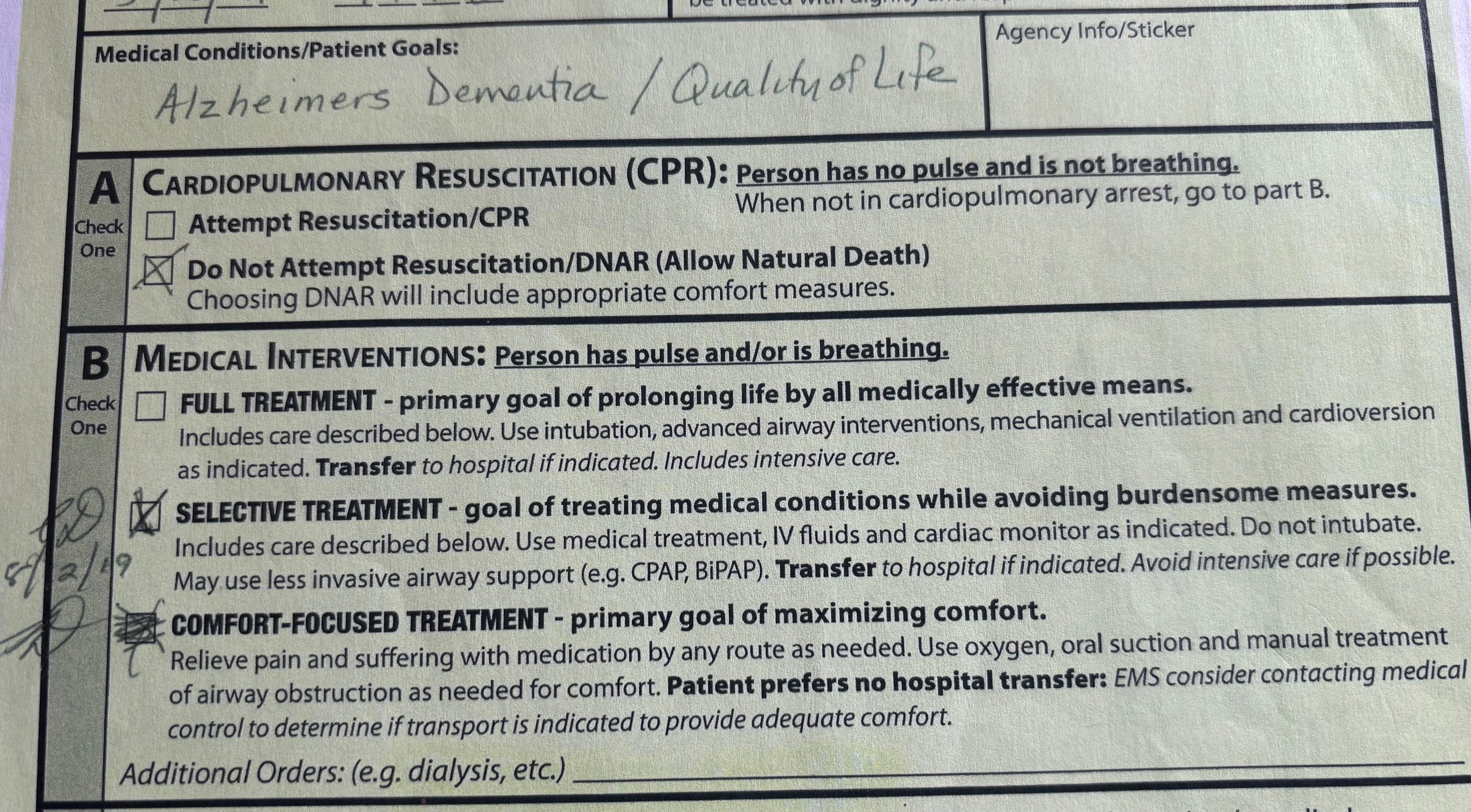
It’s so interesting looking back at the Provider Orders for Life-Sustaining Treatment (POLST) form my husband filled out in August of 2019. He died in 2023, so it was only four years, but at the moment I thought he might have many good years left. That’s probably why I spoke up when he put an X next to the box labeled Comfort-Focused Treatment.
He picked “Do Not Attempt Resuscitation” which I totally understood. Both his mother and my mother had lived with advanced dementia for many years and that was an easy call. He had selected no medically assisted nutrition by tube, and do not use antibiotics except when needed for symptom management. Somehow I comfortably put those things in a compartment in my mind labeled “non-emergency stuff.” Feeling like I would know when to pull that out and wave it at the doctors.
But when he checked comfort-focused treatment in the middle section—Medical Interventions: Person has pulse and is breathing—I panicked. That’s really the best word for it.
The other choices were Full Treatment - primary goal of prolonging life by all medically effective means, and Selective Treatment - goal of treating medical conditions while avoiding burdensome measures.
The fine print under Selective Treatment includes IV fluids, cardiac monitor, but Do Not Intubate. May use less invasive airway support (CPAP, BiPAP). Transfer to hospital if indicated but avoid intensive care if possible.
So it was just the three of us sitting in the Memory Care Clinic—the neurologist, my husband and I, looking at this piece of paper. Seconds ticked by. We were waiting for the doctor to sign the orders. I suddenly blurt out, “I guess I’m a little surprised he picked comfort care at this point.”
The doctor followed quickly with “I was thinking that same thing. I’m pretty sure you have a lot of quality time left. Do you wanna think about that?”
He looked at me and back down at the paper and started crossing out his first choice.
“You’ll need to initial and date the change Stuart.” The doctor said.
My husband was an anesthesiologist. He knew a lot about aggressive treatment at end of life. He had described the trauma of trying to resuscitate someone who was beyond saving. He had done it and years later been able to describe the scene vividly. I had also seen it when I worked in the intensive care unit.
I look back on that switch and wish I had kept my mouth shut. It was his choice. I will always conclude that he switched if because he saw anguish on my face.
The POLST form is something that was intended for decision making for terminally ill patients. It doesn’t say that anywhere, but like hospice, a lot of tools we use today originated with the cancer disease trajectory of the 80s and 90s when many cancers were diagnosed late. People living with dementia have a trajectory that is years long.
Here’s how I see the POLST form in 2025.
If you want to have CPR and a full court press, you don’t need a POLST. That is the default.
If you have mild cognitive impairment or mild dementia, you should make a decision about whether or not you want “everything done,” which is the question you will get upon entering the emergency room. If you do not want that, you definitely need a POLST form and a Durable Power of Attorney who is educated about your wishes.
If you are clear you want an “early exit,” in other words, you know you do not want to be alive to enter the severe stage of the disease, you will need to wrestle with comfort-focused care only or selective care.
Comfort-focused care is self-explanatory for the most part—no life prolonging care—although there is wiggle room for things like antibiotics if the infection causes discomfort that can’t be managed otherwise.
Selective care includes things like blood transfusions, intravenous fluids, airway support (but not intubation), aggressive medication management for things such as heart or kidney failure, and antibiotics.
I used to tell my cancer patients to review their POLST form every 2 years.
I did not do that. If I had, things might have gone smoother. As it was, in 2022 my husband got hospitalized the first time for a week. That was the first time I was informed the POLST form is only for outside the hospital. When you enter the hospital and have procedures done, full treatment is the default unless your hospital doctor writes a Do Not Resuscitate order. The results of treatment done during that hospitalization led to a second hospitalization for a week about a month later.
We went through what in palliative care terms is called medicalization at end of life. The bottom line being this idea of “selective treatment” is an opaque quagmire. The twists and turns are unpredictable, the vulnerability of both the dementia patient and the exhausted caregiver can not be overeestimated.
Do I wish I would’ve done something different? Yes, I wish I had followed my own advice. Review the POLST form every two years.
Comments
Nothing yet. Say the first thing.
Sign in to join the conversation.