
Having clear goals of care while living with dementia is one of my favorite topics. I write on it regularly as you can see here, here, here, and here.
This week I discovered a group of researchers that developed a goal attainment scaling (GAS) approach to helping people with early stage dementia define and attain their goals. It was funded by the Patient-Centered Outcomes Institute (PCOI), a nonprofit Washington D.C. based organization established by Congress in 2010. You can find the report on this project here.
The researchers utilized experts in the field as well as focus groups of both patients in early stages of dementia and their caregivers to develop a consensus inventory of goals in five categories: medical goals, quality of life - physical goals, quality of life—social and emotional goals, goals for accessing services and support, and caregiver support.
Examples of Medical Goals:
· Don’t get burdensome medical care
· Don’t take medicine with side effects
· Stay out of the hospital or emergency room
· Have doctors who work with us
· Receive needed dementia care
· Have other medical conditions managed
· Get adequate nutrition
Example of Physical Quality of Life Goals:
· Be physically active
· Able to do self-care activities (e.g., toileting, dressing, bathing) without help or without more help than is currently needed
· Able to do household and daily activities (e.g., cooking, shopping, finances)
· Be in charge of household daily activities
· Able to do recreational activities (e.g., hobbies, reading, playing games)
· Able to work or volunteer
· Able to drive or use other means of transportation (e.g., bus, rail, getting a ride)
· Able to travel
· Be physically safe (e.g., avoid household hazards or getting lost)
· Does not fall or decreases frequency of falls
· Get adequate sleep
· Die peacefully
· Live as long as possible
Examples of Social and Emotional Quality of Life Goals:
· Able to socialize with family
· Able to socialize with friends and others
· Able to maintain a relationship with a spouse or partner
· Not be taken advantage of by others
· Control agitation or aggression
· Control depression or anxiety
· Control delusions or hallucinations
· Control other troubling behaviors
· Be happy
· Keep your mind stimulated
· Be alert
· Be respected for your spiritual/religious preferences
· Able to live at home
· Not be a burden on your family
· Maintain autonomy and independence
· Have a better understanding of dementia
Examples of Goals for Accessing Services and Support:
· Have providers who understand my cultural background and/or speak my native language
· Have legal issues (such as power of attorney for healthcare) in order
· Have end of life plans (such as an advance directive) in order
· Feel financial resources are not a barrier to care
· Move to a more supportive setting (e.g., move in with family or to a nursing home or assisted living)
· Have adequate caregivers
· Have access to community services for dementia
Examples of Caregiver Support Goals:
· Able to deal with the stress of caregiving
· Receive support in coping with the stress of caregiving
· Minimize family conflict about managing his/her dementia
· Control my frustration about his/her behavior
· Feel confident in managing dementia-related problems and behaviors
· Have more free time for myself
· Have respite care available
· Maintain my own health
· Keep things as they are now
Patients were asked to select goals that were relevant to them and rate them on a scale of “not important at all,” “somewhat important,” “very important,” or “extremely important.”
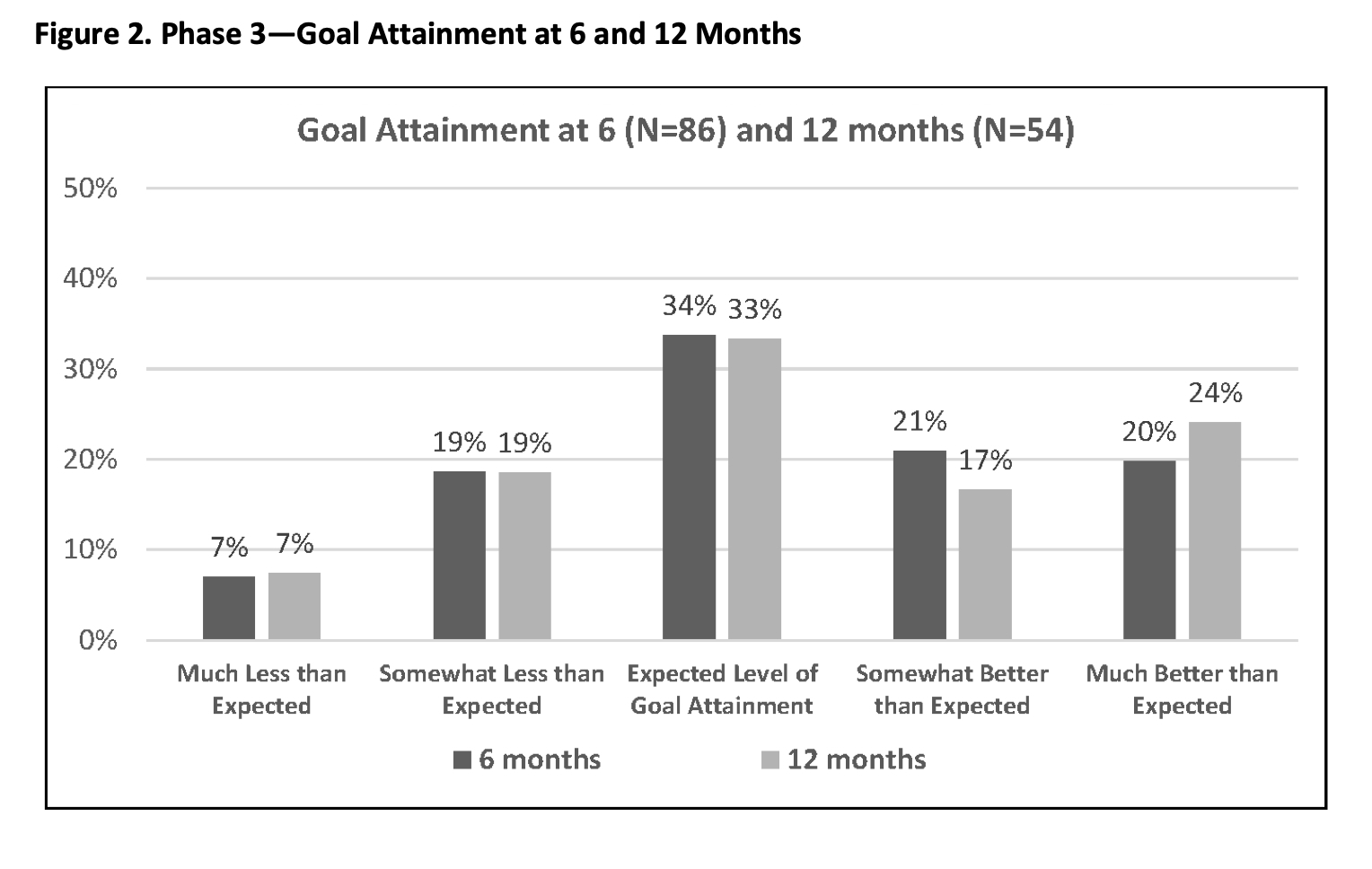
At their six month and twelve month followups they were asked to rate the degree to which those goals had been attained on a scale of “much less expected,” “somewhat less than expected,” “expected,” “somewhat better than expected,” and “much better than expected.”
At the end of the year long study, about a third of participants indicated their goals were met as expected, about 25% said their goals were met less than expected, and 17-24% reached their goals better than expected.
I remember going to see my husband’s dementia provider every six months and feeling like he took cognitive tests and I filled out caregiver distress surveys, but this process seems like something that would’ve felt like a more constructive review.
I can imagine us looking at the goals we had chosen as most important, then discussing with our provider whether we were meeting our goals. If nothing else, a very important goal being met much less than expected should trigger a conversation about how to address that issue before the limited time that doctor, nurse practitioner or social worker had to spend with us. That by itself seems transformative.
Comments
Nothing yet. Say the first thing.
Sign in to join the conversation.