
One of the most viewed articles in the American Medical Association’s (JAMA) journal in 2025 hit on the ongoing discussion on which Alzheimer’s patients benefit from the amyloid targeted therapies. You can find the link here. I’ll try to give you the basics.
The function of the amyloid targeted therapy is to clear amyloid. Amyloid plaques are found with Alzheimer’s, but not with other kinds of dementia.
Alzheimer’s Disease begins biologically many years before clinical symptoms occur. It starts with amyloid accumulation in the brain without symptoms, then later, tau tangles are present, but the anti-amyloid drugs have only shown to be effective at slowing down the decline in the early stage of the disease.
This particular article builds on the trend over the last 7 years on biological staging of Alzheimer’s Disease.
In 2018, the National Institute on Aging (NIA) in collaboration with the Alzheimer’s Association defined the first framework for diagnosing Alzheimer’s based on pathology, referred to as the ATN system.
Represents Biomarker Examples
A Amyloid-β Plaques Amyloid PET imaging; CSF Aβ42 or Aβ42/Aβ40 ratio
T Tau Tangles Tau PET imaging; CSF Phosphorylated Tau (p-tau)
N Neurodegeneration Structural MRI (atrophy); FDG PET (glucose metabolism)
CSF Total Tau (t-tau)
All of these required advanced imaging plus at least one lumbar puncture (putting a needle into the spinal canal and withdrawing cerebrospinal fluid).
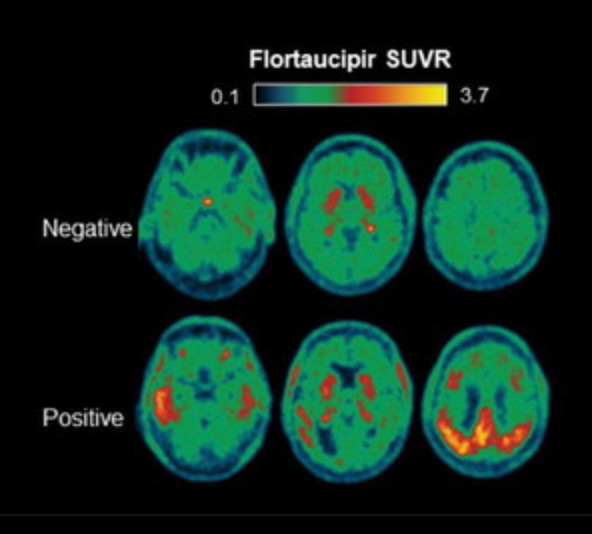
The Alzheimer’s Association recently built on that work by reframing biological staging into biomarkers that become abnormal in the early stages of the disease categorized as core 1 biomarkers (amyloid PET, amyloid CSF levels and the newer plasma ptau217 test—a blood draw which I covered in a previous post). The core 2 biomarker is Tau PET, the most reliable biological indicator in the later stages.
Tau-PET imaging was the focus of the project outlined in the JAMA article referenced above.
The article describes a Swedish study focused on the relationship between clinical staging (presence of cognitive and functional decline) and the newer biological staging. Eight hundred thirty-eight patients who were all positive for amyloid beta but differed in their tau PET uptake. Only thirty eight percent of patients had clinical symptoms that matched their biological staging. Fifty one percent of patients had more advanced clinical symptoms than their biological staging would indicate. Eleven percent of patients had more advanced biological staging than their clinical symptoms would have predicted.
Although this is only one small study, the findings are consistent with what we know about the multifactoral nature of dementia. Those with more advanced clinical symptoms than biological likely have other factors contributing—cerebral small vessel disease called vascular dementia, frontotemporral dementia (FTD). Lewy Body dementia, limibic predominant age-related TDP 43 Encephalopathy(LATE) or other non-Alzheimer’s pathologies.
Those with more advanced biological staging than clinical symptoms are said to have resilience to Alzheimer’s Disease, a condition said to be associated with higher education, more social interaction, having a “sense of purpose” and many others.
In the Swedish study patients in that group had thicker temporal lobes at autopsy - a finding the authors point to as a finding that could reflect resilience.
So the take home message—over half of these folks had Alzheimer’s (confirmed by + amyloid PET) plus other kinds of dementia. Those other components of brain deterioration won’t be helped by amyloid targeted therapy. But the tau PET is still relatively new. As of 2026 Medicare has expanded coverage for PET scans related to Alzheimer’s, with tau PET scans “covered at the discretion of local Medicare Administrative Contractors.” A multidisciplinary group is working on updating “appropriate use criteria” for tau PET scans. Find the link to that info here.
Bottom line is the science is moving toward better and better diagnostics for biological staging, that when paired with clinical symptoms, will give providers the information they need to choose the best possible treatment plans in the next few years.
Comments
Nothing yet. Say the first thing.
Sign in to join the conversation.