
About 25 years ago, I had my own relatively new website, and I was single, early 30s, and had plenty of time on my hands, which gave me plenty of time to indulge my geeky obsession with Star Trek. (I turned that obsession into part of my current job.) That obsession began in my pre-teens when I got my hands on Franz Joseph’s Star Trek Starfleet Technical Manual, an in-universe reference book based on the Original Series from the 1960s. It included detailed blueprints of the Enterprise and expositions on other Starfleet ships. The book expanded Star Trek beyond the episodes on the screen into a whole world.
These were the days when all we had were the Original Series reruns and a single movie to satisfy our Trek fandom and so I dove right in. I began to imagine the rest of the Enterprise and would invent stories of characters moving about the ship’s decks. I invented new ships and new crews and filled whole notebooks with hand-calculated warp tables, crew manifests, science department rosters, and specialization breakdowns. and on and on. (No, I’m not neurodivergent. Why do you ask?)
I also dove into the world of Star Trek novels. Once a month, my mom would drive me to the New England Mobile Book Fair, a warehouse-like store where one could buy paperbacks for 25% off the cover price. There, I would collect stacks of science fiction and fantasy novels, including every new Star Trek book, and then consume them rapidly, then wait impatiently for the next month’s trip.
Fast forward a couple decades to the early days of the web where I discover whole communities of people like me who obsess over creating new ship designs and inventing in-universe documents and blueprints. I marveled at the talent and skill it took to draw new designs or even use the primitive 3D-modeling software of the time to create images that they could upload. (Some of those sites, like Ex Astris Scientia, still exist.) There were those designs, the just-concluded Star Trek: Deep Space 9 series, and the new global war on terror and the war in Iraq. Together, they gave me the impetus to start writing my own Star Trek stories.
At the time, I had been reading a lot of Star Trek fan fiction. Fan fiction had existed long before the internet and photocopied fan stories had been around at conventions since the 1970s, but like so many things, the internet supercharged it. I admired several stories at the Trek Writers Guild (another site which still exists) and that’s where I posted my stories. They even interviewed for me an article in 2004.
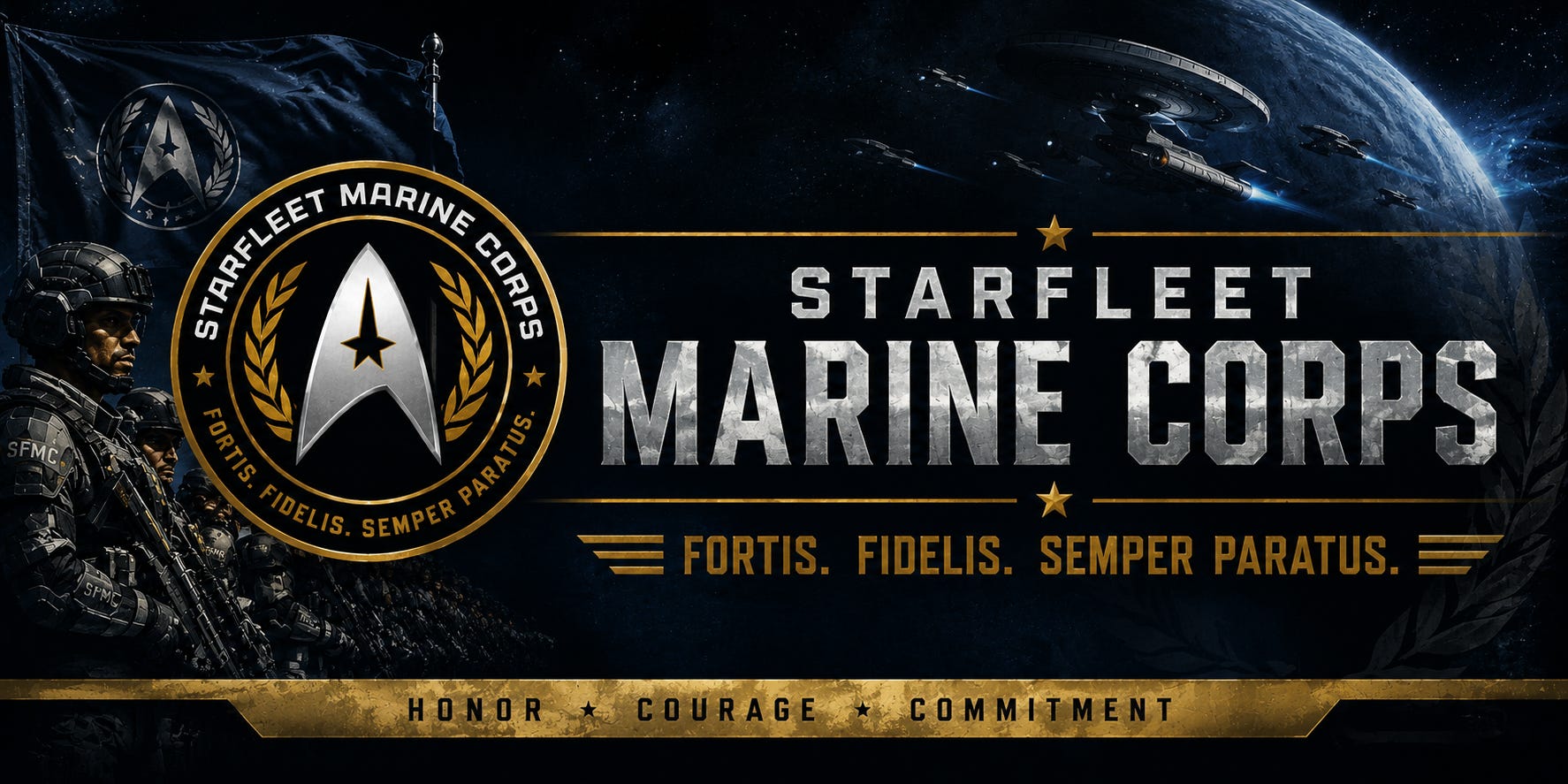
My first story aimed for the fences: a novella of an imaginary Star Trek ground force called the Starfleet Marines. I had never been satisfied with how televised Trek just pulled guys off starships and threw them on the surface off a planet with little more than phaser rifles. No shields, no armor, no tanks. Given the technologies in the shows, I imagined a very different kind of ground war. The result was “A Planet Too Far,” a Tom Clancy-style military thriller of the Marines’ invasion of a Dominion-held planet. It followed a series of characters through every phase of the campaign.1 It wasn’t great— too much tell, don’t show, and the dialogue could be rough—but I had a blast writing it and people responded warmly. I wrote a few more stories, but then I met Melanie, we dated, we married, we had kids, and ... you know the old tale.
To support the story, I developed a whole set of reference materials on the Starfleet Marines: ships, tanks, orders of battle, the whole infrastructure. I based much of the imagery off of fan-made designs, after getting permission from their creators, of course. But I couldn’t execute them exactly from my vision. I always had to take what was available and work with it as is.
Until now, that is. Suddenly there were AI tools where I could say, “Help me create an in-universe design briefing for a Star Trek Starfleet Marines tank.” I’d work through details interactively, refine the concepts, then say, “Turn this into an illustration.” Back and forth we’d go until finally I had the designs I imagined, laid out like those technical reference books I admired as a kid. I’m not an artist. I couldn’t have done it on my own. Instead the AI let me work like a director.
And in the past few weeks, I spent a lot of time developing all these reference materials, just having a blast going back to my childhood, but this time with advanced computing power instead of paper notebooks and pencils. Suddenly, I was getting story ideas, Prompts, and then outlines. I started writing one of those last week and before long, I had a short story.
So now I’m launching my newest Substack site called Starfleet Marines. Right now, it has that one short story, but also a whole library of reference materials I’ve created as background material for my stories. I plan to write many more. I know I’m mostly just enjoying the chance to revisit those days of wandering the decks of the Enterprise in my imagination.
I hope you will check it out, tell me what you think, and maybe even subscribe.
The original story is no longer online, but I may put it up after I have chance to do some rewriting.
Comments
Nothing yet. Say the first thing.
Sign in to join the conversation.