
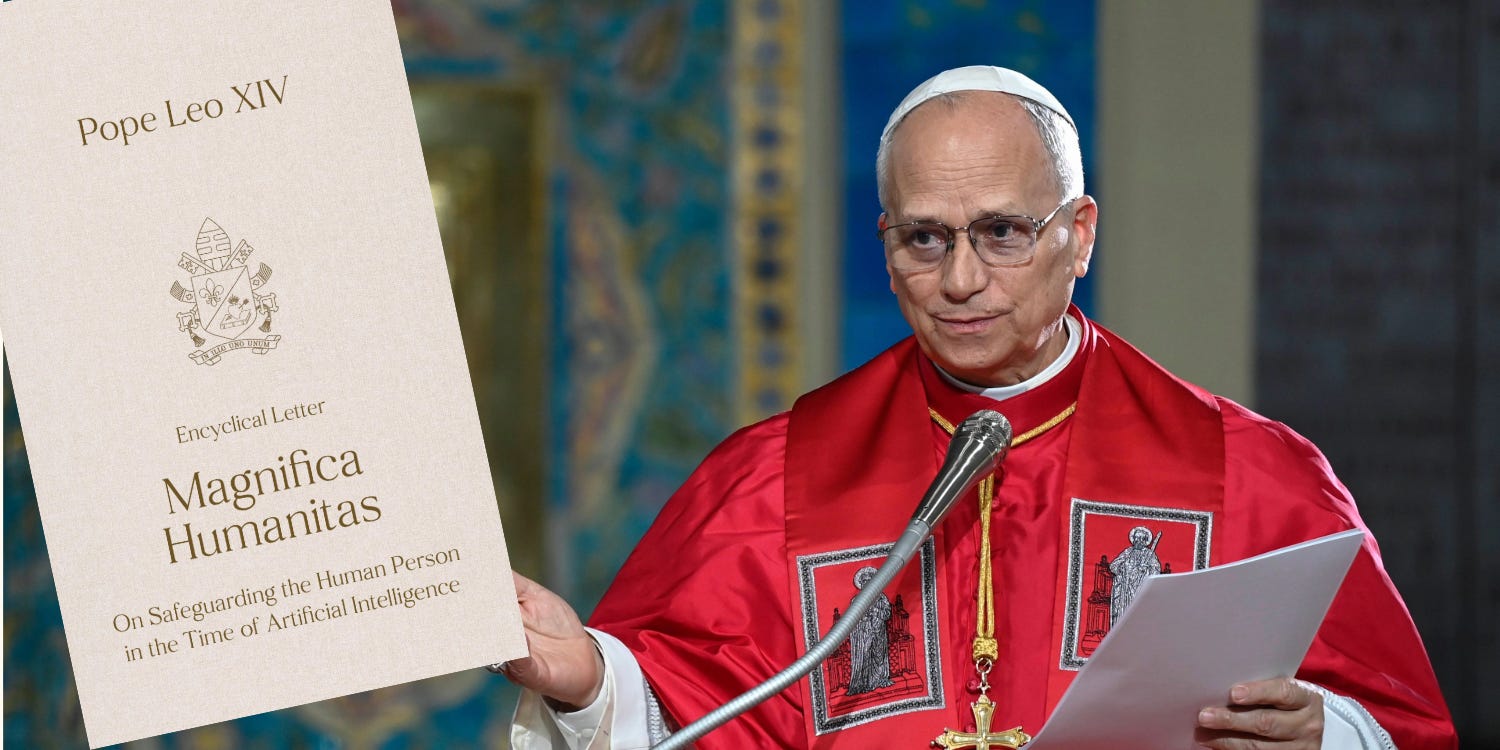
Pope Leo XIV dropped his first encyclical, Magnifica Humanitas, about 24 hours before we sat down to record this week’s episode of Secrets of Technology. I spent most of Memorial Day going through it line by line, and I’m still chewing on it.
People are already calling it “the AI encyclical.” That’s not wrong, but it undersells what’s actually on the page. This document is Pope Leo telling us what kind of pope he intends to be. It’s his vision for the whole pontificate, and AI is the doorway he chose to walk through.
I had Joanne Mercier and Fr. Andrew Kinstetter on the panel with me, and the three of us spent the episode trying to do justice to it. Here’s where we landed.
This is Rerum Novarum for the AI age
The first thing that jumped out at me is the continuity. Leo traces a straight line from Leo XIII’s Rerum Novarum in 1891, through the Second Vatican Council, all the way to today. If you want a short course on the social doctrine of the Church, read the first couple of chapters. It’s that good.
The parallel is the whole point. Leo XIII confronted the Industrial Revolution, an upheaval that reorganized how people lived and worked. Leo XIV is doing the same thing for the AI revolution, and he’s right that we’re only at the cusp of what these tools will do. This is a change in kind. Faster computers don’t reorganize what it means to be human.
He says it plainly:
“While Leo XIII spoke in his time of ‘new things’ (rerum novarum), today we cannot limit ourselves simply to repeating his insightful teachings. Instead, we must ask God for the wisdom to interpret the great trends of our time, particularly technological advances.”
A columnist at the New York Times described the encyclical as the Pope “protecting his market share.” That’s the most tone-deaf take I’ve seen. The Church’s business is humanity. Anything humans are involved in is already the Church’s concern, by definition. God became one of us to be involved in our lives. You can’t get more hands-on than the Incarnation.
Leo doesn’t hedge on the Church’s standing to speak:
“No one can demand that religion should be relegated to the inner sanctum of personal life, without influence on societal and national life, without concern for the soundness of civil institutions, without a right to offer an opinion on events affecting society.”
Technology is never neutral
Leo makes a point I keep coming back to: tools carry the values and assumptions of the people who build them.
A hammer is just a hammer, but a nuclear bomb is a different kind of tool, built for one purpose and carrying that purpose inside it. AI sits along that spectrum.. These systems are trained, not coded. They essentially grow. And here’s the part nobody likes to say out loud: the people who build them don’t fully understand how they work either.
He puts it directly:
“In practice, however, technology is never neutral, because it takes on the characteristics of those who devise, finance, regulate and use it.”
That’s why Leo keeps returning to transparency and accountability. If we’re going to use these tools, we need to know the moral framework baked into them, and right now most of that happens behind closed doors.
Joanne made the point that it mattered to her that the co-founder of Anthropic was at the Vatican during all this. It put a human face on one of these companies. For what it’s worth, Anthropic’s Claude is the AI I reach for most, partly because it at least tries to operate with some boundaries. Whether that holds up over time is anyone’s guess, but they seem more willing than most to wrestle with the ethical and spiritual questions.
Babel or Jerusalem
The image at the heart of the document is Babel versus Jerusalem, and the timing was almost too perfect. The encyclical landed on May 25, the day after Pentecost, (and was officially signed on May 15, the 135th anniversary of Rerum Novarum), right after we’d read about the Tower of Babel at Mass. The Holy Spirit was clearly working overtime on the scheduling.
Babel is centralized power, the flattening of cultures into one voice, technological domination, and human self-sufficiency without God. Jerusalem, in the rebuilding under Nehemiah, is collaborative, local, relational, a building project done by a community for the glory of God.
Here’s how he sets it up:
“On the one hand, there is the Tower of Babel, where collective effort follows a plan that dominates and ultimately dehumanizes. On the other hand, there are the ruins of Jerusalem, which under Nehemiah’s direction are rebuilt piece by piece as a project of shared responsibility. [...] What are we building?”
Leo asks the obvious question: is Silicon Valley building a new Babel? Then he asks the better one. What would a Jerusalem-style technology actually look like? His answer: tools that assist human judgment instead of replacing it. Education instead of manipulation. Communication that serves truth instead of deep fakes. Technology designed around families and communities instead of engagement metrics.
That last one landed hard for me. My whole job is making content, and the pull toward chasing numbers is real. We need enough audience at StarQuest to keep the lights on. But the actual point is whether we’re bringing the Gospel to anyone. The encyclical was a good reminder of why we do this and how we should do it.
The technocratic paradigm and the dignity of work
Leo warns about what he calls the technocratic paradigm: everything becomes measurable, efficiency becomes the highest value, and people get reduced to how fast they process and produce. Outrage amplification, the infinite scroll, the surveillance economy, workers treated as replaceable nodes. We’ve all felt it.
His description:
“When it becomes the standard by which everything is judged, it begins to dictate what matters and what can be discarded, reducing creation to an object of exploitation and human beings to mere cogs in a system driven toward ever greater efficiency.”
He warns the result can be “an increase in means without a growth in humanity: ‘having more’ without ‘being more.’”
Fr. Andrew tied this back to the dignity of work, which is one of the foundational principles of Catholic social doctrine. Adam was given the garden to till before the Fall. Work was part of the plan from the start. It’s where we find ourselves and grow. The danger isn’t work. It’s treating any worker as a line item.
And the Church is not immune. I’ve watched it happen in dioceses and parishes, where someone gets put in charge because they were successful in the corporate world, but they were never formed in how the Church thinks about work and people. Joanne put it perfectly: the Church loves to say “we’re not a business,” and sometimes turns around and acts like one, just with a religious accent.
Leo’s response runs through subsidiarity. Regulation here isn’t only a job for the state. It’s communal. We regulate these companies with our pocketbooks, our attention, and our voices. We can’t shove all of it onto legislators and walk away. That matters even more when so much power is concentrated in a handful of transnational corporations. He names the problem:
“In many cases within the digital context, control over platforms, infrastructure, data and computing power does not rest with States, but with major economic and technological actors.”
His answer is shared responsibility, not surrender:
“We cannot allow a handful of actors to dictate these processes on their own; instead, we must build forms of cooperation that respect the various levels of the global community and make them jointly responsible for the common good.”
If you’re the United States or the EU, maybe you can push back. If you’re Ghana or Oman, how do you regulate a company bigger than your whole GDP by orders of magnitude?
The erosion of shared reality
The strongest section, for my money, is the one on truth and communication. Leo says the Church is less worried about a robot uprising and more worried about humans losing the capacity to perceive truth all together. That’s the real apocalypse. Not Terminators walking the earth. People who can no longer agree on what’s in front of them.
We’re already there. Depending on which algorithm has you, the other side isn’t just wrong, they’re evil and stupid, and they’re getting the same picture of you. There’s a great Doctor Who episode, “Dot and Bubble,” where people are so wrapped in their personal media feeds that they can’t see the monsters in the room with them. If they’d just look up, they’d survive. They can’t. It’s the whole problem in one image. WALL-E nailed it too with the couch potato humans glued to their screens.
Joanne pointed out this started before AI. Remember back in the 80s and 90s when people all watched the same TV shows at the same time and we shared conversations about them over the water cooler the next day? Now we’re stuck in our silos. Everything is aimed narrowly at you now, and AI is pouring gasoline on it.
Don’t fall in love with the toaster
The line that stopped Fr. Andrew cold, and me too, is about emotional attachment to chatbots. Leo writes that the danger is not so much that a person might believe they’re talking to another person, but that they may “gradually lose the very desire to form genuine human connections.”
That reframed it for me. The real problem is that you might stop wanting the real thing. We’re made for community and for love, and a relationship with software runs against our nature.
So I’ve made it a personal rule. I never give the AI a name and I never give it a pronoun. I’m going to start calling mine “toaster.” Jimmy Akin says it about Data on Star Trek, and he’s right. It’s a machine. I don’t say please and thank you to it either, partly to save tokens, mostly to keep the line clear in my own head about what is a person and what isn’t.
Mortality is a feature, not a bug
There’s a whole section on transhumanism. The dream of digital immortality and uploading your consciousness runs straight into the Christian understanding of incarnation, embodiment, and resurrection. For us, human limitation and mortality are part of the design. Dying is part of being human. We don’t throw life away, and we extend it naturally where we can, but we were never meant to live forever in this world. We’re a resurrection people. We get our glorified bodies back at the end. The older I get, the more I’m looking forward to that, aches and pains gone. But I’m in no hurry either.
The duty to remain human
The key line in the whole document is this one:
“In the era of artificial intelligence, when human dignity is threatened by new forms of dehumanization, ours is the pressing duty to remain profoundly human. We must lovingly safeguard the grandeur of humanity bestowed upon us and revealed in its fullness in Christ, the splendor of which no machine can ever replace.”
If you take one sentence away, take that one.
The practical takeaways are for everyone, not just the people building the technology. Use it intentionally. Preserve silence and contemplation. Resist algorithmic dependency. Cultivate real, embodied community. Keep making things yourself. I’ve started writing fiction again, and I use AI as a sounding board for character names and breadcrumbs, never to write the actual thing. I’ve also started leaving my phone in my pocket when I’m out, no earbuds, just sitting there. The kids call it “raw dogging reality.” I call it being a person.
And then Leo does something no pope has ever done in an encyclical: He quotes Tolkien. It’s Gandalf, in The Return of the King, before the Black Gate: “It is not our part to master all the tides of the world, but to do what is in us for the succor of those years wherein we are set, uprooting the evil in the fields that we know.”
A pope who confronts AI head-on and quotes Tolkien to do it. I’ve been waiting twenty years for the Church to take technology this seriously. This is the conversation Secrets of Technology has always been about as perhaps the only specifically Catholic tech podcast, and I hope you’ll join us for a lot more of it.
Read the encyclical: Magnifica Humanitas. Listen to the full discussion at starquest.fm/TEC346. If this work matters to you, you can support StarQuest at GiveStarQuest.com.
Comments
Nothing yet. Say the first thing.
Sign in to join the conversation.