
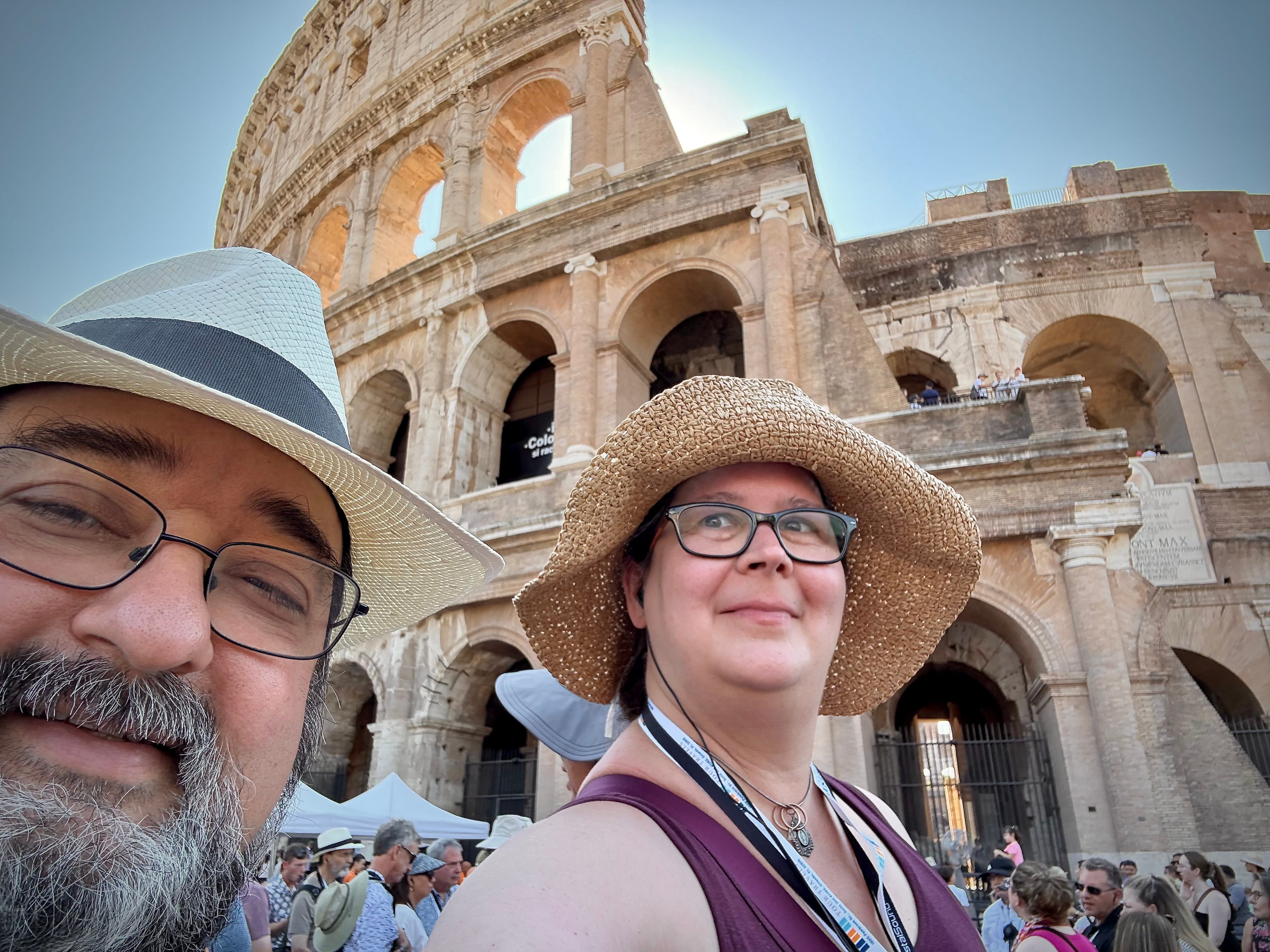
I hadn’t mentioned it here before, but over the course of two weeks in July, my wife, Melanie, and I went on a whirlwind pilgrimage to Italy associated with the apostolate where I work, StarQuest Media (SQPN), and the Jimmy Akin’s Mysterious World podcast.
More than 60 pilgrims spent 12 days in Rome, Assisi, Orvieto, Lanciano, Loreto, and San Giovanni Rotondo. Along the way, we passed through the Holy Doors of the four major basilicas of Rome; stood within a few feet of Pope Leo and attended a papal Mass; prayed near the tombs of current and future saints; touched the very stones of the home where the Virgin Mary received the Annunciation from the Archangel Gabriel; and more.
Rather than bore you with a travelogue of the places we visited, I thought I’d share my thoughts on the most surprising aspects of our trip.
You can travel to Italy in July and survive
I was one of the organizers of the pilgrimage and when we were planning it, we knew that Italy–and especially the big cities–are extremely hot and humid in July and August. So why did we choose to go then? We really didn’t have much choice due to the schedules of the major people involved. April or May would have been great and late September would have also been good, but our headline attraction, Jimmy Akin, could not do either of those.
As a consequence, during our entire trip the temperatures were generally above 90°F the entire time, except for our last evening. On one day we were in Assisi, it was near 98°. So we sweated. A lot. And we drank a lot of water and ate plenty of gelato. Sure the hotels and buses were air conditioned, but most of the ancient buildings we visited were not. So you take your time and you get used to it.
That isn’t to say that it isn’t dangerous, but if you take precautions and take your time, you can survive. Also, everyone says Rome shuts down in July as people go on vacation to escape the heat, but we hardly saw any places that weren’t open. Maybe it was because of the Jubilee Year and the new pope and all the pilgrims in the city, but this was also true in the smaller places we visited.
You are probably capable of more than you think
Related to the heat and the exertions it required, I learned that I was capable of more than I thought. I am not very fit, to be honest. I’m overweight, I’m over 50, and I hadn’t kept up with my walking regimen before the trip. This was one of my biggest worries.
But I did it. At no point did I think I couldn’t go on. And there were others who had it much worse than me. At least one older woman on the tour hobbled everywhere with her cane, but she made it.
At the end of each day, my feet were sore and I relished the idea of a shower to cool off and get refreshed, but by the end of the trip, I was still ready for more. I may not want to climb any stairs for a while now that I’m back, but I feel fit as a fiddle.
You can go from stranger to fast friends in days
On the trip I was in the strange position that most people knew me and I didn’t know them. Since I’m the cohost of Mysterious World and the host of other podcasts, people already knew me. There were also other pilgrims who I’d only known online, some for several decades, but we were meeting in person for the first time.
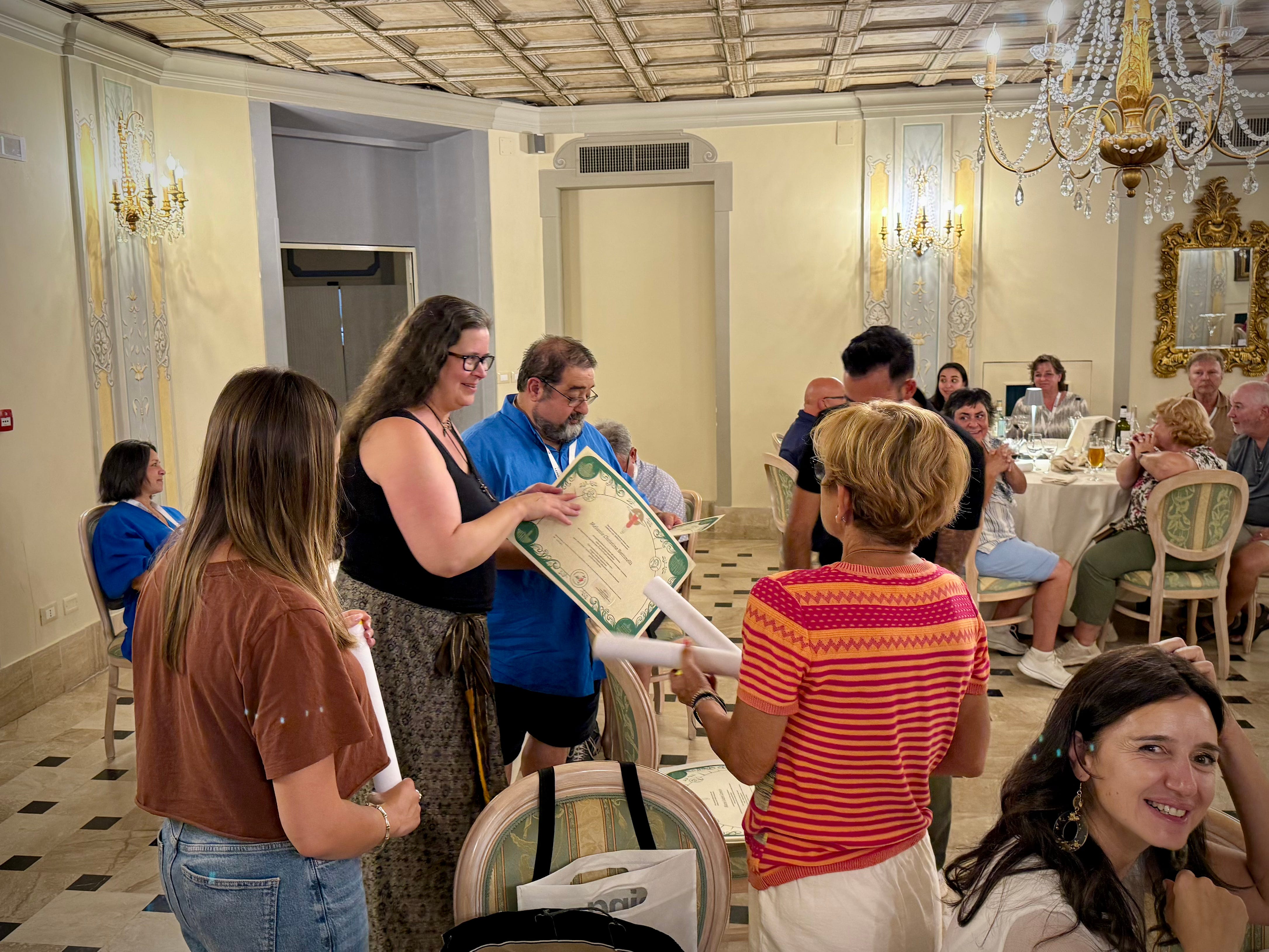
And yet, it took only hours in some cases for us to feel like old friends, making jokes and talking about interesting subjects and sharing about families and more. There’s a bond that’s created when you travel with others, especially in stressful situations. We met a couple who homeschools their kids in Canada; a wonderful gentleman from England who works on the Oxford English Dictionary; two sisters from the Pacific Northwest, one of whom retired from the US Navy as a Command Master Chief; a family of parents and two teen daughters; and so many more. At every breakfast and dinner, we made an effort to sit with new people and get to know them. With over 60 people on the trip, we didn’t quite get to meet everyone and have one of those conversations, but we made meaningful connections with many.
The Holy House of Loreto is amazing and its shrine even more so
I had been to Italy before, 25 years ago, but only in Rome and Assisi. The first time was a very quick four-day visit and the second time was during World Youth Day in 2000 and so the ability to see and do much at that time was limited by the tight schedules and crowds. Melanie had spent a semester of college in Italy so she had seen more, but mainly in Rome and northern Italy.
Meanwhile, apart from Lazio, this pilgrimage focused mostly on Umbria and southern parts of Italy and we managed to see some surprising new places. I’d purposely kept my expectations and research on the locations we were visiting low so I could experience surprise and delight and that was a good strategy.
One of the most surprising places for me was the town of Loreto and the basilica that contains the Holy House. This small stone structure inside of the massive early Renaissance church was brought from the Holy Land by an Italian family called De Angelis. (Their family name was later morphed into the legend that “angels” carried it from there to Loreto.) The Holy House is the home that the Virgin Mary grew up in with her parents, Anne and Joachim, and where she received the Annunciation from the angel Gabriel. It was incredible to stand within those walls and touch them, imagining Mary putting her hand in the same place and the Divine Light of the angel washing upon those stones. Also, in the small House, beneath an altar that was created there after the House arrived in Italy, there is a small stone altar from its time on the Holy Land. The story is that this was the altar of the Apostles, where they celebrated Mass after the Resurrection in Mary’s house. Although it’s behind a grill, I was able to touch it with my fingertips.
The basilica itself is a beautiful expression of devotion and art with many chapels provided by the donation of various nations, i.e. a German chapel, a French chapel, and others. The American chapel is the newest and reflects the status of aviation as of the 1970s and its art style is evocative of the era. It even includes images of helicopters, the first papal trip on an airplane by Pope Paul VI, astronauts, and even UFOs.
Italy is incredibly open, spacious, and unpopulated
I imagined that in a place that has been occupied by advanced civilizations for thousands of years that the land should be filled by a megalopolis. In some ways, I expected central Italy at least to be built up like the Northeast Megaplex of the United States between northern New Jersey and Boston. But what I found instead is that the land is incredibly open and rugged. Most of the area that you can see from the major highways is either mountainous or agricultural. The amount of land given over to growing sunflowers, olives, and grapes in the areas we traveled was incredible. Cities and towns, especially older walled towns, tended to be very contained.
When I consider the massive depopulation caused by successive plagues and wars over the centuries, not least the massive death toll of World War II, it makes a tragic sense. Had the war not happened, imagine the millions of people who would be alive throughout Europe today.
On a more hopeful note, Italy remains a beautiful country, not just on her incredible coasts, but also in her heartland. Driving from Rome, through the Appenines, to the Adriatic coast was gorgeous as we went from picturesque valley to valley, and then driving along the coastline south. On the US East Coast, it would be rare to find long stretches of beautiful beaches without imposing hotels lining it mile after mile.
One of the most beautiful places we visited was the small hilltop village of Monte Sant’Angelo, which overlooks the Adriatic Sea on the “spur” of Italy’s boot. This pretty town of white-walled stone buildings on steep walking streets is the home of the Grotto of Saint Michael, an ancient apparition site where the Archangel Michael appeared several times in the 5th century inside a cave. Several churches have been built, one over the other, over the cave and you enter in the top church and go down, down, down the stairs until finally you find yourself in a chapel that is half-cavern, half-building. On our trip, we arrived just as Eucharistic Adoration and Benediction were ending and we had a chance to kneel in prayer before the Lord. Over the centuries, many kings and princes and popes and other important people have made their way to this site to pray and experience this town.
The Italians have food allergies figured out
One of our concerns before the trip was that Melanie has several food allergies, including wheat and tomatoes. Imagine not being able to eat either of those in Italy of all places! But we had been assured by several people that Italians were very good about food allergies and that turned out to be true.
Every menu was clearly marked with allergens, including some we didn’t know could be allergens. At every group meal, the guides and the venue ensured that Melanie’s place setting was clearly marked and they would bring her specially prepared gluten-free pastas and breads and other items. And the Italian versions of gluten-free foods are far superior to the American packaged foods. Much American GF pasta we’ve tried tended to be gritty or odd tasting, but the Italian brands tasted just like they should! The same with the breads, which had the kind of structure that I thought only gluten could give. I don’t know what alchemy they used to create these amazing foods, but Melanie was quite appreciative.
On one night, the group went to a pizzeria in Rome where Melanie had pizza whose crust was indistinguishable from real pizza dough. It was incredibly well done.
Melanie also has a fragrance allergy, which meant that the towels and sheets in hotel rooms needed to be washed in unscented detergents. A couple of the hotels were able to accommodate us. One simply could not make it happen. Our guides went above and beyond by making a last-minute visit to a shop to buy sheets for our bed for our stay there. This is a lesson for us in the future: We need to always bring a set of sheets and towels for hotels where they can’t get us unscented sheets and towels.
Italy is very hilly
The hills! Everywhere in Italy seems to be either uphill or downhill, sometimes with very steep inclines. Towns like Orvieto, Assisi, and Loreto were built on hills to be defensible, but even more modern places seem to be on hilltops. Rome is famously built on seven hills, but everywhere we went we had to walk up and down. And when it wasn’t hills, it was stairs. And even when it was level, it was a lot of walking.
For example, on the 6th day in Rome, we walked over 7 miles. In the morning, we started at the Scala Santa, the Holy Stairs from Jerusalem where Jesus was brought before Pontius Pilate. Pilgrims can kneel and pray up the steps, but one try on my bad knees and I decided to walk up the regular staircase next to it. There are a couple of chapels at the top of the stairs, nothing too remarkable, but then it was off across the street to St. John Lateran, Rome’s cathedral. After that we walked down the street to Santa Croce, which holds a number of relics connected to the Crucifixion, including pieces of Christ’s Cross and thorns from the crown of thorns.
Then we took buses back to St. Mary Major, the fourth of the four major basilicas of Rome and the last of the main Holy Doors of the Jubilee. We stood in a long line to pass through security and then a long line inside to pass by and pray at the tomb of Pope Francis. There we saw the relics of the nativity manger and the icon of Santa Maria Salus Populum Romanum. We walked from there back to our hotel for a lunch break and then back on buses to a spot near Castel Santangelo where we walked past Piazza Navona to the Pantheon and then on to the Trevi fountain, which was incredibly crowded and way too touristy. Along the way, we saw some pretty sites and amazing churches, including the Gesu, which we didn’t see inside and which had a wedding going on.
We walked from the Trevi to the Capuchin ossuary. This is a crypt under the church of Maria Della Concezione Della Capuchins which contains several altar areas where everything is constructed of and decorated with the bones of deceased friars. It was different than I expected. First, we had a self-guided tour through a museum about the Capuchin order in general, which was pretty good. Then there was the bone crypt itself which turned out to have been more like an art project by a single capuchin and less the custom of an entire community, which surprised me. It didn’t feel creepy at all. In fact, as I looked at the skulls, I was struck by the fact that each one was a brother in Christ who lived a whole life like me, with hopes and dreams and challenges, and who was loved by God.
After Mass in the church above the crypt, we then walked to the Spanish Steps where we had a group dinner and then after, a very long walk back to the buses by the Tiber River. And that was just one day, albeit the longest. By the end of the 12-day trip, I had logged almost 50 miles of walking! That’s over 4 miles per day!
An unexpected chance to see Pope Leo
Our trip to Rome coincided with Pope Leo’s first summer vacation as pontiff. Originally we were supposed to see him during the weekly angelus prayer and blessing in St. Peter’s Square on Sunday, which usually means thousands or tens of thousands of people and the pope way up on a faraway balcony. But the Pope was at the summer retreat outside of Rome in Castel Gandolfo, where the crowds are a bit smaller, but the square is smaller too, so it would still be hard to get up close. But then our tour operator managed to snag tickets for our group to a Mass with Pope Leo in the nearby town of Albano.
So we got up early and got buses to the small town, which is only minutes from Castel Gandolfo. We would be in the square outside the cathedral, but a large screen was set up and there was only a couple thousand people at most. We also were able to stand in the shade for the whole Mass. When the time came, Pope Leo came through the square on foot, passing just within about 20 feet of us! Then we celebrated Mass with him and even were able to receive Communion from priests who brought ciboria from the pope’s altar.
From there, we quickly returned to our buses and went to Castel Gandolfo. The square there was already packed and we ended up in a massive crowd down the Main Street. We could hear his prayer, but couldn’t see him. But that was okay because we’d already seen him in Albano!
After the Angelus, at the advice of our guide, Melanie and I made our way against the crowd into the square and then down a side street. From there we came upon a small street that overlooked the volcanic lake that makes the town famous. We snagged an outside table at a restaurant and had an amazing meal with a glorious view. It was a very good day.
Italian beer is good now
One of my memories from my last trip to Italy was that while the food, wine, and gelato were great, Italian beer left a lot to be desired. The main Italian brand Peroni was essentially an equivalent to Budweiser, weak and tasteless. On our day in San Giovanni Rotondo, we had lunch in the hotel restaurant. Usually we drank wine and bottled water with our meals, but I saw they listed a couple of craft beers on the menu, a wheat beer and a saison. I was intrigued and order the wheat beer. Wow! It was great! Craft beer has come to Italy and it’s apparently good.
The guides can be great
Our tour operator arranged for local guides in most of the places we visited. In the majority of situations, they were guides vetted and hired by the tour company, but in some places we had to use guides provided by the venue or from an approved list. The guides hired by the tour company were all pretty great. Giorgio was our main guide in Rome and he was knowledgeable, faith-filled in his outlook, and proficient in English. Daniella and Romana guided us through Orvieto and Assisi and were also quite knowledgeable, fun, and personable.
On one day, we had a tour of the Vatican Museums, which was a first visit for me, although Melanie had been a few times. Our guide was Valentina, a pretty, young woman who flirted with all the male museum employees, all of whom seemed quite appreciative of her attention. She was nice, but she moved us pretty fast through the vast galleries and focused mainly on the secular art pieces or at least had a primarily secular outlook on them. In the Rafael rooms, for instance, she focused on the famous School of Athens mural, but then ignored the stupendous Adoration of the Eucharist on the opposite wall. But overall, she did a pretty good job.
In San Giovanni Rotondo where we were learning about and praying at the shrine of St. Padre Pio, we had a male guide whose name I never caught, whose English wasn’t great and whose guiding left a lot to be desired. He never quite understood that he didn’t need to translate Italian names into English and so he kept calling the town “St. John Circular,” which … isn’t quite right. But he also had a habit of stating the obvious as well. He’d point to a chair in Padre Pio’s room and say, “This is Padre Pio’s chair.” And in fact, he said little in his tour that we couldn’t have figured out on our own.
On the other hand, the guide at the Abbey of Monte Cassino, the great Benedictine monastery, was great. Her English was very fluent, her knowledge was extensive and deep, and she came with a devout understanding of St. Benedict and his monastic life.
In general, I recommend having a good guide when you visit Italy because while you can read guidebooks, there’s nothing like the passionate intensity and knowledge of someone whose passion for their home and their faith impelled them to start a career sharing them with visitors.
How a free trip can be expensive
A 12-day trip to Italy staying in very fine hotels and having top-notch guides is obviously not cheap. So how can we as a one-income family with five kids, living in one of the most expensive metros in the US on a small non-profit salary afford for both of us to go? That’s the deal the tour operators make with tour leaders. When Trinity Tour Travels approached us with the idea, they told us that for every so many people we get on the trip, we get a free trip for one of the leaders. The cost of those trips are built in to the price that the rest of the participants are paying. Such a deal! We knew we could fill at least one and maybe two buses for this pilgrimage and we did. Through the generosity of both the tour company and the other pilgrims, both Melanie and I could go on this trip of a lifetime.
But even through the biggest costs were covered, there’s still plenty of expenses. For one thing, we needed some new luggage. We had one large suitcase, but we needed a second one big enough to hold enough clothes for a two-week trip. And we needed some new travel-weight clothes suitable for the hot Italian summers. Then there were the costs on the trip itself. Breakfast and dinner were covered by the tour, but for lunches and other purchases we had to come up with that out of pocket. And while Rome isn’t the most expensive city, it’s still a big city. A fairly light, sit-down lunch for two was generally about 40 or 50 euros, which was about $50 to $60. And then there were the gifts for the kids and souvenirs and holy items. We didn’t splurge on those, but it adds up. I don’t know if we could do a trip like this every summer and maybe we’ll need to figure some things out if we do this again, but the reality is that even a free trip can be expensive.
There’s so much more I could write about our trip, but I’ll end for now by saying that this was an incredible experience, not just because of the amazing places we visited–and Italy is amazing–but also for the people we met and the new friends we’ve made. I would like to do more of these pilgrimages through SQPN, in part because they’re good for our community and it’s good for SQPN. We’re batting around some ideas for the future, including a possible North American pilgrimage (which might be more accessible to more people), as well as some of Trinity’s other packages, like the pilgrimage in the footsteps of St. Paul in Greece and Turkey. And one idea I’ve been mulling over is visiting Great Britain for a pilgrimage related to great British Christian writers like Tolkien, Chesterton, and Lewis.
If you’d be interested in a future pilgrimage, let me know in the comments, as well as any other questions related to this trip.
Comments
Nothing yet. Say the first thing.
Sign in to join the conversation.