
Hope is the defining principle of the Rebellion in Star Wars. That’s not exactly an original thought since the name of the first movie is A New Hope (ANH). Nevertheless, there’s much to unpack when we look into this idea.
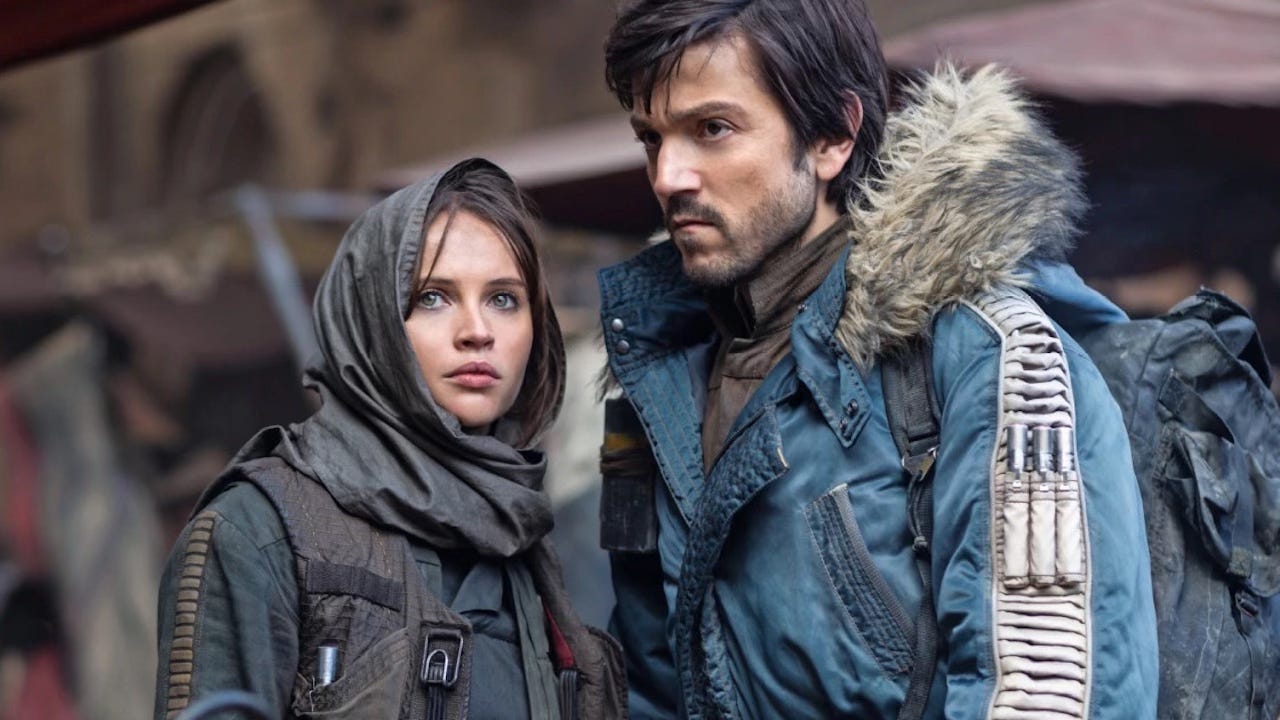
The second and final season of the Andor series has just wrapped, which leads directly into Rogue One and then ANH. In Rogue One, on Jedha, while searching for Saw Gerrera, Cassian says he’s hoping to get a meeting with him and Jyn scoffs, “Hope?” Cassian replies, “Yeah, rebellions are built on hope.” Later, Jyn echoes the same line at the Rebel council meeting on Yavin 4. As Jyn tries to convince the Alliance leaders to take action at Scarif, one of the leaders challenges her: “You’re asking us to invade an Imperial installation based on nothing but hope?” And she responds with Cassian’s line: “Rebellions are built on hope.”
Early on, Cassian is still somewhat the jaded and cynical rebel. He doesn’t quite believe in Jyn or Saw and certainly not in Galen Erso. Cassian recites the line about hope like an old mantra—repeated often, but hollow. But by the time Jyn uses it in the council meeting, she has transformed from a jaded, cynical young woman into a fervent believer. She may not trust the Rebellion fully, but she refuses to let her father’s sacrifice go unheeded. He gave up everything–life, family, freedom–for the sliver of hope that he could put a fatal flaw in the Death Star that could later somehow be exploited.
“Rebellions are built on hope—but so is faith.”
His action is a metaphor for the Rebellion at large. The Empire is immense and powerful. There are millions of stormtroopers and thousands of starships, not to mention the seemingly all-seeing Emperor and his immensely powerful henchman, Darth Vader. How could a small band of ill-equipped rebels possibly overthrow the Empire? But Galen believed and held onto his hope that somehow, some way, some day, his plan would work.
And, of course it did. But before it did, at the movie’s end, we hear of hope again. After the supreme sacrifice of Cassian and Jyn and their friends on Scarif and Admiral Raddus and his flagship and all the other Rebel ships over Scarif, Princess Leia escapes in the Tantive IV with the Death Star plans and one of the ship’s officers asks her what it was in that transmission from the planet and she replies simply–in the last word of the movie–“Hope.”
Moments later and 39 years earlier, A New Hope begins.
But where did Cassian get the idea that Rebellions were built on hope? The exact phrase itself came from an unexpected source: The concierge at the hotel on Ghorman where Cassian stayed during Andor season 2.
That sense of hope and even joy is what sets Star Wars (and Star Trek) apart from other science fiction epics. Whether it’s Alien or Blade Runner or more recently Zach Snyder’s Rebel Moon, much of what we get for space opera or epic science fiction is often bleak and dark and brutal.
That sense of hope is what resonates for Christian fans of Star Wars because hope is one of the theological virtues which St. Paul partners with faith and love in his first letter to the Corinthians (1 Cor 13:13). What sets this theological virtue apart from normal hope? The Catechism tells us, “Hope is the theological virtue by which we desire the kingdom of heaven and eternal life as our happiness, placing our trust in Christ’s promises and relying not on our own strength, but on the help of the grace of the Holy Spirit.” (CCC 1817). In other words, Christian hope is trust in the good to come, even when it seems distant or impossible. Sound familiar?
Throughout the saga, we see this kind of hope everywhere. In the original trilogy, Luke clings to the belief that good still exists in his father—despite all evidence to the contrary. His hope, rooted in love and faith, ultimately leads to Anakin’s redemption.
“The greatest acts in Star Wars aren’t victories—they’re sacrifices made in hope.”
Leia Organa, Luke’s sister, remains steadfast in hope, despite seeing her entire planet and all its people destroyed in an instant, despite being held in the depths of the Empire’s seemingly unstoppable weapon by the Emperor’s two strongest henchmen.
In the sequel trilogy, Rey carries hope throughout the three films, hoping in the future despite so much uncertainty about her past, her present, and her future. SShe doesn’t know who she is or where she comes from. Is she a Jedi? A Palpatine? Can Kylo Ren be redeemed? But her hope in ultimate good propels her forward.
Contrast that hope with the despair of the Dark Side. Anakin’s turn begins with fear—the enemy of hope. That fear drives him to control fate rather than trust it, and in doing so, he loses everything.
Palpatine, in both the Empire and the First Order, understands this. He rules by fear, control, and despair—antidotes to hope. In Return of the Jedi, he mocks Luke’s faith, telling him that his faith in his friends is his weakness. (Spoiler: It wasn’t.)
In Star Wars, like Christianity, hope also inspires self-sacrifice. Obi-wan’s death in A New Hope, Holdo’s sacrifice in The Last Jedi, and Cassian and Jyn’s deaths in Rogue One all reflect the same aspect of Christian hope in which we are willing to sacrifice present comfort for eternal truth. “Indeed I count everything as loss because of the surpassing worth of knowing Christ Jesus my Lord. For his sake I have suffered the loss of all things, and count them as refuse, in order that I may gain Christ.” (Cf. Philippians 3:8–11) Without hope, such sacrifice would be meaningless.
While the Rebellion and Resistance suffer loss after loss, defeat after, still they persist. Likewise, Christian hope also perseveres through suffering (Romans 5:3–5).
In Star Wars, hope motivates every conflict. Star Wars is always about a small, hopeful resistance against a vast, dark empire–David vs. Goliath. Hope also defines heroism. The greatest acts aren’t victories, but sacrifices made in hope. And hope reaches beyond the present. The heroes fight not for power or revenge, but for a future they may never see–a deeply Christian vision (Hebrews 11:1).
Star Wars doesn’t just tell stories about hope–it breathes it. From Luke to Leia, from Jyn to Rey, the saga holds up hope like a lightsaber in the darkness. Like the Christian call, it urges us to trust in promises not yet seen. And reminds us–as St. Paul said–“hope does not disappoint.” (Romans 5:5)
“Hope in Star Wars isn’t optimism—it’s trust in good, even when the odds say otherwise.”
Comments
Nothing yet. Say the first thing.
Sign in to join the conversation.