
When I was young, everyone used to tell me to do what you love.
They said that’s the only way you’ll be happy when you grow up.
They even had a word for it. They called it “passion.”
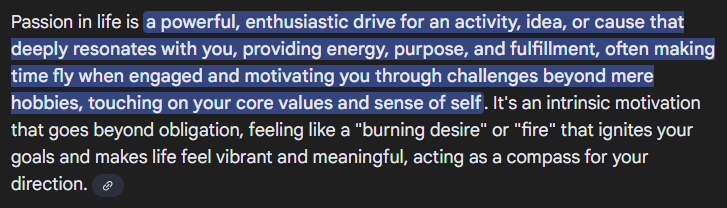
In simple terms, passion was described as doing something just for the sake of doing it.
You don’t care about the outcome. You don’t care about results, failures, or criticism. All that matters is the process.
And honestly, it sounds amazing.
But that’s also where the problem begins.
How is someone supposed to find something they don’t care about failing at?
From a very young age, most of us are taught the opposite — that failure means you’re bad at what you’re doing. At least where I grew up, that belief is extremely common.
So when you try something new and fail a few times, your brain jumps to a conclusion: this can’t be my passion.
Because how could you be bad at something that’s meant for you?
Especially when we're young, we switch our interests very quickly.
One day you want to be a writer.
The next day, a video editor.
A month later, a coder.
As our interests change, so does what we call our “passion.”
You think you’re passionate about writing because you love reading books and novels. But when you actually try writing, it feels hard. It doesn’t flow the way you imagined. So you assume it’s not for you and you quit.
Same with video editing. You enjoy watching cinematic or phonk edits. Then you try editing yourself and realize how time-consuming and frustrating it is to create just a few seconds of video. And once again, you quit.
That’s how it goes for most of us.
We grow up believing passion is something you’re born with.
If you’re not good at something early on, it must not be your passion.
So we keep switching interests, switching careers, switching paths — but never staying long enough to actually fall in love with anything. We never reach that state where we’re fully absorbed, fully focused, and deeply involved in one thing.
Not because we’re incapable but because we were taught the wrong definition of passion.
So the real question is:
How does one actually become passionate about something?
Passion comes only after you get good at something. And you get good at something only by being bad at it for a long time and still showing up.
Yes, it sounds ridiculous.
But that’s how it works.
Passion is not some intrinsic trait you discover.
You develop it through persistence.
Interest and passion are not the same thing.

Interest is curiosity. Passion is commitment.
I was interested in how apps and websites work and how they make life easier. Out of curiosity, I tried learning to code. And I was terrible at it. I could understand tutorials, but when it came to writing code myself, I froze. I procrastinated even doing 30 minutes a day.
I had quit many things before, so quitting again would’ve been easy.
But this time, I didn’t.
I kept going. I kept failing. I kept hearing that I wasn’t good enough. And slowly, I improved.
At my peak, I was coding 10–12 hours a day. For the first time in my life, I experienced real passion — doing something without caring how many times I got it wrong, tweaking and refining until it finally worked.
That’s the passion everyone talks about.
They just never explain how to reach it.
The same thing happened when I started writing.
I wasn’t good. But I stayed. And now, I can’t go a day without writing — even if it’s just one page.
So no, I don’t hate the word passion.
I just dislike how casually it’s thrown around, without depth or honesty.
Passion is not something you find. It’s something you develop.
So next time you feel interested in something, don’t confuse it with passion.
You can be interested in hundreds of things and still be passionate about none.
If you truly want passion, you must be willing to go through the phase of doubt, criticism, failure, and slow progress. You have to keep going when confidence tanks and quitting feels easier — whether you’re building a business, writing a book, launching a product, or learning a new skill.
That uncomfortable phase isn’t a sign you’re on the wrong path. It’s the price of entry.
Thanks for reading. I will see you in the next issue. Until then, take care and keep moving forward.
Comments
Nothing yet. Say the first thing.
Sign in to join the conversation.