
Anyone who knows me knows I love to dance. So there’s something quite funny about the leadership idea I currently can’t stop thinking about: it starts on a dance floor and ends with me leaving one.
I didn’t expect to learn that lesson on a mountain. But that’s exactly where it caught up with me.
The trail that kept changing its mind
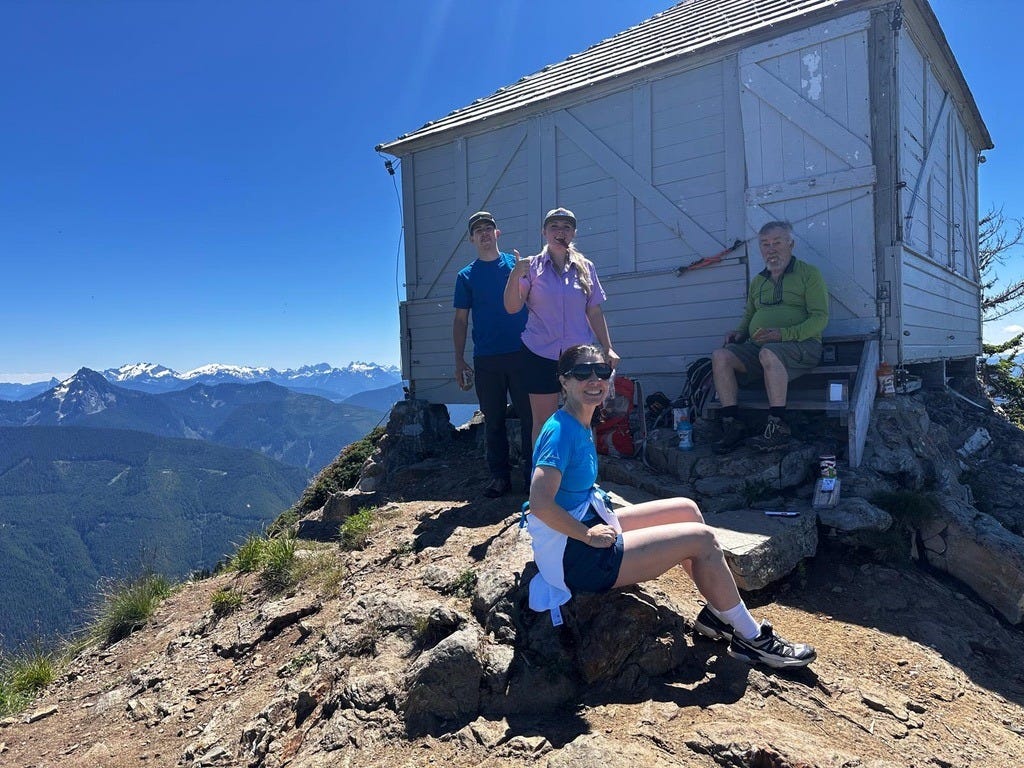
Last Sunday, on my 53rd birthday, I climbed to Evergreen Lookout in Washington State. We had three generations on the trail: my 78-year-old father, who taught all of us to love the mountains before any of us could carry our own packs, my baby brother, my 19-year-old son Bruno, my niece, and me.
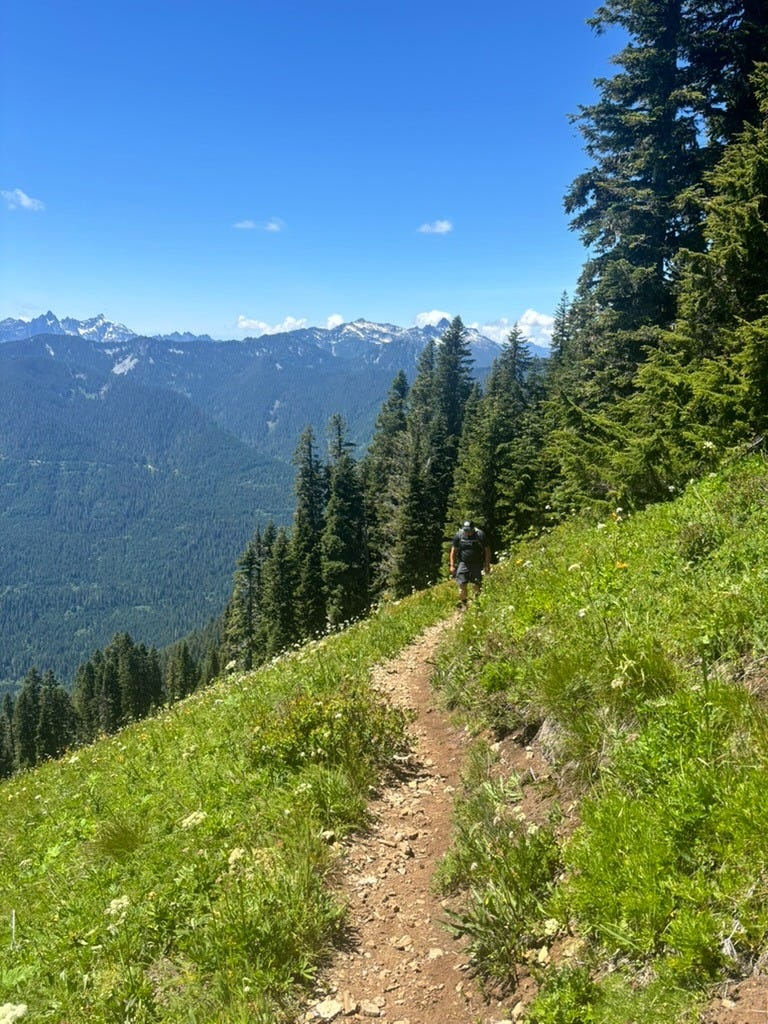
The trail couldn’t seem to decide what kind of trail it wanted to be. Punishing switchbacks for a stretch, then suddenly a meadow full of wildflowers, then back to switchbacks, then another meadow, each one somehow prettier than the last. By the time we cleared the tree line, the views were the kind you don’t really have words for. You just stop talking.
That’s the “balcony”.
I didn’t have to reach for that metaphor. It simply arrives naturally once you climb high enough above the thing you usually stand inside to see the expanse beneath you.
But the metaphor isn’t only about the view.
It’s about watching my father, at 78, struggle on some of the steeper switchbacks and keep climbing anyway, setting exactly the same steady pace on the way up and on the way down. No shortcuts. No easy way out. The exact determination he always taught us – the satisfaction of earning something beats the ease of skipping it.
And it was watching Bruno, at 19, on this trail for the first time — still just beginning to really see, the way you’re early at seeing almost everything at 19. He’s still building the muscle for looking beyond the next switchback.
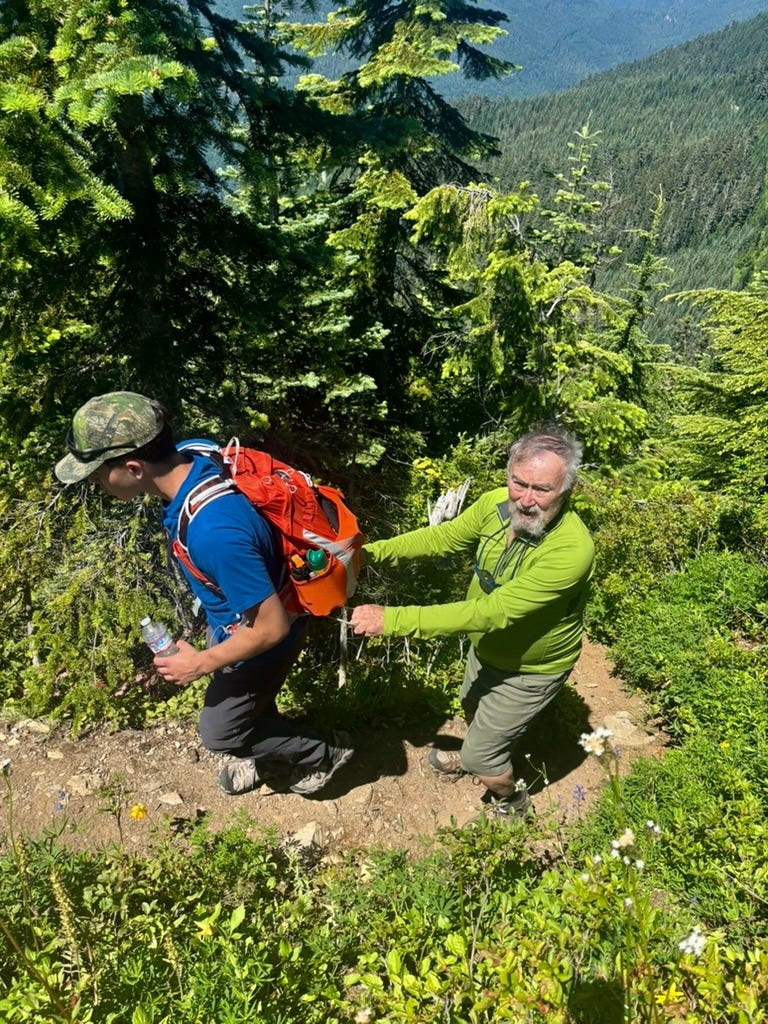
But this hike wasn’t something any of us watched from a distance. It was teamwork. Bruno did the bulk of it, sometimes gently pushing, sometimes pulling, always encouraging Grandpa up the mountain with humor, never once making it look like a chore. The rest of us filled in around him: my brother steadying a pack strap here, my niece calling out a loose rock there, and me just close enough that my father knew none of us were going anywhere without him. Getting a 78-year-old up and down a mountain isn’t a solo act, not even for someone as stubborn as my father, but it was Bruno who carried most of it.
And in between all that effort, we kept stopping, all of us, pointing things out to each other: a meadow gone wild with wildflowers, views of familiar peaks from a different angle, and the smell of warm pine in the sun. The mountain didn’t save the good part for the summit. It handed us pieces of it the whole way up, and every one of us wanted the others to see it too.
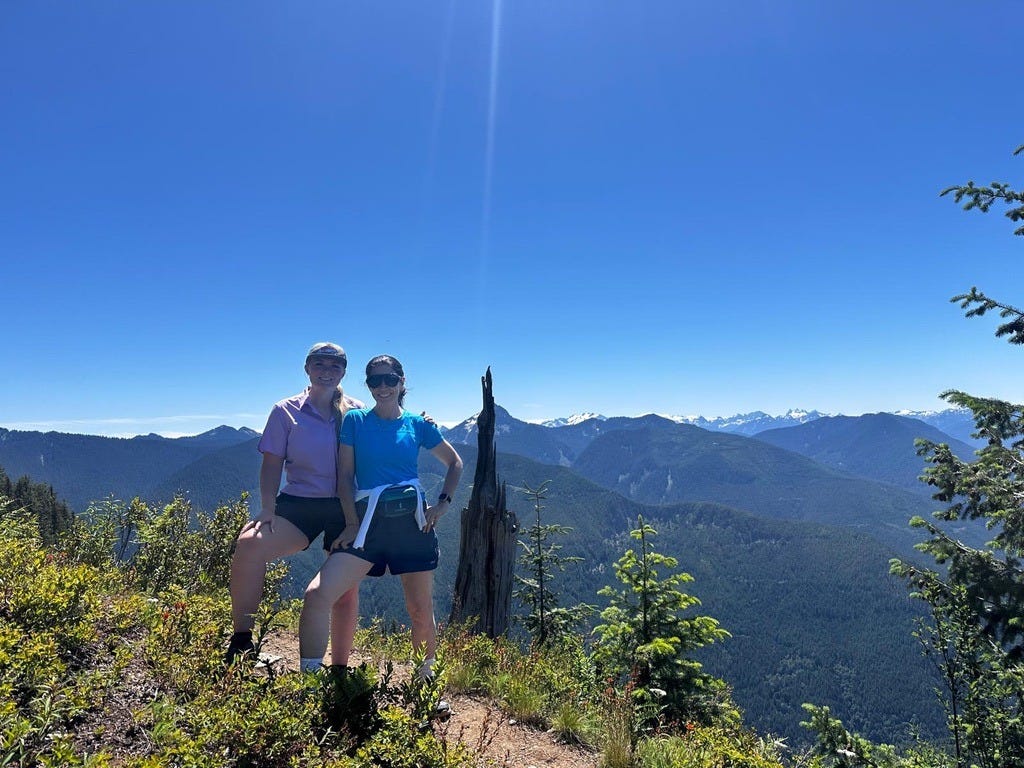
At the Lookout, I found myself zooming out — not just across the landscape, but across time. Three generations, one trail, one family moving together, each of us doing whatever needed doing and taking all of it in. My father, six decades further down the trail than Bruno; Bruno just beginning. And me, somewhere in the middle, realizing the “balcony” isn’t only spatial. It’s temporal. Turning 53 on a mountain that my father taught me to love, with my son helping him to the top, gave me a view that had nothing to do with work, and everything to do with perspective.
The floor and the balcony
There’s an old idea in leadership theory about the difference between being on the dance floor and being on the balcony. On the floor, you’re in it: moving, reacting, catching an elbow, matching the mood of the room. From the balcony, you can see the whole thing at once: who’s dancing with whom, where the energy is building, where it’s fading, which groups aren’t mixing.
Let me be careful here, because there’s a lazy version of this idea I don’t actually believe. The lazy version says the floor is where lesser leaders get stuck, and the balcony is where the wise ones live. That’s nonsense. You cannot lead from the balcony alone. Nobody trusts a leader who only ever watches from above. The floor is where relationships are built and where the real information lives.
My point is much smaller than “leave the floor and ascend to the balcony.” It’s this: some of us are so at home on the floor, so genuinely happy there, that we purposely never build the muscle for stepping up to the balcony.
I am one of those people.
I should be honest about something else, too. This idea follows me everywhere: the balcony, the lookout, whatever you want to call the place where you finally see the whole shape of things. I know the theory. I’ve probably told other people to “get on the balcony” more times than I can count.
And still, most weeks, I’m the last one to notice I’ve been on the dance floor for months, moving fast, mistaking motion for progress, until something interrupts the rhythm: a birthday, a mountain, or someone I love asking a question I didn’t want to answer.
The metaphor isn’t a skill I’ve mastered. It’s more like a friend who keeps showing up and asking, “Have you looked at things from above lately?”
Half the time, my honest answer is no.
That’s part of why actual lookouts matter to me so much. The real ones. On real trails. With real switchbacks. They don’t ask my permission the way the metaphorical balcony does. A mountain doesn’t care whether I feel like stepping back today. It simply makes me climb. And eventually, it hands me the summit view whether I was ready for it or not.
Why I’m stepping off the floor
I’ve spent the better part of thirty years building organizations. I wouldn’t trade those years for anything. They’ve been some of the most meaningful of my life.
But somewhere along the way, I became exceptionally good at staying on the dance floor: solving, responding, building, moving. Less good at climbing to the lookout before deciding where to dance next.
So here it is: I’m taking a writing hiatus and a two-month sabbatical.
I don’t want this to read as a disappearance, because it’s the opposite. It’s me finally doing, on purpose, the thing that’s hardest for someone who loves the dance floor as much as I do: leaving it while the music is still good.
I’m under no illusion that the work grinds to a halt without me, or that anyone is circling the calendar waiting for my return. The music will keep playing just fine.
That’s actually the point.
If I can’t step away without convincing myself the whole room falls apart, then I haven’t really learned anything from the balcony.
What the research says, and what I’m hoping to discover
“Leaders need rest” has become such a familiar cliché that it’s easy to nod along and then check your email anyway. But there is meaningful research behind it. Studies suggest extended breaks can improve well-being, reduce stress, increase creativity, and even strengthen organizations by creating space for others to step up. Some of the evidence is stronger than others, and I’m careful not to overstate it.
What interests me most isn’t simply whether a sabbatical helps me rest.
It’s whether it helps me return seeing differently.
This sabbatical isn’t an escape from work. It’s an investment in the next thirty years of it. If the next chapter of my work is going to matter as much as the last one, it deserves more than momentum.
It deserves perspective.
That’s ultimately what I’m testing over the next two months—not whether I can stop working, but whether stepping away changes the way I see the work waiting for me when I return. Whether distance lets me ascend to the balcony, taking in the whole floor rather than being lost in the crowd of it.
Questions I’ll be carrying with me
What have I mistaken for urgency?
Where have I mistaken activity for progress?
What am I still doing simply because I’ve always done it?
If someone described my last year from the outside, what would they notice that I’ve stopped seeing?
What would success look like if I were standing on the balcony instead of the dance floor?
Warmly,
Lisa
P.S. I’d love to hear from you. When was the last time you stepped off the dance floor on purpose, while the music was still good? What did you see from your own balcony?
Comments
Nothing yet. Say the first thing.
Sign in to join the conversation.