

AI companies are building tools we may come to rely on. The issue is not just what they can do, but what happens when we don’t control the relationships we come to need.
In his Economist interview last week, Elon Musk described an AI future of “amazing abundance,” where robots and AI provide so many goods and services that, as he put it, “Money won’t matter” — in as soon as ten years.
Musk predictions aren’t super reliable. Remember in 2014 when he said fully autonomous, driverless Tesla vehicles were just a year or two away? But this week’s headlines point to a more complicated near future: not abundance exactly, but conditional access — to tools, companions, advice, entertainment, and even the devices in our homes, increasingly governed by platforms we don’t control.
The question isn’t just whether AI can make more stuff.
It’s who owns the systems we’ll rely on, and what happens if we outsource connection, judgment, and agency, only to rent back access later.
New technology has systematically made us more capable in many ways. Increasingly, paying for a tool just gets you inside the company’s terms. Software can disappear. Features can move behind paywalls. Devices can be remotely limited, updated, or abandoned. Ownership has become conditional.
And then there is companionship. This week stories of loneliness influencers, AI companions, and chatbot harms all circle the same market opportunity: loneliness is sticky. A person who feels unseen is a person who may keep coming back to the thing that seems to see them.
It’s not that synthetic comfort can’t help us. But when comfort is driven by a retention strategy, retention can quickly lead to dependency.
There is nothing inherently wrong with paying for ongoing support. Therapy, coaching, education, community, and relationship tools all require ongoing investments.
But do these things help you return to your life with more clarity, courage, and connection? Or do they quietly create addictions that turn us away from human engagement?
It is hard to trust that a world where money “doesn’t matter” will automatically benefit the many rather than the few, especially when so much of today’s technology is moving toward closed systems that can be tuned, restricted, or withdrawn.
We should be worried about a future where every human needs gets converted into a closed system someone else controls..
If we want a future where technology helps us become more capable, connected, and harder to manipulate, we need to start building it now.
The laws being drafted right now will decide what AI gets to be. We’re tracking their progress so you don’t have to.
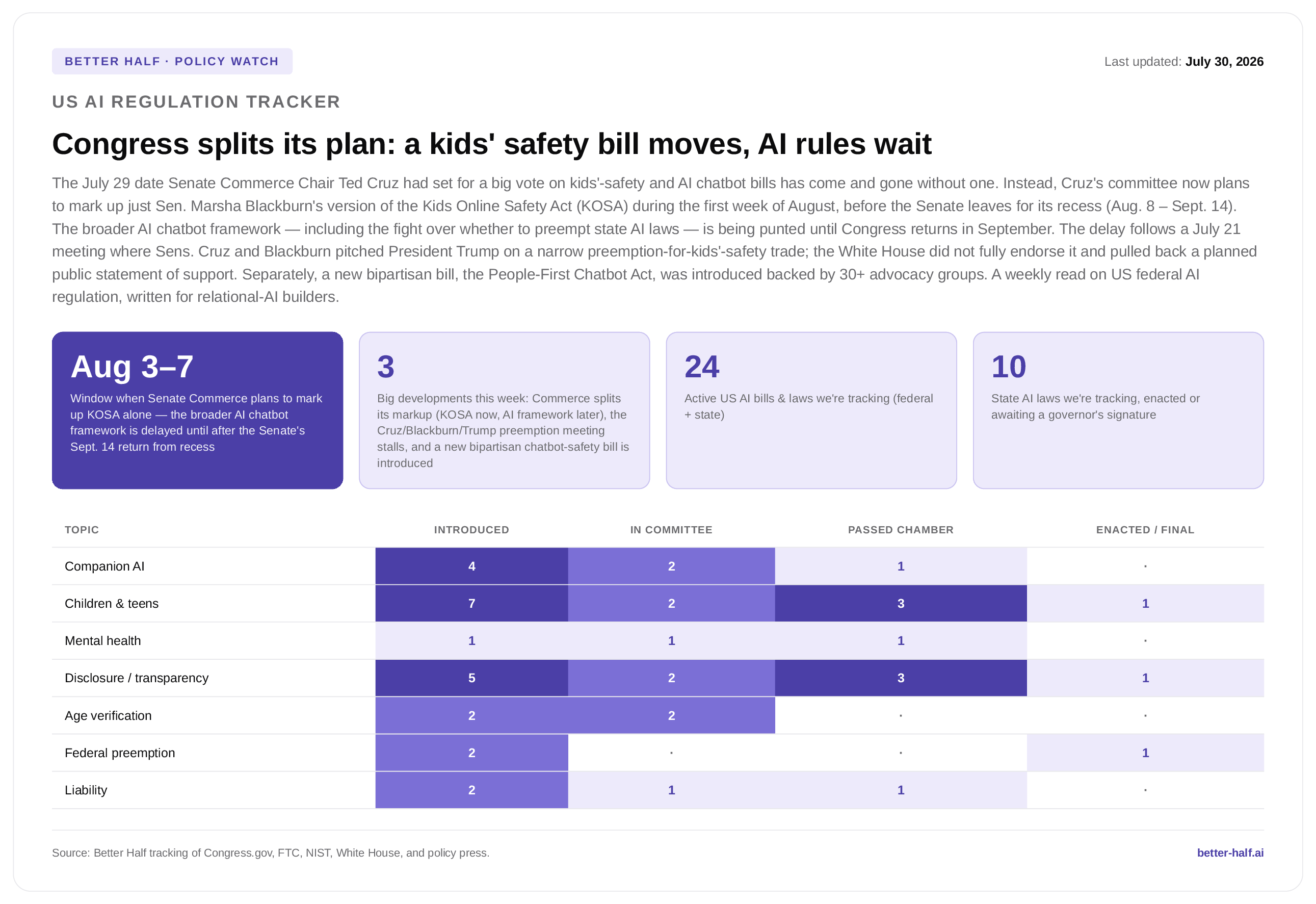
For the full breakdown — every bill, lawsuit, and commentary piece we’re tracking — visit better-half.ai.
Gizmodo’s Kyle Barr says that Apple’s new technology leasing program is just the beginning of a slippery slope into a world where we rent access to our things.
An argument for not living a “life of abundance” (with no work to do) and retiring at 35: it’s lonely.
Have you heard of loneliness influencers? Fascinating.
A new paper finds that being critical of AI flattering others doesn’t protect people when the same thing happens to them.
Mark Zuckerberg hasn’t been acting like the future is for everyone. But now he says it is.
Say goodbye to your Roomba, maybe. The Trump administration wants to ban “advanced robotic devices” from entering the United States.
While they’re at it, the administration is trying to ban non-citizen independent technology researchers from working in the U.S.
From the alignment world: The Long (Self-)Correction: a useful read on the way AI discourse is recalibrating after years of overconfidence, backlash, and institutional self-correction.
Watch this TikTok to listen to the earworm about the creepy uncanny valley baby. Stay for the epic comments:
This is Good Friction, Better Half’s look at relational AI — the technologies deepening human connection, and the ones quietly pulling us apart. Subscribe below.
No posts
Comments
Nothing yet. Say the first thing.
Sign in to join the conversation.