

You buy a few shares in a company listed on the stock exchange. For years, you can sell or buy them whenever you choose. Then one day, the company announces it is leaving the market.
Your shares are still yours, but you can no longer easily trade them. Because you are a minority shareholder, you may not even get a vote on the decision. And the price offered may fall well short of what they are worth.
In the finance world, this is called delisting, and across Europe it is happening more and more. Yet the rules protecting small investors, when they do, are weak, uneven, and full of gaps.
For years, Brussels has worked on the front door (listing). The 2024 Listing Act eased the path for companies wanting to go public, part of a wider effort to make Europe’s stock markets more attractive. The back door (delisting) has been left largely untouched. There is no equivalent EU rulebook governing how companies leave.
Yet, according to the delisting study conducted by BETTER FINANCE and DSW, its German member organisation, between 2010 and 2022, the EU lost nearly 15% of its listed companies, falling from 7,400 to just over 6,300. Euronext alone recorded 355 delistings between 2019 and 2023, including 110 in 2023 and roughly €467 billion in market value was withdrawn in a single year.
Not everyone sees a crisis. At a recent BETTER FINANCE event in Brussels, Jakub Michalik from Euronext pushed back on pessimism, saying the picture is “not amazing, but not terrible either.”
Perhaps that is true, but BETTER FINANCE believes that, even where new listings hold up, the rules for the companies walking out of the back door remain weak.
Every time a company leaves the stock market, the pool of firms that ordinary savers can invest in transparently gets a little smaller. Listed companies must publish accounts, disclose risks, and answer to shareholders. Once they delist, much of that goes away.
The money does not disappear, it shifts. More and more of it ends up in private markets, where pension funds and wealthy investors buy whole companies away from public view. In a recent panel organised by BETTER FINANCE, Guillaume Prache, President of BETTER FINANCE, warned that private equity should not be a substitute for public markets, but rather complementary to them, because ordinary savers are not its natural audience.
That’s because private equity is inherently illiquid, intermediated, and suited to investors who can bear long holding periods and opaque pricing. Retail investors should not be pushed into such an environment without a clear exit mechanism.
In September 2020, the Berlin-based tech group Rocket Internet announced it was leaving the Frankfurt Stock Exchange. Minority shareholders were offered €18.57 a share to sell up, a figure based on the average market price over the previous six months. The problem was that those six months fell squarely within the pandemic crash. The price was low, and the company knew it.
This was a buyback that Rocket Internet ran itself, approved at an extraordinary general meeting. DSW, the largest minority shareholder organisation in Germany, called it a wealth transfer to controlling shareholders worth roughly €200 million.
Then, in December 2021, just over a year after the delisting, the founder’s investment vehicle bought out a hedge fund still holding shares. The shares were bought at €35.00 each, nearly double the exit price paid to minority shareholders. Had the deal happened a few months earlier, every former shareholder would have been owed the same.
Thanks for reading Inside EU Finance: The Individual Investor Brief! This post is public so feel free to share it.
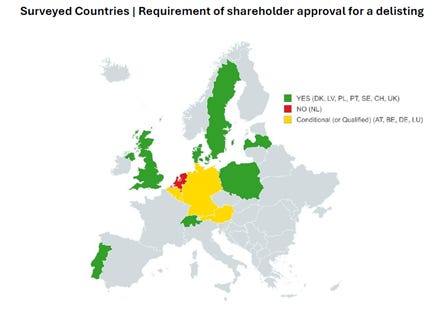
What happened in Frankfurt could just as easily happen in Amsterdam, Brussels, or Riga. The BETTER FINANCE–DSW study, which surveyed twelve European jurisdictions, found that small shareholders face three recurring problems when a company decides to leave the market.
No guarantee vote
According to the study, in Germany, the Netherlands, and most Belgian cases, a company can leave the stock market without ever asking its shareholders. That leaves minority investors with no say over a decision that directly affects the value of what they own, and no platform on which to question the management running the company.
No guaranteed fair price
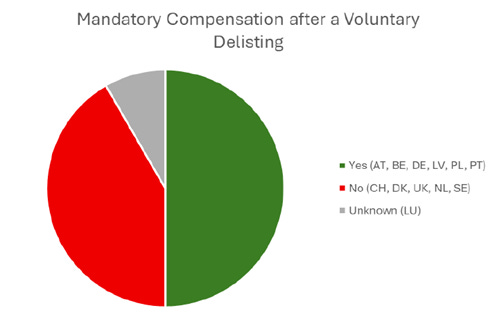
There is no EU-wide rule requiring companies to offer minority shareholders a fair exit price, and the methods used to calculate one vary widely. Latvia, for instance, often relies on book asset value, which can sit well below what the shares are actually worth.
No real way to challenge
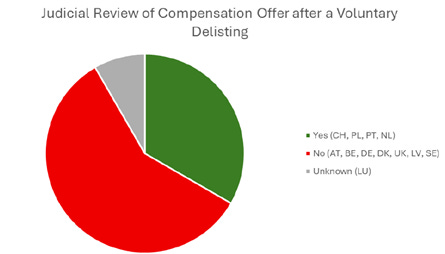
In most surveyed countries, there is no clear way to challenge an inadequate offer in court. Where there is, the process is slow and expensive. Even in Germany, where a special court procedure does exist, cases can drag on for years before a small shareholder sees a decision.
Delisting is not the only way small shareholders lose out. In a corporate restructuring, they can be wiped out altogether. For example, in the German cases of Leoni and Varta, existing shares were cancelled, new ones handed to a chosen investor, and minority holders walked away with nothing. No vote, no compensation.
The Credit Suisse rescue in 2023 was an extreme example. Shareholders received a single UBS share for every 22.48 they held. The deal was agreed over a weekend, with no chance to intervene.
There is one bright spot, though. Squeeze-outs, where a majority owner forces remaining shareholders to sell, are at least harmonised at the EU level, typically at 90 to 95% ownership. But how the price is set, and whether it can be challenged, still vary from country to country.
The fixes are not complicated. A minimum EU-wide floor of protection would cover the three weak points:
· a real shareholder vote when a company decides to leave the market,
· a guaranteed exit price set by independent valuation,
· an affordable, timely way to challenge a bad offer in court.
Brussels has spent years making it easier for companies to list. The same effort needs to go into protecting the people left behind when those companies walk back out.
Public markets are how millions of ordinary Europeans share in the growth of the economy. If leaving the stock market means small investors lose out by default, trust in those markets quietly erodes. And once that trust is gone, it becomeseveryone’s problem, not just the shareholders’.
No posts
Comments
Nothing yet. Say the first thing.
Sign in to join the conversation.