
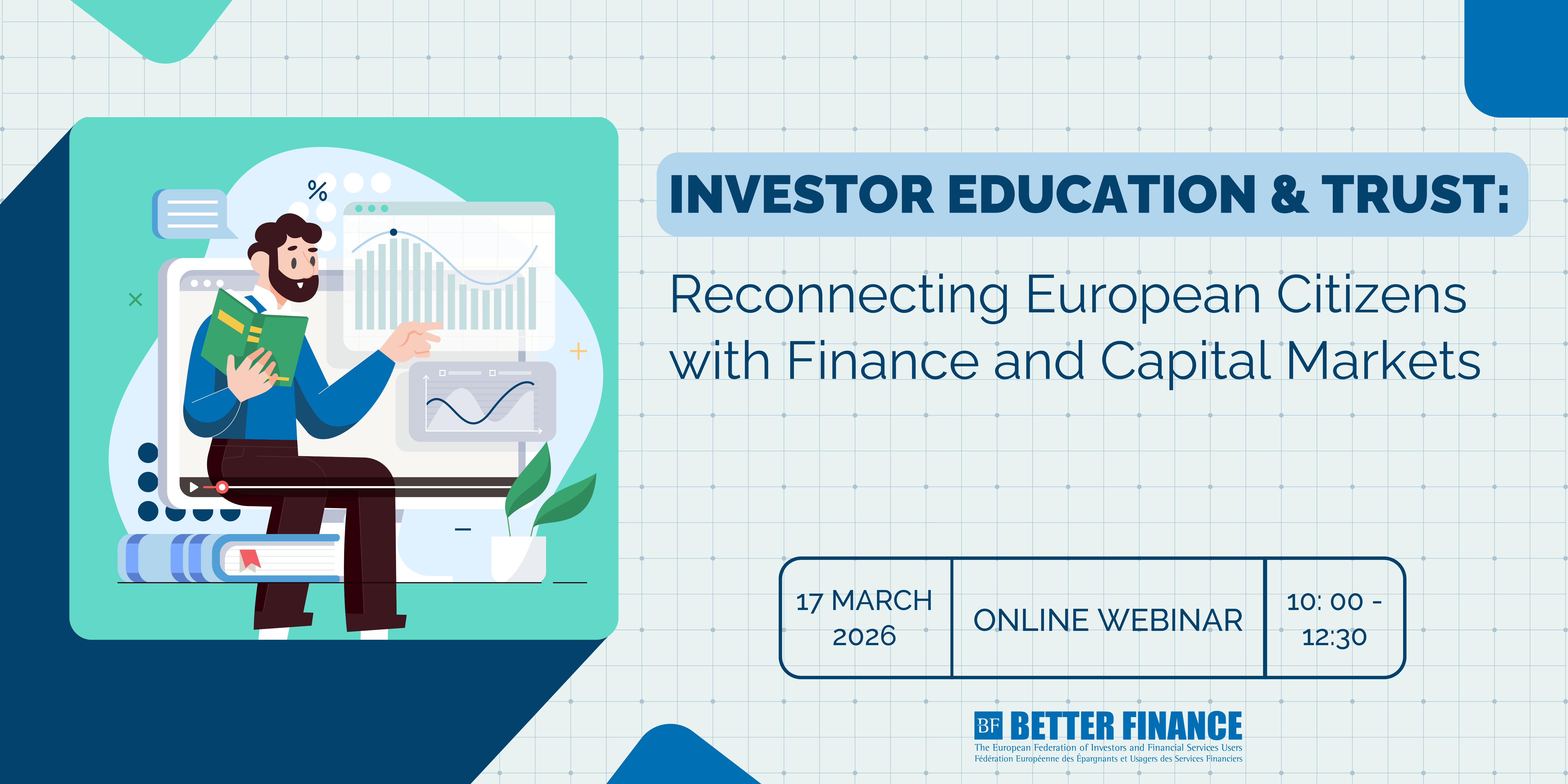
On 17 March, BETTER FINANCE hosted the online conference “Investor Education & Trust: Reconnecting European Citizens with Finance and Capital Markets.” The goal: to tackle the persistent gap in financial literacy across Europe. As Aleksandra Mączyńska, Managing Director at BETTER FINANCE, made clear, “Investor education is not just about knowledge. It’s about empowerment...about giving people the ability to ask the right questions and look after their financial health.”
As the BETTER FINANCE & EFPA study identified, Europeans care about their financial health. Most say it matters, but only a few feel ready to act. As investment participation and understanding remain low across the EU, the conference looked at how education, advice, and policy can work together to build trust, confidence, and meaningful participation in financial markets.
The conference opened with a keynote from Alexandra Jour-Schroeder, Deputy Director-General at the European Commission. During her speech, Jour-Schroeder emphasised that financial literacy has become a societal and economic priority. However, she was equally clear that financial literacy cannot replace regulation: robust consumer protection frameworks remain essential, with both elements working in tandem.
She presented the EU Financial Literacy Strategy, built on four main pillars:
Coordination and best practices: sharing knowledge across Member States. There is no one-size-fits-all solution.
Communication and awareness: launching an EU-wide campaign and building a network of national financial literacy ambassadors.
Monitoring and evaluation: improving data collection and measuring impact, with future EU-wide assessments.
Funding and support: using EU programmes like Erasmus+ and ESF+ to improve access to funding.
Beyond education, financial literacy is also key to the Capital Markets Union agenda. When people understand finance, they are more likely to invest. When paired with tools such as savings and investment accounts and pension-tracking systems, citizens can take more control of their financial future.
Jour-Schroeder concluded by calling for coordinated action by policymakers, stakeholders, and groups such as BETTER FINANCE to keep education accessible, unbiased, and effective.
Thanks for reading Inside EU Finance: The Individual Investor Brief! This post is public, so feel free to share it.
Moderated by Anne Gaignard, CEO of Place des Investisseurs, the panel discussion explored why financial literacy remains persistently low despite increasing policy attention across Europe.
Chiara Monticone, Senior Policy Analyst & Coordinator at OECD/INFE, provided a data-driven diagnosis, noting that “very few people understand compound interest… even among people who hold savings and investment products.” She stressed that the issue goes beyond access to a deeper gap between exposure, understanding, and behaviour. While levels vary across countries, the structural causes are shared: historically generous pension systems meant individuals did not need to make investment decisions. Today, expectations have changed, but habits and confidence lag behind.
Josias Fagerland, Chairman of the Danish Young Shareholders, highlighted a 65% rise in young investors in Denmark in 2019-2020. However, many entered markets without prior knowledge, relying on:
social media
peer discussions
trial-and-error investing
This makes increased participation both promising and risky.
Camille Beaudoin, Chair of the IOSCO Committee on Retail Investors and Director of Financial Education Expertise and Partnerships at AMF Québec, emphasised that financial literacy is built by real-life experiences. “People do not wake up in the morning with the wonderful idea to take a book,” he said. Learning happens when people are forced into action: buying, selling, borrowing, or making major financial decisions. Awareness campaigns are effective only when they create repeated, relatable engagement.
Mariola Szymańska, President of EFPA Poland, argued that knowledge, skills, and motivation are insufficient without habit formation. She also cautioned against separating independent education from licensed financial advice, since for many adults, learning happens through personalised conversations around real decisions. This relationship is more important than ever, as misinformation, AI tools, and finfluencers can generate false knowledge as easily as real knowledge.
On AI and digital tools:
Fagerland warned that the increased use of ChatGPT by young people can create overconfidence through generic advice.
Monticone highlighted that to overcome AI risks, such as hallucinations, bias, misleading outputs, and data privacy concerns, users need judgment and critical thinking to assess answers.
Beaudoin underlined that regulation must adapt, treating digital finance as central to investor protection.
Overall, the panel showed that financial literacy is not just an education issue but a behavioural, structural, and trust-based challenge that requires coordinated action across policy, advice, and regulation.
Following the panel, Fagerland shared a case study from Denmark. The focus: a youth-led financial education initiative which aims to close the gap in how young people learn about money and investing. He explained that while students want to learn, financial literacy is absent in most schools.
The numbers speak for themselves: 94–95% of students want to learn about financial literacy in school. However, access remains inconsistent and dependent on individual teachers. To address this gap, the initiative brings sessions directly to high schools across Denmark, reaching more students every year.
The approach has four key elements:
Peer-to-peer learning. Educators are only a few years older than the students. This makes the sessions more relatable and engaging.
Learning by doing. Students take part in interactive exercises, like building a mock portfolio, to understand risk, diversification, and decision-making.
Tailored delivery. Content is adapted to different backgrounds, regions, and levels of experience.
Nationwide reach. The programme puts a strong focus on smaller towns, where financial literacy gaps are often the biggest.
At its core, the programme aims to teach essential principles such as risk awareness and long-term thinking. As Fagerland noted, the objective is to ensure that “you have financial understanding to make the decision that is right for you.”
The initiative has already reached thousands of students and received strong feedback. But the bigger goal is clear: to show policymakers that financial literacy should not depend on individual effort. It should be a mandatory part of education.
The conference concluded with a clear message: financial education empowers people, but only when combined with fair, transparent, and accessible financial systems. People need to be able to act with confidence, not just follow incentives. Better product design, easier comparisons, and strong default options are all essential to support education.
The takeaway is simple: Education, regulation and good market design must work hand-in-hand. Only then can people make informed choices and build lasting financial resilience.
No posts
Comments
Nothing yet. Say the first thing.
Sign in to join the conversation.