

Imagine you and your best friend have a few hundred euros to invest. You like to play it safe, so you invest in a boring investment-grade bond. To buy in, you typically need EUR 100,000.
Your best friend is on the opposite side. She wants to invest her money in private equity, infrastructure debt or real estate, the kind of assets that are illiquid, hard to value, and carry higher risk. Contrary to your high entry point, she can invest any amount she likes.
This is a hypothetical example but not a hypothetical reality. It is how Europe’s retail investment rules work today. Whilst the safer option imposes an entry ticket, the riskier one does not.
It is worth sitting with that reversal for a moment, because it is not the whole story. It is one symptom of a wider pattern.
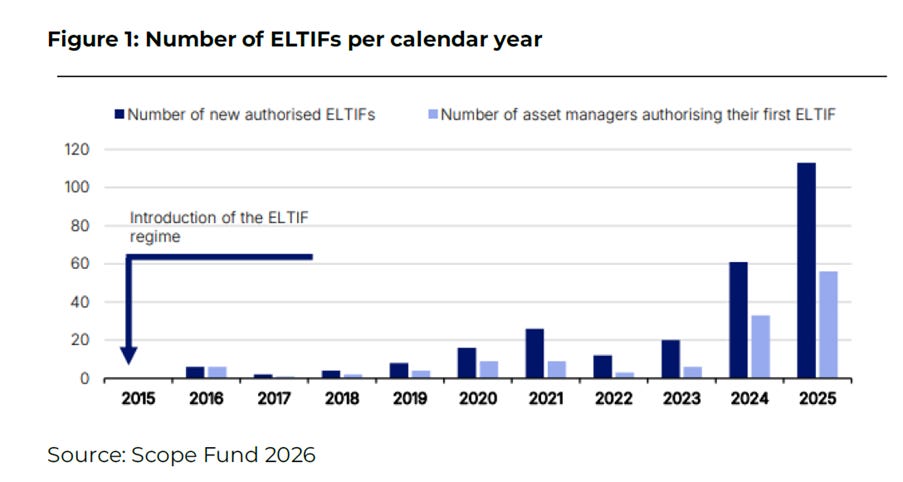
By any measure, ELTIFs are having a moment. By the end of December 2025, 268 ELTIFs were registered and authorised across the EU. The market is now worth at least EUR 34 billion, an increase of EUR 12 billion since 2024. This constitutes a growth rate of 54.7% in a single year.
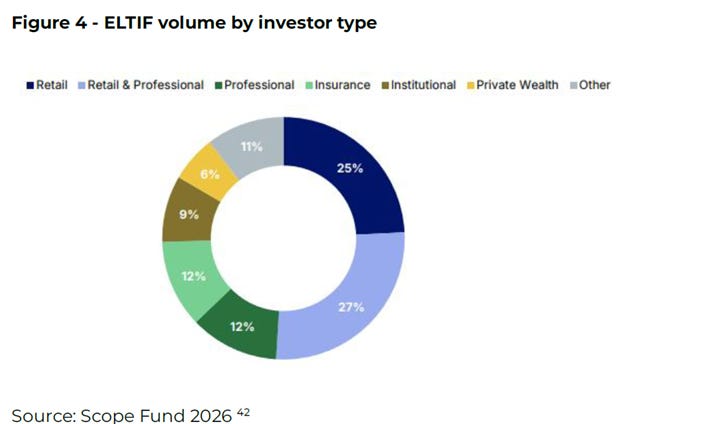
Retail investors are at the centre of this expansion. Nearly three-quarters of ELTIFs (74%) are now accessible to them, accounting for 69.4% of total fund volume. At least EUR 8.2bn of ELTIF assets are directly in retail hands.
On its own terms, the Commission’s Savings and Investments Union agenda is working, as household money is flowing into private markets.
The question is, at what cost? Will savers be better off?
The boom did not happen by accident. It was incentivised, and part of that incentive involved removing protections.
Under the original ELTIF rules, retail access came with two guardrails: a minimum investment of EUR 10,000, and, for anyone with a financial portfolio below EUR 500,000, a cap limiting ELTIF exposure to 10% of that portfolio. The 2024 revision, the so-called ELTIF 2.0 abolished both. With a fully open entry model, there is now no minimum subscription and no portfolio-based cap.
BETTER FINANCE opposed the change at the time, even though it was disregarded by the Commission and co-legislators.
This is what produces the paradox from the opening of this article. On the one hand, investment-grade corporate or government bonds — safer, liquid, easier to value — often still require minimums of around EUR 100,000. On the other hand, illiquid private assets, wrapped in an ELTIF, now require nothing at all. Access was widened at precisely the point where caution was most warranted.
An ELTIF is, in principle, closed-ended. As an ELTIF investor, you get the money when the fund reaches the end of its life, not before. Semi-liquid versions exist, but their exit routes come with asterisks.
The difficulty is that when you invest in an ELTIF, the underlying assets cannot simply be sold when you want to get out. Instead, any exit mechanism has to find a way to transfer your investment without selling the assets held by the fund.
One such route is “matching,” during which your existing shares are passed to an incoming investor, and nothing is sold. It works only if a buyer exists. If none appears, there is no exit; you remain locked in until the investment reaches maturity. The regulation itself requires managers to warn retail investors, in writing, that matching guarantees neither a match nor a way out.
Then there are Liquidity Management Tools, presented as safeguards. In practice, they can delay withdrawals, adjust redemption prices, or impose extra costs. The adjustments often rest on manager estimates rather than observable market prices.
Investor protection on paper requires the paper to be accessible. In Germany, it often isn’t.
DSW, a BETTER FINANCE member organisation, has flagged the problem. On some ELTIF managers’ websites, retail investors trying to view the Key Information Document (KID) or prospectus must first confirm that they qualify as professional investors or that they have already undergone a MiFID II suitability assessment and received the corresponding statement. This is a significant practical issue as a retail investor legally entitled to receive a KID before deciding to invest cannot access it without misrepresenting their own status. And even when the documents are reachable, German-language prospectuses are often labelled “convenience translations”, meaning they may not be legally binding in court.
The suitability requirement itself carries a contradiction. Distributors must assess suitability whenever ELTIFs are marketed to retail investors, even where no advice is given. Yet the regulation states that providing a suitability statement does not, in itself, constitute investment advice. Most investors will hear “suitable” as a recommendation. If the fund disappoints, who is liable?
Costs are no clearer either. There is still no ESMA report on actual ELTIF market costs, and the figures that do exist come from two disclosure regimes, PRIIPs and MiFID II.
None of this is an argument for locking retail investors out of private markets. BETTER FINANCE’s report is clear on this: retail investors should not be excluded simply because these markets are complex.
However, the wide-open access to private equities for retail investors cannot be considered progress without proportionate safeguards. It is, in fact, a risk transfer. BETTER FINANCE proposes repairs.
First, reinstate the guardrails that ELTIF 2.0 removed, specifically, the minimum investment thresholds or equivalent suitability gates for the riskiest illiquid products, and the 10% cap for investors with portfolios below EUR 500,000. A threshold is a simple backstop where a suitability assessment alone may not be enough.
Second, make liquidity tools and costs legible. Disclosure should be scenario-based, showing investors not just how these mechanisms work but what they may cost them in practice, in terms of access to money, valuation and exit timing.
Thanks for reading Inside EU Finance: The Individual Investor Brief! This post is public so feel free to share it.
Private markets will never match the liquidity or transparency of listed ones. Illiquidity is inherent; no fund structure can overcome it. The problem is whether the people now being welcomed in understand what they are holding, and can get out when they need to. For the moment, ELTIFs make it easier to get in than to understand what you have bought.
No posts
Comments
Nothing yet. Say the first thing.
Sign in to join the conversation.