
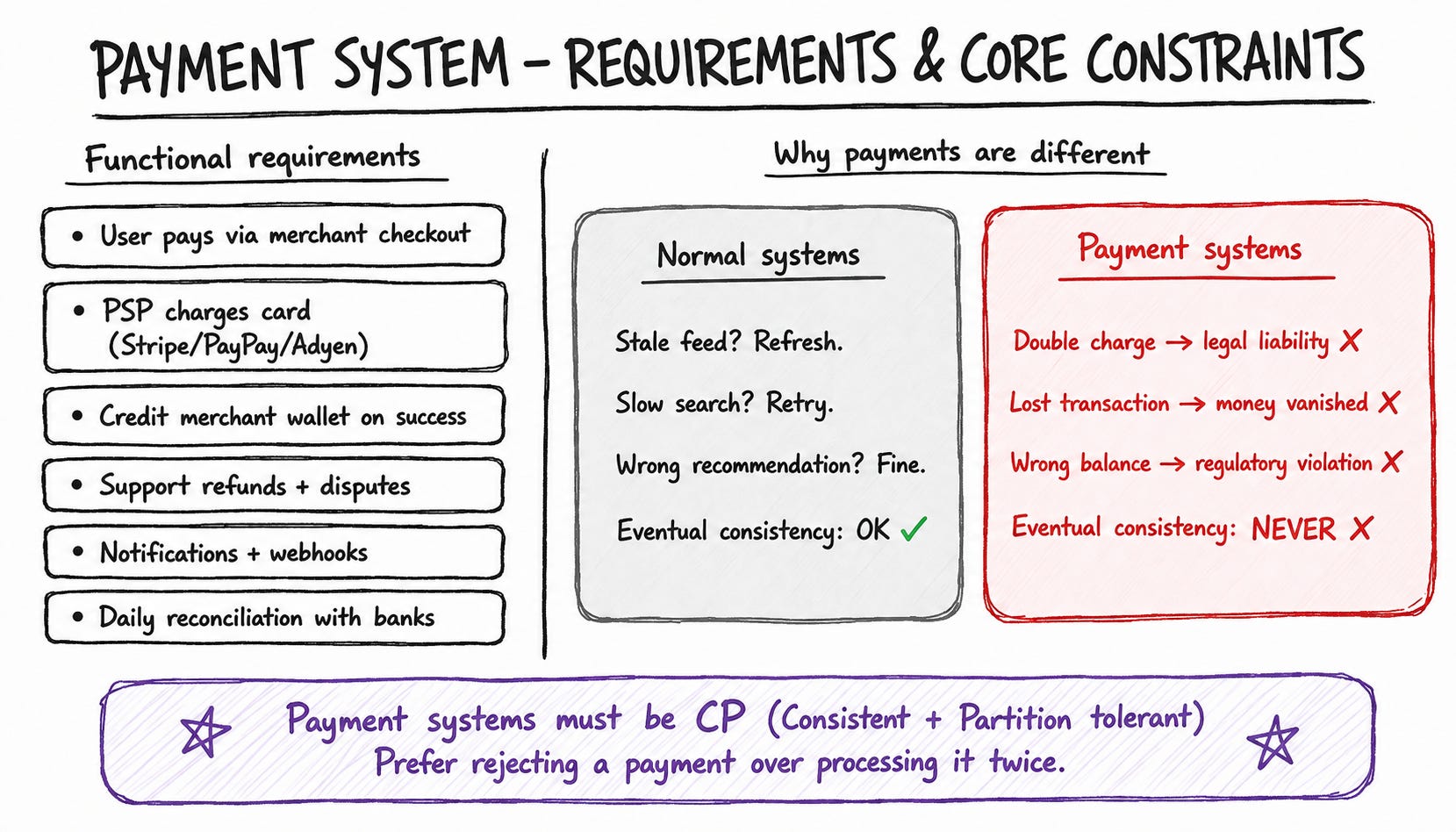
Money is the one domain where “eventually consistent” is not a strategy — it’s a liability.
A social feed that shows a stale post for 30 seconds is a minor annoyance. A payment system that charges a customer twice, fails to credit a merchant, or loses a transaction in a network timeout is a legal, financial, and reputational catastrophe.
A generic system design interview covers scalability, databases, caching, and architecture. A payment system design must include financial constraints, payment lifecycles, idempotency, reconciliation, ledger separation, and failure handling.
This post covers the complete design — from the payment state machine to double-entry bookkeeping, the SAGA pattern, and the reconciliation pipeline that catches everything else.
Functional requirements:
User initiates payment via merchant checkout
System charges the user via external Payment Service Provider (PSP)
Credit merchant wallet after successful payment
Support refunds, partial refunds, and disputes
Send payment notifications (email, push, webhook)
Daily reconciliation with PSP and banks
Non-functional requirements:
Reliability is critical — failed or duplicated transactions have serious consequences. Engineers commonly use idempotency keys, distributed databases, retries, message queues, and failover mechanisms to ensure payments are processed exactly once.
Consistency over availability — prefer rejecting a payment over double-processing it
Full audit trail — every state change immutably recorded
PCI DSS compliance — card data never stored in application layer
Scale:
Transactions per day:      1 million
Peak TPS:                  ~200/sec (10x average)
Refund rate:               ~2% of transactions
Average transaction:       ¥5,000 (JPY)
PSP response time:         200-800ms
Reconciliation window:     Daily (T+1)
Audit log retention:       7 years (regulatory requirement)
We have to build a CP system — consistent over available. This is not a very high TPS and relational databases can handle this easily. The consistency requirement drives the architecture more than the scale requirement.
The core services are:
API Gateway (auth, rate limiting, routing — never contains payment logic),
Order Service (owns the business order; payment is a consequence of an order, not vice versa),
Payment Service (owns gateway integration, payment state machine, idempotency), Wallet Service (owns internal balances, wallet ledger, transfers),
Accounting Service (owns double-entry ledger, journal entries),
Webhook Service (receives, verifies, deduplicates, and queues gateway events), Notification Service (emails/SMS/push on payment events).
Comments
Nothing yet. Say the first thing.
Sign in to join the conversation.